|
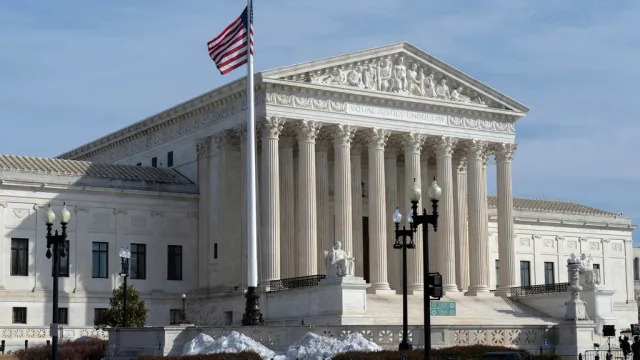
The Supreme Court’s decision that the sweeping tariffs imposed under the International Emergency Economic Powers Act exceed the executive’s authority is a welcome restraint on the president’s abuse of tariff statutes. But the job remains only partially done.
The Supreme Court decision puts the ball squarely back in Congress’ court to complete the job of defining a new tariff agenda.
The Trump administration’s sweeping and volatile tariffs undermined the global system that had been in place for decades. President Trump had imposed the highest tariffs since 1934, increasing prices for American businesses, workers, farmers, ranchers, and families.
Tariffs are regressive taxes, hitting lower income Americans the hardest, deepening domestic inequality, and potentially creating an affordability crisis. Research from the nonpartisan Tax Foundation found that the administration’s tariffs amounted to an average tax increase of $1,000 per U.S. household in 2025. That cost is set to rise to $1,300 per household this year if the policies stay in place.
Yet there is increasing agreement that there is no going back to the tariff system that was in place prior to 2017. The global system of multilateral negotiations that gradually reduced global tariffs has lost both public and political support in the U.S.
China’s economic rise and rapid technological change, along with insufficient U.S. investment in education and social safety nets and declining middle class economic opportunity, left many workers behind. This has fueled frustration with the existing trade regime, and a shift towards the protectionism we are now seeing.
With the old regime discredited and a coherent new tariff regime not yet defined, Congress must take up its constitutionally mandated authority and legislate the key building blocks of a new tariff doctrine.
A 21st Century tariff doctrine must bring down prices, support American businesses and farmers, strengthen supply chains, and repair economic alliances.
Rebalancing constitutional tariff authority and legislating guardrails
Over the last several decades, Congress has delegated much of its trade authority to the president, giving successive administrations greater latitude in tariff implementation. This administration has abused these statutes, using them far beyond the intent of Congress. A new tariff doctrine should have congressional oversight with clear metrics, transparent review and periodic sunsets.
Now that the Supreme Court has ruled on Trump’s tariffs under the International Emergency Economic Powers Act, Congress should reform the other tariff statutes. Statutes. This includes Section 338, an excessively broad statute not used since the 1930s, which should be repealed. Sections 232 and 301 should be reformed so that they are interpreted narrowly with congressional approval and imposed for a time-limited period.
Additionally, new tariff statutes are needed to address China’s practices, such as industrial overcapacity, where current law is insufficient.
Finally, Congress should pass legislation that defines clear parameters for tariff authority. It should prohibit using tariffs to raise revenue or for partisan political purposes, while mandating transparency and regular review and oversight.
Defining the parameters of a new 21st Century tariff doctrine
In defining a new 21st Century tariff doctrine, Congress should focus both on lowering tariffs and the burden on American families and businesses, and on defining the appropriate parameters for using tariffs.
Lawmakers should remove tariffs that burden families and businesses without serving the national interest. Good examples include foodstuffs still subject to tariffs and products not made in the U.S.
Tariffs should be used as leverage to unlock markets for American exports. The current tariffs can also be used as leverage to negotiate discrete sectoral or plurilateral agreements that would be approved by Congress.
Congress should keep a narrow set of tariffs tied to long-term competitiveness and security to further the following goals:
- Modern Industrial Policy: Tariffs can be used as targeted, temporary protection for strategic technologies or national security sectors, and to encourage domestic supply chain development for strategic goods.
- National Security: Tariffs should not be the first-line national security tool. When used, they must be narrow, evidence-based, allied-coordinated, and paired with export controls and industrial policy.
- Climate Policy: Use tariffs to implement a carbon border adjustment mechanism to support clean U.S. production, penalize higher emission imports and prevent carbon leakage.
The Supreme Court has taken the first step. Congress now has the opportunity to pick up the ball and define a 21st Century Tariff Doctrine that lowers tariffs and prices, while countering non-market behavior, promoting domestic innovation, protecting national security, supporting alliances and empowering workers.
A successful tariff agenda must be implemented in coordination with allies and in tandem with a strong industrial strategy and a plan for workforce development and community support.
*Dr. Orit Frenkel is co-founder and CEO of the American Leadership Initiative. She is a former senior executive at the General Electric Company and served as director for trade in high-technology products at the Office of the U.S. Trade Representative. Follow her on Twitter @OritFrenkel and @AmerLeadInt.
|