Volume 1 | October 2018
ANA\C Newsletter
General Assembly 2018 SPECIAL EDITION
|
|
Attention ANA\C Members!
Be the voice of the nursing profession. Please review the ANA\C Bylaws proposal changes for 2018 and tell us what you think.
(Survey Monkey page also contains a link to view proposed bylaws changes)
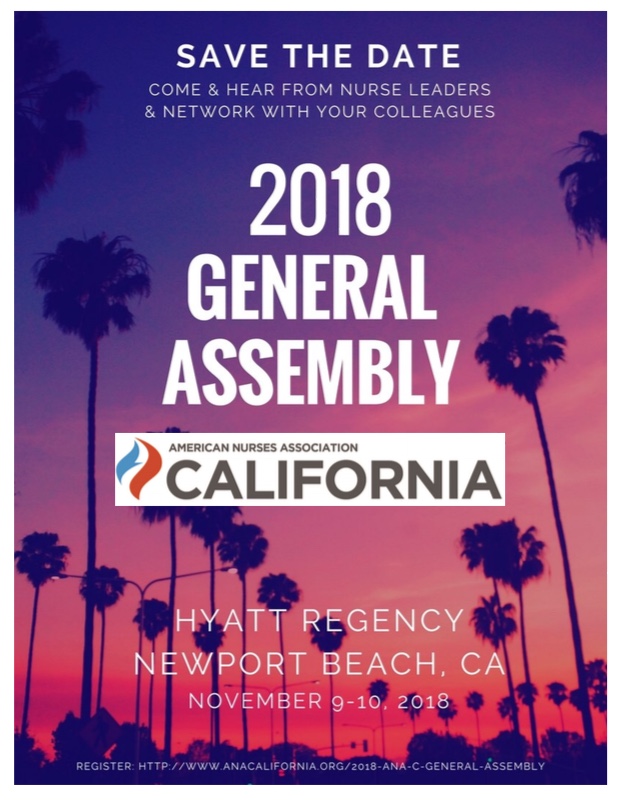
Thank you for participating! We look forward to seeing you at the ANA\C General Assembly in Newport Beach, Nov 9-10, 2018!
|
|
Book Your Hotel Room for ANA\C General Assembly
Conference
November 9-10, 2018
Hyatt Regency Newport Beach
in Newport Beach, CA
To Register for the Conference click here:
https://anacalif.memberclicks.net/ana-c-2018-general-assembly
|
|
Greetings from Sacramento! The American Nurses Association\California has been continuing to work hard for the profession over the last few months. I hope that you are enjoying some of the changes that are being made within our association, and that you follow our weekly newsletter, the
ANA\C Nursing Flash (
formerly the
ANA\C Weekly
)
.
We have shared the information about the 2018 General Assembly, the BRN Summit Meetings regarding clinical education and regional clinical placements, and various articles for both patient and nurse health awareness.
Based on recommendations from our virtual business meeting at El Camino Hospital, we have been implementing strategies to reach out to our members in various ways. This includes our newsletter changes, video welcomes to our new members, legislative updates to our committees via video, and increasing our visibility to members.
The 2018 legislative session has wrapped up for the year, but out advocacy never stops. The debate about how to provide health care for all continues, and ANA\C remains committed to our involvement with various coalitions to ensure that the voice of nursing is present. We support meaningful access to care for all Californians and have a duty to healthcare consumers to ensure that this is successful. We advocated for the healthcare rights and furthering the profession in Washington DC during ANA’s Hill Day 2018, and continued the conversation about multiple issues that have an impact on nursing across our society today.
Our Board of Directors is truly excited to see the number of members who have taken advantage of our Value Pricing Pilot. We encourage you to share the news with other colleagues who are not members yet so that they can lock in membership at a pilot reduced rate.
Our collaboration with other states has been tremendously successful as the regional workgroups are taking the voice of nurses in the western states to a national platform. The voice of ANA\C is also present at the national stage with our members recently appointed to the ANA PAC Board of Trustees, ANA Committee on Nursing Practice Standards, and the ANA Professional Policy Committee. The voice of nursing in California has been elevated to a higher level of professionalism and involvement- this effect comes directly from your participation, and I cannot thank you enough for your membership and dedication to the profession. As always, please feel free to reach out to me anytime with feedback, questions, or even just to say hello. I appreciate the time it takes to connect with others, and I look forward to hearing from you soon!
-Phillip Bautista, ANA\C President
|
|
|
|
EXECUTIVE DIRECTOR REPORT
|
By Marketa Houskova
As I close out my first year as the ANA\C Executive Director, it is my pleasure to report that under the dynamic leadership of our Board of Directors led by President Phillip Bautista and Vice President Dr. Anita Girard, great strides have been accomplished in...
|
|
|
|
 |
ANA\C AWARD WINNERS ANNOUNCED!
ANA\C will award six accomplished members and leaders in nursing practice inside and outside of clinical or academic settings, at the upcoming 2018 ANA\C GA in Newport Beach, California, on Nov 9-10, 2018. We are proud to announce the 2018 ANA\C Award Winners...
|
|
|
|
|
|
|
ANA POLITICAL ACTION COMMITTEE (PAC) 2018
|
|
By Elizabeth Dietz, EdD, RN, CS-NP, Past President of ANA\C & Past Director of Legislation
Another ANA Member Assembly has come and gone. It was an exciting time in DC – a time to meet with legislators – ANA staff and friends.
ANA PAC serves all of the ANA membership in order to participate in raising contributions to support candidates running for federal office. There are State PACs from a number of the State Nursing Associations (SNAs), but at this time ANA\C does not have its own state PAC. The ANA PAC is regulated by the Federal election commission and must be legal as well as transparent to be involved in the political process.
ANA PAC helps members support incumbent candidates who demonstrate their commitment to advance issues, bills, and causes affecting nursing. The ANA PAC also supports new candidates who demonstrate commitment to nursing in their own states. We review legislator’s federal and state voting records. We educate candidates and congressional members regarding our concerns. We communicate regularly with the SNAs to collect information about their state legislators to ensure they are supporting nursing issues.
The following issues are key to the ANA PAC in considering support of federal candidates:
ANA-PAC is the only group within ANA that can provide financial support to federal candidates.
The ANA PAC’s goals are to raise at least $500,000 each federal election cycle. We also want at least 6% of our ANA PAC eligible members to contribute. We only solicit donations from ANA members.
The ANA PAC is led by the ANA PAC Board of Trustees – 3 ANA Board members are appointed by the ANA President. The other 8 members are appointed by the ANA Committee on Appointments. ANA members can communicate to the PAC office by providing information to the Board of Trustees.
By going onto the
Nursingworld.org
web site you can navigate to the ANA PAC organization site and see how to support causes that affect you in California and Washington DC.
Any ANA\C member in good standing who is interested and works for these causes may submit their name to the Committee on Appointments at ANA. Please join me and other members who have served. It is an exciting opportunity to represent nursing while working on issues with our legislators.
|
|
|
|
|
|
IMPORTANCE OF THE ANA MEMBERSHIP ASSEMBLY MEETING
|
By Zack Huddleston, BSN, PHN, RN
ANA\C Alternate Representative 2018
This was my first experience attending the ANA Membership Assembly. As a new participant I learned just how important the membership assembly is in sharing our Nursing Voice, reviewing Policy, and Networking opportunities.
|
|
|
|
THE POLICY CAFE:
A New Forum for Membership Voices to Be Heard
|
|
By Elissa Brown,
MSN, RN, PMHCNS-BC
The
Policy Café
provided a new forum for members to provide feedback to help guide ANA’s position on key issues affecting the nursing profession at the 2018 membership assembly. It touched on issues that affect health care in nursing such as the Opioid Epidemic: The Evolving Role of Nursing, and the Registered Nurse Utilization of Nursing Assistive Personal in All Settings.
The goal of the
Policy Café
was to provide an avenue for members to use their voices and share their concerns and ideas on how they see the selected issues affect nursing. These issues will need to be addressed through ANA position statements and utilizing the input from members help to develop new position statements on these key issues.
The Café had a total of six stations (see table A), with different topics that members could choose to provide input on. Other topics included important issues such as Sexual Harassment, Evaluation of Occupational Licensure, Health Promotion & Disease Prevention, and Equipment/Safety Procedures to Prevent the Transmission of Blood Bourne Diseases. Members were able to choose up to three station topics to share their thoughts.
Table A
- Station 1: Registered Nurses Utilization of Nursing Assistive Personnel in All Settings
- Station 2: Evolution of Licensure
- Station 3: The Opioid Epidemic: The Evolving Role of Nursing
- Station 4: Sexual Harassment
- Station 5: Promotion and Disease Prevention
- Station 6: Equipment/Safety Procedures to Prevent Transmission of Blood Bourne Diseases
Members were excited to provide input regarding these topics to help shape the ANA position statements regarding these key issues. Participation by members was higher than expected which caused some limitations in the amount of feedback that could be shared within time constraints.
With increased support and improved planning, it is hoped the the
Policy Café
will return as a forum for members to share their opinions at future membership assemblies.
|
|
Workplace Violence: #EndNurseAbuse
|
|
By Ruth Rosenblum
“Someone else told me I should never have been hired and her friend should have been given the position. When I wanted to go to PM shift, one of the charge nurses said, ‘What makes you think we even want you on the PM shift?’”
“A Labor and Delivery nurse friend of mine was told by a patient that she couldn’t competently understand labor pains bc she didn’t have children. This same nurse was struggling with infertility.”
“The resident MD then called the unit and proceeded to yell over the phone, calling our staff incompetent, asking me why I hadn't contacted the social worker earlier, stating that because of my ‘mistakes and lack of knowledge,’ I had prevented 50 patients in ED from getting admitted to the unit.”
In 2010, a study of 2,354 nurses found that 3 out of 4 nurses have experienced violence at work, while 9 out of 10 have suffered verbal abuse. Dr. Rose Chapman, lead author of this study, commented: “Many of the nurses who took part in the research said that they did not report incidents because they felt that workplace violence was just part of the job”. Generally, violence of any type is underreported. What’s more, reports that are filed usually fail to capture the severity of the situation.
A reader expressed their thoughts on this article: “The dilemma of the nursing profession is that nurses are expected to put up and shut up, due to the caring nature of the role. We deal with vulnerable individuals, yet at the same time the very vulnerable individuals are the ones being abusive and violent.”
Pamela Cipriano
,
ANA President, suspects that due to the fundamental “caregiver” nature of nurses, they become easy targets for people to lash out on. The nursing industry is 91% female, and some postulate that high rates of abuse against nurses reflect the broader trend of violence toward women.
Each case of nurse abuse is different. We must also be aware of nurse abuse that masquerades as lateral violence or bullying amongst health care professionals (RN to RN, MD to RN, etc.). need to be Violence should be examined on a spectrum of malevolent behavior. So, what can be done to stem this dangerous tide?
The US Labor Department's Occupational Safety and Health Administration
(OSHA)
made it clear that to pass regulations to prevent violence and protect healthcare employees would require creating a nationwide standard and taking it through though the federal regulatory process which would be a lengthy undertaking. At the very least, a set of standards must be developed for all healthcare workplaces.
Training, awareness drills, protocols, de-escalation training and back-up to call would likely help nurses feel safer, a plan, another plan, and a contingency plan are all needed to combat and prevent violence. While nurses and doctors in ERs and psychiatric units already have a lot of training, this phenomena is escalating to where it is necessary to have some training in every health care organization and every unit.
Gordon Gillespie, PhD, RN, FAEN
states that health care workers and administrators need to take universal precautions to prevent violence—much like they do to prevent contracting infectious diseases, he says. “If we take the stance that everyone has the potential to be violent, then nurses will interact with people differently and be more likely to protect themselves.”
Finally, the ANA has developed a Pledge to
#EndNurseAbuse.
Text PLEDGE to 52886 to add your name.
We urge you to follow this
link,
take the Pledge, and share with nursing colleagues and friends.
|
|
|
|
THROUGH THE EYES OF A NEW NURSE - THE IMPORTANT ROLE WE PLAY IN HEALTH CARE LEGISLATION
|
|
By Daniel Estep, BSN, RN, PHN
We spoke with policymakers and lobbyists about current issues in politics that affect us all. When we introduced ourselves as future nurses, we could instantly see their eyes light up. Everyone had a story to tell about a nurse who made an impact in their life or had a family member or friend that is a nurse. When speaking to Assemblywoman Marie Waldron, she shared with us how a nurse with vigilant assessment skills was instrumental in saving her baby’s life.
Many nursing organizations were in attendance, including the Association of California Nurse Leaders and California Association for Nurse Practitioners
.
H
owever, no matter what one’s specialty, we shared the honor of having RN behind our name. Collaborative.
Powerful and intimate connections are made between nurses and their patients, and it is these connections that exemplify why it is important for nurses to be involved in
health policy
. People trust nurses and value our input. We are there for our patients when at times, no one else is. This reflects how the nursing profession embodies a selfless dedication and responsibility to ensuring health and well-being. This commitment should not end at the bedside, but needs to be carried into all arenas of healthcare delivery.
The impact that legislation has on healthcare delivery in the United States makes it one of the most important arenas for nurses to participate equally. We have the unique hands-on experience, expertise, and knowledge of the entire continuum of healthcare that is required for legislators and the public to be well-informed. It is through this participation in the development and advocacy of health policy that nurses can represent the patients’ voice at some of the highest levels of decision making.
Collaborative efforts are required if we want to see transformation at the bedside and beyond. We “R N” this together, and joining the
ANA
is a great first step to positively impact our profession, patients, and communities at large through outreach and legislation.
|
|
|
|
|
|
HOW A BRAIN ANEURYSM SAVED MY LIFE: AN RN SELF ADVOCACY STORY
|
By Rachel Napoli, DNP, CNS, PHN, RNC-OB, IBCLC
Assistant Professor of Nursing, Sonoma State University
Registered Nurse: Petaluma Valley Hospital (Family Birth Center)
As nurses, our main job is to advocate for patients, but what do we discover when the tables are turned, and we are suddenly required to advocate for ourselves?
|
|
|
|
|
|
|
|
|