|
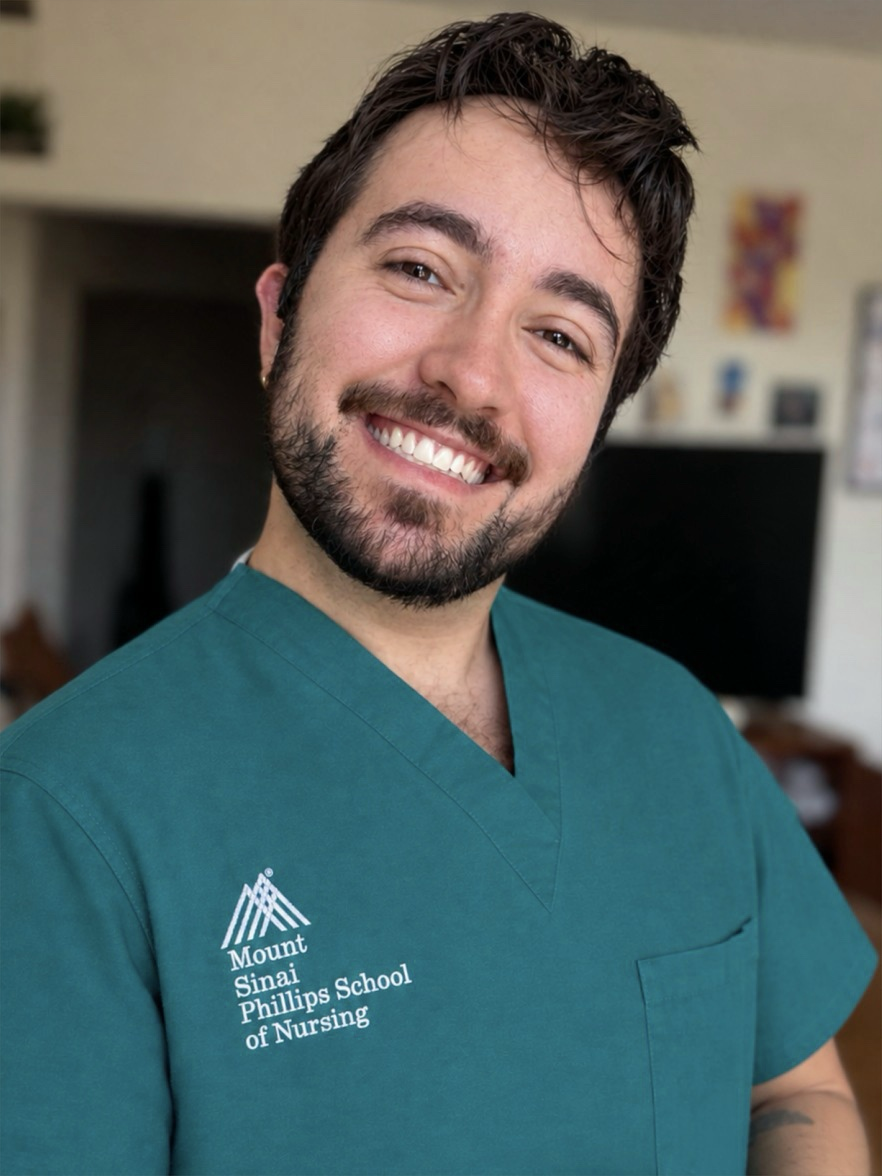
Alex Escaja-Heiss (he/they)
Student, Mount Sinai Phillips School of Nursing
Former Health Educator at the Mount Sinai Institute for Advanced Medicine
Years as an ANAC member: Less than 1
Local ANAC Chapter: Greater New York
What does Hispanic Heritage Month mean to you personally and professionally?
As a first-generation American who grew up in Burlington, Vermont, the only Spanish I heard was my mother's. Representing just 2.8% of residents, Vermont has the smallest Latine and Hispanic population in the country. A large portion of that population is made up of underrecognized immigrant farmworkers in rural areas, who are the backbone of Vermont's famed dairy industry. Organizations like Migrant Justice do great solidarity and advocacy work to raise awareness and improve working conditions, but there is much isolation. Growing up in such a homogeneous place with little Latine representation in local culture, education, and leadership, Hispanic and Latine Heritage Month gave me an opportunity to celebrate and witness the contributions of Hispanic and Latine communities. Professionally, I see it as a time to reflect on the representation of Hispanic and Latine workers in my office and clients in my clinic, and to assess how institutions are investing in our people.
How does your work connect to HIV prevention, treatment, advocacy or care within Hispanic and Latino communities?
My career in health education and HIV prevention started in high school, when I worked as a Peer Educator at Planned Parenthood of Northern New England (PPNNE). It was a gratifying experience to serve as a reliable resource and advocate for sexual health and relationships among my peers, and using that knowledge for myself was an empowering gift in its own right. After being honored with a Choice Champion Award from PPNNE my senior year, high school graduation marked the end of my time in the program, and for a while, I thought that would be the end of my professional experience in healthcare. Little did I know that, after graduating with degrees in Film and Gender Studies at the University of Vermont and a stint working in film, including as a consultant for GLAAD on Spanish-language and Latine LGBTQ media, my experience as a teenager in Vermont would land me a job as a Bilingual Health Educator at the Mount Sinai Institute for Advanced Medicine in New York City. During my time there, I had the pleasure of working with local organizations like the Latino Commission on AIDS Oasis Center, Voces Latinas, the Translatinx Network, and the Colectivo Intercultural TRANSgrediendo. We also offered rapid HIV and STI testing, sexual health education, and free appointments for prevention services and mental health counseling at sex parties and nightlife venues. As one of the few Spanish speakers and one of the few trans people in my department, I made a particular effort to offer these services at trans club nights around the city, many of whose patrons were Latina. It means a world of difference to provide empowering, culturally sensitive, and gender-inclusive sexual healthcare in Spanish. The experiences I had and relationships I built with patients inspired me to return to school and earn a BSN. After I graduate in December 2026, I hope to continue providing trans-inclusive, Spanish-language HIV prevention and sexual healthcare services on a greater scale.
How can individuals and organizations strengthen HIV advocacy within Hispanic and Latino communities?
I am a proud student member not only of the Association of Nurses in AIDS Care, but also of the World Professional Association for Transgender Health (WPATH), and, notably, the National Association of Hispanic Nurses (NAHN), which I want to give a special shout-out. Associations like these harness the power of organizing, resource-sharing, solidarity, and mentorship. Being new to the world of nursing, I was embraced by NAHN with a warmth I can only attribute to my fellow Hispanics and Latines. At the national conference in Denver this year, I was overwhelmed with pride and appreciation. Never in my life had I seen so many Hispanic and Latine professionals, leaders, and changemakers in one room. The space radiated with wisdom, experience, and a shared understanding of the stakes we face in today's social and political landscape.
I bring up NAHN to acknowledge intersectionality and the value of solidarity. Existing organizations in HIV advocacy should seek out Hispanic and Latine community leaders to hire, collaborate with, and welcome into decision-making spaces, if we aren't there already (odds are, we're not). When I worked in film, and it came to casting marginalized actors in authentic roles, I heard agencies say things like, "There just aren't [e.g. transgender, Latine, disabled, indigenous,] actors out there." That simply isn't true, and the same goes for hiring diverse staff and seeking partnerships. If we know anything about systemic inequality, it's that marginalization is intentional and self-sustaining. If individuals and organizations want to strengthen HIV advocacy within Hispanic and Latine communities, I suggest approaching and collaborating with existing associations like NAHN, and where there's an absence, supporting the on-the-ground efforts already organizing our communities. Because I promise: they're there.
|