Dear Tribal health leaders, colleagues, and partners,
In the whirlwind of day-to-day routines and the demands that go with work and life, it’s easy to lose sight of your own well-being. Whether your contribution to our team is in a clinical setting, in communities we serve at a field clinic or at a construction site, or any of the other countless critical roles people play every day at ANTHC, we all need to pause from time to time and focus on self-care.
Community Health Services Division focuses attention to this area during Mental Health Awareness Month. Several factors contribute to mental health and well-being. One that is close to home is our physical environments. In honor of Mental Health Awareness Month, ANTHC promoted weekly activities included steps to create a personal safe space to help reduce stress, an emotional safe space to help overcome challenges, and a physical safe space free of safety hazards.
In today’s ANTHC Update, we highlight CHS programs that are focused on addressing some difficult issues related to mental health, such as suicide, substance misuse, and intergenerational trauma.
Suicide Prevention Program
Suicide has a devastating impact on people, families, and communities across Alaska. This is especially painful in rural Alaska, where people and regions are so closely connected. The ANTHC Suicide Prevention Program – part of the Wellness and Prevention Department in our Community Health Services Division – collaborates with community partners and Tribal health organizations within the Alaska Native Tribal Health System to provide evidence-based education and training about suicide prevention, intervention and post-vention. Our education and training offerings include:
-
Applied Suicide Intervention Skills Training (ASIST), a 2-day intensive workshop created by LivingWorks that teaches suicide intervention skills.
-
SafeTALK, a 3.5-4-hour suicide alertness workshop created by LivingWorks for anyone 15 and older. The workshop teaches participants to identify suicide warning signs and connect at-risk individuals to intervention resources in their community.
-
QPR (Question, Persuade, Refer) Gatekeeper, a 1-hour course taught in a clear, concise format using the latest in educational technology and practices.
-
Adult Mental Health First Aid, designed for 18 and older to learn how to help someone who may be experiencing a mental health related crisis or problem. Topics covered include anxiety, depression, psychosis and addictions.
-
Youth Mental Health First Aid, designed to teach parents, family members, caregivers, teachers, school staff, peers, neighbors, health and human services workers, and other caring citizens how to help adolescents (ages 12-18) experiencing a mental health or addiction challenges or are in crisis. The course introduces common mental health challenges for youth, reviews typical adolescent development, and teaches a 5-step action plan for how to help youth in both crisis and non-crisis situations.
If you would like more information on how to host or participate in a training, please visit our website or contact us at (907) 729-3752 or email preventsuicide@anthc.org.
Substance Misuse Prevention
Our Substance Misuse Prevention Program supports Tribes and Tribal health organizations to prevent substance misuse and dependence in the communities. Program strategies include supporting evidence-based practices and encouraging assessment, evaluation and funding support of local-level efforts to promote substance misuse prevention and promote resiliency. Some specific efforts that the Substance Misuse Prevention Program supports include safe medication disposal, opioid prevention, and rural alcohol prevention.
A variety of trainings are available to Tribal health organizations and communities, including:
-
Substance Abuse Prevention Skills Training, an interactive 4-day training developed under the Substance Abuse and Mental Health Services Administration’s Center designed to teach the entry-level prevention practitioners the fundamentals of substance abuse prevention.
-
Opioid Overdose Recognition and Response Training, an online 15-minute training designed to increase access and instill confidence in using naloxone nasal spray to reverse an opioid overdose. The training provides step-by-step instructions for how to administer naloxone. Once the training is complete, participants receive an opioid overdose response kit, which includes two doses of nasal spray, gloves, a face shield for CPR, a fentanyl test strip, and instructions. Visit iknowmine.org for more information on the training.
Behavioral Health Department
The Behavioral Health Department, offers several programs to promote health and well-being in our Alaska Native communities:
-
Community Reinforcement and Family Training (CRAFT) is a form of therapy that helps family members improve their personal well-being and learn specific skills to motivate their loved one toward substance abuse treatment. The three primary goals are to help the family work with their loved one to reduce substance use, move the loved one toward treatment, and improve their own lives. As of this February, we have clinicians trained in CRAFT at 15 different Tribal health organizations and the ANTHC Behavioral Health Wellness Clinic.
You can learn more about CRAFT at our website.
-
The Alaska Blanket Exercise (ABE) is a participatory history lesson, developed in collaboration with Alaska Native Elders, knowledge keepers, and educators, that fosters truth, understanding, respect, and reconciliation among Indigenous and non-indigenous peoples.
Through an experiential learning activity, participants walk on blankets representing the land and into the role of Alaska Native people by reading scrolls and carrying cards which ultimately determine their outcome as they literally ‘walk’ through situations that include pre-contact, colonization and resistance. Through the exercise, participants will gain knowledge and understanding of Alaska Native history, since time immemorial; develop an understanding of the impacts of intergenerational trauma on Alaska Native people; and develop an awareness of and gain an understanding of what they can do in their own lives and communities to break cycles of intergenerational trauma.
A Southeast ABE adaptation was completed in 2022 and ANTHC plans to create new regional adaptations in the near future. We also recently piloted a Youth ABE, a three-part series reformatted for youth, with a special emphasis on healthy coping skills and youth empowerment. The ABE can be offered in-person or virtually.
|
|
|
|
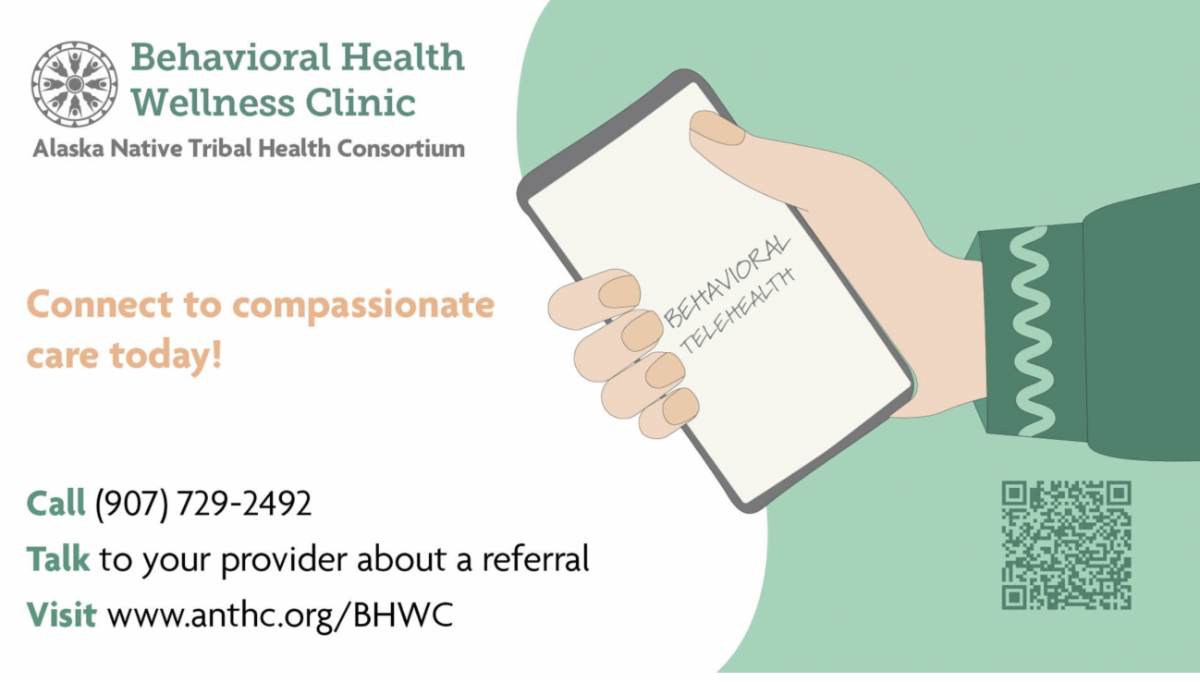
The Behavioral Health Wellness Clinic serves Alaska Native individuals 18 years and older throughout the state of Alaska. The ANTHC Behavioral Health Wellness Clinic is designed to meet your everyday behavioral health needs. All services are provided by telehealth. Our goal is to promote intergenerational wellness through compassionate and easy-to-connect to behavioral health care. Whether you are looking for support for yourself or a loved one, we are here to help you. The Behavioral Health Wellness Clinic provides all services in a private and confidential manner.
Quyana,
Valerie Nurr’araluk Davidson, President/CEO
Weather Potdevin, Senior Director for Community Health Services
You have automatically been included on our weekly ANTHC updates mailing list. Those who would like to subscribe to this update can click here to sign-up.
For help with this subscription, or if you do not see our updates in your inbox, please send a note to news@anthc.org.
If you would like to provide feedback on content you would like to see in future updates, please click here.
|
|
|
|
Copyright © 2023. All Rights Reserved. |
|
|
|
|
|