Newsletter


September, 2024

ABOUT US
CONTACT US
WAYS TO GIVE


In this newsletter

  • AOK Celebrates 25 years of sanctuary management
  • Rare moth sighted at Mount Mitchell Heritage Prairie Park
  • The Battle over Black-footed Ferrets heats up. AOK is working to protect the rarest mammal in North America
  • Feedback Request - How can we improve these newsletters?
  • Opportunity to comment on Kansas's State Wildlife Action Plan
  • Window strikes are deadlier than we thought
  • AOK Events
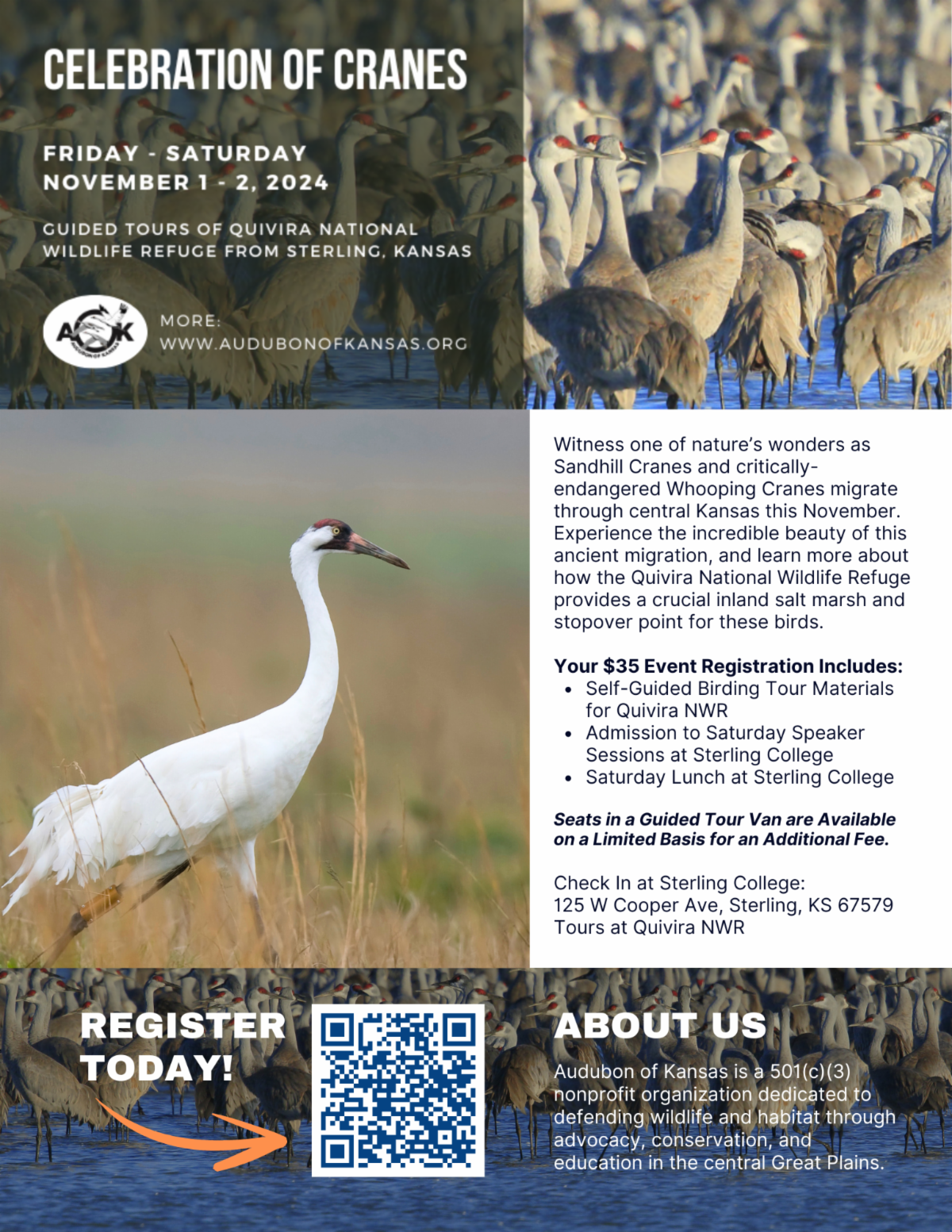
  • Register now for Celebration of Cranes!
  • October 6: Open House at Hutton Niobrara Ranch Wildlife Sanctuary near Bassett, Nebraska
  • Nov 1-2: AOK's Celebration of Cranes, Sterling, KS
  • Philanthropy Corner: Welcome Kathryn! Our new Director of Philanthropy and Event Manager
  • Chapter Spotlight: Sunflower Audubon growing in western Kansas
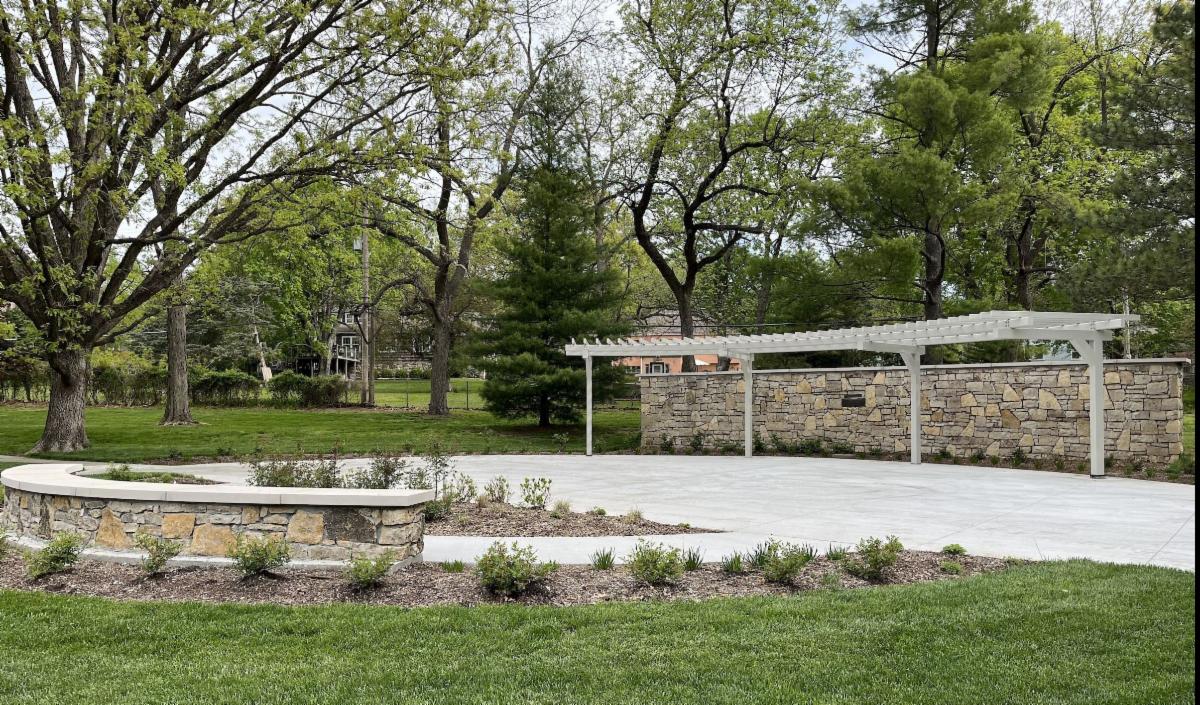
  • AOK Nature Spot Recommendations: Antioch Park in Merriam (Kansas City area) is a great place for beginning birders

AOK Celebrates 25 years of Sanctuary Management


Twenty-five years ago, the Kansas Audubon Council became Audubon of Kansas (AOK). Shortly after the organization was formed, a major gift from Harold and Lucille Hutton established a land stewardship program and literally put AOK on the map. Located along the Niobrara River in northern Nebraska, the Hutton Niobrara Ranch Wildlife Sanctuary consists of 5000 acres of rangeland, wetlands, wet meadows, and riparian woodlands. Harold implemented habitat restoration during his lifetime, and we continue to implement prescribed fire and other conservation practices today. The Hutton’s vision was that it be a cattle ranch that supports wildlife. We continue to lease the property to cattle grazing and haying, but it also supports mountain lion, elk, sharp-tailed grouse, prairie-chickens, porcupine, and a diverse array of wildflowers and insects. This property is not open to the public, but those staying at the Hutton House (on site lodging) have access to the property.


AOK now manages three properties including Achterberg Wildlife-friendly Demonstration Farm and a portion of Mount Mitchell Heritage Prairie Park. Achterberg is 240 acres near Lincoln, KS (950 N 170th Rd). Connie was one of the first female lawyers in the state. As a youngster, she caught catfish in the creek that runs through the property. While Connie was still alive, AOK worked with her to establish grassland buffer strips with shrub thickets between the farmland and Bullfoot and Horse Creeks which run through the property. Now, the area supports one of Connie’s favorite birds, the bobwhite quail. We continue to manage the property to control invasive elm. This property is open to the public, and has a 1-mile hiking trail.


Mount Mitchell is managed by the Mount Mitchell Prairie Guards and consists of some of the finest virgin prairie still present in the Flint Hills. There are public hiking trails which take you to a wonderful vista at the top of the hill. The place abounds with history: Captain Mitchell was a member of the Beecher Bible and Rifle Colony and a Conductor on the Underground Railroad hiding freedom-seekers in the loft of his log cabin. The site also contains a portion of the Topeka-Fort Riley Road and glacial erratics from the last ice age.


Several new properties will soon be added to our land stewardship program. Gary and Carolyn Haden’s Far West Farm is one of them. We look forward to telling you about additional properties in the future!


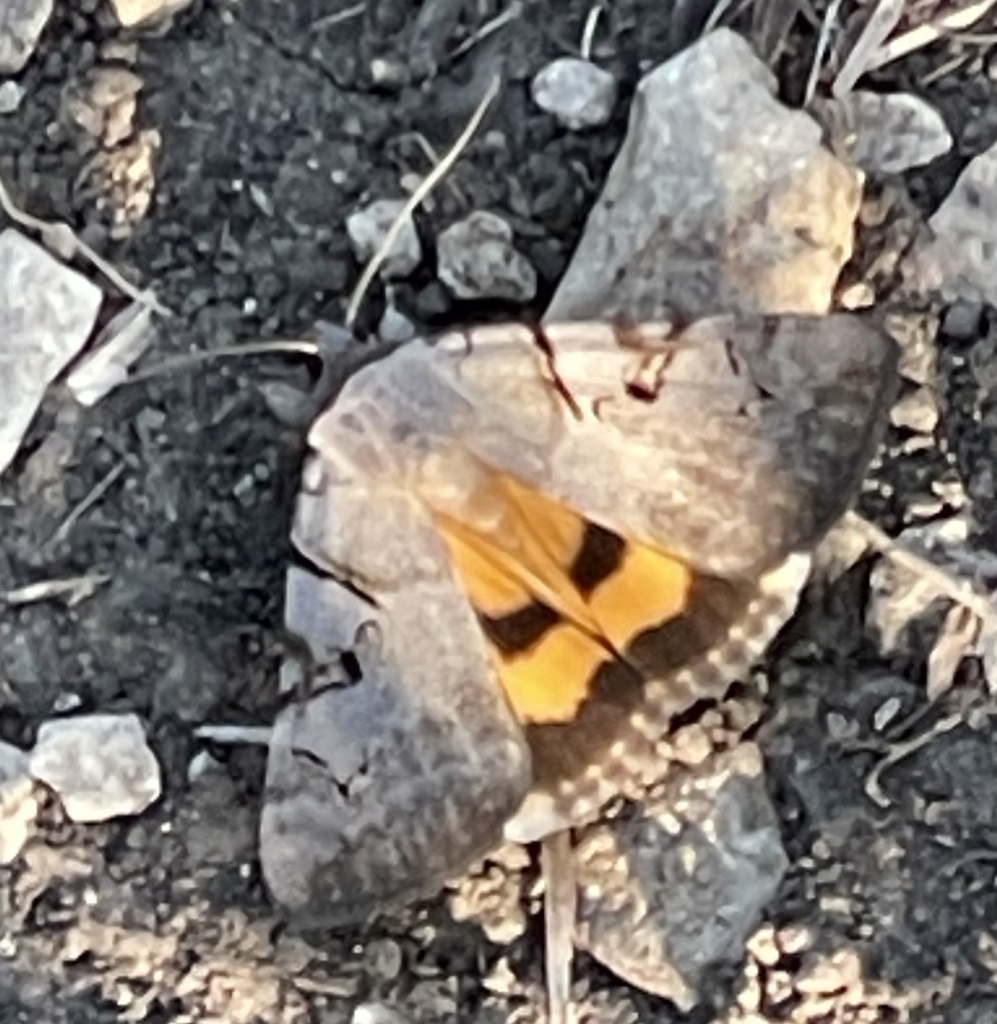
All three of our current properties and three future properties are monitored for wildlife (See June’s newsletter). Each wildlife group requires a different survey method. Flowers and insects are photographed and uploaded to iNaturalist for identification. We recently were contacted about one of these observations: an Abbreviated Underwing (Catocala abbreviatella). The larvae of Abbreviated Underwings feed on leadplant, resting at the base of the plant during the day and crawling up to the tips to feed at night. This species is listed in Kansas as a “Species in Need of Conservation.” This designation is one step below “threatened,” with the highest designation being “endangered.” iNaturalist does not show any other observations of this species in Kansas. This is the second time we were able to document an unusual occurrence of a species. Our July 2022 newsletter highlights the westernmost documentation of the Bladetooth Wedge snail at Achterberg. 


At AOK, we are proud that we are not only saving critical habitat for wildlife, but we are also able to contribute to the scientific understanding of abundance and distribution of species, and share our observations with you.


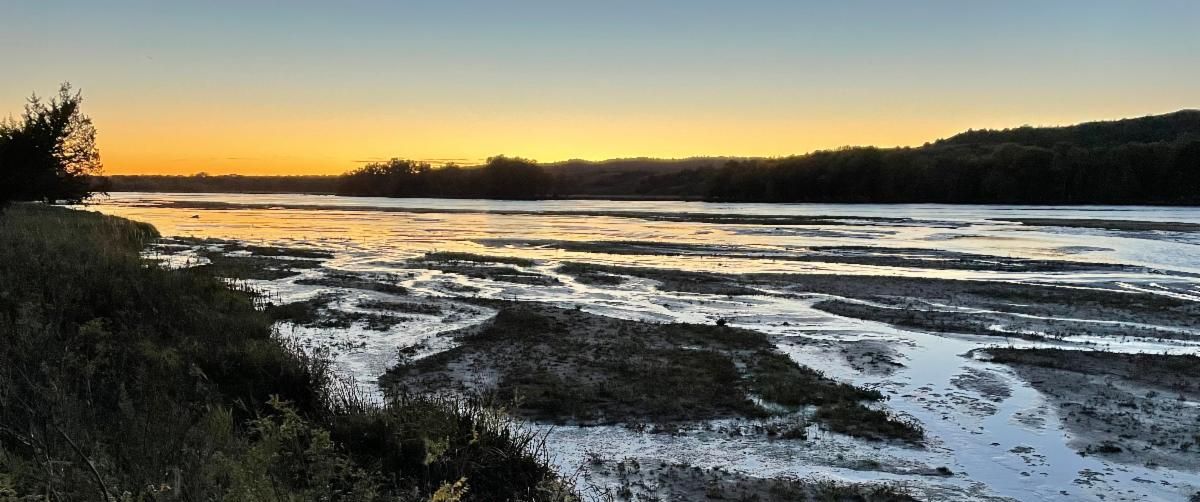
Essay and photos by Jackie Augustine. Top photo: The Niobrara River as viewed from Hutton Niobrara Ranch Wildlife Sanctuary. Inset photo: Abbreviated Underwing photographed at Mount Mitchell Heritage Prairie Park.

The Battle over Black-footed Ferrets heats up. AOK is working to protect the rarest mammal in North America


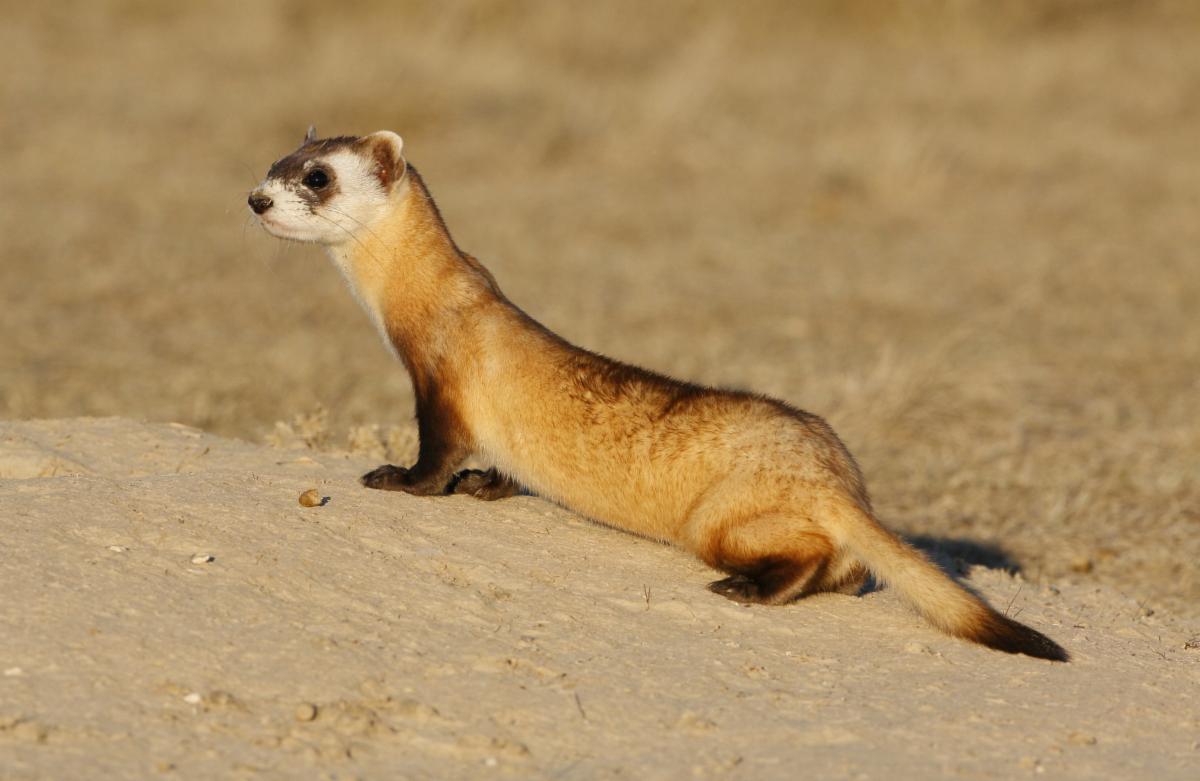
Nearly two decades ago, a war between wildlife exterminators and conservationists waged in the shortgrass prairie of Logan County and in Kansas courthouses. The conservationists won that battle, but now a new battle is brewing. That battle focuses on the rarest mammal of North America: The Black-footed Ferret. Let me tell you a little ferret biology and history, the battle that waged decades ago, and the new battle. 


First, Black-footed Ferret biology and conservation:

Ferrets are dependent on prairie dogs as a food source and to provide shelter for raising offspring. They cannot exist in the absence of prairie dogs. Ferrets were first documented by John James Audubon along the Platte River in Nebraska. In the late 1800s, there were estimated to be 500,000-1 million ferrets. By the 1950s, they were presumed extinct. Agricultural expansion and prairie dog eradication contributed to their decline. Prairie dogs have been blamed for eating cattle forage, creating holes which break cattle’s legs, and for spreading plague.


A population of ferrets was rediscovered in 1964, and captive breeding was attempted. Those efforts ended in failure when the wild population died out in 1974 and the last captive ferret died in 1979. Ferrets were presumed extinct a second time. 


In 1981, ‘Shep,’ a farm dog in Wyoming, brought home a strange mammal as a gift for the owners. The owners took the mammal to a taxidermist. That taxidermist identified it as a Black-footed Ferret and reported the sighting. Another captive breeding program was established with 17 ferrets, and this time, it is successful. Almost two dozen ferret populations have been re-established in the wild from captive populations, one population of which is in Kansas.


Second, the ferret/prairie dog battle nearly two decades ago:

Kansas has a law from 1901 that has been modified through the years and is still enforced today that calls for the eradication of prairie dogs. It enables County representatives to enter private land, poison prairie dogs, and then charge the landowner for the ‘service.’ If the landowner does not pay, a lien can be placed on the property. It does not matter if the landowner wants the prairie dogs or not, the county can kill them. 


Larry Haverfield, Gordon Barnhardt, and Maxine Blank had prairie dogs on 26,000 acres, and in 2005, asked the US Fish and Wildlife Service to consider their property for Black-footed Ferret reintroduction. After detailed surveys, the ‘Butte’ landowners, as they are called, was the best reintroduction site with prairie dogs present on 6,400 acres. Plans were being made to reintroduce the ferret for the fall of 2007. Then, the battle began…


The first assault started at 6 p.m. on the Friday evening of the Labor Day weekend in 2007 when an exterminator hired by Logan County entered the property and spent the weekend dropping poison in burrows, then blocking them with plastic sandbags to prevent any animals from escaping. The poison used kills all life within the burrows. Attorney Randall K. Rathbun was able to halt that operation in Shawnee District Court the following week. Logan County appealed the limitations on their poisoning prowess. A trial was held on November 20, 2007, Larry Haverfield’s 70th Birthday. Following the first trial, the Honorable Charles E. Andrews entered a restraining order limiting the extermination activities by Logan County on the ranch complex. Following additional litigation activity, Senior Judge Jack L. Lively determined that the injunction shall become permanent, and the defendant’s (Logan County Commission) request to exterminate prairie dogs on the complex pursuant to Kansas Statutes 80-121 et seq., was denied. Later, a Kansas Court of Appeals panel affirmed the earlier decision by Senior Judge Jack Lively, which permanently enjoined Logan County from eradicating prairie dogs on approximately 10,000 acres of ranchland owned by Larry and Bette Haverfield, Gordon Barnhardt and Maxine Blank.


On December 18, 2007, a week before Christmas, 24 Black-footed Ferrets were released in prairie-dog colonies, 50 years since the last verified occurrence of the species in Kansas. 


Lastly, the current battle:

On September 16, 2024, the Logan County Commissioners and 11 landowners filed a lawsuit against the Department of the Interior and the US Fish and Wildlife Service (USFWS). They are claiming that notification procedures have not been followed regarding the reintroduction of ferrets on a second site in Logan County. AOK is concerned that the Department of the Interior and the USFWS will bend to the County’s demands. We are currently gathering information in the case, extending our support to the ferret-friendly landowners, and developing ways to combat the negative rhetoric directed to ferrets and prairie dogs. Audubon of Kansas will be ready to act when necessary. 


Text by Jackie Augustine. Photo of Black-footed Ferret by Bob Gress.

 
Read more about Larry Haverfield and the First Battle
Read about recent Ferret Happenings
Read the press release about the current lawsuit

Feedback Request -

How can we improve these newsletters?


Last month marked the third year anniversary of Audubon of Kansas's electronic newsletters. That newsletter had our highest readership to date - 1,841 people! Compare that to 416 people who opened our first newsletter three years ago.


Even though our newsletters seem to be successful, we would welcome feedback about how we can improve. Click the link below to tell us what you like about the newsletter, your favorite topics, suggest topic ideas, and more. The survey shouldn't take more than 10 minutes to complete. If you have problems completing the survey, please contact Jackie.


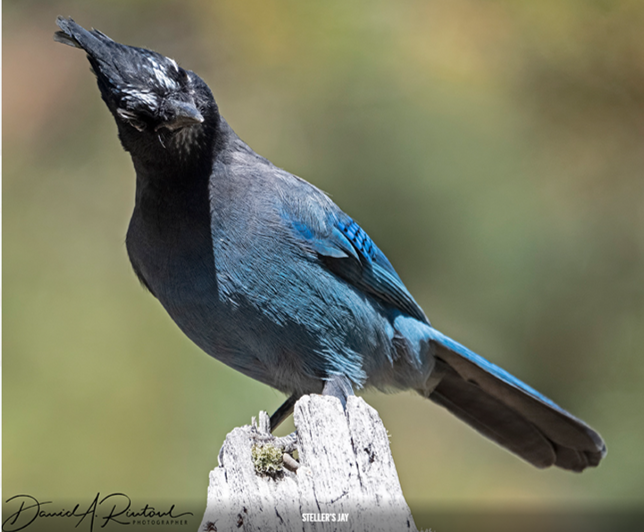
Inquisitive Steller's Jay photo by David Rintoul.

Take the newsletter survey!

Opportunity to comment on Kansas's State Wildlife Action Plan


The Kansas State Wildlife Action Plan (SWAP) is currently undergoing its 10-year comprehensive revision and your expertise, experience, and input are needed. The Kansas SWAP is a statewide plan for conserving and managing Kansas’ s most at-risk fish, wildlife, and plants and their habitats.


For those that are not as familiar with SWAPs; Congress created the State Wildlife Grant Programs in 2000 to provide critical funding to state fish and wildlife agencies to conserve at-risk fish and wildlife. The use of State Wildlife Grant Program funding is guided by SWAPs. In 2005, our first Wildlife Action Plan was submitted to the Service for approval. The SWAP is required to address eight planning elements and must be reviewed and revised at least once every ten years. A key component of each plan is the identification of Species of Greatest Conservation Need (SGCN).


Eight Required Elements:

1. Distribution & abundance of wildlife

2. Condition of key habitats

3. Threats or data gaps

4. Needed conservation actions

5. Monitoring needs

6. Plan revision schedule

7. Partner coordination

8. Public involvement


In 2015, Kansas underwent its first comprehensive revision, updating the SGCN list, incorporating climate change and analyzing a subset of SGCN to assess their vulnerability to climate change. We also developed a map of physical geographical landscapes where conservation actions can be applied for maximum benefit to wildlife, called Ecological Focus Areas (EFAs).


In 2022, we underwent a minor revision focusing primarily on the SGCN list. Plants were added to the list for the first time in KS SWAP history, as well as more invertebrate species with a strong focus on pollinators. Other additions to the SWAP were sections highlighting law enforcement and policy related to nongame wildlife, and wildlife outreach and education.


In this 2025 comprehensive revision, we want to consider many of the changes that Kansas and its wildlife have experienced since the 2015 plan. To help ensure the Plan is balanced and is able to leverage the resources and capacity of the public and private sectors, we want the planning process to be informed by citizens, experts from universities, and state, federal and local governments agencies. We want to gather input from wildlife and outdoor recreation enthusiasts, farmers and ranchers, business owners and others.


We will be holding regional meetings throughout the state this summer to collaborate with you, our partners, to ensure the inclusion of emerging challenges, and include the conservation issues and actions that are priorities for you.


External Partners meeting from 1:00 pm to 4:00 pm.  

9/18 – Pratt Office, Downstairs conference room

        512 SE 25th Ave

        Pratt, KS 67124

10/3 – Emporia, Dynamic Conference Room

        3601 W 6th

        Emporia, KS

10/9 – Topeka Region 2 Office, conference room

        300 SW Wanamaker Rd

        Topeka, KS 66606

10/16 – Garden City/Lee Richardson Zoo Finnup Center

        312 Finnup Drive

        Garden City, KS 67846


If you are interested in contributing to this process we hope to see you at one of these meetings. If you cannot attend a meeting, you can submit written comments to Daren Riedle and Megan Rohweder.


The current draft of the 2025 SWAP working draft can be found here at the bottom of the page: https://ksoutdoors.com/Services/Kansas-SWAP


Photo: Henslow's Sparrow by David Rintoul.


Window strikes are deadlier than we thought


After deaths by feral and free-roaming cats (which are estimated to be between 1.3-4.0 billion birds annually), window/building collisions are the highest cause of mortality of wild birds in the United States. It was estimated that about 600 million birds were killed by window collisions each year. These estimates were derived from birds found dead adjacent to buildings. The birds that were stunned, and eventually flew off were considered to live happy, healthy lives.


Ar Kornreich and colleagues looked at the outcomes of 3,100 stunned birds of 152 species that were taken to rehabilitation facilities. Despite treatment, 60% of these patients died. Smaller birds, like warblers and finches, were more likely to die than larger birds like ducks and gulls. Younger birds were more likely to die, presumably because their skulls still have softer spots that fill in with ossification as they age. The authors concluded that well over 1 billion birds die each year from building collisions in the United States if direct mortalities and delayed mortalities that occurred during recovery are combined. If birds are not found and treated by rehabilitators, mortality rates are likely to be higher. The number may be even higher. Although the sample size was relatively small, Brendon Samuels and colleagues found that 80% of birds flew away following window collisions.


Other major causes of avian mortality include vehicle collisions (214 million/year) and industrial collisions (64 million/year). Climate change and declining food sources (such as insect declines caused by climate change and herbicide and pesticide use) are also causing bird declines, but scientists have not been able to estimate the number of declines per year from these sources of mortality.


Citations

Kornreich et al. 2024. Rehabilitation outcomes of bird-building collision victims in the northeastern United States. PLoS ONE 19(8): e0306362. https://doi.org/10.1371/journal.pone.0306362

Samuels et al. 2022. Opening the black box of bird-window collisions: Passive video recordings in a residential backyard. PeerJ Dec 20:10:e14604

Loss et al. 2013. The Impact of free-ranging domestic cats on wildlife of the United States. Nature Communications 4:1396

Loss et al. 2015. Direct mortality of birds from anthropogenic causes. Annu. Rev. Ecol. Evol. Syst. 46:99-120

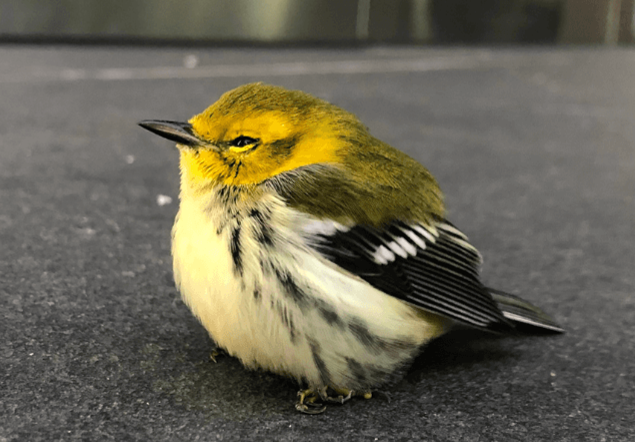
Black-throated Green Warbler injured after a collision with a building. Image from American Bird Conservancy's report of the story.

AOK Events

Click to learn more about the amazing Celebration of Cranes Festival

October 3-7

Work Fun! Week at Hutton Niobrara Ranch Wildlife Sanctuary, Bassett, NE

(see below)


October 6

Open House at Hutton Niobrara Ranch Wildlife Sanctuary, Bassett, NE

(see below)


November 1-2

Celebration of Cranes at Sterling/Quivira National Wildlife Refuge


December

Registration opens for Kansas Lek Treks Prairie-Chicken Festival


April 10-13, 2025

Kansas Lek Treks Prairie-Chicken Festival, Hays, KS

Visit the one-of-a-kind Hutton Niobrara Ranch Wildlife Sanctuary for a little work or a whole lot of fun


BASSETT, Nebr. – The public is welcome to the Open House event at the Hutton Niobrara Ranch Wildlife Sanctuary on Sunday, October 6th from 1 p.m. - 4 p.m. with a guided driving tour of the ranch departing at 2:30 p.m.


Visitors are invited to learn more about the nearly 5,000-acre ranch that was gifted by Harold and Lucille Hutton to the Audubon of Kansas to be managed in perpetuity as a wildlife sanctuary, educational facility, and working ranch. Located on the Niobrara National Scenic River north of Bassett, the property includes a guest house and museum that highlights the life and legacy of the couple, including numerous photographs, artifacts and art gallery.


Harold Hutton was a writer and historian, best-known for his research and publications on area history including books about the Niobrara River and local outlaw Doc Middleton. This year highlights the 50th anniversary of the publication of his book, Doc Middleton: Life and Legends of the Notorious Plains Outlaw. Hutton spent 19 years researching and writing the work published in 1974 by Swallow Press. A special display will showcase Hutton’s research documents, photographs and published works.


The guided driving tour will include a demonstration of cedar management, a tour of the wetland easement area, breath-taking views of the Niobrara River, and exploration of the ‘Hutton Homestead’. This house was used by the Hutton’s after they were wed. We will carpool in 4WD vehicles for this tour.


In conjunction with the open house event, the Audubon of Kansas invites volunteers to participate in “work week” activities at the Hutton Niobrara Ranch Wildlife Sanctuary from October 2-7. Volunteer work is available for all skill levels. Participants can come for a day or stay for the week with lodging and evening meals provided for volunteers (reservations required).


To learn more about volunteer opportunities or to RSVP, contact Amy Meyer, Sanctuaries Manager, at amy@audubonofkansas.org or call/text #: (402) 382-5538.


Both events are free and open to the public.

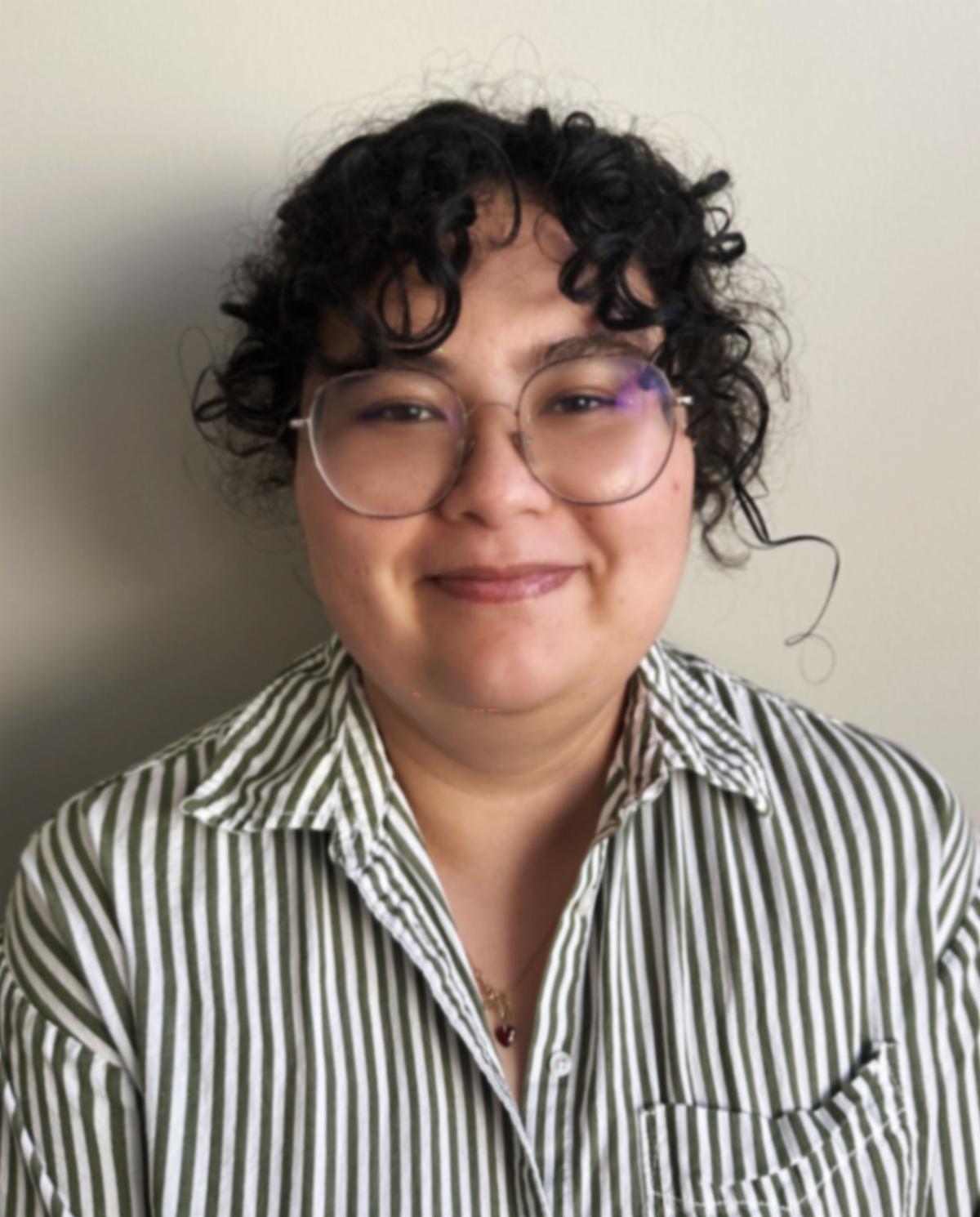
Welcome Kathryn! Our new Director of Philanthropy and Event Manager


Audubon of Kansas is excited to announce Kathryn Chambers as our new Director of Philanthropy! She hails from the Kansas City (MO) area, but grew up in Wichita and received a Bachelor of Business Administration in Economics and History Minor from Wichita State University. She was previously a Development Specialist at the Union Station Kansas City. She successfully coordinated and implemented a wide range of fundraising activities, including grant writing, donor cultivation, and event management.


When asked why she wanted to become the Director of Philanthropy at Audubon of Kansas, Kathryn answered, "AOK touches every individual in Kansas." She also admired how AOK's sanctuaries fulfill the vision of their donors (AOK takes on properties others organizations pass on, telling the story of the people involved with the land). She wants to see her work make an impactful difference, positively affecting the world around her. She knows she can make a difference for wildlife and the people that love Kansas wildlife at Audubon of Kansas.

Welcome Kathryn to AOK!

Chapter Spotlight:

Sunflower Audubon growing in western Kansas


Sunflower Audubon was formed a year ago, and has recently achieved official nonprofit status! Congrats Sunflower!


Sunflower Audubon is hosting great speakers at their monthly meetings. Last month, Dr. Elmer Finck talked about small mammals. With the knowledge of what a mammal is, they are getting even more focused information in this month's presentation: Dr. Lorelei Patrick will talk about BATS! The topic seems quite appropriate for October. Imagine all those people you can impress at Halloween parties with your newly acquired bat knowledge! The bat talk will be:

Thursday, October 17, 5:30pm

Fort Hays State University Albertson Hall Room 169

509 S Campus Dr, Hays, KS


You can find out about this and future programs by joining their FaceBook group.

Join Sunflower's Facebook page

AOK Nature Spot Recommendations:

Antioch Park in Merriam (Kansas City area) is a great place for beginning birders


This location was recommended by board member Lucia Johnson from Mission, KS: Antioch Park (6501 Antioch Rd, Merriam, KS 66202) is a quick and easy place to bird. It is especially nice for beginners as it is small has paved trails. The terrain is such that it is easy for older and some handicapped individuals to use. Antioch is an urban park that is easily accessed by those living in NE Johnson County. In the spring, I have seen Wilson, Magnolia, and Blackburian Warblers and Blue-headed Vireos. The usual NE KS regulars are also seen including Red-headed Woodpeckers.


According to eBird, Dark-eyed Juncos, Red-breasted Nuthatches, and Brown Creepers return in October to spend their winters in this park. Carolina Wrens and American Robins can be found year-round.


Text by Lucia and Jackie. Bird information from eBird. Photo from Johnson County Park and Recreation District's website.


Contact Us


Jackie Augustine - Executive Director - General Questions, Programs, Future Sanctuaries - jackie@audubonofkansas.org


Kathryn Chambers - Director of Philanthropy - Gift Planning, Membership, Endowments, Events Management - giving@audubonofkansas.org


Amy Meyer - Sanctuaries Manager - Questions about AOK sanctuaries and habitat management - amy@audubonofkansas.org


Audubon of Kansas

PO Box 1106

Manhattan, KS 66505-1106

785-537-4385

 
Facebook  Instagram  LinkedIn  YouTube