Adirondack Park Invasive Plant Program September 2025 Newsletter

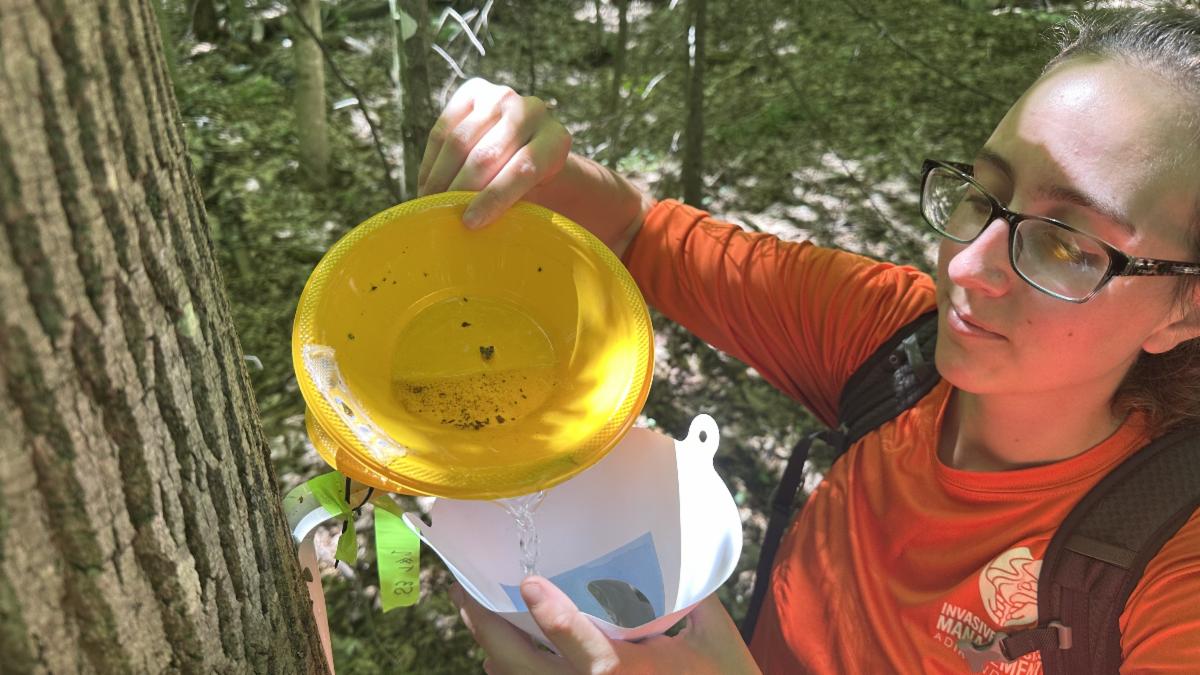
The onset of September means that fall is on the horizon in the Adirondacks, and a sneak-preview of our most colorful season is already evident by the colorful leaves on some of our most drought-affected trees. The lack of precipitation this summer has caused dry waterways and lower-than-average lake levels, and it’s made for a field season with few rain days. But even though summer has ended, the field season isn’t over yet! Most of our summer seasonals will be with us for another month with the exception of Adirondack Invasive Species Assistant Becca Tamanga, who will be wrapping up her fourth season with APIPP this week. The image above shows Becca collecting yellow pan traps, which will be examined for signs of the biological controls we released in 2023 and 2024 to manage emerald ash borer, an invasive forest pest. Returning summer seasonals bring with them knowledge and experience, and we can’t thank Becca enough for all of the amazing hard work she has done for APIPP and the Adirondacks. Thank you, Becca!


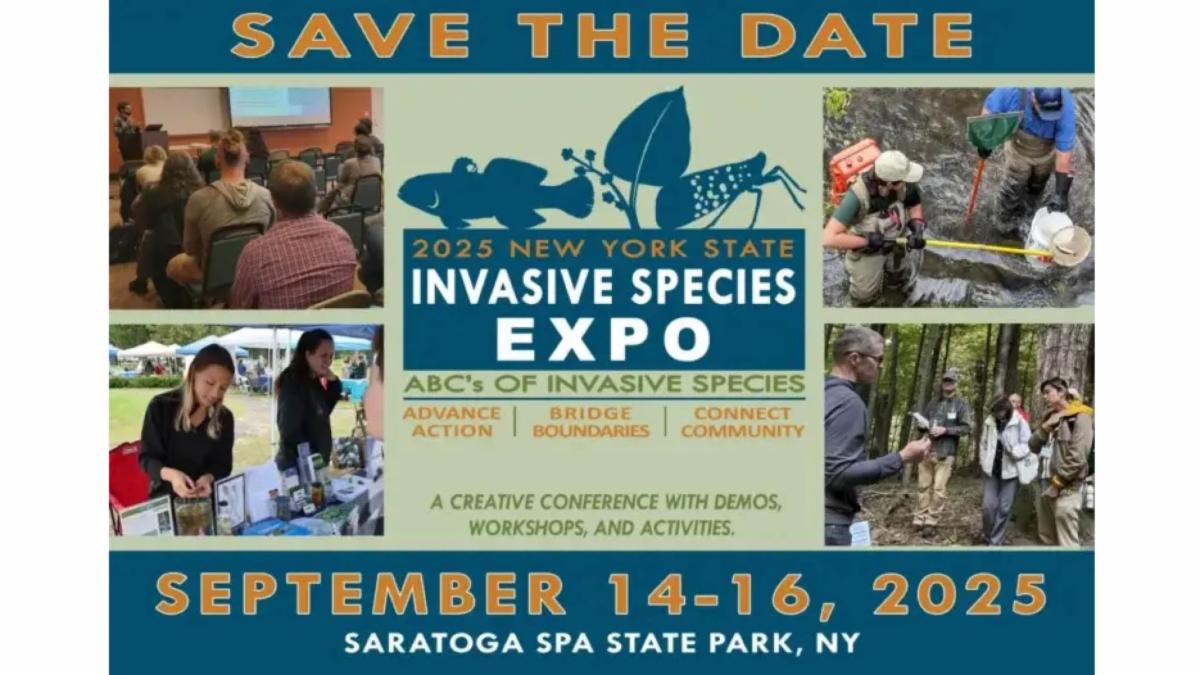
APIPP staff will be busy wrapping up our field season as the leaves begin to turn, but we’ll all be taking a break from the Adirondacks and heading to Saratoga Spa State Park in Saratoga for the 2025 New York State Invasive Species Expo, which runs from Sunday, September 14 to Tuesday, September 16. The expo, hosted by the New York State Department of Environmental Conservation (NYSDEC), will feature a wide variety of workshops and presentations that will cover everything from invasive species identification to the latest methods for monitoring for and managing invasive species. It is a fantastic way to get up to date on all things invasive-species-related. You can read more about the expo below.

Species of Concern: Beech Leaf Disease

Litylenchus crenatae mccannii

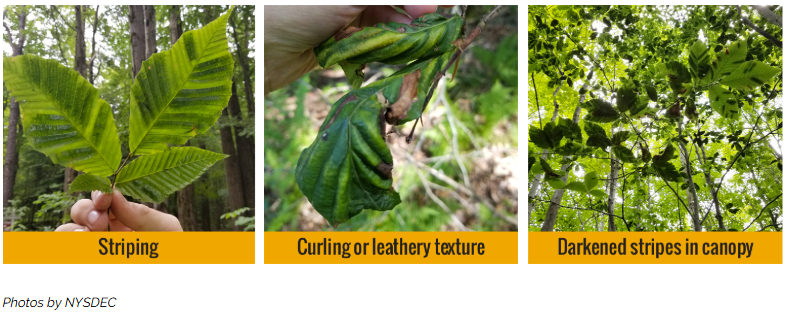
Beech leaf disease (BLD) is widely believed to be caused by the nematode Litylenchus crenatae mccannii and the telltale leaf banding that accompanies it was first observed in the Adirondack region in 2022. Once a tree is infected, BLD damages beech leaf buds, causing banding in between leaf veins. BLD also causes leaves to curl and take on a leathery texture, turning to withered and dropped leaves as the disease progresses. BLD can lead to tree decline and mortality. 


Professionals and citizens alike can help us to better understand BLD distribution in the Adirondacks by surveying for and reporting BLD with the volunteer Forest Pest Hunters program – the survey season is now open through October 8. There are resources like our 2024 Beech Leaf Disease Webinar, Adopt-A-Trail map, and detailed BLD Survey Protocol to help you prepare.  


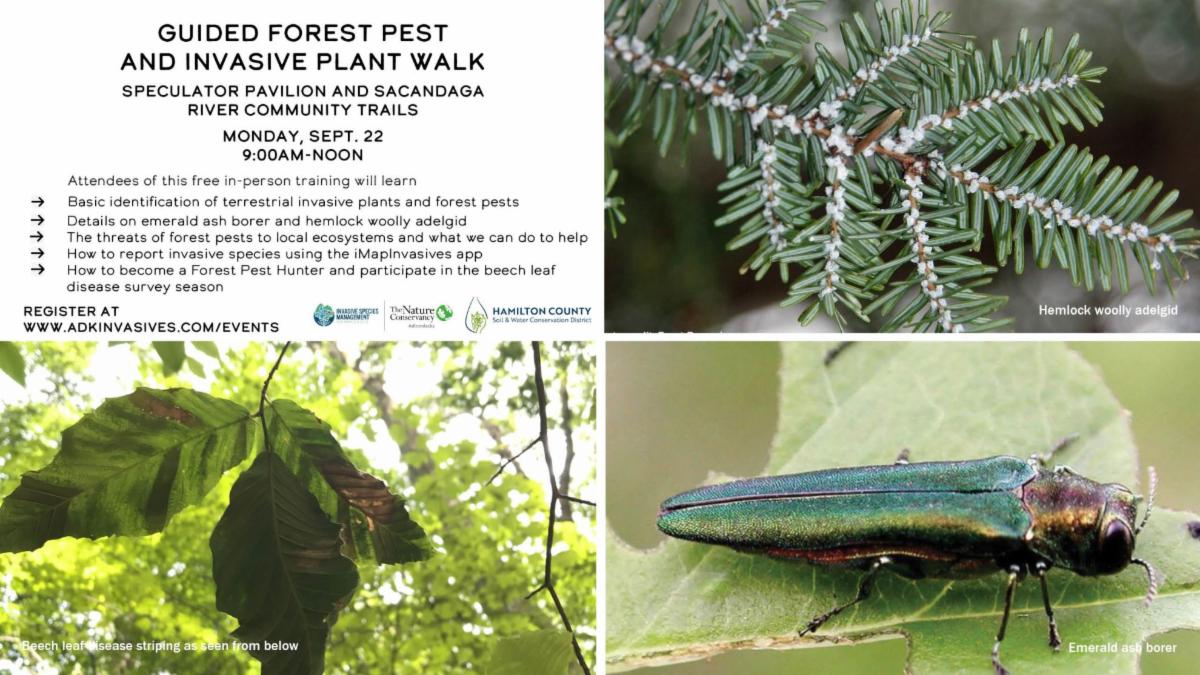
We are also looking forward to a training on Monday, September 22 at the Speculator Pavilion. Staff from APIPP and Hamilton County Soil and Water Conservation District will give a presentation on how to identify and report forest pests like BLD, followed by a walk on the nearby Sacandaga River trails. You can learn more about the training here.

Key Identification Features

  • Dark bands between leaf veins 
  • Leaf curling 
  • Leaves with a leathery texture, unlike the typical papery texture of healthy leaves

APIPP in the Field

Water Chestnut Pull


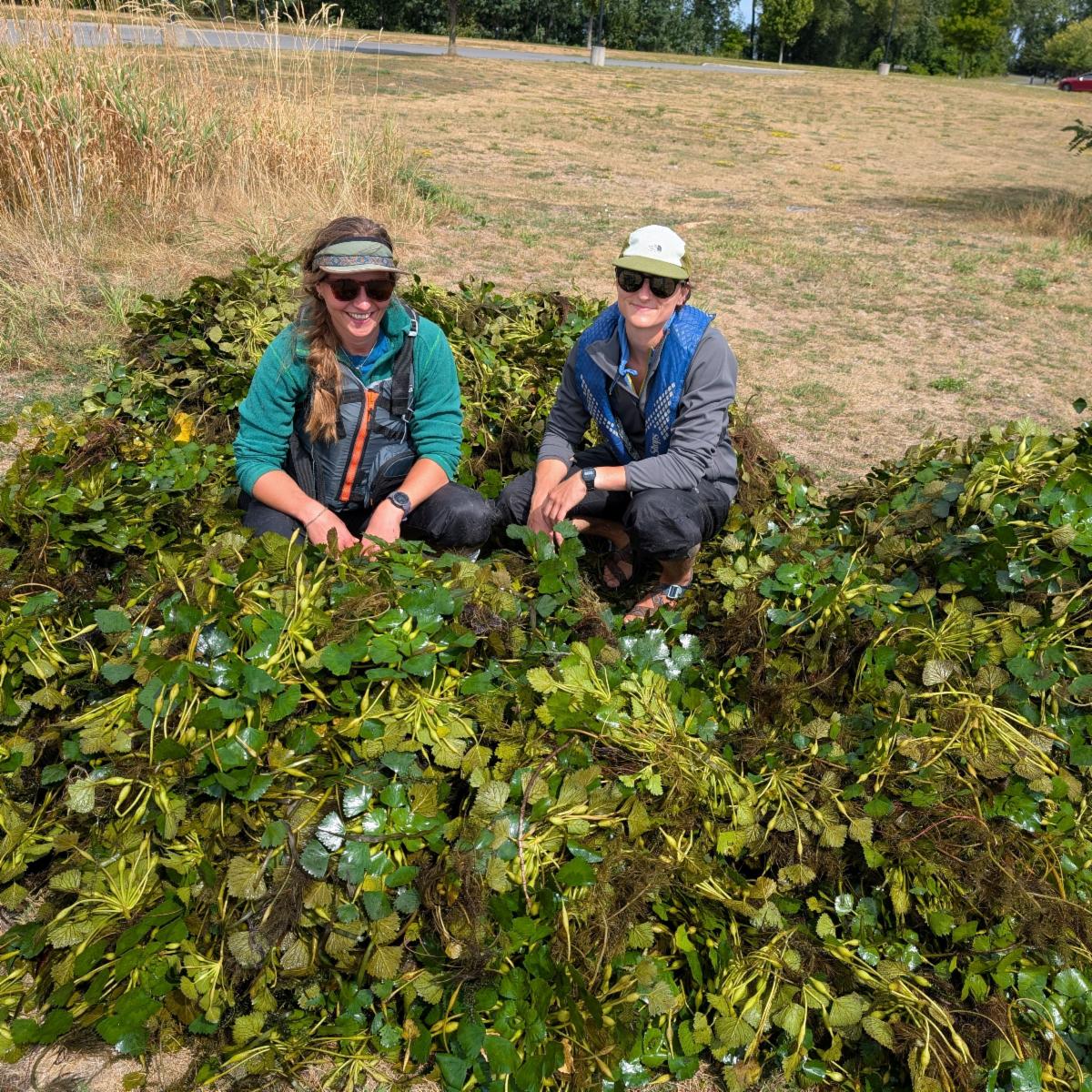
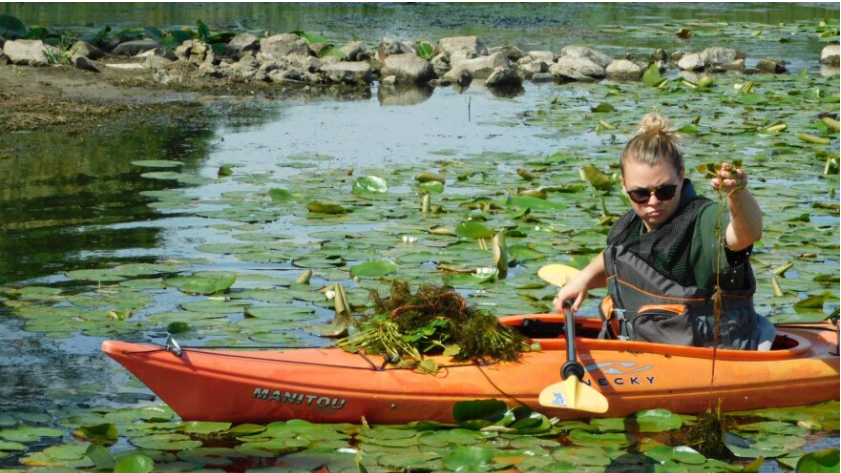
Water chestnut is an aquatic invasive species that aggressively crowds out native plants. This floating non-native plant is found in several locations throughout Lake Champlain. On August 28, three APIPP staff participated in a hand harvest coordinated by the Lake Champlain Basin Program and the NYSDEC. Water chestnut was harvested from Wilcox Dock and City Dock in Plattsburgh. Hand harvesting is one approach to management, particularly to control newly established populations. Over 7,000 plants were harvested and removed from the two locations combined. Other partners included Clinton County Soil and Water Conservation District, NYSDEC, Lake Champlain Sea Grant, Lake Champlain Basin Program, and Champlain Watershed Improvement Coalition of New York. 

People in the Field

2025 NYS Invasive Species Expo


Every two years the NYSDEC holds a gathering of invasive species experts from across the state. The 2025 New York State Invasive Species Expo will take place on Sept. 14-16 at Saratoga Springs State Park in Saratoga. The first day is a community day held in conjunction with the farmers market, where there will be tabling and hands-on events. Monday and Tuesday are both packed with talks and workshops led by PRISM staff, professors, and other invasive species experts. APIPP’s Program Director Brian Greene will be presenting on water quality monitoring on lakes where invasive milfoils are being managed and APIPP Communications Manager Shaun Kittle will lead a photography workshop and co-lead a workshop on education and outreach efforts for addressing invasive species. There are dozens of talks and topics, so we would love if you could stop by. For more information and to register, visit 2025 New York Invasive Species Expo – NYIS. 

Ask APIPP

Q: I think I found an invasive species but I’m not positive if I’m identifying it correctly. Should I still report it to the iMapInvasives app?

A: The short answer to your question is yes, you should use iMapInvasives to report everything you find that you think might be an invasive species. Many native species can be easy to mistake for invasive species and a lot of the damage caused by forest pests can look a lot like naturally occurring damage. Since determining what is invasive can be tricky, all reports made via iMapInvasives are reviewed by invasive species experts, so don’t hesitate to photograph and submit anything that looks suspicious! We’d much rather have a bunch of reports come in that aren’t invasive species than to have an invasive species go unreported. 


And speaking of reporting invasive species, APIPP has two volunteer programs, Forest Pest Hunters and Lake Protectors, that have monitoring seasons open through fall. The Forest Pest Hunters program focuses on two invasive insects—beech leaf disease in mid-summer and fall and hemlock woolly adelgid in winter—while the Lake Protectors program asks volunteers to monitor the waterbody of their choice for all aquatic invasive species. It’s important for every volunteer participating in those programs to report whether or not invasive species are present on the trail or waterbody they’ve adopted. By doing so, volunteers are helping us understand where invasive species have spread, and the non-detects help us track which areas have been monitored so we know where to focus our efforts in the future.  

Do you have a question for APIPP? Email adirondackinvasives@gmail.com

ICYMI 
Groups meet near Plattsburgh creek to harvest invasive water chestnut


Upcoming Events

September 14-16

2025 New York State Invasive Species Expo

September 22

Guided Forest Pest and Invasive Plant Walk 

September 27

Xperience For All


Facebook  Instagram  YouTube