ARCS® Foundation, Metro Washington Chapter (MWC) October 2026 Newsletter | | |
2026
Nov 5: SAR, 6:30 pm, National Academy of Sciences
Dec 6: Holiday Party, 4-7 pm, home of Julie Hohl
2027
Jan 31: Winter Membership Meeting, Riverbend Country Club, Great Falls, VA
Feb 6: ARCS Loves You
Mar 4: Senior Member & Past Presidents Brunch, home of Julie Hohl
Mar 9: Visit at University of Maryland
Mar 24: Visit at University of Virginia
Mar 31: Visit at Johns Hopkins University
Apr 2: Eagle Award Gala, Army and Navy Club in Washington, DC
Week of Apr 12: Visit at Georgetown University
Apr 22: Visit at George Washington University
May: Spring Membership Meeting, TBD
| | |
Dear ARCS MWC Members,
As we settle into the 2026–2027 year, we are excited about the work ahead and grateful for the dedication and enthusiasm of our members.
One of our most important priorities this fall is identifying our Nominating Committee. This committee plays an important role in the future of our Chapter by helping identify and recruit the next generation of board leaders. Anne Wingo will be reaching out to members who were nominated to serve. Thank you to everyone who is willing to consider taking on a leadership role!
Speaking of Board meetings, please remember that all Board meetings are open to our members. We welcome your participation and would love for you to join us to learn more about what we are working on and how you can get involved.
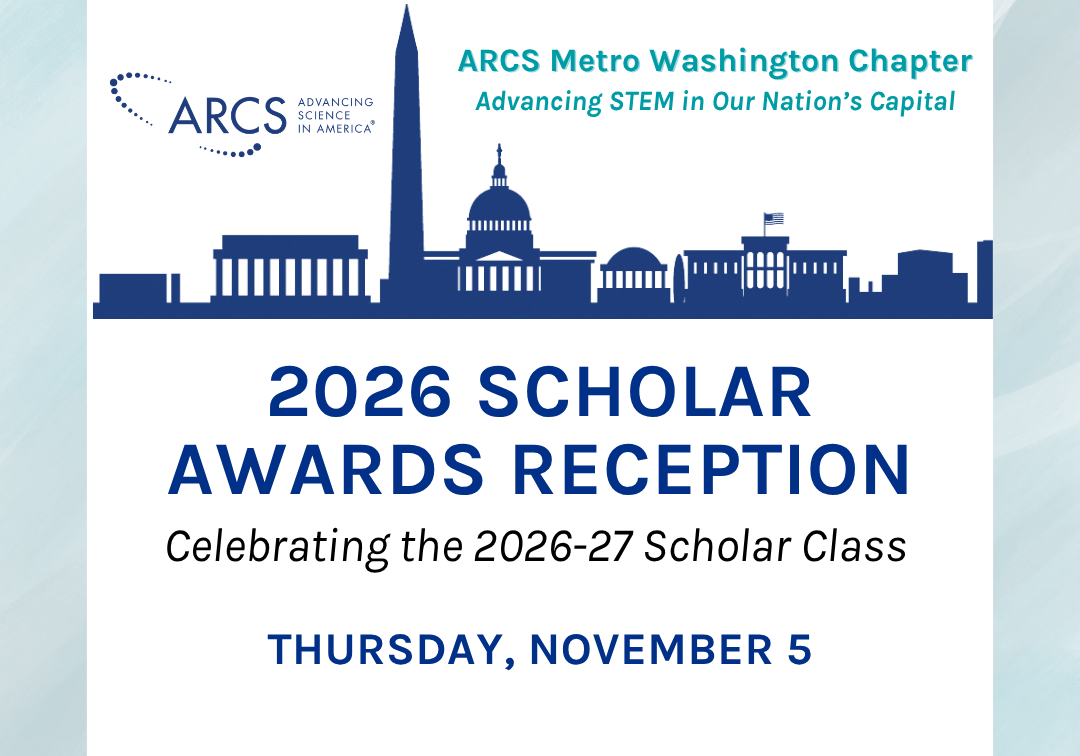
We also want to strongly encourage everyone to attend our Scholar Awards Reception on Nov 5 at the National Academy of Sciences. The SAR is at the heart of what ARCS represents: celebrating the outstanding students whose research will advance science and technology, learning about their exciting work, and honoring them with their ARCS Scholar Medallions. This year, we will recognize 22 Scholars.
We are especially excited to welcome our keynote speaker, Dr. GP Sandhoo, Director of the Space Development Agency and an ARCS Scholar Alum, who was a 1995–1997 ARCS MWC Physics Scholar at George Washington University. His perspective as both a distinguished leader in science and technology and a former ARCS Scholar makes him a wonderful speaker for this occasion.
Tickets are just $75, so please invite your friends, colleagues, and potential new members to join us for this special evening. The more people who experience the impact of ARCS firsthand, the stronger our Chapter will become!
Thank you for all you do to support our scholars and advance the mission of ARCS MWC. We look forward to seeing you at the SAR!
Warmly,
~ Julie Hohl and Jane Riddle, ARCS MWC Co-Presidents
| | |
This year's Scholar Awards Reception (SAR) is coming up on Thurs, Nov 5 at 6:30 pm at the National Academy of Sciences. Our featured speaker is ARCS MWC Scholar Alum Dr. Gurpartap "GP" Sandhoo, Director of the Space Development Agency and the Space Force Portfolio Acquisition Executive for Missile Warning and Tracking and an ARCS MWC Scholar Alum.
We hope you will join us and bring a guest! RSVP by Oct 26. For planning purposes, please RSVP with either your confirmation or your regrets.
Interested in sponsoring the SAR? Reach out to Jane Riddle at mwcpresident@arcsfoundation.org.
| | |
Help Expand Our Reach and Increase ARCS MWC Scholar Impact!
As we prepare our End-of-the-Year Appeal, please think of friends, family members, and colleagues who care about science, education, and the future of STEM. Your introduction could help bring a new supporter into the ARCS community—and expand opportunities for our outstanding Scholars. Send suggested names and contact information to Patty Sparrell (ptsparrell@gmail.com) by Nov 11, 2026. The Development Council will handle all communication.
| |
Mark your calendars! Join your ARCS friends for a wonderful holiday party on Sun, Dec 6, at the beautiful home of Julie and Kurt Hohl. Festive food and warm fellowship awaits you between 4 and 7 PM. It will be a great time to catch up with friends and celebrate the season.
Dress in festive holiday attire and enjoy champagne punch, wine, beer, heavy bites/ small plates, dessert, and coffee. Valet parking will be available.
We will be collecting for SHARE donations. Winter coats and seasonal items are always needed.
Look for more details soon. Come celebrate!
| |
Save the date! The 2027 Eagle Celebration will be held on Fri, Apr 2, 2027 at The Army and Navy Club in Washington, DC.
We will be honoring Commander Everett Alvarez Jr., U.S. Navy (Ret.). Everett was the first American aviator shot down over North Vietnam and was held as a prisoner of war for more than eight years. Following his Navy career, he served as Deputy Director of the Peace Corps, Deputy Administrator of the Veterans Administration, and for more than 20 years as a member and two-time chair of the Board of Regents of the Uniformed Services University of the Health Sciences, the nation’s military medical school. Everett’s wife, Tammy, has been a member of our chapter since 1986 and has helped in several roles over the years.
Thank you to Alice Laning for being our club sponsor. More details on this sure to be exciting event will be sent out in the coming months.
| | |
One of the highlights of the year is the ARCS MWC University Visits, to meet with our ARCS Scholars and their mentors and hear about their research. Mark these dates on your calendar. We encourage all members to participate in at least one University Visit!
University of Maryland - Tues, March 9, 2027
University of Virginia - Wed, March 24, 2027
Johns Hopkins University - Wed, March 31, 2027
Georgetown University - Week of April 12, 2027
George Washington University - Thurs, April 22, 2027
| | |
ARCS MWC welcomed new member Melissa Schwartz this month! Melissa is sponsored by Julie Hohl and Jane Riddle.
Melissa grew up in Portsmouth, VA. She attended the College of William and Mary, where she majored in International Relations and Government, before attending Emory University School of Law. Melissa then moved to the DC Metro area and joined the law firm of Paul Hastings LLC. She's a member of the Paul Hastings Global Finance Group, and specializes in complex commercial and corporate finance transactions as well as debt restructurings, workouts and bankruptcy matters.
Melissa and her husband, Jamie, have three sons who all attended local McLean public schools and graduated from Langley High School. Through the years, Melissa has been a dedicated volunteer for their schools, including in the Parent Teacher Associations. She has taken on leadership roles such as PTA President, VP of Membership, and VP of Fundraising, as well as serving as Class Parent lead several years and helping with her sons' activities. When she's not immersed in professional or community endeavors, she's exploring her interests in ancestry research – she's traced her Virginia ancestry all the way back to Jamestown in 1619! – travel, reading, and movies.
Julie and Jane have known and worked with Melissa for many years in their roles at Langley High School. They describe her as a remarkable individual whose contributions to both our professional and local communities have been invaluable, and they have witnessed firsthand her unwavering dedication and commitment.
Melissa attended the ARCS MWC Winter Membership Meeting with Retired Associate Justice Anthony Kennedy and enjoyed meeting other members there. With her youngest son now embarking on his college journey, Melissa is excited to support ARCS’ mission and our chapter!
| | |
Samuel Allsup – Endowment Scholar
1st Year Scholar, PhD Candidate, Biochemistry and Molecular & Cellular Biology
Georgetown University
Research: My research is focused on using viral elements of the human genome to induce cell death in ovarian cancer cells, as well as attracting cells from the immune system to attack ovarian tumors.
How Will Your Research Benefit Society?
The 5-year survival rate for ovarian cancer – just 30% – has not significantly changed in decades, illustrating the serious need for new and inventive treatments for patients with this disease. Ovarian cancer is characterized by poor recognition by the patient immune system, which means that while other forms of cancer have benefitted drastically from the advent of immunotherapies, ovarian cancer has yet to see significant benefit from these therapies. Our research focuses on activating the innate immune system to produce signaling molecules to notify the immune system of apparent “infection”, attract immune cells, and lead to cell growth inhibition and cell death. This novel method of leveraging the innate immune system within the cancer cells themselves in order to kill cancer cells relies on a field of immunology that is well studied for the treatment of infectious disease, but is not utilized to its full potential in cancer research. We propose to harness this particular field of immunology to activate patient immune response to ovarian cancer, and potentially to other cancers as well, increasing survival and improving prognosis.
How will an ARCS Award Benefit Your Research?
This award would allow me to utilize cutting edge methods of immune profiling to characterize the immune response of ovarian cancer to a novel method of therapy, synthetic innate immune activation, as well as the potential to combine this new therapy with existing cancer treatments to augment their response. Immune cells and immune responses are driven by signaling molecules called cytokines and chemokines, which activate, attract and drive anti-tumor immune cells. Multiplex high-throughput cytokine/chemokine profiling would allow me to understand the complex, often minute changes in immune signaling which drastically influence immune responses in-vivo. Immune responses are also driven by spatial location of immune and cancer cells. Multiplex spatial immunostaining allows for extremely precise, microscopic analysis of the spatial aspect of anti-tumor immune responses in response to a novel innate immune therapy.
Without this generous award from ARCS award, I would not be able to fund this mix of extensive immune cell profiling, cytokine and chemokine analysis and spatial immune mapping, in combination with a novel and innovative method of ovarian cancer therapy. This funding would allow for an extremely deep and nuanced understanding of changes in the immune environment of ovarian cancer induced by this treatment. With our proposed method of activating the innate immune system within the cancer cells themselves, we may be able to augment the response of ovarian cancer to established immunotherapies which have yet to show benefit.
Career objectives: I plan to pursue a career in medical cancer research, focusing specifically on underserved research areas like female reproductive cancers. My path includes targeted postdoctoral training, focusing on female reproductive cancers, followed by a transition to the pharmaceutical industry, where I will focus on maximizing the clinical impact of my work. As my career progresses, I hope to lead research teams developing cutting-edge, novel methods of cancer screenings and therapies specifically focused on addressing healthcare disparities. My goal in combining my academic research with experience in the pharmaceutical industry is to bridge the critical gap between laboratory discoveries and marketable treatments in the United States.
| |
Hayden Barry – Forster Family Foundation Scholar
1st Year Scholar, PhD Candidate, Materials Science and Engineering
University of Virginia
Research: My research focuses on improving superconductor-insulator-superconductor junctions, which act as tiny, ultra-fast switches that are the building blocks of future quantum computers and advanced sensors. By using a Transmission Electron Microscope (TEM), a tool powerful enough to see individual atoms, we investigate how tiny flaws at the junction's edges can slow down or disrupt the signal. This allows us to map out microscopic defects and learn how to build more perfect, efficient hardware for faster data processing and better space-exploration tools.
How Will Your Research Benefit Society?
The research enables the development of ultra-fast, energy-efficient quantum computers and high-sensitivity space sensors by using atomic-resolution microscopy to eliminate microscopic defects in superconductor-insulator-superconductor junctions. By mastering these materials, we can provide the foundational technology for safer nuclear energy and more efficient solar power, ultimately significantly improving energy security.
How will an ARCS Award Benefit Your Research?
An ARCS award would provide the critical financial support and professional recognition necessary to accelerate the development of a predictive design framework for next-generation superconducting digital logic and quantum sensing platforms. Specifically, this fellowship would facilitate the complex, multi-modal characterization of NbTiN-based SIS junctions using advanced techniques like monochromated EELS and 4D-STEM, allowing for a deeper investigation into how atomic-scale defects and grain morphology govern macroscopic quantum transport. Beyond technical resources, the award supports the dissemination of these findings to the broader scientific community, helping to bridge the gap between atomistic interface engineering and the deployment of robust materials for high-thermal-budget SDL circuits and advanced nuclear reactor sensing.
Career objectives: I hope to stay in academia and become a professor of Materials Science Engineering.
| |
Kristan Morgan – Mars Foundation Scholar
1st Year Scholar, PhD Candidate, Geography & Environmental Engineering
Johns Hopkins University
Research: My research estimates CO2 sources and sinks in the Amazon, using NASA satellite data to model broader tropical South America to understand the environmental levers and knobs that control the contemporary tropical carbon cycle in one of Earth's most vulnerable environments.
How Will Your Research Benefit Society?
My passion for my field is fueled by the deep impacts the science has on society and the future of the Earth’s climate. If the Amazon rainforest, a massive carbon sink, continues to deforest at current rates and releases terrestrial carbon as atmospheric carbon dioxide, the climate implications would be severe and global, changing nearly every aspect of our society. Outside of my Amazonian research, I participate in ensemble global modelling projects including the OCO-2 Modeling Intercomparison Project (MIP). Comprised of 14 modelling frameworks from across the world, including my own model, the OCO-2 MIP uses the latest greenhouse gas satellite data to provide ensemble estimates of CO2 sources and sinks for the years 2015-2024, effectively establishing our current understanding of carbon cycle science. I explain to my friends and family that the science in my field shapes society’s perspective on Earth’s climate, both current and future. Thus, the benefit of continued science in my field cannot be understated.
How will an ARCS Award Benefit Your Research?
Because I am employed at NASA GSFC concurrently with my PhD pursuits in Geography & Environmental Engineering, I do not receive a graduate stipend through Johns Hopkins. Being granted the ARCS Graduate Scholar Award would both accelerate and advance my young career. I require strong, often costly, technology that can “keep up” with the atmospheric models I run, requiring intense coding and analysis. I also love travelling to share my science at US conferences, but it is my dream to share my science abroad at the International Workshop on Greenhouse Gas Measurements from Space (IWGGMS). The funding opportunity to attend IWGGMS and network with my European colleagues and science heroes in-person would help me become more established in the field globally. Similarly, being afforded the opportunity to meet with a particular colleague in France, a project scientist for ESA’s MicroCarb, would transform my career as this upcoming satellite’s data will be crucial to assimilate in my atmospheric model to better constrain the Amazonian carbon cycle and advance my PhD.
Career objectives: My passion is carbon cycle science, and everything I do in my young career is to enable me to become a leader in the next generation of carbon satellite meteorology. I've worked with incredible scientists and network with nearly the entire Orbiting Carbon Observatory-2/3 (OCO-2/3) community, the NASA satellite Missions I use in my research at Johns Hopkins. I find synergy with my NASA work and my education goals, working hard to earn my Master's and start my PhD both while working full-time, fueled by my unstoppable drive to advance my young career. My goal is to leverage my deep roots in NASA to secure a post-doctoral position with the European Space Agency (ESA) and continue my work modeling tropical South American with their upcoming Mission MicroCarb’s data. My ultimate career objective is to be a well-respected scientist in the carbon science group at Cooperative Institute for Research in the Atmosphere (CIRA) in Fort Collins, CO, where my personal science heroes are.
| | |
Submit articles, pictures, pdfs, and website links by the 25th of each month for publication the following month to Helen Miller at mwcnewsletter@arcsfoundation.org.
ARCS® and its logo are registered with the US Patent and Trademark Office.
| | |
We have a new mailing address in Virginia!
Please make a note for future communications:
ARCS MWC
P.O. Box 477
6841 Elm Street
McLean, VA 22101
| | | | |