|
Structure
AIPs have a standardized format and structure, with ICAO providing the guidelines. Within AIPs you will find them organized into four sections:
AIP/e-AIP
General (GEN)
- Rules for entry, transit, and departures of aircraft, passengers, and cargo
- Contact information
- List of navigation aids
- Local regulations and requirements
- Fees and airspace charges
En Route (ENR)
- Airspace classification
- Air traffic flow management
- Flight planning information
- Airway and waypoint information
- En route charts
Aerodrome (AD)
- Aerodrome and heliport information
- Charts
Amendments (AMDT)
- Amendments to the AIP outside of the published AIRAC cycles
Supplements (SUPs)
- Supplementary information not included in the AIP
- Temporary warning/danger areas
- Information about new procedures
Aeronautical Information Circular (AICs)
- Information which does not qualify to be included in the AIP or published as a NOTAM
- Flight safety
- Legislative matters
- Preferred routes
The access to AIPs, however, can be challenging. The practice of publishing AIPs has come a long way from the paper and CD-ROM era, with the vast majority of ICAO member states publishing their information on the internet. Many AIPs can be accessed without a need for a login (i.e. Singapore and United Arab Emirates) while some require a user to create a free account. Frustratingly though, some countries such as Mexico, have access to the AIP restricted behind a paywall.
AIRAC Cycles
AIPs are typically published every 28 days (single cycle) or 56 days (double cycle), though some countries update their data less frequently. These cycles are known as Aeronautical Information Regulation and Control (AIRAC) cycles. During these cycles air navigation authorities will publish changes to airways, airport names, location identifiers, and much more. Upcoming AIRAC effective dates can be found here on ICAO’s website.
Preferred Routes
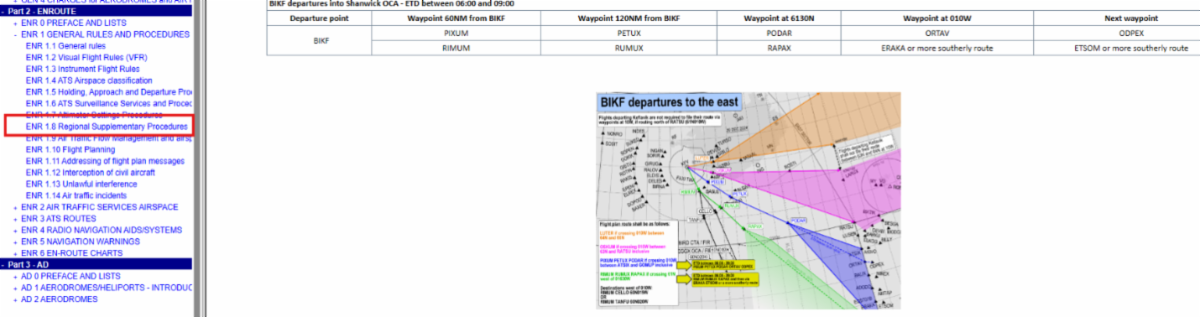
While AIPs are standardized in their structure, that does not necessarily mean you will find the information you are looking for in the same spot. Take routing for instance. Finding the preferred routing within an AIP can be a frustrating experience and an exercise in patience. This critical information can be found in various places, but there are areas of the AIP where you can reliably find this critical piece of information.
En-Route 3 ATS Routes (ENR) Section
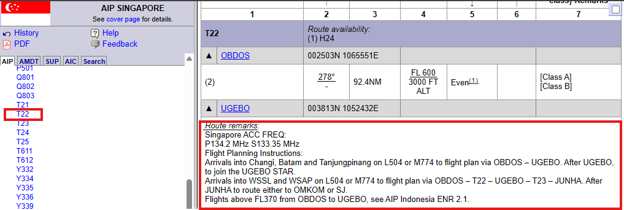
- The AIP for Singapore displays important route information in ENR 3 – ATS Routes. After navigating to this section, you will need to choose section ENR 3.1 or ENR 3.2 and select an airway. In our example from the article introduction, the rejection message indicates airway T22. By selecting the airway and referencing the Route remarks we can see preferred arrivals into Seletar Airport (WSSL).
|