Volume 103 | Tuesday, November 26, 2024

Jump Seat Logo _New_.png

Winter Weather Operations

Welcome back to Jump Seat. As the winter season for the Northern Hemisphere is quickly approaching, our ARINCDirect team of meteorologists have put together forecast guidance and useful tools for operating in winter weather conditions. This week’s article highlights the climatological forecasts, winter weather products, and recommended best practices for flight plan filing in the United States during the winter months.


As we also look forward to 2025, we want to know what you would like to hear more about. Please consider submitting Jump Seat topics via our survey here: Jump Seat 2025 

El Niño-Southern Oscillation: What it Means for this Upcoming Winter


You may often hear the terms “El Niño and La Niña” during climate discussions, but what exactly are they? Simply put, they are variations of the normal trade winds and sea surface temperatures over the Pacific Ocean, which can lead to an irregular weather cycle. 


El Niño is characterized by higher-than-normal sea level pressure and weaker trade winds near Indonesia. This leads to an influx of warm water to the east towards South America. The warmer waters cause the Pacific jet stream to move south resulting in dryer and warmer conditions in the Northern United States and Canada, while wetter than usual conditions will persist across the Southeastern United States. During the winter months, this leads to increased snowfall in the southern Rockies and Sierra Nevada and below-normal amounts in the Midwest/Great Lakes region. 


During a La Niña year, the opposite occurs. Sea level pressure is higher in the central/eastern Pacific and stronger than normal trade winds will push the warmer water westward towards Asia. This results in colder water off North America pushing the jet stream farther north. The weather impact is wetter and colder conditions in the Northwest United States and Canada and drier conditions in the southern United States. In the winter this means you can expect above-average snowfall in the Pacific Northwest and Great Lakes regions. 


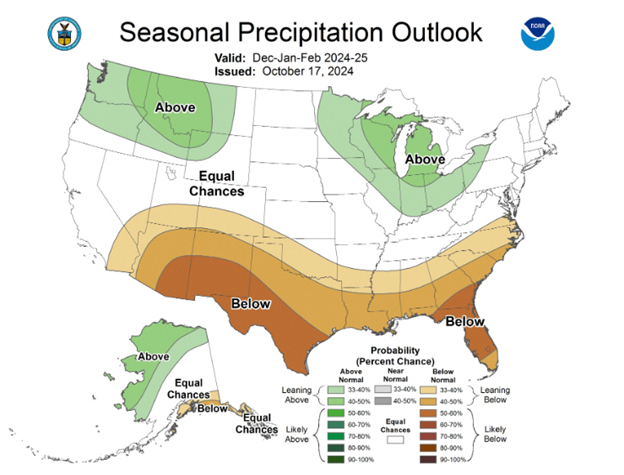
So, what kind of winter is being predicted this year? Normal, El Niño or La Niña? For December 2024 to February 2025, climate experts are anticipating a slow-developing La Niña for these winter months. This means a wetter-than-average season for the Pacific Northwest and Great Lakes regions and a drier-than-average season for the southern United States.  

Figure 1. The U.S. Winter Outlook map, favoring drier-than-average precipitation across much of the Southern U.S. Wetter-than-average conditions likely across the Pacific Northwest and Great Lakes region. Courtesy of NOAA. 


Decoding Winter METARs & TAFs  


It likely comes as no surprise that winter weather has the potential to significantly disrupt airport operations and aircraft performance. Whether in the form of liquid, frozen, or freezing precipitation, having an accurate forecast of precipitation type, onset, and duration can help operators plan safely and accordingly.  


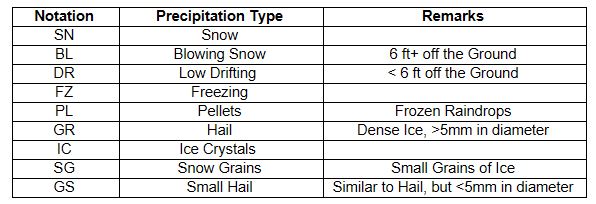
Thanks to Meteorological Aerodrome Reports (METARs) and Terminal Aerodrome Forecasts (TAFs) pilots are given a good estimate of departure and destination observations and forecasted conditions. As we transition into the winter months, it is important to review some of the less common notations and abbreviations that can differentiate precipitation type, size, and even snow depth.   

Below is a METAR issued for Denver International Airport (KDEN) following a recent snowstorm that impacted the region.  


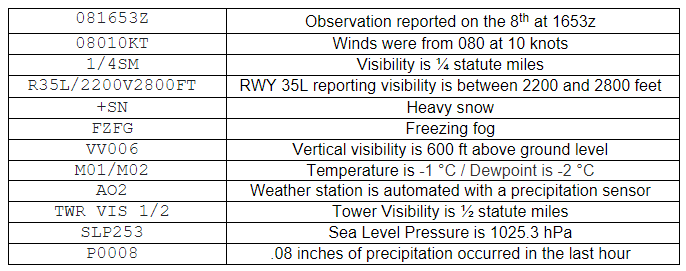
KDEN 081653Z 08010KT 1/4SM R35L/2200V2800FT +SN FZFG VV006 M01/M02 A3023 RMK AO2 TWR VIS 1/2 SLP253 P0008  


Generally speaking, we can interpret the METAR as indicating that airport was in the midst of low IFR conditions with heavy snow, freezing fog, and a quarter-mile visibility. Fully decoding the METAR gives us additional information which can help decide if you want to proceed with operations: 

If you’re having trouble decoding a METAR, the Aviation Weather Center’s site has a handy tool to provide plain-language weather observations. NOAA also has a printable quick reference guide as well.


FICONs


Field Condition NOTAMs (FICONs) and specialized NOTAMs that relay field reports (SNOWTAMs) represent a standardized reporting system for observed airfield conditions, braking action reports on runways, taxiways, and movement areas. They are especially useful for flight crews, ground operations, and air traffic controllers to assess the operational impacts of winter weather in real time. FICONs utilize numerical and alphanumeric codes to highlight contaminants and surface conditions for every third of a runway. These conditions are typically reported every hour, or as airfield conditions evolve.


Runway Conditions Code (RwyCC) values less equal to or less than 5 in the winter months may indicate the presence of dry, wet, and/or compacted snow, slush, or ice, implying potential issues with braking deceleration and control. Any uncertainty with the assessments or further questions could likely be addressed directly to the airport or FBOs for a first-hand account of the current conditions.


Let's look at an example of a FICON:


RWY 28 FICON 3/3/3 100 PCT 2IN DRY SN OVER COMPACTED SN


By decoding the report, we can see that Runway 28, the landing runway, is completely covered by two inches of dry snow over compacted snow. The depth of the compacted snow is not reported.


For more information on decoding FICON’s, the FAA has published a document outlining standard procedures. ICAO has a reference manual for the dissemination of SNOWTAMs, which can be found here


Filing Best Practices: Ski Country & Snowbird Volume


As if winter weather preparations weren’t enough, preparing for increased holiday traffic remains another key concern for operators. Popular winter-time destinations in the Colorado Ski Country, such as Eagle County (KEGE), Rifle Garfield Country (KRIL), and Aspen/Pitkin County (KASE), in addition to high-volume Florida and Caribbean travel, are subject to traffic management initiatives by the FAA on peak travel days.


While delays may be inevitable on these busy days, there are a few steps that you can take ahead of time to best prepare you and your travelers. Filing your flight plans at least 24 hours in advance will make you “known traffic” to the FAA, preventing you from potentially lengthy delays as a late (or last-minute) filer.


In the days leading up to, during, and after holidays, the FAA mandates the use of Holiday Airspace Release Program (HARP) routes, primarily along the East Coast. West Atlantic (WAT) airspace and HARP routes are typically exempt from re-routes, assuming that they are filed in the exact way that they are published. It’s highly recommended to be familiar with the FAA Routing Playbook, which provides the full list of mandated routes.


Being flexible - with routing, and even filed flight levels - in/around Airspace Flow Programs (AFPs) can alleviate delays associated with those boundaries. It is important to note that every program is different, so please reference the latest on the FAA’s National Airspace Status website or contact the ARINCDirect Flight Operations team.


Lastly, be sure to include your email, along with other crew or operations emails, into our “EDCT/CTOT Notifications” section of the Filing page to be alerted of any issued delays, should they occur. For more guidance on winter weather operations, please reference one of our previous Jump Seat articles. Winter operations can prove challenging even for the most experienced operators. ARINCDirect’s 24x7 support teams are standing by, ready to assist with your operational needs.

Did you know?

  • In addition to FAA certified dispatchers, ARINCDirect boasts a group of trained and degreed meteorologists among their Flight Operations team. 
  • ARINCDirect has a regular presence at industry events such as the Teterboro Users Group (TUG) and the FAA/Collaborative Decision-Making meetings to serve as a voice of the business and general aviation communities. 
  • The Western Atlantic (WAT) airspace was previously known as WATRS airspace until September of 2023. 

Useful Links

  • Check out the Eurocontrol’s Network Operations Portal for a wealth of useful information about Europe’s airspace. 
  • Looking for airport webcams? The FAA’s WeatherCam page has a number of handy tools including weather overlays in addition to cameras with visual references. 
  • The United Kingdom Met Office issued their global climate outlook, you can read the document here
  • Thinking about operating to Samedan/Engadin airport (LSZS) near St. Moritz for skiing in the Alps or the World Economic Forum? The airport website has useful tools such as a webcam and information for pilots about special filing procedures

Thank you for reading!

More Jump Seat
ARINCDirect Support