|
Still Time to Register for Chicago Courses!
|
|
|
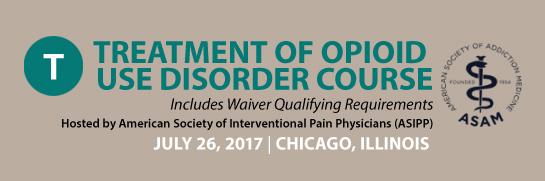
Treatment of Opioid Use Disorder Course: Waiver Qualifying
July 26, 2017!
Learners will be able to:
- Apply for a wavier to prescribe buprenorphine to their patients with opioid use disorders
- Identify and assess patients who are appropriate for treatment with medications
- Have specific knowledge concerning the use of medications to manage patients with addiction involving opioid use
- Discuss the psychiatric and medical co-morbidities associated with opioid addiction
This course is SAMHSA-supported and meets the requirements needed to obtain the waiver to prescribe buprenorphine in office-based treatment of opioid use disorders.
This is an 8-hour blended course combining 4 hours of online learning followed by 4 hours of live learning. The live portion of the course builds off the content delivered in the online portion. Course faculty are expecting you to come to the live course with the online portion completed.This is an 8-hour blended course combining 4 hours of online learning followed by 4 hours of live learning. The live portion of the course builds off the content delivered in the online portion. Course faculty are expecting you to come to the live course with the online portion completed.
|
|
2017 ASIPP Washington Legislative trip
Set for Sept 12-13, 2017
At no other time in the history of the American Society of Interventional Pain Physicians has it been more important for you, as members, to get involved in our advocacy efforts. Our specialty has been gravely affected by drastic and severe coverage cuts. These cuts so radical, they have hurt more than just our bottom lines; some practices and surgery centers have been forced to close their doors.
The election of President Trump and his appointment of Representative Tom Price as Health and Human Services Secretary and Seema Verma to head the Centers for Medicare and Medicaid Services have given us some hope and an opportunity to achieve some of our goals, and possibly reverse these cuts retroactively and reinstate the previous reimbursement or even improve reimbursement for 2018.
Now is our chance! Let your voices be heard!
We have scheduled a legislative conference September 12 and 13. To participate in this conference, you must to be in Washington on Tuesday, September 12 in order to attend the preparation session. Wednesday, September 13, we will head to Capitol Hill to hear speeches and meet with Senators and Representatives. Some appointments may continue through Thursday. If you would like to leave on Wednesday, please do not plan on leaving before 6 pm.
Each member is expected to visit two senators and one member of Congress for a total of three visits.
ASIPP will be booking a block of rooms for those who choose to attend. You will be responsible for travel expenses.
Please let us know as soon as possible if you will be attending so that we can begin making the appointments. Contact Kasi Stunson kstunson@asipp.org.
|
|
|
GOP Stares Down Loss on Health-Care Bill
WASHINGTON—Senate Republican leaders said Tuesday they would push ahead with a vote to repeal the Affordable Care Act early next week even as GOP defections made it clear the effort would fail.
The move from Majority Leader Mitch McConnell (R., Ky.) means Senate GOP leaders plan to hold a vote they expect to lose, an unusual move that may be designed to let the Senate quickly move on from the health debate after a turbulent monthslong effort to roll back the ACA. With a separate bloc of Republicans
saying Monday night they wouldn’t support a broader health bill, that made two major
GOP health efforts thwarted by internal party opposition in less than 24 hours.
Access to this article may be limited.
|
|
|
Are Benzodiazepines as Deadly as Thought?
Abstract
Objectives To evaluate the risk of all cause mortality associated with initiating compared with not initiating benzodiazepines in adults, and to address potential treatment barriers and confounding related to the use of a non-active comparator group.
Design Retrospective cohort study.
Setting Large de-identified US commercial healthcare database (Optum Clinformatics Datamart).
Participants 1:1 high dimensional propensity score matched cohort of benzodiazepine initiators, and randomly selected benzodiazepine non-initiators with a medical visit within 14 days of the start of benzodiazepine treatment (n=1 252 988), between July 2004 and December 2013. To address treatment barriers and confounding, patients were required to have filled one or more prescriptions for any medication in the 90 days and 91-180 days before the index date (ie, the date of starting benzodiazepine treatment for initiators and the date of the selected medical visit for benzodiazepine non-initiators) and the high dimensional propensity score was estimated on the basis of more than 300 covariates.
Main outcome measure All cause mortality, determined by linkage with the Social Security Administration Death Master File.
Results Over a six month follow-up period, 5061 and 4691 deaths occurred among high dimensional propensity score matched benzodiazepine initiators versus non-initiators (9.3 v 9.4 events per 1000 person years; hazard ratio 1.00, 95% confidence interval 0.96 to 1.04). A 4% (95% confidence interval 1% to 8%) to 9% (2% to 7%) increase in mortality risk was observed associated with the start of benzodiazepine treatment for follow-ups of 12 and 48 months and in subgroups of younger patients and patients initiating short acting agents. In secondary analyses comparing 1:1 high dimensional propensity score matched patients initiating benzodiazepines with an active comparator, ie, patients starting treatment with selective serotonin reuptake inhibitor antidepressants, benzodiazepine use was associated with a 9% (95% confidence interval 3% to 16%) increased risk.
Conclusions This large population based cohort study suggests either no increase or at most a minor increase in risk of all cause mortality associated with benzodiazepine initiation. If a detrimental effect exists, it is likely to be much smaller than previously stated and to have uncertain clinical relevance. Residual confounding likely explains at least part of the small increase in mortality risk observed in selected analyses.
Doximity
|
|
|
The Post-Republican Obamacare Market Will Be "Stable" and Very Profitable for Health Insurers
Predictions that the individual health insurance market will now implode are misplaced.
First, in the wake of the Republican collapse of efforts to replace Obamacare, Medicaid will continue on unaffected. The Obama Medicaid expansion is fully funded for years to come. The nineteen states that did not take the expansion will continue to be on the outside looking in as their taxpayers continue to fund the expansion in the 31 states that did expand. And, health insurers will continue to enjoy that growth in their business as states continue to benefit from the open-ended federal funding.
The individual health insurance market will not collapse.
Healthcare Policy and Marketplace
|
|
|
Nearly half of patients who stop taking opioids for 6 months resume use later
A new study of medical records offers insights into the persistence of opioid use: Most patients who were prescribed opioid painkillers did not go back for a refill right away, but nearly half of patients who stopped taking the drugs for at least 6 months ended up using them again over a 3-year period. “This key finding indicates that programs that address opioid use need to focus on long-term support and education to ensure that individuals do not become long-term users,” psychiatrist and lead author Shareh Ghani, MD, vice president and medical director of Magellan Health Services, San Francisco, said in an interview.
Researchers also found that opioid use appeared linked to three unexpected conditions – lipid disorders, hypertension, and sleep-wake disorders – and found that more than half of those who had at least two prescriptions for high-dose opioids kept taking the drugs over 18 months after an initial 90-day period.
|
|
|
Strategies to Curb the Opioid Epidemic: A National Academies Report
On July 13, 2017, the Board on Health Sciences Policy of the Health and Medicine Division of the National Academies of Sciences Engineering and Medicine (
NASEM) issued a report titled “Pain Management and the Opioid Epidemic: Balancing Societal and Individual Benefits and Risks of Prescription Opioid Use.” The US Food and Drug Administration (FDA) commissioned this comprehensive report to provide an update on current evidence on research, care, and education in the pain field, and to identify actionable measures for the FDA to more adequately address the ongoing opioid epidemic. The report highlights the fact that “A sustained, coordinated effort is necessary to stem the still-escalating prevalence of opioid-related harms, including a
culture change in prescribing for chronic noncancer pain, aggressive regulation of opioids by the FDA, and multi-pronged policies by state and local governments.”
|
|
|
Doctors Accused of Selling Drugs to Addicts and Dealers Charged in Federal Bust
Federal officials have located a Connecticut doctor accused of fleeing the country after being named a suspect in an investigation into what authorities are calling the largest ever health care fraud enforcement action by the federal Medicare Fraud Strike Force in the country, NBC writes. Dr. Bharat Patel, 70, of Milford, and 47-year-old Dr. Ramil Mansourov, of Darien, are accused of running a “pill mill” and selling prescriptions for drugs, including oxycodone and hydrocodone, to addicts and drug dealers, who would then sell the drugs on the streets. In all, 412 defendants have been charged across the country, including 115 doctors, nurses and other licensed medical professionals, for alleged participation in health care fraud schemes involving approximately $1.3 billion in false billings.
Billion-Dollar Opioid Fraud Crackdown, 400 Charged
The Department of Justice on Thursday announced charges against more than 400 people in connection with a major crackdown on medical fraud aimed at combating the nation’s opioid epidemic, NBC news writes.
The investigation focused on doctors who authorities say were prescribing unnecessary opioids and medical facilities that preyed on addicts to shell out cash for unnecessary treatments that only worsened their condition. “Some doctors wrote out more prescriptions for controlled substances in one month than entire hospitals were writing,” Acting FBI Director Andrew McCabe told reporters. “To opioid addicts, these prescriptions escalate their dependence on drugs. They are a death sentence, plain and simple.”
Charges Filed Against Northern California Physician For Unlawfully Dispensing Oxycodone
36-Count Indictment Filed Simultaneously with Largest Health Care Fraud Enforcement Action in Department of Justice History
SAN FRANCISCO — Christopher Owens, a physician licensed to practice in California, was indicted on Tuesday with unlawfully prescribing oxycodone, announced U.S. Attorney Brian J. Stretch and Drug Enforcement Administration Special Agent in Charge John J. Martin. The indictment alleges that between September of 2012 and June of 2015, Owens, 50, now of Indianapolis, IN, intended to act outside the course of usual professional practice and without a legitimate medical purpose when he prescribed oxycodone on numerous occasions. In sum, Owens is charged with 36 counts of distributing oxycodone, in violation of 21 U.S.C. § 841(a)(1) and (b)(1)(C). Owens was arrested on Tuesday, July 11, 2017, in Indianapolis, Ind., and is currently scheduled to appear in Indiana before a U.S. Magistrate Judge for a detention hearing on Monday, July 17th.
|
|
|
You Don't Know What You Don't Know
If the whole "happily retired Secretary of Defense" thing doesn't work out, maybe Donald Rumsfeld should think about becoming a physician.
I'm (a little bit) serious. I'm sure he'll be remembered for a lot of things, but it increasingly seems that 1 of his lasting contributions will have been popularizing an extremely useful framework for discussing how physicians, and many others, organize knowledge.
I'm talking, of course, about the (in)famous press conference in which he declared that there are known knowns, known unknowns, and unknown unknowns, the latter of which pose the most nefarious threat to our best-laid plans. Rumsfeld didn't devise this concept or its many corollaries, but he is responsible for stating it with a clarity that makes its applicability to medicine obvious.
Medical Bag
|
|
|
Interventional Pain Management Reports is an Open Access online journal, a peer-reviews journal dedicated to the publication of case reports, brief commentaries and reviews and letters to the editor. It is a peer-reviewed journal written by and directed to an audience of interventional pain physicians, clinicians and basic scientists with an interest in interventional pain management and pain medicine.
We would like to invite you to submit research case reports, brief commentaries and reviews to
Interventional Pain Management Reports
Journal. Your article will be published
‘FREE’ of charge.
Led by Editor in Chief: Kenneth Candido, MD, Chairman and Professor, Department of Anesthesiology , Advocate Illinois Masonic Medical Center in Chicago, IPM Reports focuses on the promotion of excellence in the practice of interventional pain management and clinical research.
Interventional Pain Management Reports is an official publication of the American Society of Interventional Pain Physicians (ASIPP) and is a sister publication of
Pain Physician.
Interventional Pain Management Reports
Interventional Pain Management Reports is an open access journal, available online with free full manuscripts.
The benefits of publishing in an open access journal that has a corresponding print edition journal are:
- Your article will have the potential to obtain more citations.
- Your article will be peer-reviewed and published faster than other journals.
- Your article can be read by a potentially much larger audience compared with traditional subscription-only journals.
- Open Access journals are FREE to view, download and to print.
So submit today your:
Case Reports
Technical Reports
Editorials
Short Perspectives
Click
HERE to read the Instructions for Authors for article submission
Click
HERE to submit a manuscript
|
|
|
OHSIPP Meeting
August 25-27, 2017
The Ohio Society of Interventional Pain Physicians (OHSIPP) has set the dates for its 2017 meeting.
Dates are Friday Aug 25 thru Sunday Aug 27, 2017.
The meeting will be held in Cincinnati at the Westin Hotel, 21 E 5th St , at Fountain Square .
Contact Michelle Byers for more information MichelleHByers@gmail.com
|
|
|
The NIPM-QCDR, a new offering from ASIPP®, is specifically tailored for interventional pain physicians. Your practice can use the NIPM-QCDR to fulfill the 2017 requirements of the Centers for Medicare & Medicaid Services (CMS) Merit-based Incentive Payment System (MIPS).
- Meet CMS MIPS mandates for Quality and Improvement Activities
- Receive credit toward Advancing Care Information
- Report on specialty-specific measures developed by ASIPP
- Understand and adjust your 2017 performance to optimize future CMS reimbursement with real-time reports available on-demand
- Be better prepared for CMS quality reporting in future years when penalties and incentives get even larger
- Improve the quality of patient care in the specialty of interventional pain managementLearn more and get started with 2017 reporting by visiting ArborMetrix.com/NIPM-QCDR.
|
|
|
|
|
|
|