|
Treatment of Opioid Use Disorder Course: Waiver Qualifying
July 26, 2017!
Learners will be able to:
- Apply for a wavier to prescribe buprenorphine to their patients with opioid use disorders
- Identify and assess patients who are appropriate for treatment with medications
- Have specific knowledge concerning the use of medications to manage patients with addiction involving opioid use
- Discuss the psychiatric and medical co-morbidities associated with opioid addiction
This course is SAMHSA-supported and meets the requirements needed to obtain the waiver to prescribe buprenorphine in office-based treatment of opioid use disorders.
This is an 8-hour blended course combining 4 hours of online learning followed by 4 hours of live learning. The live portion of the course builds off the content delivered in the online portion. Course faculty are expecting you to come to the live course with the online portion completed.This is an 8-hour blended course combining 4 hours of online learning followed by 4 hours of live learning. The live portion of the course builds off the content delivered in the online portion. Course faculty are expecting you to come to the live course with the online portion completed.
|
|
2017 ASIPP Washington Legislative trip
Set for Sept 12-13, 2017
At no other time in the history of the American Society of Interventional Pain Physicians has it been more important for you, as members, to get involved in our advocacy efforts. Our specialty has been gravely affected by drastic and severe coverage cuts. These cuts so radical, they have hurt more than just our bottom lines; some practices and surgery centers have been forced to close their doors.
The election of President Trump and his appointment of Representative Tom Price as Health and Human Services Secretary and Seema Verma to head the Centers for Medicare and Medicaid Services have given us some hope and an opportunity to achieve some of our goals, and possibly reverse these cuts retroactively and reinstate the previous reimbursement or even improve reimbursement for 2018.
Now is our chance! Let your voices be heard!
We have scheduled a legislative conference September 12 and 13. To participate in this conference, you must to be in Washington on Tuesday, September 12 in order to attend the preparation session. Wednesday, September 13, we will head to Capitol Hill to hear speeches and meet with Senators and Representatives. Some appointments may continue through Thursday. If you would like to leave on Wednesday, please do not plan on leaving before 6 pm.
Each member is expected to visit two senators and one member of Congress for a total of three visits.
ASIPP will be booking a block of rooms for those who choose to attend. You will be responsible for travel expenses.
Please let us know as soon as possible if you will be attending so that we can begin making the appointments. Contact Kasi Stunson kstunson@asipp.org.
|
|
|
Hot Spots for the Opioid Crisis
Problematic pockets in every state, CDC reports
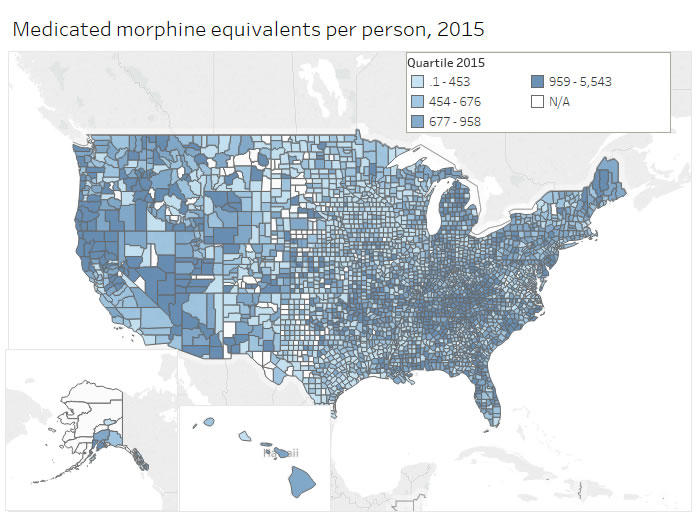
New county-level data from the CDC highlight the extreme geographic variation in opioid prescription rates, with some areas showing average morphine equivalents per capita 10 times greater than those of less-impacted counties. As seen in the map below, Appalachia appeared to be one giant hot spot. But every state had at least one county with a high per-capita rate of prescribed opioid use. Overall prescribing has fallen in the past few years, but the amount of opioids per person was still three times higher in 2015 than it was in 1999.
Those were the major findings in a
Vital Signsrelease from the CDC, which focused on opioid prescribing. The data looked at trends through 2015, which notably does not include the agency's
2016 opioid guidelines. The numbers will serve as a baseline to measure the impact of those guidelines going forward, said acting CDC Director Anne Schuchat, MD.
|
|
|
Health Care Spending Per State Stabilized From 1991 to 2014
HealthDay News -- According to a study published in Health Af airs, there was minimal change in health spending by state from 1991 to 2014. David Lassman, from the Centers for Medicare & Medicaid Services in Baltimore, and colleagues examined per capita spending by state of residence and per enrollee spending for Medicare, Medicaid, and private health insurance from 1991 through 2014. They also assessed the effects of implementation of the Affordable Care Act and the most recent economic recession and recovery on health spending.
The researchers note that the lagged impact of severe recession and extended modest recovery as well as the enactment and implementation of comprehensive health reform legislation had effects on health care coverage, as well as its financing and delivery
|
|
|
FDA Adds Immediate-Release Opioids to REMS Program
The FDA is adding immediate-release opioids to its risk evaluation and mitigation strategy (REMS) for extended-release/long acting opioids, the agency announced this morning.
Kicking off a two-day meeting on strategies to evaluate the real-world impact of abuse-deterrent opioids, FDA Commissioner Scott Gottlieb, MD, said the U.S. is "awash" in immediate-release opioid products, with some 90% of the 200 million annual opioid prescriptions written being for these quick-release pills, which include Vicodin and Percocet.
|
|
|
Department of Justice News
Mallinckrodt Agrees to Pay Record $35 Million Settlement for Failure to Report Suspicious Orders of Pharmaceutical Drugs and for Recordkeeping Violations
Mallinckrodt LLC, a pharmaceutical manufacturer and one of the largest manufacturers of generic oxycodone, agreed to pay $35 million to settle allegations that it violated certain provisions of the Controlled Substances Act (CSA) that are subject to civil penalties, Attorney General Jeff Sessions of the Justice Department and Acting Administrator Chuck Rosenberg of the Drug Enforcement Administration (DEA) announced today.
This is the first settlement of its magnitude with a manufacturer of pharmaceuticals resolving nationwide claims that the company did not meet its obligations to detect and notify DEA of suspicious orders of controlled substances such as oxycodone, the abuse of which is part of the current opioid epidemic. These suspicious order monitoring requirements exist to prevent excessive sales of controlled substances, like oxycodone in Florida and elsewhere. The settlement also addressed violations in the company’s manufacturing batch records at its plant in Hobart, New York. Both sets of alleged violations impact accountability for controlled substances, and the compliance terms going forward are designed to help protect against diversion of these substances at critical links in the controlled substance supply chain.
Detroit Area Medical Biller Sentenced to 50 Months in Prison for Her Role in a $7.3 Million Dollar Healthcare Fraud Scheme
A Detroit-area medical biller was sentenced today to 50 months in prison for her role in a $7.3 million Medicare and Medicaid fraud scheme involving medical services that were billed to Medicare and Medicaid but not rendered as billed.
Acting Assistant Attorney General Kenneth A. Blanco of the Justice Department’s Criminal Division, Acting U.S. Attorney Daniel L. Lemisch of the Eastern District of Michigan, Special Agent in Charge David P. Gelios of the FBI’s Detroit Division, and Special Agent in Charge Lamont Pugh III of the U.S. Department of Health and Human Services Office of Inspector General’s (HHS-OIG) Chicago Regional Office, made the announcement.
Dawn Bentley, 56, of Oakland County, Michigan, was sentenced by U.S. District Judge Sean F. Cox of the Eastern District of Michigan, who also ordered Bentley to pay $3,253,107 in restitution jointly and severally with her co-defendants. After a one-week jury trial in January 2017, Bentley was convicted of one count of conspiracy to commit health care fraud, wire fraud and mail fraud, as well as one count of mail fraud. Bentley was sentenced to 50 months in prison on each of the two counts, to run concurrently, followed by one year of supervised release.
Department of Justice
|
|
|
Smartphones: Physicians' Best Ally?
The other day, The Atlantic posted the following brain teaser/search-engine-optimizing clickbait: They posed the question What is the most underappreciated medical invention of all time? No definition of terms was supplied — they wouldn't want to do anything to discourage ridiculous responses.
For helpful inspiration, they also posted answers from an array of luminaries, ranging from the president of the American College of Physicians (the stethoscope) to an actor on a medical-procedural show (tongue depressors).
Medical Bag
|
|
|
Morphine Microdose Therapy Safe, Effective in Chronic Non-Cancer Pain
Morphine microdose therapy may be successful in a community pain clinic setting in achieving analgesia, improving safety, and avoiding systemic side effects, according to results from a retrospective review published in
Pain Medicine.1
Denise M. Wilkes, MD, PhD, from the department of anesthesiology and pain medicine at the University of Texas Medical Branch in Galveston, Texas and colleagues retrospectively reviewed the charts of 60 patients with chronic, non-cancer pain who had completed a microdose morphine regimen and had an intrathecal (IT) pump implanted between June 2008 and October 2014. During
IT therapy, the researchers recorded dose changes over time, pain scores, side effects, and maximum dose.
|
|
|
A SPECIAL RATE FOR ASIPP MEMBERS TO THE NAPA PAIN CONFERENCE:
The Napa Pain Conference, slated for August 17-20 of this year, brings world-class speakers to the stage for every session, and offers unparalleled learning and networking opportunities to its hundreds of attendees - the finest clinicians, researchers, and industry innovators in pain and neuroscience.
Learn more at napapainconference.com, and click the link below to register today. Early registration rates have been extended for members of ASIPP through June 30, 2017. Use code ASIPPEarly to receive the discount for registration to the full conference, and to our pre-conference workshop sessions on Intraspinal Drug Delivery and Regenerative Medicine.
Discounted lodging rates are first-come, first-serve. Book your room today - the Meritage Resort sold out in 2015 and 2016!
Earn up to 24.75
AMA PRA Category 1 Credits™ at California's Premiere Pain Conference. Content is applicable to practitioners of all levels, in all settings.
|
|
|
Interventional Pain Management Reports is an Open Access online journal, a peer-reviews journal dedicated to the publication of case reports, brief commentaries and reviews and letters to the editor. It is a peer-reviewed journal written by and directed to an audience of interventional pain physicians, clinicians and basic scientists with an interest in interventional pain management and pain medicine.
We would like to invite you to submit research case reports, brief commentaries and reviews to
Interventional Pain Management Reports
Journal. Your article will be published
‘FREE’ of charge.
Led by Editor in Chief: Kenneth Candido, MD, Chairman and Professor, Department of Anesthesiology , Advocate Illinois Masonic Medical Center in Chicago, IPM Reports focuses on the promotion of excellence in the practice of interventional pain management and clinical research.
Interventional Pain Management Reports is an official publication of the American Society of Interventional Pain Physicians (ASIPP) and is a sister publication of
Pain Physician.
Interventional Pain Management Reports
Interventional Pain Management Reports is an open access journal, available online with free full manuscripts.
The benefits of publishing in an open access journal that has a corresponding print edition journal are:
- Your article will have the potential to obtain more citations.
- Your article will be peer-reviewed and published faster than other journals.
- Your article can be read by a potentially much larger audience compared with traditional subscription-only journals.
- Open Access journals are FREE to view, download and to print.
So submit today your:
Case Reports
Technical Reports
Editorials
Short Perspectives
Click
HERE to read the Instructions for Authors for article submission
Click
HERE to submit a manuscript
|
|
|
OHSIPP Meeting
August 25-27, 2017
The Ohio Society of Interventional Pain Physicians (OHSIPP) has set the dates for its 2017 meeting.
Dates are Friday Aug 25 thru Sunday Aug 27, 2017.
The meeting will be held in Cincinnati at the Westin Hotel, 21 E 5th St , at Fountain Square .
Contact Michelle Byers for more information MichelleHByers@gmail.com
|
|
|
The NIPM-QCDR, a new offering from ASIPP®, is specifically tailored for interventional pain physicians. Your practice can use the NIPM-QCDR to fulfill the 2017 requirements of the Centers for Medicare & Medicaid Services (CMS) Merit-based Incentive Payment System (MIPS).
- Meet CMS MIPS mandates for Quality and Improvement Activities
- Receive credit toward Advancing Care Information
- Report on specialty-specific measures developed by ASIPP
- Understand and adjust your 2017 performance to optimize future CMS reimbursement with real-time reports available on-demand
- Be better prepared for CMS quality reporting in future years when penalties and incentives get even larger
- Improve the quality of patient care in the specialty of interventional pain managementLearn more and get started with 2017 reporting by visiting ArborMetrix.com/NIPM-QCDR.
|
|
|
|
|
|
|