|
THE BIWEEKLY
MAY 15, 2026
Published by the Alberta Society of Professional Biologists
| | |
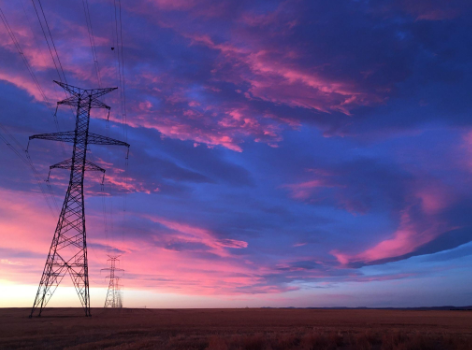
This photo, titled Morning Surveys, was taken by Sonya Coyston, P. Biol., with an iPhone, in the early morning near High River, Alberta. The photo was taken while completing detailed site assessments in a cultivated field to support application for a Reclamation Certificate after de-commission, salvage, and reclamation of a transmission line right-of-way.
The powerline had been in place for many years and was salvaged and removed once it hit its lifespan expectancy. It was first installed before many of the provincial reclamation and environmental protection guidelines were in place, therefore was not constructed using rigorous environmental protection measures that would be required today in order to mitigate long term impacts to the environment.
This project ended up costing more to reclaim then it did to decommission and salvage because companies were not required to follow stringent environmental protection measures at the time. It was a great example (to the client and their contractors) of both why we need to think about reclamation and long-term productivity of sites in the planning phases of a project (not just at the end) and showing that the environmental mitigation measures we implement during construction actually make a difference in the long run.
The best management practices and recommended guidelines for environmental protection we have in our industry currently are a direct result of the research and inputs of passionate people like those in the ASPB, contributing to provincial policy and informing and advising clients to put those policies into practice. Text from Sonya Coyston.
| | |
The ASPB Salary Survey
is open now and will
close June 1, 2026.
The ASPB Salary Survey (covering 2025) opened May 1 and is available through the Member Dashboard. The survey is short and anonymous and will remain open for member response until June 1, 2026. Participation in the survey is open to most registration categories, including Temporary Withdrawn and Associated members, but excluding Students. We encourage all eligible members to participate so the ASPB can gather accurate data on member compensation across the profession.
| |
|
ASPB CONFERENCE SPONSORSHIPS
ARE NOW AVAILABLE!
As always, it is our valuable sponsors who provide the power
to drive the standard of excellence
for which our conferences are known.
For full information, please go to 2026 Sponsorship Packages
| | |
At the ASPB, we gather snippets of biology information from sources like Nature (UK) and Scholar Alerts (Google), which we select and share in the BIWEEKLY. Here is the latest batch (the links are HOT):
WETLANDS & WATERSHEDS
Riparian Vegetation and Environmental Variables Differ Across Age and Management of Created Wetlands in an Agricultural Landscape
https://www.watercanada.net/alberta-water-council-shuts-down-amid-funding-cuts/
Multispecies genomic assessment and monitoring of fish biodiversity in response to a major hydroelectric development
INDIGENOUS KNOWLEDGE
Shifting the paradigm: An Indigenous knowledge‐based stewardship plan to replenish boreal caribou in Athabasca Chipewyan and Mikisew Cree First Nations' …
WILDLIFE & FISHERIES
A fully automated framework for acoustic identification and localization of terrestrial wildlife at scale
Consumption of anthropogenic foods influences the nutritional and reproductive condition of hunter‐harvested black bears
Energetic mechanisms underlying naphthenic acid fraction compound toxicity in rainbow trout mitochondria and hepatocytes
Fish Consortium Activities
Technique for using archived scales as a source of DNA to support conservation and fisheries management
Acceptability of black bear management options relative to frequency of sightings and conflicts with humans
Energetic mechanisms underlying naphthenic acid fraction compound toxicity in rainbow trout mitochondria and hepatocytes
Juvenile predation overwhelms nutritional effects on female ungulate fat reserves in a high‐predation system
The upland sandpiper in northeastern Oregon: distribution, abundance and nesting ecology of a peripheral sub-population
Of mountain goats, elk, American pika, and bumblebees in Glacier National Park, Montana, USA, and Waterton Lakes National Park, Alberta, Canada, from 2013 …
Whooping Cranes: 12 Secrets about The Giant That Came Back
From extirpation to establishment: short-term success of a translocation of Franklin Ground Squirrels …
White-tailed deer scavenging community in a chronic wasting disease-endemic region and considerations for prion movement
Spatial and Temporal Patterns in Amphibians and Reptiles Found on Roads in Canada Revealed Through Community Science Data
A mountain without wolves, a wilderness without mosquitoes or a forest without anything that ‘pushes back’ may be beautiful to us, but a world without fear would soon turn ugly.
Chronic Wasting Disease management responses in North America: A public policy analysis
Eagles and vultures are exposed to high levels of lead in Canada
Synthesis of Anthropogenic Impacts on Birds-Systematic Map and Bibliometric Analysis of Meta-Analyses
Bayesian Methods of Integrating Multiple Sources of Data to Estimate Wild Population Abundance
Patterns of waterfowl communities in wetlands in the Beaver Hills Region of Alberta
Density‐dependent habitat selection in plains bison
A case study leveraging angler reported data for whirling disease monitoring in Alberta
Red-belted Bumble Bee-Bombus rufocinctus
Bad Nature: How Rat Control Shapes Human and Nonhuman Worlds by Andrew McCumber
Biotic and abiotic factors and their interaction influence the seasonal movement patterns of a dispersal limited benthic species
PROTECTED AREAS and MANAGEMENT
David Attenborough at 100: in photos
Evaluating commonly used tools to quantify human activity for protected area management
https://www.canada.ca/en/environment-climate-change/services/environmental-indicators.html
FORESTRY
AWA-Logging-Report-Upper-Oldman-Watershed.pdf )
Picture a Forest: A Mixed-methods Exploration of How We Talk and Think About the Places Where Wild Animals Live
BOTANY
The cyanolichen Fuscopannaria frullaniae is a basidiolichen in the genus Acantholichen (Hygrophoraceae, Agaricales)
A fungal-mite nitrogen loop supports fungal symbionts in nutrient-poor host plant systems
Disproportionate belowground carbon loss and ecotone sensitivity in boreal peatland wildland fires: Insights from LiDAR and field data
Assessing the effects of seismic line disturbance on boreal peatland water balance using CoupModel
Evaluating species identification apps as a tool for small plot-based surveys of vascular plants in Alberta
ENGINEERING & DESIGN
Road Ecology in North America: Emerging Issues and Ongoing Challenges
Technological Methods in Road Ecology
Impacts of Traffic Noise on Wildlife
Multispecies Justice in Engineering, and Engineering Design
We need all the carbon removal we can get
Wildlife Road-Crossing Structures
Beyond the Right-of-Way: Integrating Fence and Road Ecology
“I am still processing this miraculous information. But of course it is not a miracle, it is science at its best.”
A flood-resistant nest box for wetland-dependent secondary cavity-nesting birds
ARTIFICIAL INTELLIGENCE
Fabricated citations are growing
Chatbot beats emergency room doctors
AI rewrite simplifies protein alphabet
AIs should be given a sense of smell
AI can make dangerous bioweapons
MICROBIOLOGY
Tweaking microbes to fight pollution
Microbes eat pollution — if we let them
| | |
Four Seasons of Indigenous Learning
This Indigenous-led course is open to everyone. It starts in the autumn, goes until the spring, and includes:
- 5 hours of self-paced online learning (interactive, with videos)
-
7 x 1 hour virtual presentations by an incredible group of Indigenous presenters
- Recordings of the presentations, if you can’t join live
-
Upon completion, we provide a Certificate of Completion (12 learning hours) and $25 to access excellent Indigenous resources.
Early bird registration closes June 30. Learn more & sign-up.
| | |
LakeWatch Scholarship
Open for Applications
The annual ALMS Dr. Ron Zurawell LakeWatch Scholarship($2,000) is open for applications until July 31st. You can find all scholarship details here: www.alms.ca/scholarship.
| | |
CONFERENCE 2026
CALL FOR ABSTRACTS WILL CLOSE ON JUNE 1st !
The theme of the ASPB 2026 Conference (November 4-6, 2026) is Supporting Biologists: in the Field and Beyond
For details please go to 2026 Conference Abstract Info
| | |
Court Upholds Just Cause
for Resumé Misrepresentation
According to a Field Law Workwise Newsletter (May 2026), an Alberta court has upheld dismissal for cause where a senior executive falsely claimed to be pursuing an MBA. The Court found the misrepresentation was intentional, material to the role, and undermined the trust essential to an executive position; employers are entitled to rely on resume representations and need not independently verify credentials before acting on dishonesty, particularly for senior hires.
| | |
Exploring Bathroom Access During Fieldwork
Lethbridge Polytechnic, led by Dr. Everett Hanna, PBiol, CWB® (Environmental Sciences) and Josh Hill (General Arts and Sciences), has
launched a survey exploring bathroom access during fieldwork and how it relates to health, safety, well-being, and professional experience in field-based work. The research team understands this topic will resonate with the many field work practitioners in the ASPB’s membership and has requested that the ASPB share the attached poster and survey link (https://www.surveymonkey.com/r/CYDVB5H), aiming to capture a wide range of perspectives across career stages and sectors. They consider support from organizations like the ASPB to be extremely valuable in helping reach that goal; the study is sanctioned by the Lethbridge Polytechnic Research Ethics Board.
| | |
SEMINARS, WEBINARS & COURSES
MAY
| |
The 2026 Alberta Soils Tour:
Exploring Palliser's Triangle
The Alberta Soils Tour, presented on May 27 through May 29, 2026 by the Alberta Soil Science Workshop Organizing Committee, is an excellent training opportunity for those working with soils, whether the focus is soil conservation, land reclamation, or agronomy. Experts will provide background on soil formation and the various soil profiles for each of the landscapes encountered during the tour. The tour provides hands-on field opportunities for professional development, learning, and collaboration.
The 2026 Alberta Soils Tour would require two or three overnight stays in Medicine Hat, AB. To book your accommodation, or to see the tour poster, please visit http://www.soilsworkshop.ab.ca/tour.html
REGISTRATION DEADLINE: May 01, 2026
| | |
University of Calgary to host eighth annual
Together | Ensemble Conference
on May 19 and 20, 2026
Together | Ensemble is Canada’s leading national conference for collaborating and accelerating progress on the UN Sustainable Development Goals (SDGs). It brings together inter-generational Indigenous Peoples, youth, academia, government, business, and community leaders to turn global goals into local action and address Canada’s toughest sustainability challenges.
For more information and registration, please HERE.
| | |
Track & Sign Specialist Certification
May 23 & 24, 2026, Lardeau Valley, British Columbia
This 2-day field-based workshop offers participants the opportunity to earn a Track & Sign Specialist Certification, the highest level of Track & Sign certification available within the CyberTracker system.
Sage Raymond and David Moskowitz will lead the workshop.
(This workshop is meant for expert trackers)
Learn more here
| | |
Vertex Professional Training
Bryophyte and Wetlands Courses
COURSE 1 May 25 -26 – Wetland Bryophyte Identification
COURSE 2 May 27-28 – Upland Bryophyte Identification
Details and links to register: Vertex - Professional Training 2026
| | |
SEMINARS, WEBINARS & COURSES
JUNE
| | |
Vertex Professional Training
Bryophyte and Wetlands Courses
COURSE 3 June 1-2 – Wetland Bryophyte Identification
COURSE 4 June 3-5 – Boreal Wetlands Field Course
Details and links to register: Vertex - Professional Training 2026
| | |
SEMINARS, WEBINARS & COURSES
JULY
| | |
Whitebark Pine Ecosystem Foundation Events
The Whitebark Pine Ecosystem Foundation of Canada has upcoming events that are relevant to Alberta Society of Professional Biologists. Please get in touch if you require more details.
-
2-day field competency - Survey Methods and Health Training July 8-9, 2026, at Golden, BC.
https://whitebarkpine.ca/our-work/training/
-
Science and management conference - Collaboration for Recovery: Active Management in a Changing Climate October 14-15, 2026, Radium, BC.
https://whitebarkpine.ca/conferences/
| | |
SEMINARS, WEBINARS & COURSES
AUGUST
| | |
SEMINARS, WEBINARS & COURSES
SEPTEMBER
| | |
Track & Sign Certification (FIERA)
September 12 & 13, 2026, at Hinton, Alberta
This 2-day field-based workshop is open to all skill levels and offers the opportunity for participants to earn certifications in Track & Sign from Levels 1 to Professional (Level 4).
Learn more here
| | |
BSc & MSc degrees in Ecological Restoration
at
THE BC INSTITUTE OF TECHNOLOGY
If you’re passionate about helping ecosystems recover and thrive, the BSc & MSc Programs in Ecological Restoration at BCIT are worth exploring. The programs blend scientific knowledge with practical, field-based experience and offer both part-time and full-time options. Learn more about how the programs can support your career goals:
https://www.bcit.ca/programs/ecological-restoration/
| | |
NATURAL RESOURCES
TRAINING GROUP
Avian Nest Sweeps and Monitoring Methods - Online - May 21st - 22nd, 2026
Electrofishing Certification - Online (self-paced) & Winnipeg - May 22nd, 2026
Technical Writing for Professionals - Online - May 25th - 26th, 2026
Wetland Assessment - Online - May 26th - 27th, 2026
Electrofishing Certification - Online (self-paced) & Courtenay - May 29th, 2026
Electrofishing Certification - Online (self-paced) & Terrace - May 29th, 2026
Fish Habitat Restoration — Prescription Development - Online, June 1st, 2026
Electrofishing Certification – Online (self-paced) & Cranbrook, June 4th, 2026
Fish Habitat Restoration — Stream Morphology Assessment - Online - June 8th, 2026
Species at Risk - Online - June 9th - 10th, 2026
Fish Habitat Restoration — Identification of Factors Limiting Fish Productivity - Online - June 9th, 2026
Advanced Electrofishing – Online – June 12th, 2026
Construction Monitoring — Principles of Erosion and Sediment Control on Construction Sites - Online - June 16th, 2026
Electrofishing Certification - Online (self-paced) & West Vancouver - June 19th, 2026
Bat Habitat Assessment – Online – June 23rd – 24th, 2026
Electrofishing Certification - Online (self-paced) & Cochrane - June 23rd, 2026
Amphibian Survey and Collection Methods - Online - June 23rd, 2026
Introduction to Environmental Work on Construction Sites - Online - June 29th, 2026
For the full calendar of upcoming courses, and course details, follow this link:
https://nrtraininggroup.com/schedule/
| | |
This week’s banner photo:
Morning Surveys
was photographed and commented upon
by Sonya Coyston, P. Biol.
In Alberta, Professional Biologists are registrants of the Alberta Society of Professional Biologists (ASPB), and are subject to a code of ethics, continuing competency requirements, and a disciplinary process. The ASPB is a self-regulated organization under legislation in the Province of Alberta, meaning its purpose is to protect the public of Alberta by ensuring biologists are qualified to practice biology in accordance with that legislation. The society is governed by a Board of Directors elected by its registrants.
PROFESSIONAL BIOLOGISTS PROTECT THE PUBLIC INTEREST
You are probably receiving this newsletter because you are an ASPB Registrant. This newsletter provides relevant information and professional development opportunities for our members, as well as essential member-related society business; if you are registered with the Alberta Society of Professional Biologists, please DO NOT unsubscribe.
For more information about the Society or to contact the administration, please visit the website: https://www.aspb.ab.ca
Opinions and general news published in this e-newsletter
do not necessarily reflect the opinions or policies of the Society or its Board of Directors.
ASPB may use AI-assisted tools in the development of communications, administrative correspondence, website content, and other documentation.
2026
| | | | |