|
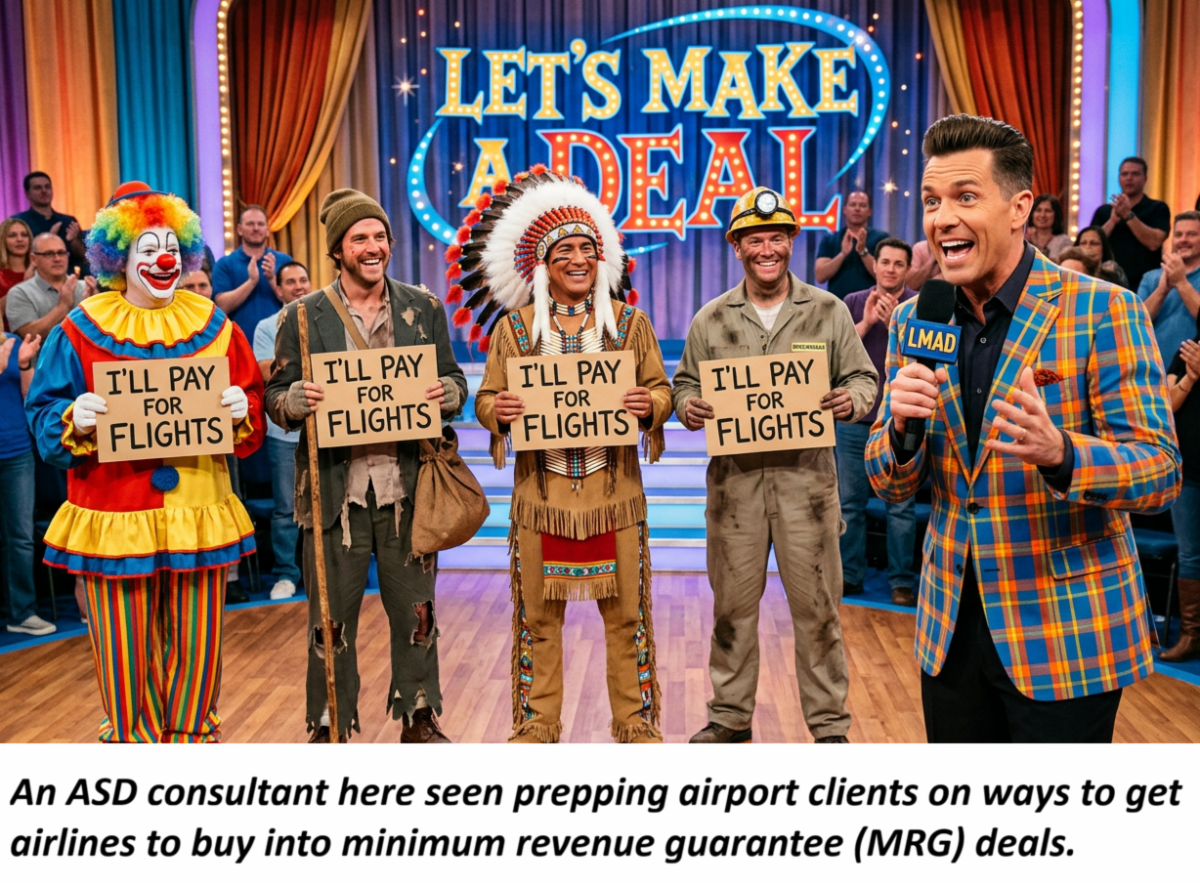
The Monty Hall Air Service Development System.
Some of It Is Just Milking Communities.
Summary: Providing airlines with a minimum revenue guarantee to incubate service is a proven approach. Unfortunately, some communities are assuming that just "luring" airlines is the entire game. The concept of developing a clear plan based on future air transportation and consumer realities is too often ignored. Result: pro-tem placebo service that has no long term foundation.
In the past five years, a disturbing trend has spread in regard to small community air service development.
Latter-day Monty Halls Are Back! The game is to get aggressive to make a deal for airline service. Not a lot of need for determining what air access the region might need going forward. No fun in that. Just open up bids and raise the ante until some operator finds the market to have potential. Not necessarily traffic potential, but revenue potential based on subsidy dollars for as long as the subsidy lasts.
Actually, Flights, Not Air Access, Becomes The Goal. The game is to convince a community that offering some long green to come to town is the alpha and the omega of air service development. Don't bother doing any hard analyses of the future trends in air transportation. Or whether actual consumer support is more than a press release from the mayor plus a couple hundred "yes" responses from a survey that just asks if the responder would "use" the local airport. Whether it's for drag racing or air service based on a specific level of service is not on the question list.
The bar is up in regard to the air service access recruiting. Particularly in regard to airline fleet shifts. This is resulting in the airports at many smaller communities becoming uneconomic for scheduled network-carrier air service. It’s reality. But it doesn't mean the citizens in such communities are condemned to living in the commercial equivalent of Devil's Island, as some industry organizations imply.
Regionalization often represents an alternative that small local airports cannot match. The Deal here is to respond by paying a carrier to come to town, even if there's no professional projections regarding if consumers will use it.
Witness Dubuque. Poster Child For Effects of Fleet Shifts. According to numbers from our friends at Airline Data, Inc., in 2016, DBQ had AA nonstops to ORD, and over 72,100 total passengers. But over 90% of those people were connecting over the hub, and only 2,903 were local Chicago O&D. Without that connectivity to other AA destinations, DBQ would never have had any AA flights.
Great. But this was on 50-seat ERJ-145s. When these were phased out, it was obviously concluded by AA that DBQ was not an economic best use of $30 million E-175s, which had more than 50% more seats, and probably even more than that in all-up sector cost.
Point: as far as strong connective local air service is concerned, DBQ is no longer in the play. Changes in fleet applications and in raw operational economics generated an air service pink slip for Dubuque. Same is true for airports like Williamsport, where AA once carried 40,000+ passengers. Now, it is gone for the same reasons as at DBQ.
Reality ignored: Fleet changes affect air service potential. But, wait! Monty is banging at the door with a sure-fire solution.
MRG Addiction Is Spreading. Let's be clear: offering incentives to get airlines into town are logical. Fee and rent waivers and revenue guarantees are in concept – and in general practice – sound marketing activity.
But in more and more cases, MRGs are being peddled as cures for air service blues based on the veneer assumption that any flights are better than no flights, even if they will burn through the subsidy and leave the community flat. In short, the new approach is that there’s no need for any other professional analyses. Just get flights.
‘Course, this new Monty Hall M.O. is sometimes accessorized by a “leakage” study - for several grand - to prove to the community that there’s plenty of demand, and therefore it's a slam-dunk to get an airline interested.
In some cases, it’s just to offer some heavy gelt for whatever the airline wants to fly. And then pony up some heavy fees for the privilege of getting “expert” advice that’s coincidently just what the client wants to hear. Please don't educate the client about pesky evolution in the air transportation industry.
Incredibly, in a lot of these cases there is no target, no hard futurist plan for air access needs. Just “more flights” or “more destinations.”
The underlying quicksand is the contention that any service is worth tossing money at. Hard analyses of the potential levels of connectivity, or in some cases, analyses of how a new route might make sense, are not in the program. Professional analyses of consumer access alternatives – such as competing airports – are certainly never considered. Just cut a deal for flights.
Recent examples that might be considered.
Natchez: Passenger Demand Isn’t In The Plan. The annual revenue support for one six-day-per-week MRG round trip on United/SkyWest to IAH was reported to have initionally been $1.2 million and has now ballooned to over $2 million, the reason being fuel spikes. Between this and other airport finance requirements, they’re scrambling for money.
The local media indicated that the community was considering a $4 million, 20-year bond offering to cover the expenses of the airport, with support for these scheduled flights being a key component. Lots of financial gymnastics. But what was never considered is whether the subsidized service actually works.
It's hardly scientific, but still a solid indicator of how this market is doing is a glance of the seats open the day before the flight. See, United on its website shows maps of available seats early in the booking process. From this, taking into account seats that are usually blocked from sale, probably for W&B reasons on the 50-seat CRJ, the indications are that HEZ might be clocking in at well under a 35% load factor. Write that MRG check, folks.
Yet nobody is bothering to consider whether, say, 15 departing passengers per day justifies millions in new airport debt and a hefty MRG. It's flights, and that's the main goal.
Des Moines: Flights Are The Goal, Regardless. Just noticed where Des Moines will be offering over $200K in reward for any nonstop flights to a new destination. Sounds great. But at DSM, outside of Florida leisure markets (which actually divert local spending to the Sunshine State), there are very few non-hubsite O&D markets with stand-alone O&D demand that DSM can support.
Sure, Breeze might be interested in looking. They have lots of new airliners being delivered. Day of week nonstops to Boston or maybe RDU might have some traction. They can come and go. But any hard independent analysis of the economic contribution isn’t a prerequisite. Naturally the airport can engage an economic impact study to be done, conveniently often by the very same consultant that's engineering the MRG program.
The story here is that the driver is flight departures for the sake of flight departures, and not developing a professional, targeted air service access program. It’s like wanting to build roads with no plan for what the need might be.
The real focus should be on connectivity to the world, well beyond fare-impulsed leisure traffic. As fleets continue to evolve, community ASD planning must evolve as well.
That means AED – airport economic development – will be the future for a lot of small airports.
Regardless of any ASD Monty Halls still desperately selling snake oil to unwary communities, the ethical responsibility is to completely inform the client community of the the hard facts, including the evolving changes in air transportation that can affect propensity of attracting air service at the local airport in the future.
One of the critical component for professional ASD analyses - MRG or other - is the fleet plan of each airline system. Another is hard risk analyses of whether the proposed service can attract ridership. The third is to avoid being a sugar daddy for operators with excess airliners all dressed up with otherwise no place to go.
There is nothing wrong with MRG programs. As long as they are based on clear understanding of what the goals are, and of air transportation realities.
And latter-day Monty Halls are not involved.
________________
________________
|