ATEC Fly-in Debrief: Ushering in a New Part 147 |
|
|
|
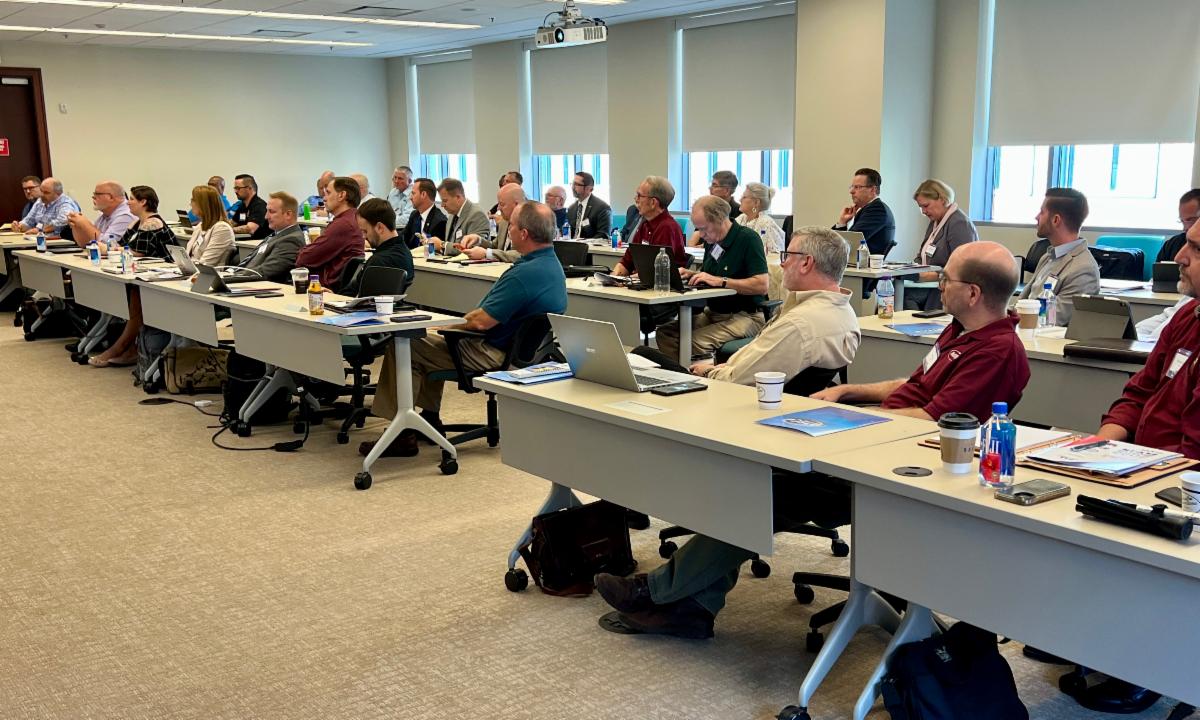
Coincidence that the FAA scheduled the new rule's effective date for the same day as the annual ATEC-FAA roundtable discussion? As fate would have it, regulators and regulatees alike came together on Sept. 21 to usher in a new approach to aviation technician education.
The group took the opportunity to discuss a few bumps in the road, but largely celebrated a seemingly smooth transition to a new rule that, while long expected, was abrupt in its 120-day "flip the switch" approach.
|
|
|
|
FAA Flight Standards Acting Executive Director Larry Fields and several agency representatives, including frequent ATEC webinar contributor Tanya Glines, encouraged aviation maintenance technician schools to elevate compliance concerns to ensure they are addressed.
Discussions also turned to other regulatory initiatives impacting aviation technical workforce development including testing capacity and changes to regulation that would provide students earlier paths to certification and allow part 147 programs to more easily matriculate high school students into their programs.
|
|
|
|
The afternoon focused on ATEC's Choose Aerospace aviation maintenance curriculum and how industry and part 147 schools can leverage the program to build feeders into their scholastic and career opportunities. Attendees also got an update on the initiative, which has wrapped up a pilot test and is currently being implemented in eleven high schools and part 147 programs across the U.S.
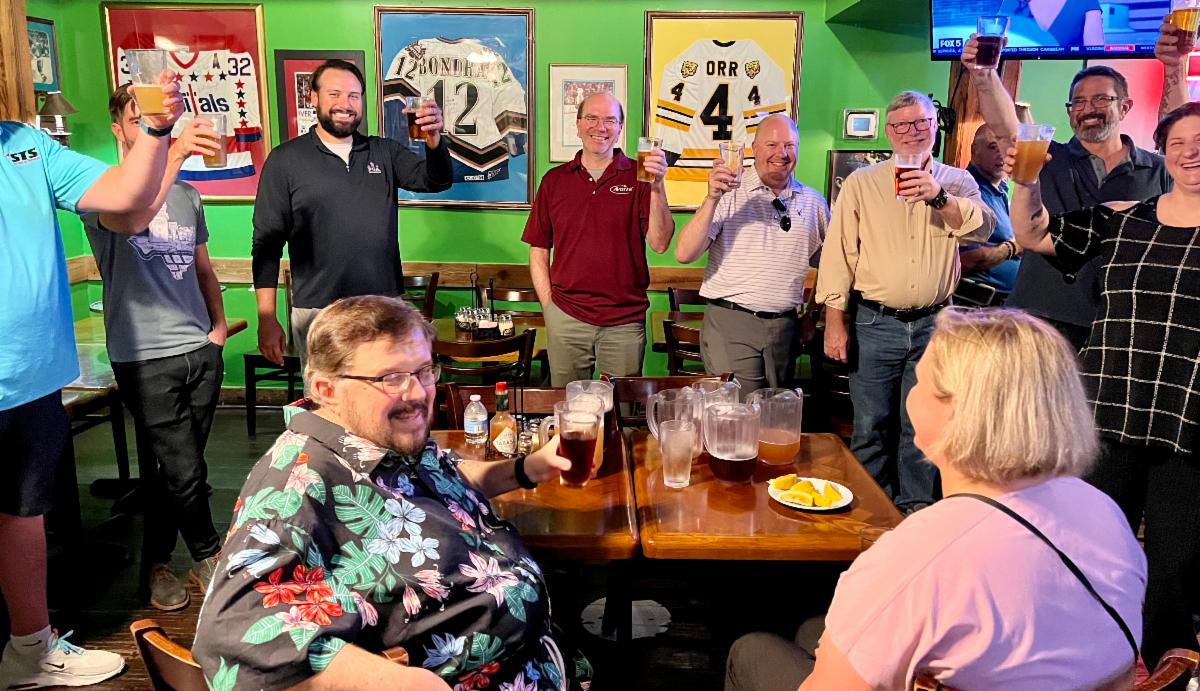
After a celebratory dinner, attendees started fresh the next day on Capitol Hill, participating in 45 congressional meetings highlighting council legislative priorities and educating members of congress on workforce demand and opportunities created through aviation technical education. |
|
|
|
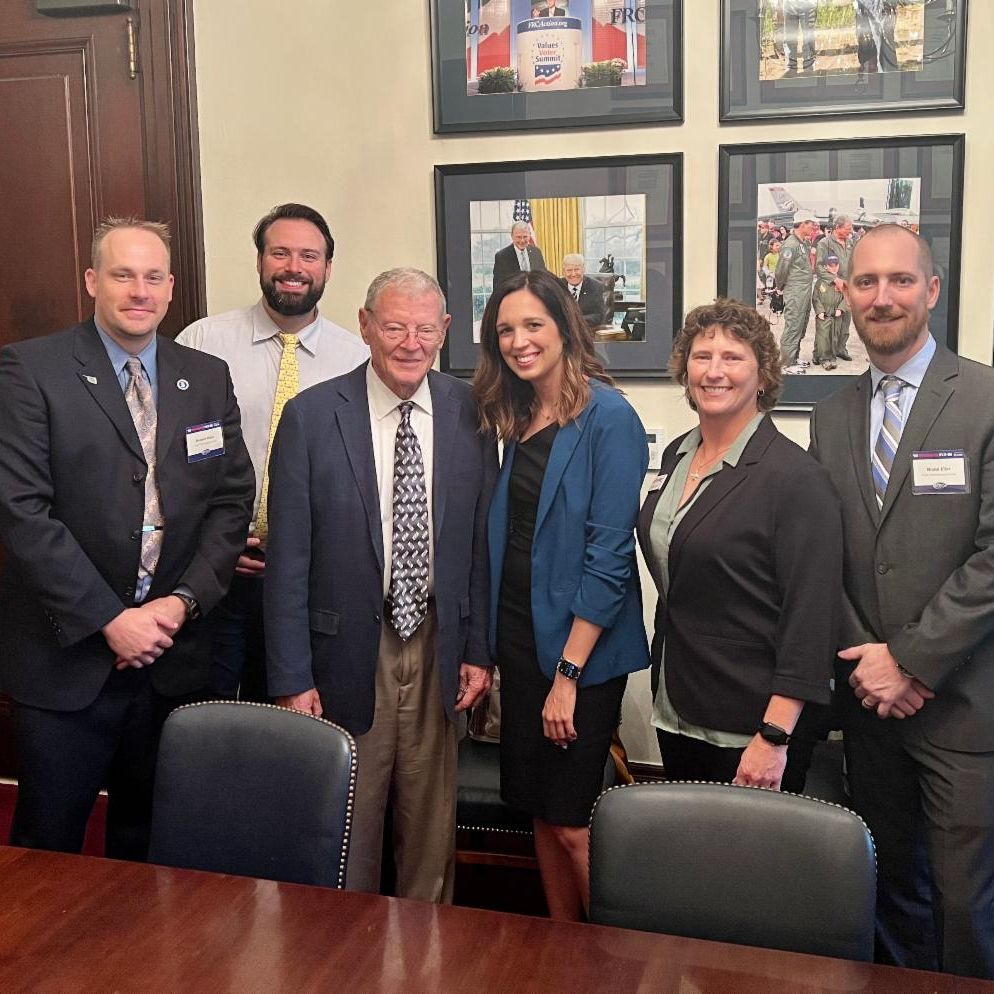
The Oklahoma delegation, with representatives from Tulsa Tech, ATEC, and American Airlines, visit with retiring senator James Inhofe. Inhofe championed the PARTT 147 Act, the FAA workforce development grant program, and countless other legislative initiatives in support of aviation throughout his tenure. |
|
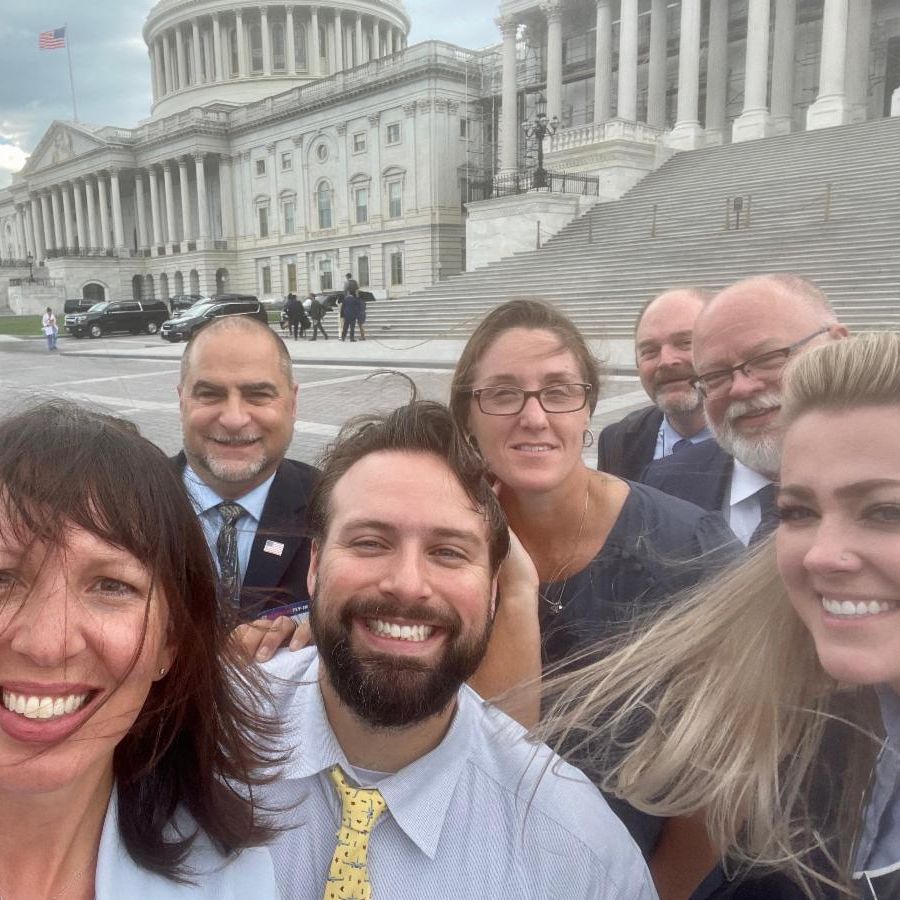
Members representing education (Cape Cod Community College, Southern Illinois University, Texas State Technical College, and Spokane Community College), industry (American Airlines), and labor (Aircraft Mechanics Fraternal Association) stop for a quick selfie while criss-crossing Capitol Hill. |
|
|
|
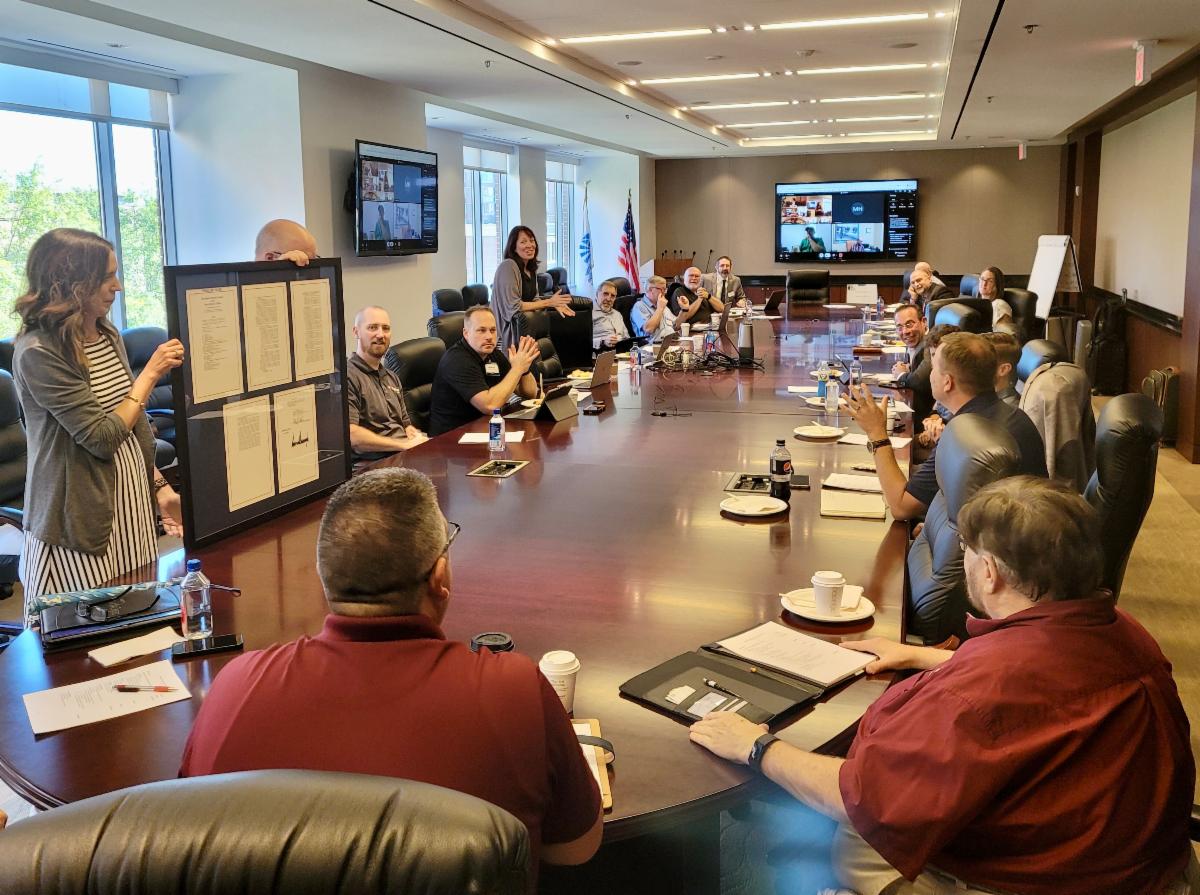
The three-day event wrapped with the annual ATEC board meeting where the council recognized exiting and long-time director Ryan Goertzen. Ryan has served on the ATEC board for a decade, including four years as president. Under his leadership, the trade association's operating budget increase 400 percent and its membership more than doubled.
Ryan was steadfast in the pursuit to reform part 147, leading congressional advocacy efforts culminating in what ultimately passed Congress as a direct rule. As recognition of his work, fellow directors presented Ryan with a red line copy of the law that directed the FAA to remove and replace part 147 with ATEC-crafted language.
|
|
|
|
While Ryan's term on the ATEC board has ended, he continues on as a founding director and president of ATEC's sister organization, Choose Aerospace. In that role he leads pursuit of an aggressive goal to enroll 10,000 students in the aviation maintenance curriculum by 2027. The aviation technician education community is indebted to Ryan for his service and continued dedication to this community.
During its annual meeting the board elected new leadership. WSU Tech Aviation Program Dean James Hall will serve as ATEC president. Jim was originally elected to the board in 2017 and has served on the executive committee as treasurer and vice president. In addition to his contributions to ATEC, Jim was appointed as a member of the Youth Access to American Jobs in Aviation Task Force, a group that recently published recommendations to the FAA Administrator (see related story, below). Jim will serve a two-year term.
Directors selected Southern Illinois University's Karen Johnson to serve as vice president, and Southern Utah University's Jared Britt to serve as treasurer. The board also moved a slate of new directors, each of which will serve a four-year term (see Welcome New Directors, below). The entire directory of ATEC's elected, volunteer leaders is at www.atec-amt.org/leadership.
The board also took the following actions at the annual meeting:
- Approval of the 2022-23 budget to include:
- For the first time in seven years, a conference registration fee increase from $495 to $595. While the cost to attend is subsidized by sponsor contributions, which is important especially to ensure our smaller school representatives can attend, the additional income will make up for increased expenses to put on the event.
- Segregated funds to obtain contract support for the council's marketing and communications efforts (see opportunities).
- Renewal of the council's management services agreement with Choose Aerospace to ensure the foundation has operational support needed while it continues to pursue its own, independent revenue streams that will allow it to stand on its own. The board also voiced it's continued support of the initiative and discussed several ways the council could partner with Choose Aerospace toward common objectives, including developing an ATEC Academy to train Choose Aerospace teachers and utilizing its regulatory expertise to advocate for change to facilitate pathways from high schools to AMTS.
- Pursuit of other regulatory objectives now that the new part 147 is published, including expansion of testing capacity.
- Recognition of the largest membership roster ever, largely due to member engagement during transition to the new rule. The board also discussed ways to ensure ATEC retains the 79 percent of AMTS (151 out of 190) that are currently members.
Meeting minutes, director terms, governing documents, and council budgets are available for member review (member password required) at www.atec-amt.org/governance. |
|
|
|
Thank You Fly-in Sponsors! |
|
|
|
Greg Emerson, VP of Base Maintenance, American Airlines
Greg oversees American's global base maintenance operation, including the Tulsa aircraft overhaul organization, the component repair and overhaul business unit, the American engine repair and overhaul team and maintenance repair and overhaul suppliers. Greg began his aviation career as an AMT in the U.S. Navy and then spent 17 years with Delta Air Lines. Greg has held senior leadership roles in business aviation, rotorcraft operations and in maintenance, repair and operation management. He earned a Bachelor of Science in professional aeronautics and aviation safety and management from Embry-Riddle Aeronautical University and a Master of Business Administration from The University of Texas at Arlington.
|
|
|
|
Suzanne Markle, President and CEO, Pittsburgh Institute of Aeronautics
Suzanne oversees the strategic direction and operation of all PIA locations and programs. Since joining the organization in 1999, Suzanne has held duties as a general studies faculty member, coordinator for educational development, director of alumni services, director of education, director of admissions, executive vice president, and chief operating officer. Markle also serves on the board for PIA and the Mid-Atlantic Association of Career Schools. In 2020, she was appointed by the DOT to serve on its Women in Aviation Advisory Board and is a member of the nomination committee for the National Aviation Hall of Fame. Suzanne holds a Master of Business Administration degree from Seton Hill University, a Bachelor of Science degree in Secondary Education from California University of PA, and a certificate in Diversity and Inclusion from Cornell University.
|
|
|
|
Sheryl Oxley, Aviation Program Coordinator, Tulsa Tech
Sheryl joined Tulsa Tech in 2004 as an instructor and has taught A&P curriculum for both high school and adult learners. Prior to joining Tulsa Tech, Sheryl served 27 years in the Air Force and has also worked with Delta Airlines, Atlantic Southeast Airlines, and Bombardier Aerospace in both hangar heavy maintenance and line maintenance. She regularly volunteers for EAA AirVenture and KidVenture and serves as a PAMA Olympic and MRO AMC coach. She has been a Designated Mechanic Examiner since 2008. Sheryl has a Bachelor of Science in Career and Technical Education from Oklahoma State University. When Sheryl’s not at work, you might find her at her favorite Crossfit gym, hiking, mountain biking, doing home improvement, working on various vehicles, or just playing with the dogs.
|
|
|
|
Jim Smith, Director of Aviation Maintenance Technology, Marshall University
Jim led the development of Marshall's new part 147 program, writing the curriculum and overseeing certification, construction, staffing, and grant development. He is the former director of RCBI aerospace at the Robert C Byrd Institute, part of the Marshall University Research Corporation. He's also served as the deputy director of Huntington Tristate Airport, airport operations specialist at Lexington Bluegrass airport, and as an airport planner for the aviation engineering division AECOM. Jim holds a Bachelor’s in aviation business management from Utah Valley University, multiple industry certifications in operations and SMS, and is currently pursuing his Master's in aviation safety at the University of Central Missouri.
|
|
|
|
Scott Sykes, Chief Development Officer, U.S. Aviation Academy
Scott was instrumental in standing up U.S. Aviation Academy's part 147 program, which obtained FAA certification in 2021. Scott enjoys the challenges the aviation industry brings: finding the best solution for US Aviation customers, creative problem solving, and pragmatic thinking. He obtained his private pilot license at U.S. Aviation Academy and started the airframe and powerplant program in January 2021. Scott graduated from Baylor College with a Bachelor's degree in economics and a Master's in economics from the University of North Texas. At home, Scott enjoys spending time with his wife, five snakes and dog. If he is not home, he is at the lake waterskiing.
|
|
|
|
The New Part 147 Compilation |
|
|
|
As a service to the membership, ATEC has compiled the new regulation, certification standards, and guidance into one (large!) document. Download and print the PDF so you always have the regulatory language at your fingertips (while double checking to ensure the print version is the latest revision). Member password required. |
|
|
|
Take a minute to save these URLs in your bookmarks, and use them often! |
|
|
|
The New Part 147 Training Series |
|
|
|
ATEC held a series of webinars in the 120 days leading up to the new rule's effective date. Recorded sessions are available at www.atec-amt.org/the-new-part-147, or through the links below. All AMTS personnel would benefit from the training. |
|
|
|
Call for Presentations: Part 147 Best Practices |
|
|
|
The new part 147 provides new ways for certificated programs to better prepare students for careers in aviation maintenance. Several annual conference breakouts will focus on these opportunities. To that end, ATEC is seeking representatives from schools and industry to share best practices and experience on specific topics. Read More.
|
|
|
|
FAA Publishes Guidance for Evaluating Part 65 Mechanic Applicants |
|
|
|
With publication of the new part 147 and mechanic airman certification standards, the FAA is adjusting the way it evaluates mechanic applicant experience under 14 CFR part 65. Applicants must now document experience in 50 percent of skills set forth in the ACS. Read More.
|
|
|
|
Youth in Aviation Group Publishes Recommendations |
|
|
|
The FAA's Youth Access to American Jobs in Aviation Task Force (YIATF) recently published a list of recommendations to Congress in response to its mandate to identify ways to expand access and awareness to aviation careers. Read More.
|
|
|
|
SMART Grants NOFO, Applications Due Nov. 18 |
|
|
|
The DOT is seeking applications for its new Strengthening Mobility and Revolutionizing Transportation (SMART) grants. The program was created by the Infrastructure Investment and Jobs Act which authorized and appropriated $500M to support advanced smart community technologies and systems. Read More.
|
|
|
|
ATEC Journal: Spring 2022 |
|
|
|
This summer, ATEC published the Spring 2022 edition of the ATEC Journal. In this issue, Embry-Riddle's Christine Kelley and Robert Gallagher present their findings on COVID-19 impacts to FAA mechanic certification testing. You can download the issue here.
|
|
|
|
In its 2022-2041 Pilot and Technician Outlook, Boeing projects that over the next 20 years, commercial aviation will need 610,000 new maintenance technicians to maintain the global commercial aviation fleet—134,000 of those in North America. Read More.
|
|
|
|
Where are the Mechanic Examiners? |
|
|
|
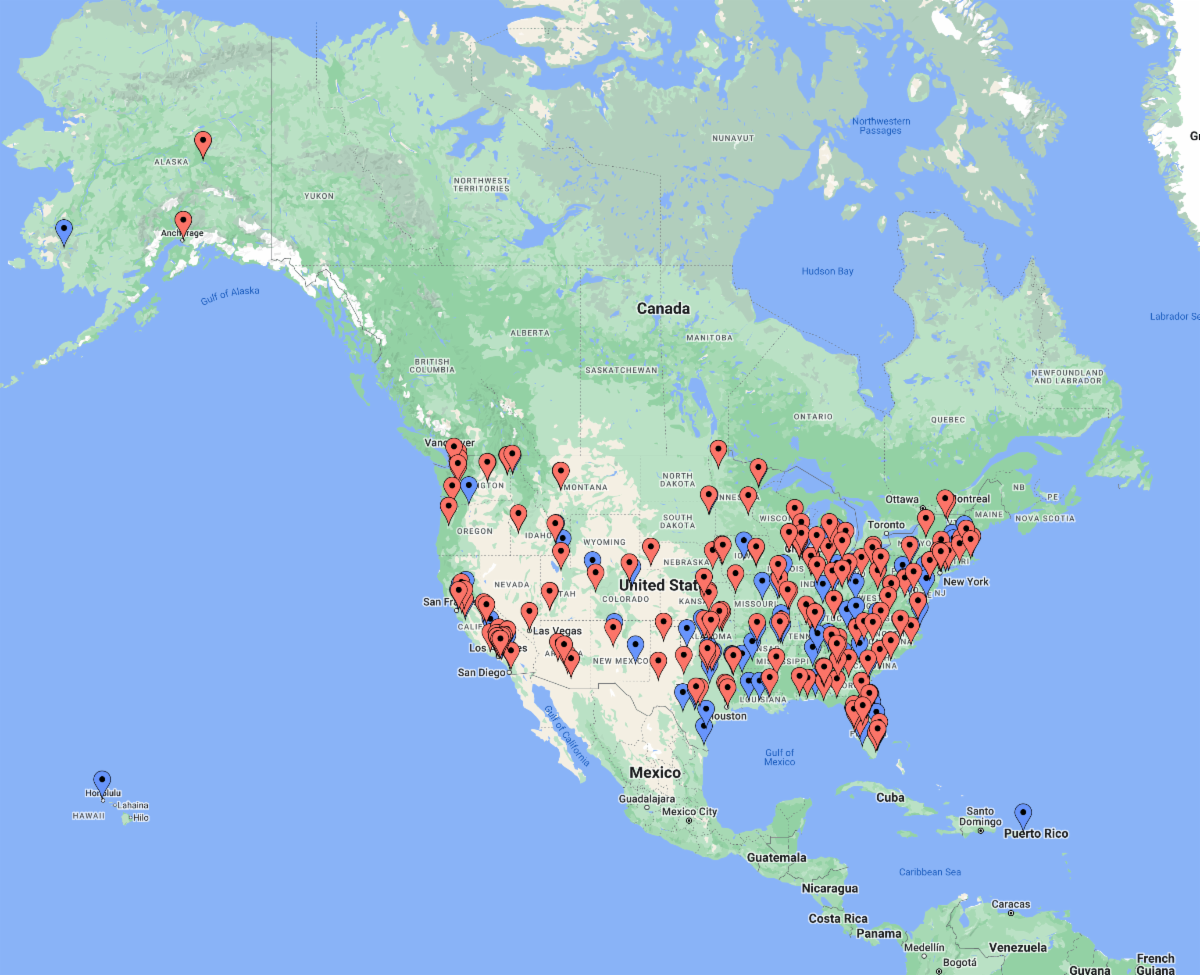
ATEC is putting renewed energy into ensuring AMTS students have access to testing as they pursue FAA mechanic certification.
The first step is to illustrate and define the problem. Curious about testing capacity vs. demand in your area? Check out ATEC's DME vs. AMTS map (click left).
|
|
|
|
Q: We understand that part 147 certificate holders can get access to the FAA’s WebOPSS system, which would allow the school to electronically request changes to our operations specifications. This sounds like it would greatly streamline the review and approval process. How do we get access? See the answer.
Q: For currently-enrolled students that have already completed a portion of the A&P curriculum, do we need to go back and train them on ACS elements that are newly-incorporated before we issue the requisite authenticated documentation in order for them to test? See the answer.
Q: We heard that the new part 147 also makes changes to early testing under 14 CFR 65.80. Is early testing going away? See the answer.
|
|
|
|
Calling All High Schools! |
|
|
|
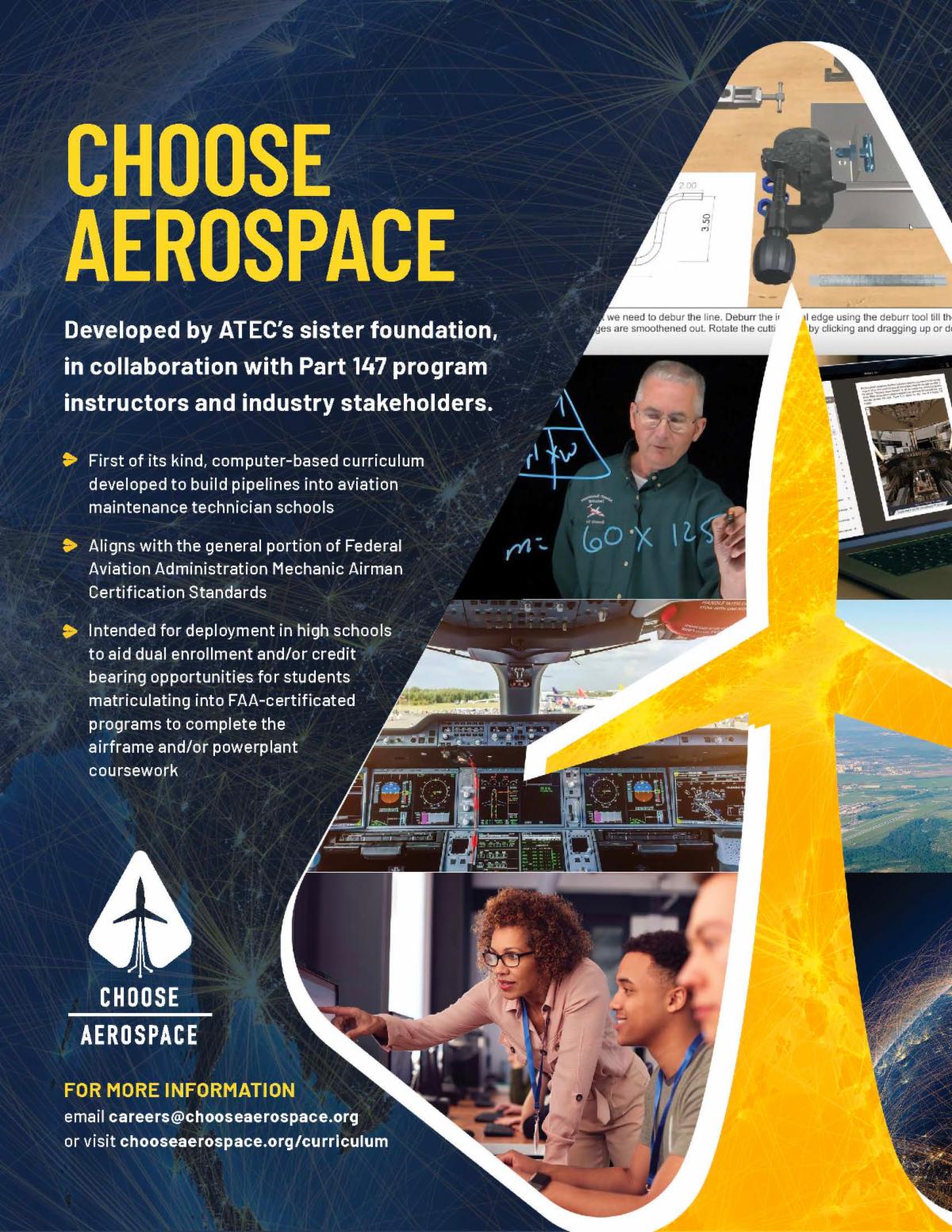
After a year-long pilot test, several schools cross the country have officially adopted the Choose Aerospace Aviation Maintenance Curriculum for the 2022-2023 academic year.
The curriculum covers the general portion of the FAA mechanic airman certification standards and puts students on a direct path to certification; either through direct-employment opportunities or matriculation agreements with partner part 147 programs. It was created as a resource for AMTS to develop high school feeder programs in their own community.
|
|
|
|
Scholarship Opportunities |
|
|
|
Association for Women in Aviation Maintenance has scholarship opportunities for potential and current students, those transitioning from the military, and for guys too! Applications are being accepted now through November 15, 2022.
Regional Air Cargo Carriers Association (RACCA) Aviation Scholarship promotes and assists in make aviation as a career choice and to make students aware of the opportunities in the air cargo industry. Applications are being accepted now through October 15.
|
|
|
|
Aviation Technician Education Council
|
|
|
|
|
|