Autism spectrum disorder (often called ASD or just “autism”) is a diagnosis that refers to differences in social communication, behavior, and sensory processing. In April 2024, 11% of Indiana students receiving special education services were classified as having autism as their primary disability (source: IDOE).
In the classroom, autism may present as difficulty socializing with peers, a strong need for routine, challenges transitioning between tasks, difficulty with self-regulation, or trouble managing time and staying organized. Some students may struggle with sensory processing in environments that seem typical to others, such as classrooms with bright LED lighting or a faint background hum. These students often benefit from structure, predictable routines, and clear communication.
Assistive technology can help students with autism regulate their sensory input, improve executive function, and support communication. Some helpful tools include:
Sensory regulation tools: Noise-reducing earmuffs, fidgets, weighted lap pads, and active seating options (such as wobble seats or foot fidgets) can help students manage sensory input.
Executive function supports: Time Timers, visual schedules, and vibrating wristbands assist students in staying on track and managing transitions.
Augmentative and Alternative Communication (AAC): For students with greater communication needs, AAC supports such as picture cards, GoTalk devices, or communication apps (like LAMP or Proloquo2Go) can help them express themselves effectively.
Ready to explore how assistive technology can support your students with autism? Reach out to ATLAS to discover what tools and strategies are available to try!
Interested in scheduling an educational session? Complete our TA Request Formand a member of our team will reach out to you!
Summer Learning
ATLAS can provide high-quality learning opportunities for LEA staff. Specialists can offer a wide variety of topics including Apple, Google, and Microsoft Accessibility, Augmentative and Alternative Communication, Autism, Mobility, Specific Learning Disabilities, and much more! Looking for something else? ATLAS is able to tailor an educational session to specific needs.
Professional Development sessions are lead by ATLAS staff members and can be presented in person or virtually. Most sessions run 30-60 minutes unless otherwise requested.
Erin is the ATLAS Project’s Loan Library Lead. Prior to working with the loan library, Erin spent nearly 8 years in museums and public libraries planning programming. Erin holds a BA in Arts and Humanities from Indiana University and is excited to merge passions of accessibility and data collection in our K-12 Loan Library! Erin enjoys the outdoors, lounging with cats and family, and reading audiobooks.
The first modern hearing aid was invented in 1898 by Miller Reese Hutchison and used an electric current to amplify weak audio signals. Today, hearing aids use AI to filter background noise and enhance speech! Learn more!
Check out two of our newest devices!
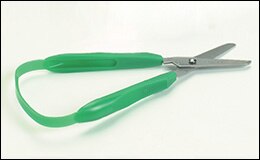
Easi-Grip Loop Scissors
Easi-Grip® Scissors are specially designed to support individuals with limited hand strength, coordination challenges, or those learning to develop scissor skills. The ultra-lightweight, self-opening design reduces hand fatigue, making cutting easier and more accessible for children with special needs.With a continuous loop handle and no finger loops, these scissors require only a gentle squeeze to cut, automatically reopening when pressure is released.
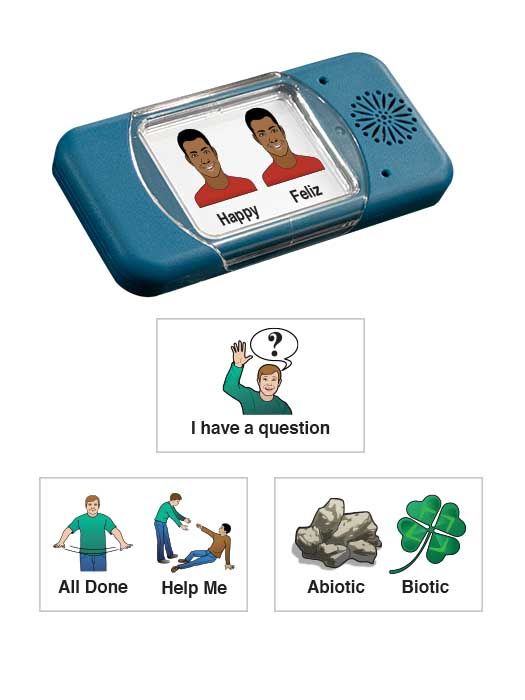
Go Talk Duo
The new Go Talk Duo provides different options with new, enhanced sound quality, one- or two-message capability, and a quick and easy way to change overlays. Find multiple uses with the one-message option; or use the duo mode for simple sequencing, multiple choice selections, or language exploration.