|
ABBOTT & COSTELLO
NEWSLETTER
July, 2017
|
THE ORIGIN OF THE
BURLESQUE ROUTINES
By
Ron Palumbo
Co-author of Abbott and Costello in Hollywood
(In June of 2016 we published our first Timeless Routines issue, followed by Part 2 in January of this year. This issue will spotlight more of Abbott and Costello's timeless skits).
Every Abbott and Costello fan, whether knows it or not, is a burlesque fan. Bud and Lou performed the same routines on radio, in movies, and on TV that they performed when they started out in burlesque.
These routines were based on a shared body of sketches and situations that had been passed down for decades or even centuries. Wordplay and cross-talk routines were popular in 19th century minstrel shows, and much of that material carried over into 20th century burlesque. Physical bits went back much further, at least as far as the Renaissance and the commedia dell'arte.
Rookie burlesque comics learned the material by watching other comedians perform. Bud Abbott, by starting his career in the box office, had an invaluable education watching a new show every week for several years. When he transitioned into performer, Bud worked in shows on the Columbia and Mutual circuits. Lou Costello began in a tiny stock company then graduated to the big time on the Mutual wheel.
When these big circuits crumbled in the early 1930's, the boys, along with hundreds of other comics, landed in the erratic and fiercely competitive world of stock burlesque. A comics worth was measured by how he embellished, and freshened up the old material. He put the dialogue into his own words, injected local or topical references, current jokes, or his own idiosyncratic pieces of business. In this way, a comic built his own version of a routine. It was not unlike jazz in that regard, with each comedian riffing on a basic melody or composition. Another analogy can be found in popular music. Dozens of singers did the same catalog of standards; it was an artist's unique interpretation that made a song a hit, or a singer a star.
As burlesque comics played with older, proven gags, "new" routines also evolved. Who's On First? came together by cherry picking bits from older routines like Watt Street and Who's the Boss, and updating the context. A series of quick, unconnected gags were organized into a Crazy House scenario. Three or four haunted house gags could be fused to create an entirely new sketch. On the other hand, a single gag in a long sketch could be fleshed out to become a routine of its own.
At first, Bud and Lou tailored and honed routines to their unique personalities and chemistry. Later, John Grant, an ex-straight man who became their head writer, added more to their repertoire. With this refined material, Bud and Lou in a few short years rose to become the most popular movie stars in the world and the highest paid entertainers in show business.
There were two reasons for the boys' unprecedented success with this material. Even in burlesque, Abbott and Costello did a clean act. They cleaned up the skits and made them presentable to a wide audience. But, more importantly, they simply performed this material better than anyone else. The proof is that hundreds of comics used the same material for years but never made it out of burlesque.
If the routines were good to Bud and Lou, the boys were good to the routines. They are part of America's comic and cultural heritage, and it is unlikely that we'd have such a complete catalog of this material, expertly performed, if Bud and Lou hadn't preserved them on film.
Ron Palumbo co-authored "Abbott and Costello in Hollywood" with A&C's estates archivist Bob Furmanek. Ron is also the founder of the Official Abbott and Costello Fan Club and publisher of the Fan Club Quarterly.
|
CRAZY HOUSE
(Also Known as the "Rest Cure")
|
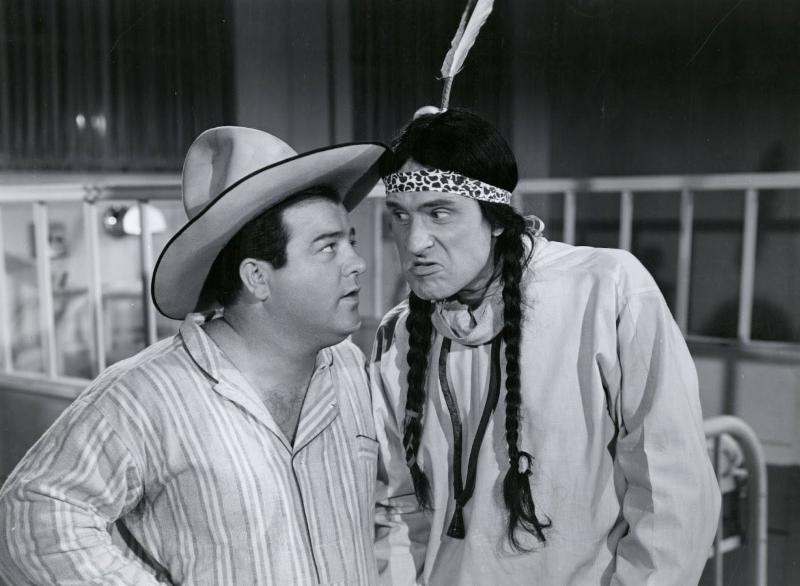
Bud and Lou performing the routine in their 1942 film,
Ride 'Em Cowboy
BUD AND LOU
PUT THEIR 'CRAZY HOUSE' IN ORDER
by
Jeff Solimando
We may never know if Abbott and Costello's "Crazy House" sprouted its roots in a traveling circus tent, one of New York City's dime museum attractions or at a turn-of-the-century vaudeville circuit theater. Yet, one fact holds true; Bud and Lou's combination of comic timing and flawless execution helped turn this much-copied "spoof" into a classic that still captivates audiences decades after its inception.
"Crazy House quite simply, is the result of a new take on a bunch of old acts the boys would collect, update then piece together. While in the process of reconstructing "Crazy House," Bud and Lou continued to adhere to vaudeville founder B.F. Keith's standards on decency and steered clear of using of "... vulgarity or coarse material." The skit was rewritten, wrapped up and presented to audiences using Bud and Lou's professional chemistry as the proverbial "bi, fat bow." The final product kept viewers laughing to the point where even the critics seemed to ask, "who hit the home run?"
"Crazy House" (aka the "rest cure") appeared on stage, screen and television and could vary both in approach and presentation; depending on the character's motivation and demeanor. For example, on a 1953 episode of The Colgate Comedy Hour, "Crazy House" takes on the form of typical sketch comedy. Lou suffers from a bout of insomnia and Bud checks him into a modern-day hospital in search of relief. Once admitted, Lou suffers through a series of setbacks and annoying disruptions that catapults his frustration and exhaustion. Feeling like he's trapped in a mental hospital instead of a medical facility, Lou can't seem to get the rest he so desperately needs.
In contrast, the boys customize "Crazy House" a bit differently in their 1942 film, Ride 'Em Cowboy! In the film, Lou plays "Willoughby," a rodeo peanut salesman who's on the run from a group of American Indians after refusing to marry the chief's "curvy" daughter "Moonbeam" (Jody Gilbert). After a particularly stressful day, Willoughby's partner Duke, (Bud Abbott) puts his pal to bed so he can get some rest. As the poor, troubled Willoughby frets his way towards a restless sleep, we segue into the "Crazy House" skit through a creatively crafted dream sequence.
Unlike the Colgate Comedy Hour where Lou, Bud and the lovely Hillary Brooke banter in the lobby of a present-day hospital, Ride 'Em Cowboy's adaptation of "Crazy House" begins with a ghost-like apparition of Willoughby's subconscious wandering alone towards "Dr. Ha Ha's Sanitarium." Once inside, Willoughby discovers the Indians he fears are taking on the form of everyone in his dream. Bud appears to the frightened Willoughby as an Indian doctor, and "Sunbeam," "Moonbeam's" beautiful sister (Linda Brent) as a sanitarium nurse who sports long dark braids and a feathered headband.
Once settled in his room, Lou (as Lou or Willoughby) is again the victim with various intrusions including but not limited to: an encounter with a delusional Indian woman who mistakes him for bed of roses in need of watering, a water spritzing telephone, an encounter with a clairvoyant who paints Lou's palm red and random gunfire that escalates to a full-scale "shoot-out" between General Custer's soldiers and Sitting Bull's warriors. The gun battle is what ultimately awakens Willoughby and sends him running to his pal Duke for reassurance and comfort.
In comparing the two versions of "Crazy House," we can see how the set-up, costumes and approach may change, yet "the schtick remains the same." Researching the history of these burlesque and vaudeville routines can provide awesome insight into how so many of Abbott and Costello's bits evolved. "Crazy House' may have passed through many hands throughout its life cycle, but it wasn't until Bud Abbott and Lou Costello breathed new life into the bit that "Crazy House" finally gained its shot at immortality.
|
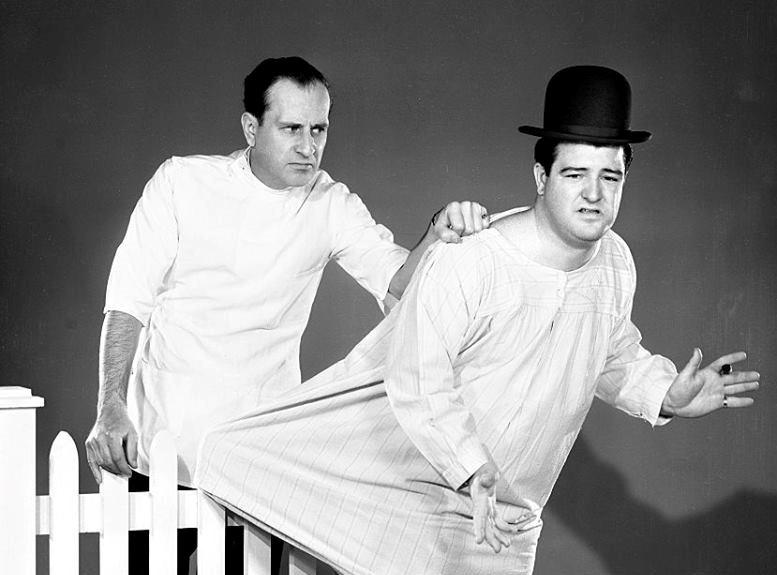
Bud and Lou Reprising "Crazy House" in
Streets of Paris (1939)
Anthony Balducci's Journal
on
Crazy House
Anthony Balducci (Anthony Balducci's Journal) wrote the following regarding this memorable routine:
Crazy House casts the comic as a new night watchman at an insane asylum. The watchman is instructed to watch that patients don't escape. The watchman is determined to do his job well, but the irrational behavior of the patients create unending problems for him.
Andrew Davis, author of Baggy Pants Comedy: Burlesque and the Oral Tradition, wrote, "The scene is a fast-paced hodgepodge of entrances and exits, as various lunatics enter, interact with the comic, and exit quickly." It has been difficult to research the routine because it has wound its way through a long and varied history with a variety of names. The Crazy House routine was known for a time as Dr. Dippy's Sanitarium. The name "Dr. Dippy" was a ready comic label for an amiable quack. Dr. Dippy and his dippy sanitarium appeared in various forms of entertainment. Happy Hooligan, Frederick Opper's lovable comic strip hobo, wandered across Dr. Dippy's Sanitarium in the comic supplement of the Hearst newspapers. In 1906, Biograph produced a 7-minute film called Dr. Dippy's Sanitarium, which was a loose reworking of the stage sketch.
Additional titles were given to this routine as it made its way back to the stage. An alternate title like A Night in the Sanitarium varied so little from the Dr. Dippy's Sanitarium that it's hard to understand why the title was changed at all. The routine was billed at one theater under the title Dr. Knutt's Sanitarium. But does changing the doctor's name from "Dr. Dippy" to "Dr. Knutt make a significant difference? It just makes life difficult for diligent researchers like myself.
A Variety critic was upset by one comic who performed the routine at the People's Vaudeville Theater. He wrote, "The caliber of this number may be understood from the fact that the Irish comedian said "hell" four times and "damn" twice."
Harry Hasting delivered Dr. Dippy's Sanitarium to the Gayety Theater and the Olympic Theater. Variety liked that Hasting transferred the routine to an outdoor rather than indoor location. The critic regarded this as (Hasting) "turning the old piece inside out."
Forget about the screaming lunatic woman, or the comedian shouting "hell" and "damn," or the exterior location. At the time, the prime specialist of the routine was Billy Hart, who had developed his own version of the scene called Female Sanitarium. The unique aspect of Hart's adaptation was that, just as the title suggested, the attendant found himself accosted exclusively by female patients. Newspaper records show that Hart regularly performed this routine as a member of The Cracker Jacks, a stock troupe of the Columbia Wheel, between 1907 and 1911. Hart's version of the routine remained a staple of the Columbia Wheel long after Hart's departure.
This routine continued to flourish. In November, 1912, the American Roof Theater presented a modified version of the routine called Fun in a Turkish Bath.
In March, 1920, Sliding Billy Watson presented Dr. Dippy's Sanitarium at the Olympic Theater. Variety reported, "Watson and his company getting a world of fun out of this ancient burlesque classic.
Through most of the routine's history, there were sexual elements. The female patients in Hart's version were likely pretty chorus girls. Other versions of the routine included a shapely nurse who did bumps and grinds. That, is burlesque.
Anthony Balducci notes that, "I did follow one false lead in my research on "The Rest Cure." A lunatic asylum was the setting of a popular sketch called "Pompey's Patients," which was performed in minstrel shows in the 1800's. The sketch had reportedly changed little when it was later transferred to vaudeville under the name "Lunatic Asylum." Someone dug the old script out of an attic for a show at San Francisco's National Theater in August, 1907. Variety reported, "The Lunatic Asylum is old enough to be new, and was strange to a major portion of the audience." I have a vague idea of the kit's premise based on assorted comments that I picked up here and there in newspaper accounts. Though I was unable to confirm the exact and complete content of the act, I do not believe it is the same act as "The Rest Cure." If I understand it correctly, this act had to do with a young man visiting an insane asylum to obtain the director's consent to marry his daughter. Through a series of misundertandings, the asylum director mistakes the young man for a patient and the young man mistakes the asylum director for a patient."
(Courtesy of Anthony Balducci, Anthony Balducci's Journal)
|
|
TWO TENS FOR A FIVE
(the "Money Changing" Skit)
|
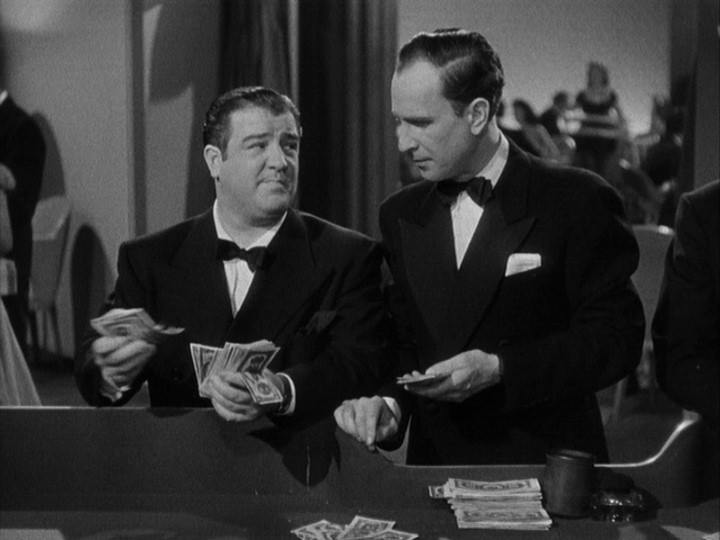
Bud and Lou recreate the skit in
One Night in the Tropics (1940)
Abbott and Costello used the Two Tens For a Five routine in their debut film, One Night in the Tropics.
It was known at the time to be a vaudeville standard, although according to 'Anthony Balducci's Journal,' no newspaper or clue to its actual origins could be found. A joke that appeared in a 1895 edition of the San Jose Letter had to do with an old colonel being conned by a young man with this bit of fast talk. What is known is that the routine had previously turned up in two early sound shorts, The Lunkhead (1929) starring Harry Gribbon and directed by Mack Sennett, and Hot Spot (1932) starring Ben Blue and directed by Del Lord.
In One Night in the Tropics, their first scene takes place in the casino. This was a clever way of introducing two radio comedians to filmgoers. The boys quickly launch into their Money Changing routine. Lou discussed this routine in a 1940 New York Times interview. "Me and Bud always pull a lot of 'skulls' on the stage. Now for a 'skull,' Bud feeds me a piece of business (like, 'Have you got two tens for a five?'). I fall for it, start to walk away, and then stop short, making like I'm just wising up that something's wrong. When I say, 'Hey, what's the idea?,' that's the 'skull,' that's where we get the laugh, for the piece of business becomes entrenched in the minds of the people in the audience during the few seconds I leave Bud. We build this up to a terrific situation simply by repeating this business, with me being gypped in each exchange. When I come back for my money, Bud gets mad and says, 'I shouldn't have done business with you in the first place. Here's your five, give me back my two tens.' We keep this up. It's screwy, but it gets laughs."
(Courtesy of Anthony Balducci's Journal, and "Abbott and Costello in Hollywood" by Ron Palumbo and Bob Furmanek).
|
|
MUDDER/FODDER
(the "Racetrack" Routine)
|
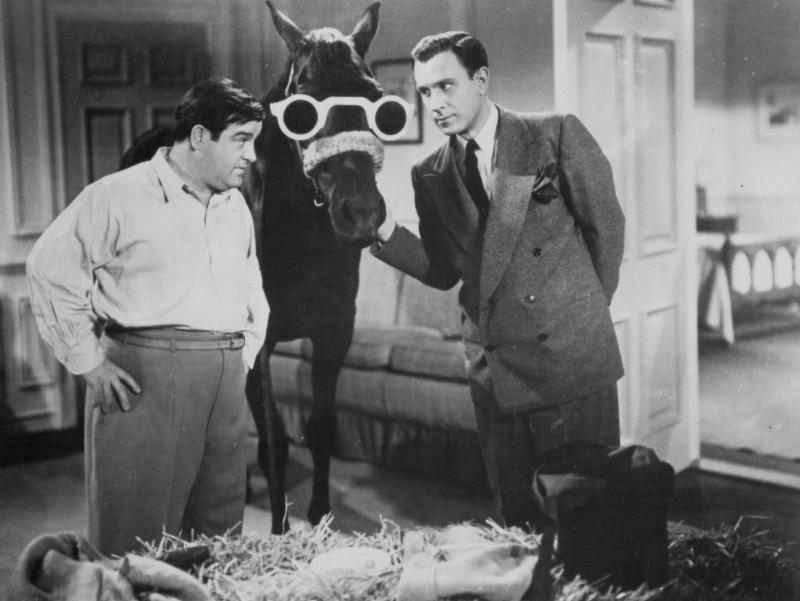
In a scene from
It Aint Hay (1943)
The reviews of several burlesque revues refer to a stock cross-talk routine known as the "Racetrack" routine. In all likelihood, this is the Mudder/Fodder routine that became a favorite of Abbott and Costello fans.
A Variety critic credited Owen Martin and Ed Lee Wroethe as the originators of this comic banter. The most extensive description of the "Racetrack" routine was published in the New York Clipper on December 21, 1921. It read as follows:
"Ed Lee Wrothe and Owen Martin came next with a new act billed as 'Now.' The story revolved around a race track and consisted of mostly track chatter. The act all the way through was funny to a lot of the audience who understood it, and occasionally here and there a laugh was registered. The act opened in front of a New York tenement. Ed Wrothe, as a janitor whose wife had saved considerable money, put over some very good lines that registered strong on laughs. Following this, the act goes into 'Three' with a race track setting and Martin keeps up a rapid fire of talk in the language of the track."
Anthony Balducci's Journal
In Abbott and Costello's 1943 film,
It Aint Hay, they revive the
Mudder/Fodder routine when Wilbur (Lou Costello) feeds candy to a horse. "You'll spoil the horse's appetite," Grover (Bud Abbott) admonishes Wilbur. "Now he won't eat his fodder." Wilbur is confused. "Eat his father? What do you think Finnegan is, a cannibal!" Later, Sam, Harry and Chauncey (played by Shemp Howard, Eddie Quillan and David Hacker) clarify a racing form for Wilbur. "If a horse has an 'x' in front of his name , that show's he's a mudder," explains Sam. "How can
he be a mudder?" wonders Wilbur. "Ain't a she always a mudder?" "No," answers Grover. "Sometimes he is a better mudder than a she." Finally, in Finnegan's stable, Wilbur tries to take the ailing horse's pulse. Grover instructs him to examine the horses forelegs. "The horse's forelegs are in front
," he explains. "The horse's forelegs are in front? What's those things in the back -- crutches?" cracks Wilbur. The routines would turn up again in
The Noose Hangs High (1948).
In
The Noose Hangs High, the
Mudder/Fodder routine was a sentimental favorite of the boys, since it was the first bit they performed on the Kate Smith Program in 1938. It was a natural for the picture's horse racing sequences. In this instance, Lou performs the bit with Leon Errol during a riotous billiard game.
"Abbott and Costello in Hollywood"
Ron Palumbo and Bob Furmanek
|
|
MOVING CANDLE
(the "Candlestick Routine")
|
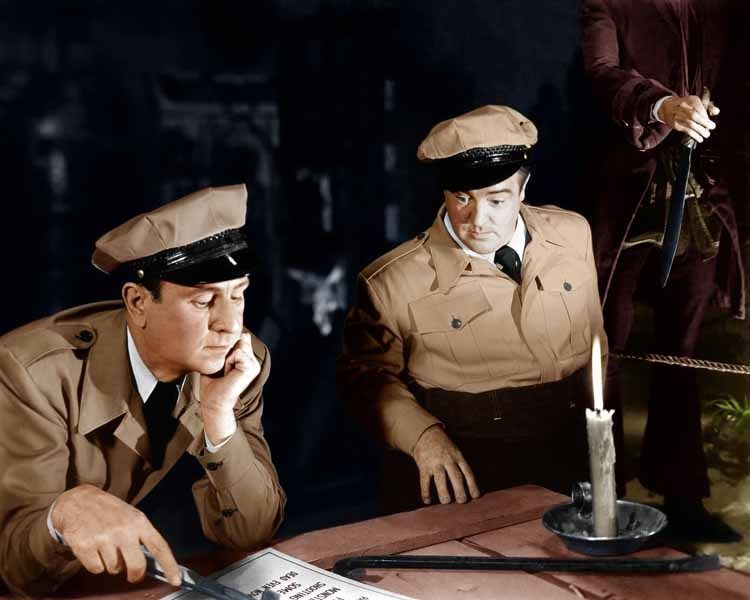
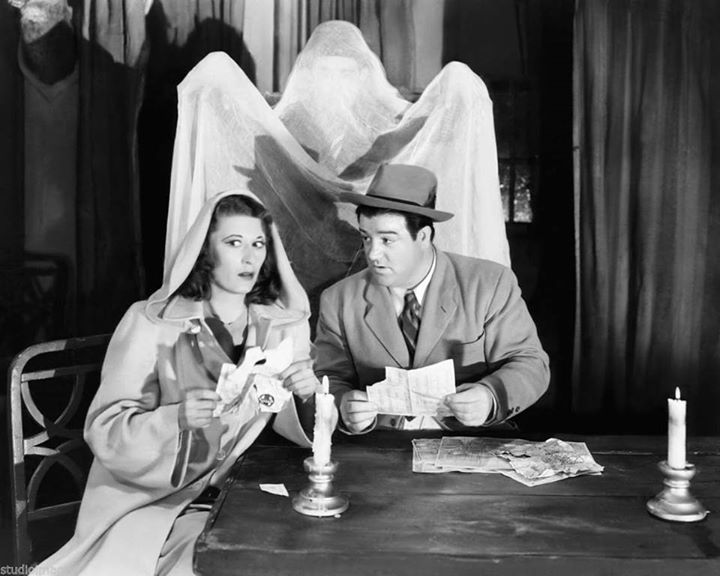
In a scene from Hold That Ghost (1941) with Joan Davis
THE CANDLESTICK ROUTINE
by
Bob Wilson
When Chris Costello asked for volunteers to research the background to Abbott and Costello's most beloved routines, I couldn't resist. Especially this particular routine which remains one of the highlights from one of my favorite A&C films, Hold That Ghost.
The routine features Lou (Ferdie Jones) and Joan Davis (Camille Brewster) sparring with a fake spook in the hotel the boys had just inherited. Joan's facial expressions and Lou's reactions to these events result in one of the finest scenes in the film. Robert Lees and Fred Rinaldo did an excellent job incorporating the routine into their screenplay.
The "Moving Candle" gag is the film's centerpiece. In it Chuck orders Ferdie to study a map to find the easiest way back to town. As Ferdie reads the map, two candles mysteriously levitate and slide back and forth. Every time he summons Chuck or Camille, the candles stop moving. Costello's pantomime elaborates on the loosely written scene. He uses everything -- gasping breath, hand gestures, etc. -- to convey sputtering fear. He knows exactly how long to keep this up before giving birth to an audible "Oh, Chuck!" each time.
Bud also expands on the bare bones of the script, and knows when to throw Costello a plum line. After Camille has missed seeing the candle move for a second time, further infuriating Ferdie, Chuck reasons, "Take it easy, don't get excited about this thing. Everything's alright. You have company here -- you're not alone." To which Ferdie can sarcastically retort, "No, not much." Universal's other comedy team, Olsen and Johnson, paid homage to this sequence in their own horror comedy, "Ghost Catchers" (1944)
"Abbott and Costello in Hollywood"
Ron Palumbo and Bob Furmanek
Locating the origin of this routine has been challenging. I turned to fellow A&C fan, Jeff Solimando and suggested I delve into Shakespeare's history of ghostly comedy. Excited, I took my research to England, via email, asking Cambridge's own Andy Muir. My pal wrote back saying that there was no history of ghostly comedy in Shakespeare.
I had exhausted my research books on Bud and Lou and was as empty as Moose Matson pulling in for a tank of gas. I turned next to Colette Joel, who was busy putting finishing touches on her forthcoming documentary,
Bowery Rhapsody. Colette wrote to the Margaret Herrick Library, aka the Academy Library. The response received concluded that this routine was more-than-likely from Abbott and Costello's vaudeville repertoire.
|
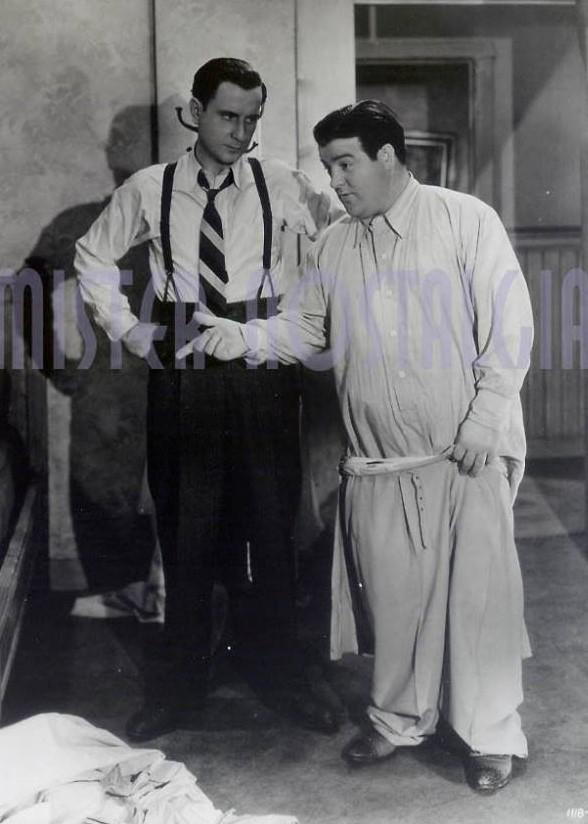
"Changing Room" scene in
Hold That Ghost (1941)
The
Moving Candle (or Candlestick routine) may have been variations or an offshoot from other skits.
In "Abbott and Costello in Hollywood" by RonPalumbo and Bob Furmanek, they mention the following:
One of the all-time best sequences in any Abbott and Costello film is the "Changing Room" scene where Ferdie's bedroom transforms into a gambling casino. "The 'Changing Room' scene was very, very carefully worked out, writer Robert Lees recalled. "Of course, the 'Changing Room' is really a variation of their 'Moving Candle' routine. Something happens to Costello that Abbott doesn't see. Fred Rinaldo and I knew that the chandelier would come down and be the roulette table; we knew the beds would turn over and be the crap table. We knew all these things would happen. Now, Abbott and Costello managed to work it out pretty well. They were never very sure of visual gags. They were more sure of their own routines.
|
|
BUZZING THE BEE
(Sons of Neptune)
|
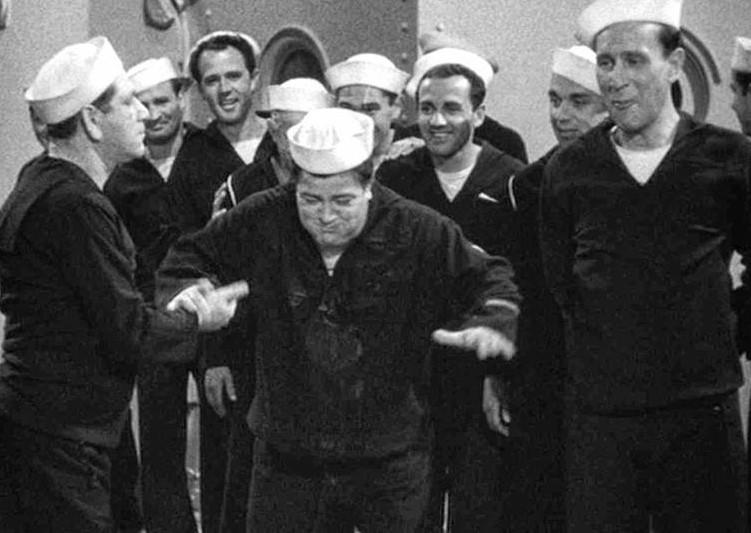
In a scene from
In the Navy (1941)
In an excerpt from a
Variety review dated November 9, 1917,
Buzzing the Bee can be traced back to that date, and possibly even before.
In Anthony Balducci's Journal, he retrieves the review which reads:
"The French Burlesquers" is the ostensible name
of the current troupe, but Billy Grogan Spencer is featured over the title. He is teamed with Nat Young, the latter doing a Hebrew. They get laughs with rough stuff. One of their stunts was called "Buzzing the Bee" It consisted of one circling around the other, who when he says, 'give it to me,' receives over his countenance a mouthful of water from the "buzzer."
A version of "Buzzing the Bee" was also included on Pigmeat Markham's 1968 album, "Backstage."
In Ron Palumbo and Bob Furmanek's book,
Abbott and Costello in Hollywood:
John Grant had integrated a few Abbott and Costello routines for"In the Navy" (1941), but informed executive producer Milton Feld that the rights to one other routine would cost around $300. Since the studio memo is not specific, we can only speculate which routine Grant meant. A fair guess would be "7 X 13=28" or "Sons of Neptune" (Buzzing the Bee), since they had not yet been incorporated into the script.
During the Sons of Neptune scene, director Arthur Lubin started laughing uncontrollably. "We started shooting and I started to laugh, and Lou broke down in the middle of the second take and started to laugh and the whole company laughed." A look at the script reveals that Costello's break up was not that spontaneous: it is, in fact, in the script. Proof positive is that years later, whenever Abbott and Costello performed the routine (which is actually called "Buzzing the Bee"), they broke up in the exact same places. This doesn't distract from the effectiveness of the scene, however, which Costello plays wonderfully.
(Courtesy of Anthony Balducci's Journal and "Abbott and Costello in Hollywood by Ron Palumbo and Bob Furmanek).
|
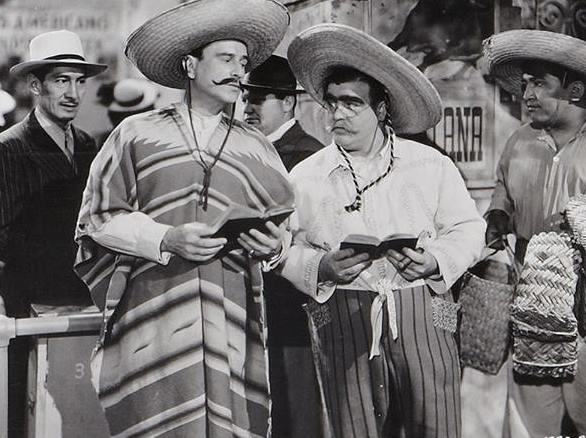
In a scene from Mexican Hayride (1948)
The burlesque team of Carson and Willard specialized in wordplay routines. They received an enthusiastic write up from the New York Clipper for delivering this type of patter in a 16-minute skit performed at the American Theater in June, 1919. What patter they originated and what patter they simply copied cannot be verified. All I can offer is that comic business later became enshrined in the formidable gag catalog of Abbott and Costello, whose exceptional talents allowed them to corner the market on this type of humor.
Carson and Willard's exchange about silver ore later turned up in Abbott and Costello's Mexican Hayride (1948). The scene starts out with Abbott admiring a piece of jewelry.
Anthony Balducci's Journal
In
Mexican Hayride, a more familiar Abbott and Costello turn is the
Silver Ore routine. Bud admires some native jewelry. "Just think," he says, "when it came out of the ground, it was nothing but crude chunks of silver ore." "Silver or what?" Lou wants to know. "Silver ore! That's the way they find silver," Bud explains. "It's been lying on the ground for thousands of years. When they dig it up, they smelt it." Lou reacts. "If it's a thousand years old,
no wonder they smelt it." Bud continues, "Then after it's melted down, it's made into these ornaments by a smith." Lou asks, "Couldn't they be made by a Jones?" "Certainly," affirms Bud. "but Jones would have to be a smith."
"Abbott and Costello in Hollywood"
Ron Palumbo and Bob Furmanek
|
HAVE A QUESTION?
WE HAVE THE ANSWER!
|
Photo Credit: Chris Costello
Lou shares a comedic moment with best friend Bill Bendix
QUESTION:
Who were Lou's friends in Hollywood, and was there any one in particular that he was close to?
Fred Fronne
Kearney, Nebraska
ANSWER:
As large as the Hollywood community can be, it can also be quite small. Dad and Bud met many of their era's great stars and comedians (including teams) at restaurants, night clubs, events and parties. They were friendly with many, but as in any social circle, whether it's Hollywood or another business or special interest group, there are those you gravitate towards and form friendships with.
Dad and Bill Bendix had a close friendship. Bill and his wife, Tess, often times socialized with dad and mom. My only recall of Mr. Bendix was when he came out to our ranch in Canoga Park to show dad his new car. I was maybe eight at the time and had this electric two-seater T-Bird. I was coming down a dirt road, not going fast, when I saw Bill and dad talking beside his car. As I got closer, I waved and yelled, "Hi, Uncle Bill!" Within seconds my car smashed into the front side of his brand new car. I was stunned, and thinking, "Oh, boy. I'm going to get it now!" He looked at where my car connected with his (a rather shocked expression), and dad chewing furiously on his cigar shaking his head. Suddenly, Bill Bendix looked over at me and with that smile said, "Not a scratch." He turned and looked at dad clasping his hands "How long before she gets her drivers license?"
Chris Costello
Lou's youngest daughter
|
|
ABBOTT & COSTELLO
MEET THE YOUNGSTERS
|
Young Abbott and Costello Fan
Scores a Perfect Home Run With
Who's On First? Book Report!
Photo Courtesy of Ginny Capitelli
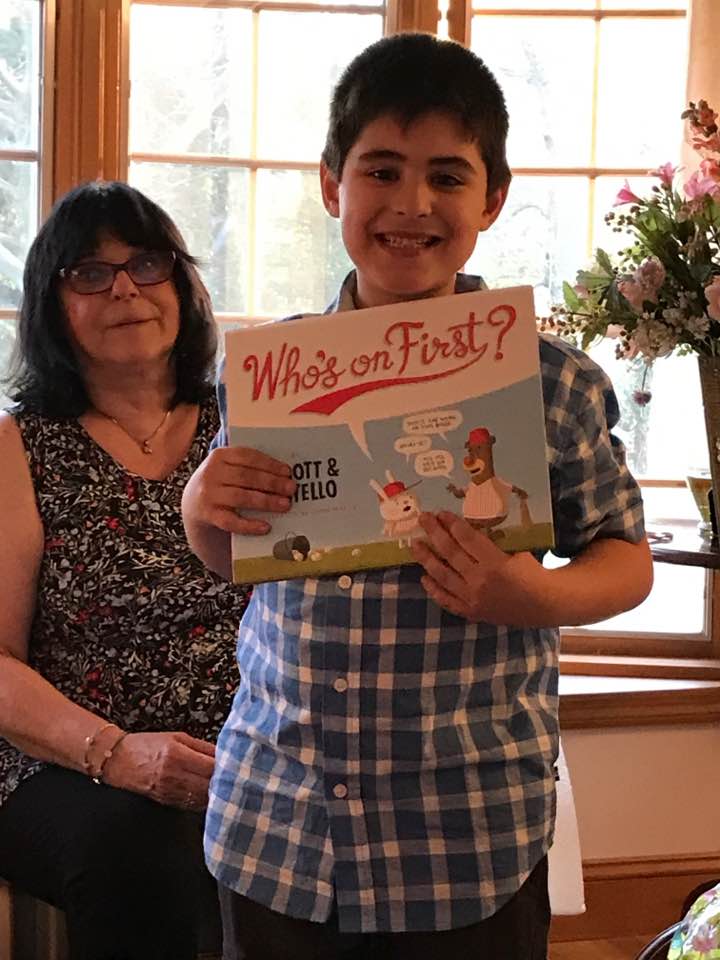
Joseph Belfiore proudly shows off his Who's On First? book
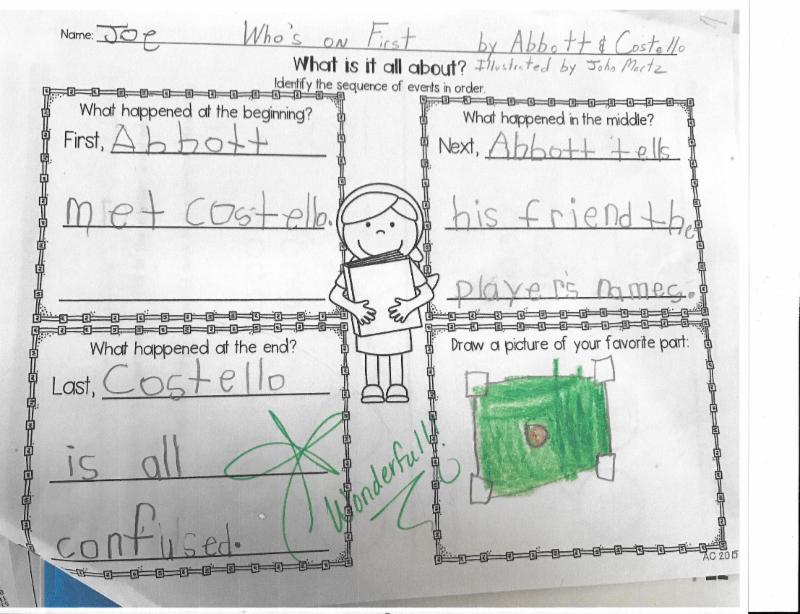
Joseph Belfiore of Long Island, not only read the Who's On First? Children's Book, but decided to do a book report as part of a class project!
Joseph attends Branchbrook Elementary School in Smithtown, Long Island and is in Mrs. Fenster's class. Take a look below at the wonderful comment written by Mrs. Fenster!
The Abbott and Costello families would like to gift a copy of this book to the school's library. Please contact us at: ACCollectibles@aol.com and we'll be sure to ship the school their very own copy.
From all the many Abbott and Costello family members, congratulations Joseph ~ you hit a home run!
|
|
BEHIND-THE-SCENES
Of Their Timeless Routines
|
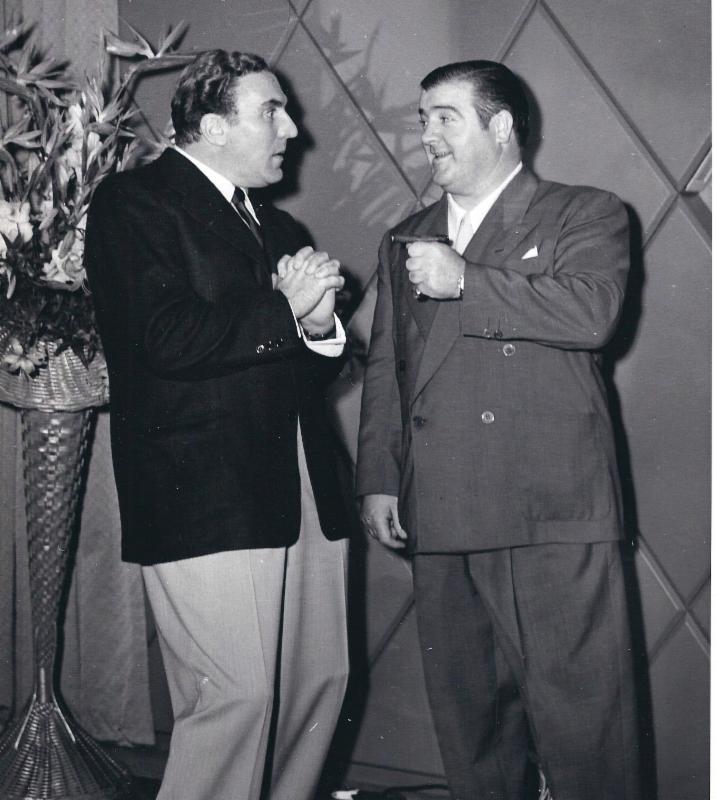
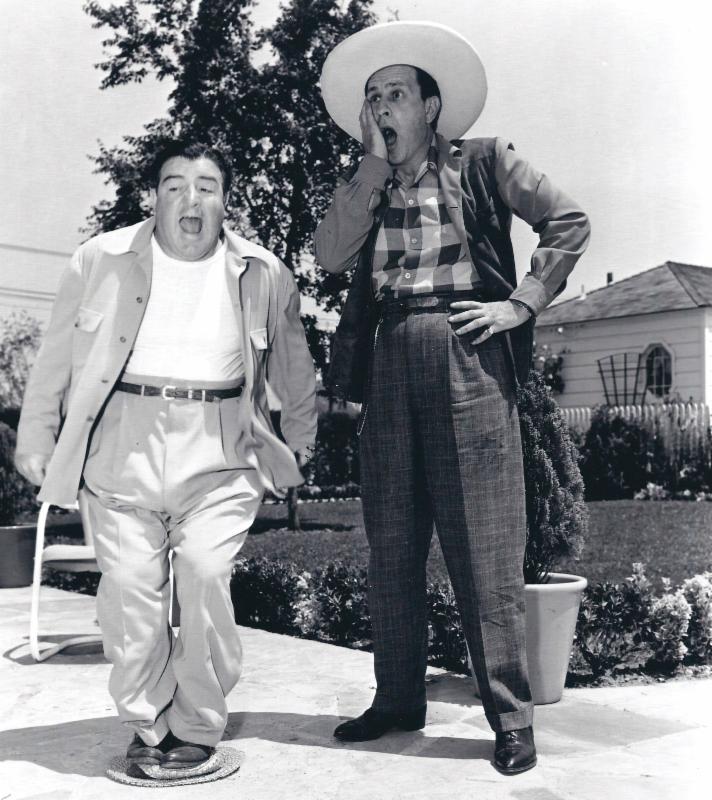
Bud and Lou hamming it up for the cameras during a publicity shoot (1940's)
Bud and Lou get into their own act when Universal Studios did a photo shoot back in the 1940's.
This shot was taken at Lou Costello's home, and as you can see, he's putting his own twist to the Susquehanna Hat routine.
|
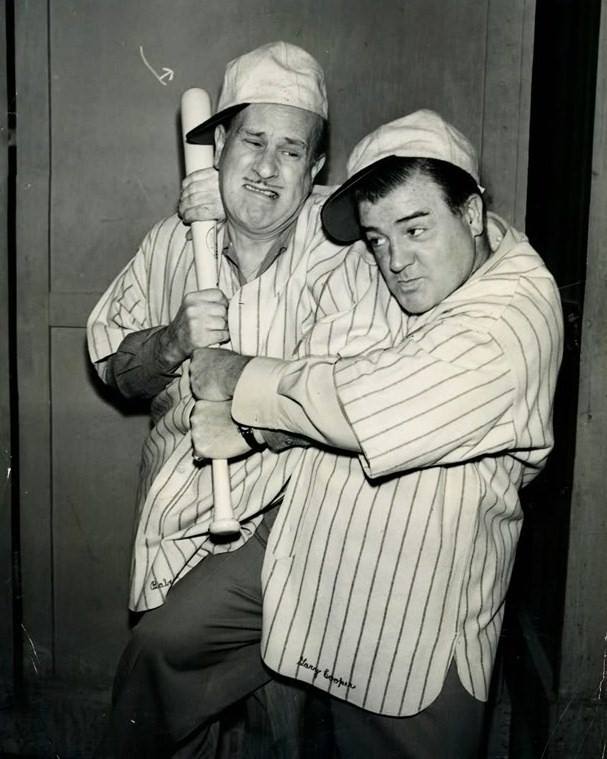
Backstage for either a benefit or television show, Bud and Lou have some fun for the cameras with Who's On First?
|
FAN CORNER
Richard and Barbara Rommeney
Bay Shore, N.Y.
|
Photo Courtesy of Richard Rommeney
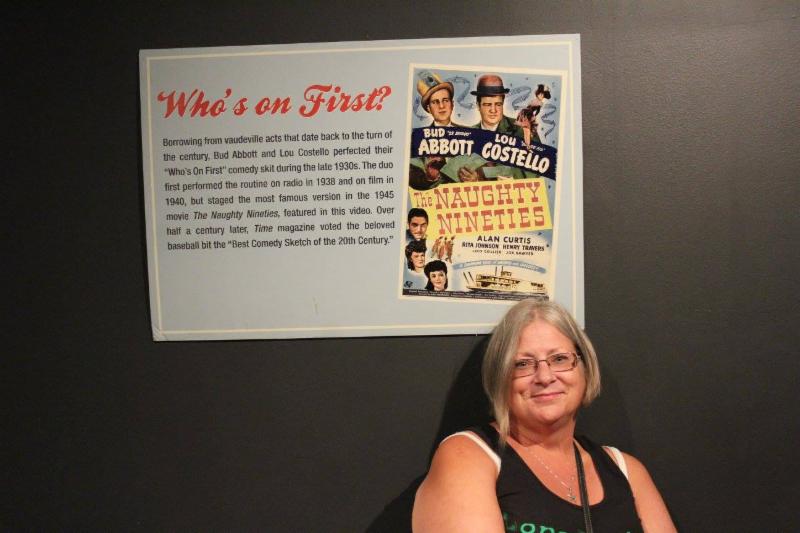
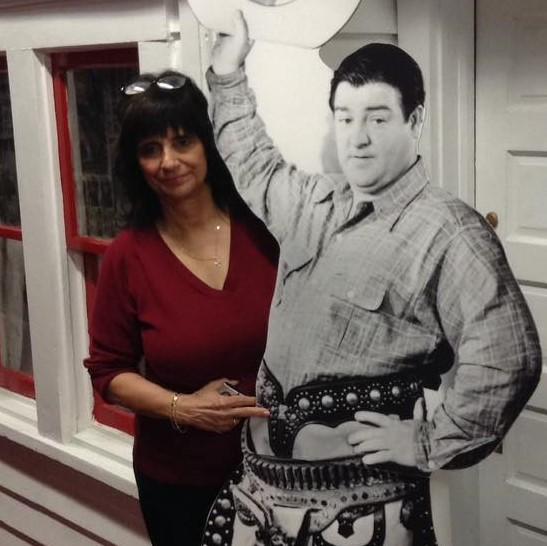
Barbara Rommeney at the Baseball Hall of Fame
BASEBALL HALL OF FAME
Recently, my wife Barbara and myself spent a weekend in Cooperstown, New York for our friends' wedding. We had a few hours to kill before the festivities so we paid a visit to the National Baseball Hall of Fame. When we walked in, my wife, Barbara, immediately asked where the Abbott and Costello exhibit was located.
The Hall of Fame plays "Who's On First?" continuously from their 1945 film
Naughty Nineties. Barbara sat down and watched that routine over and over while our daughter and I explored the museum. When we finished our tour, the three of us watched it a few more times before leaving to attend the wedding.
Despite (or because of) the repeated viewings, we left the museum with smiles and laughter. It's great that the Hall of Fame honors this classic routine by such legendary performers.
Richard Rommeney
|
LARRY WOLFF
Lecture Presentation
August 5
10 am - 12 noon
Amityville Public Library
W Oak Street & John Street
Amityville, New York
(631) 264-0567
Admission: FREE!
|
|
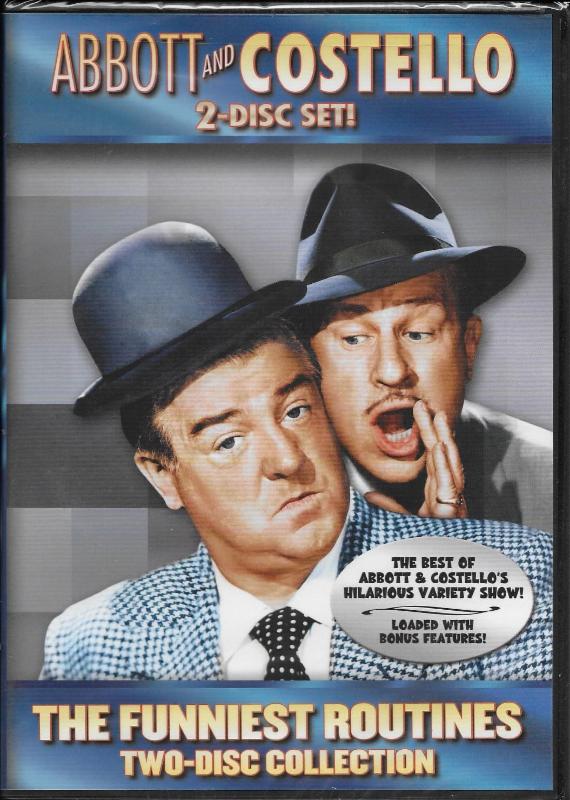
Check out all our product, including this newly-added DVD collection on Abbott and Costello's Funniest Routines!
|
RALPH MARLIN
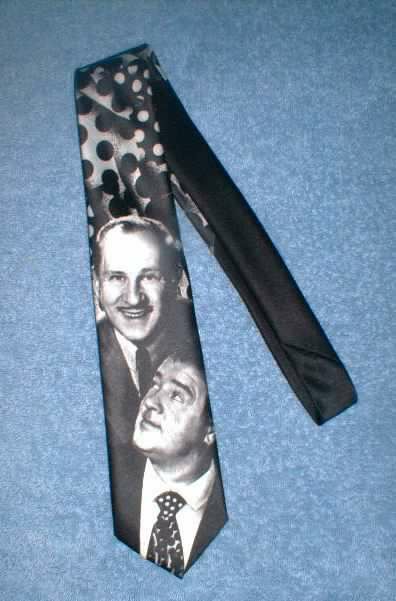
Abbott and Costello Neck Tie was produced in the 1990's. Considered a rare find, check Ebay for possible auction listings.
Courtesy of Bob Wilson
|
|
WHO'S ON FIRST? ABBOTT & COSTELLO
Hosted by Chris Costello
ABBOTT AND COSTELLO 4 EVER
Hosted by Bob Wilson
ABBOTT AND COSTELLO FAN CLUB
Hosted by Robert Michael Jensen
ABBOTT AND COSTELLO FANS
Hosted by Michael Amaral
THE WORLD OF ABBOTT AND COSTELLO AND FRIENDS
Hosted by Michael Lovaglio
|
|
SHARE NEWS & INFORMATION
Email: ACCollectibles@aol.com
|
Share A&C news, information, stories, events, airings, screenings, and more.
Email your submissions.
|
BEAR MANOR MEDIA
www.bearmanormedia.com
|
|
BEAR MANOR MEDIA
For the best in new nostalgia books, over 900 titles!
|
If you love nostalgia, you'll love what BEAR MANOR MEDIA has to offer on their web site!
|
|
|
|
|
|