STAY INFORMED – TALKING POINTS – ACTIONS TO CONSIDER – JAHM – STORIES | |
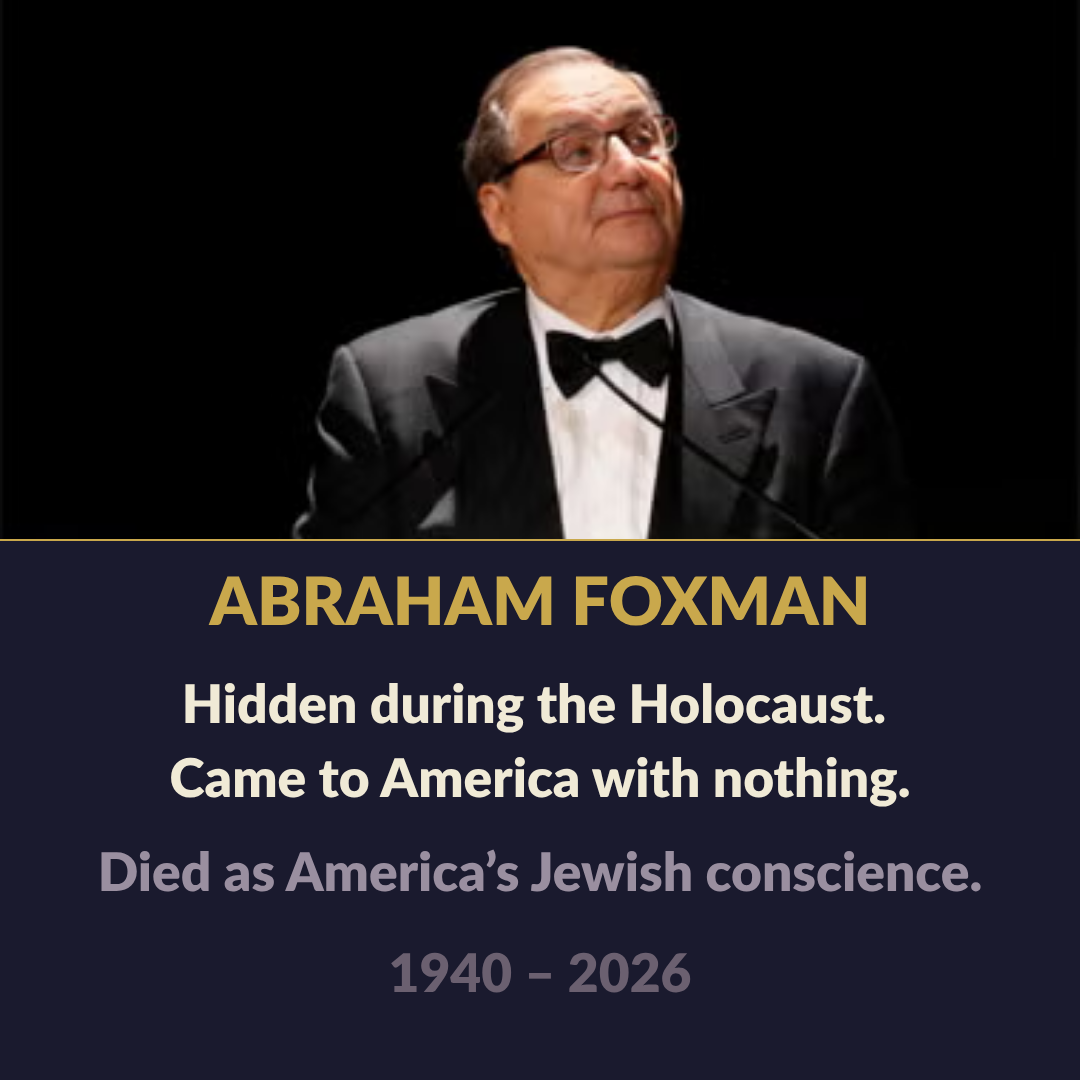
Abraham Foxman: Esteemed American Leader Provided Moral Clarity
| |
Holocaust survivor, American immigrant and the face of Jewish civil rights for a generation – Abraham “Abe” Foxman passed away on May 10 at the age of 86. For nearly three decades Foxman led the Anti-Defamation League, becoming the most recognized Jewish American civil rights voice of his era. He was received by popes, presidents and prime ministers.
Foxman called out antisemitism wherever he found it – from the left, right and center, from governments to Hollywood – without asking anyone’s permission. He believed people could change. And he proved that you could criticize Israel, disagree with its leaders and still be one of its most credible defenders. At a moment when this kind of moral clarity is in short supply – the Jewish world has lost one of its giants.
The Hidden Child Who Became America’s Jewish Conscience
Foxman’s life was shaped by survival from its earliest days. He was born to Polish Jewish parents in 1940 in what is now Belarus. Foxman called his birth the “wrong time and place to be born a Jewish kid.” When the Nazis ordered the Jews of Vilnius into the city’s ghetto in 1941, his parents made an impossible decision – entrusting their infant son to his Polish Catholic nanny. She baptized him and raised Foxman as a Catholic child. Her actions saved his life – fourteen relatives did not survive the Holocaust.
When his parents miraculously survived the Holocaust, they fought to reclaim their son from his nanny – prevailing in what Foxman later described as “the first custody battle in Soviet-liberated Europe.” In 1950, the family immigrated to America, settling in NYC. Foxman attended a yeshiva, earned a degree from City College of NY and a law degree from NYU. He joined the Anti-Defamation League straight out of law school in 1965 – and only left when he retired.
| |
Building a Movement Against Hate
Foxman rose from staff lawyer to the ADL’s longest-serving national director – a role he held from 1987 to 2015. Under his leadership, the organization transformed into one of the most influential civil rights institutions in the U.S. – monitoring antisemitism across America, advocating for anti-discrimination legislation and running anti-bias training programs for schools and law enforcement. He counseled presidents of both parties, prime ministers and three popes. Israeli President Isaac Herzog hailed him as “a prominent, distinguished force in the American Jewish community and a bridge between Israel and the Diaspora.”
He Called Out Critics from Every Direction
Throughout his career, Foxman believed that no relationship, ideology or political affiliation exempted anyone from accountability. When public figures made antisemitic remarks, he confronted them directly – and when their repentance was genuine, he accepted it. He stated: “If you don’t let them change, then you become the bigot.”
Foxman retained his place as a leading voice even after his retirement. In 2024, he condemned President Trump’s Madison Square Garden rally in NYC for its “hate, racism and antisemitism.” More recently, Foxman denounced the 40 U.S. Senate Democrats who voted against providing bulldozers and bombs to Israel during the Iran War. He warned that the “progressive socialist wing is a calamity for the Democratic Party, if it will not be contained and stopped.”
Last year he stressed the dangers posed by the far left and far right: “The 20th Century history of Nazism and communism should be an alarm bell as to just how dangerous this is, and not just for us Jews, but for all of society, for all who care about democracy, individual freedom and dignity.”
He was equally willing to criticize Israel and its leaders when he believed they were wrong – and he did from a place of unquestioned commitment to Israel’s defense. Foxman publicly opposed Israeli Prime Minister Benjamin Netanyahu’s 2015 address to Congress on Iran. He viewed it as an inappropriate intervention in American politics.
That record of criticism only deepened his credibility. Throughout his career, he defended Israel unapologetically in diplomatic meetings, on television and on university campuses. Israeli Foreign Minister Gideon Sa’ar shared how Foxman “devoted his life to defending the Jewish people and strengthening the bond between Israel and Jewish communities worldwide.”
| |
Warnings Left Unanswered
Foxman warned 11 years ago about many of the issues still plaguing the Jewish community across America and around the world today. He noticed that Jewish students on American campuses were removing their kippot and tucking away their Star of David necklaces – hiding their Jewish identity to avoid harassment. He also observed that 2015 was the worst year for European Jews since the Holocaust. Foxman concluded that the fight against anti-Jewish hate was far from over – “nobody at the ADL would be retiring any time soon.” A decade later, the problem has only grown.
A Legacy That Must Live On
Foxman’s passing drew an outpouring of tributes from leaders across the Jewish world. Current ADL CEO Jonathan Greenblatt stated: “America and the Jewish people have lost a moral voice, a passionate advocate for the Jewish people and the State of Israel, and a remarkable leader.” William Daroff, CEO of the Conference of Presidents of Major American Jewish Organizations, said that “every conversation with Abe Foxman reinforced the idea that leadership requires courage, urgency and the willingness to speak out when others remain silent.” Met Council CEO David Greenfield called him “the kind of leader that all of us aspire to be.”
More than 500 family, friends, current and former ADL officials and national Jewish leaders gathered at the Park Avenue Synagogue in Manhattan to pay their respects to Foxman. Eulogies were given by former U.S. Ambassador to the UN Susan Rice, U.S. Holocaust Memorial Museum Executive Director Sara Bloomfield and other dignitaries. May his memory be a blessing.
| | |
1. Moral clarity on antisemitism is what most of today’s leaders are missing
As antisemitism surges globally and institutions increasingly excuse it when politically convenient, Abraham Foxman held one standard for his entire career: antisemitism is antisemitism, regardless of who is doing it or where it comes from. Former U.S. ambassador for antisemitism Deborah Lipstadt praised his commitment to “condemning Jew-haters from the right, left and center” – without calculating the political cost. That standard is exactly what is missing today. Leaders across the political spectrum routinely ignore anti-Jewish hate when it comes from their own parties, politicians and allies. They hedge, equivocate and stay silent. Foxman never did.
2. People are willing to change – but only if we are willing to talk to them
Foxman confronted antisemitism wherever he found it – and accepted genuine apologies. He criticized Jesse Jackson for his antisemitic comments and support of antisemites – Arafat and Farrakhan. He also watched him change and eventually called on him when Jews needed allies. Foxman asserted that “if people can understand that they can come around from being a bigot, then I think it serves us. It serves them. It serves the community.” Foxman never stopped reaching out. In an era when people increasingly refuse to talk to those who disagree with them, his refusal to write people off may be his most impactful legacy.
3. His life was the American story
Foxman was born into hiding – a Jewish infant baptized Catholic to survive the Holocaust – and came to America as a refugee with his parents and little else. He died as one of the most recognized civil rights voices in the country. That arc is the American story: arrive with almost nothing, build something that lasts and refuse to disappear. The question he leaves behind is not how to mourn him – it is whether we are willing to preserve his legacy. He did his part, now it is our turn.
| | |
Click here to read a first-hand account about Abraham Foxman
written by Rabbi Eric J. Greenberg
| | |
Abe Foxman devoted his life to fighting antisemitism and building a world where people could change. We can honor that legacy by doing the same.
-
Share his story: Pass this edition along to someone who did not know Foxman – Jewish or not. His life makes the case better than any argument.
-
Apply his standard: When you hear antisemitism from someone on your own side of the political aisle, do not look away. Contact your U.S. Representative and Senators and other local officials – urging them to hold the same standard Foxman did – no exceptions, no party exemptions.
-
Reach out across the divide: Reach out to a friend who may not fully understand the realities facing Israel, and start a conversation – not to argue, but to listen and share information. Foxman believed people could change. So can we.
| | |
JAHM Week 3 Focus: Mid-19th Century and Civil War, 1826-1875
This year, Jewish American Heritage Month (JAHM) celebrates the extraordinary contributions of Jewish Americans – from before the American Revolution to the present day – across science, music, arts, sports, literature, military, business, and civic life. Formally recognized by the U.S. government since 2006, JAHM also promotes education about Jewish history and combats antisemitism.
Spotlight: Rebekah Gumpert Hyneman – Poet, Storyteller, and Champion of Jewish Identity
One of the most compelling Jewish literary voices of 19th-century America, Rebekah Gumpert Hyneman used her pen to inspire pride and resistance to assimilation among her fellow Jews:
-
Born in 1812 near Philadelphia to a Christian mother and Jewish father, she was raised Jewish and remained devoted to her faith throughout her life
-
After her husband disappeared on a trading expedition, she formally converted to Judaism in 1844 – and soon after turned to writing as her calling
-
Best known for The Leper and Other Poems (1853), one of the most notable works of Jewish American literature of its era
-
Her poems, essays, and short stories repeatedly returned to the theme of characters who reject the ease of assimilation and are rewarded for their steadfast faith
-
In her celebrated series "Female Scriptural Characters," she elevated the stories of Esther, Ruth, Deborah, and the Matriarchs, highlighting the strength and virtue of Jewish women throughout history
Through her writing, she urged her community to recognize the power and beauty of their tradition at a time when assimilation pressures were intense
Click here to learn more about Rebekah Gumpert Hyneman and other remarkable Jewish Americans who shaped our literary and cultural heritage.
#JAHM #JewishAmericanHeritageMonth @weitzmanmuseum
| | |
Stories Impacting American Jews
Stories Impacting the U.S. and Israel
Stories from Around the World
| | CLICK BELOW TO ACCESS ADDITIONAL FOCUS PROJECT RESOURCES: | |
Want to Read More of Our Talking Points? | Did you miss a recent edition of The Focus Project? No need to search your inbox. Our most recently published editions are available on our website. Click below to continue reading. | | | | |
The Focus Project develops and distributes news, background, history and weekly talking points on timely issues to inform individuals and organizations about issues affecting the American Jewish community and Israel, and help readers speak with more consistency and clarity. The editions also provide potential responses for addressing incidents of antisemitism and anti-Zionism. With input from a spectrum of major American Jewish organizations, we focus on that which unites us, rising above political and individual agendas.
Recognizing that hatred of Jews comes in many forms and directions, we strive to address all sources as they arise, and educate our growing audience on topics ranging from inter-religious relations to relevant international developments. From week to week, we may focus on issues arising from the political left, university campuses, from the political right and from institutions, government, and corporations. We don’t try to address all issues in each edition. We hope you will find this information useful in your writing and/or speaking. We are always open to your feedback: info@focus-project.org.
| | | | |