August 17, 2026 | Fall News | | EVP & Provost Dr. Debbie Thorne welcomes the FGCU community to the 2026-27 academic year | (2-minute watch) Provost Thorne reflects on how far we've come and the student success ahead. | |
In This Issue
- A welcome message from Provost Thorne to open the new academic year — reflecting on how far we've come and the student success ahead.
- Partners in success — academic advisors guide students and support faculty.
- Canvas Quick Tip — a fast, practical idea you can use right away.
-
Plus important announcements and faculty resources. Keep reading!
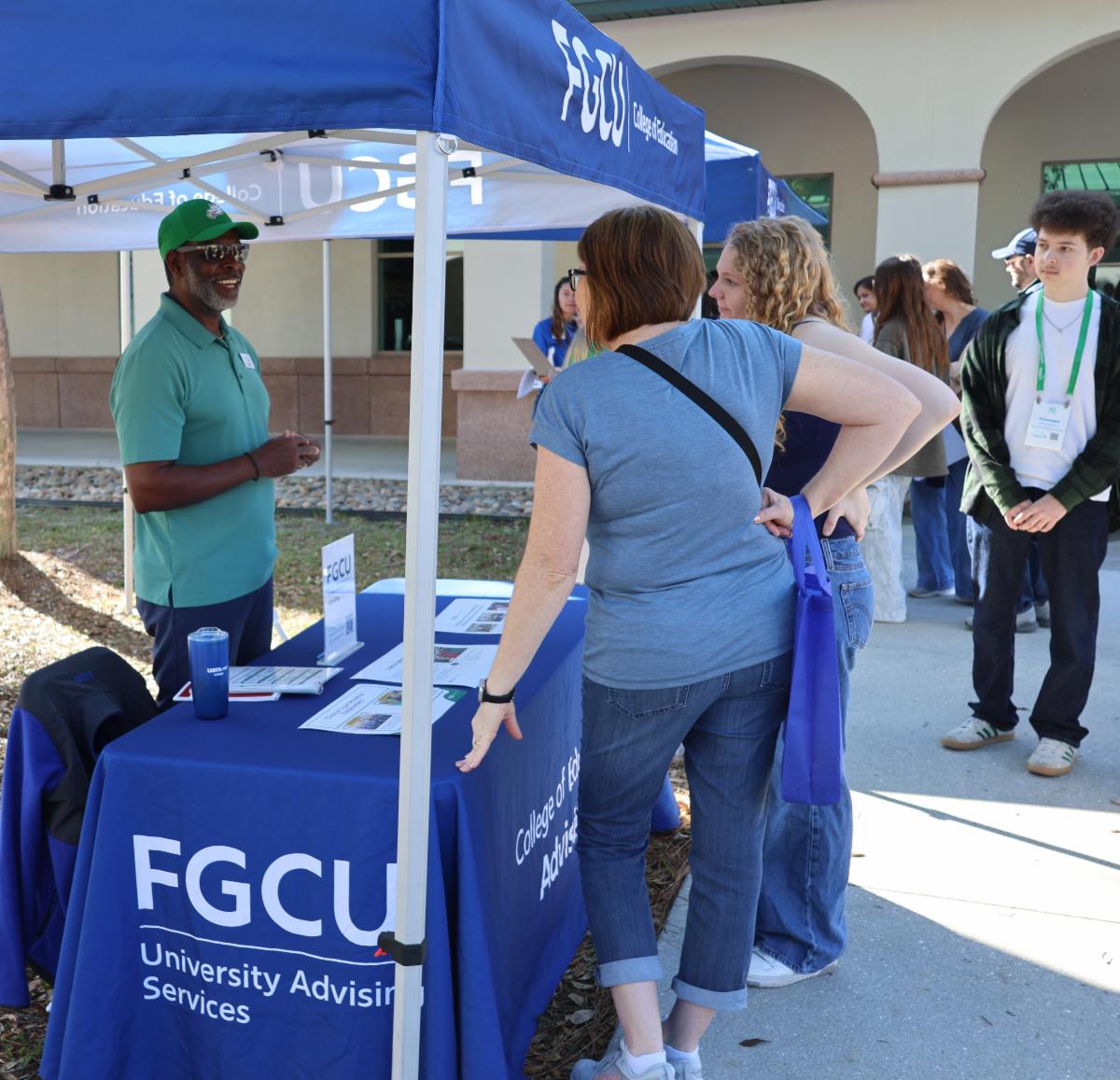
| | Your partners in success: Academic advisors guide students and support faculty | | Director of the College of Education Advising engaging with students during an outdoor event | | |
The start of a new academic year brings excitement and transitions. For freshmen and returning students, navigating courses, majors, and opportunities can be overwhelming. FGCU’s academic advisors are instrumental and strategic partners in each student’s academic journey; they help remove barriers and obstacles that can thwart student progress.
Whether students have declared majors or are exploring disciplines, advisors explore the many academic, social, and co-curricular opportunities available to them—such as research groups and student organizations—to help them make informed decisions about their aspirations and expand their academic path.
Academic Advising is housed under University Advising Services, and with the new Student Success Plan 4.4 Academic Advising Task Force Report: Advancing Student Success Through a Distinctive Model of Academic Advising for FGCU: The Right Student, The Right Support, at the Right Time—FGCU’s advising offices are cultivating closer partnerships with the colleges.
Advising leadership meets regularly with college deans, and advising teams interact closely with faculty. This collaborative approach reflects FGCU’s mission to sustain strong working relationships across academic units in service of student success and a transformative student experience.
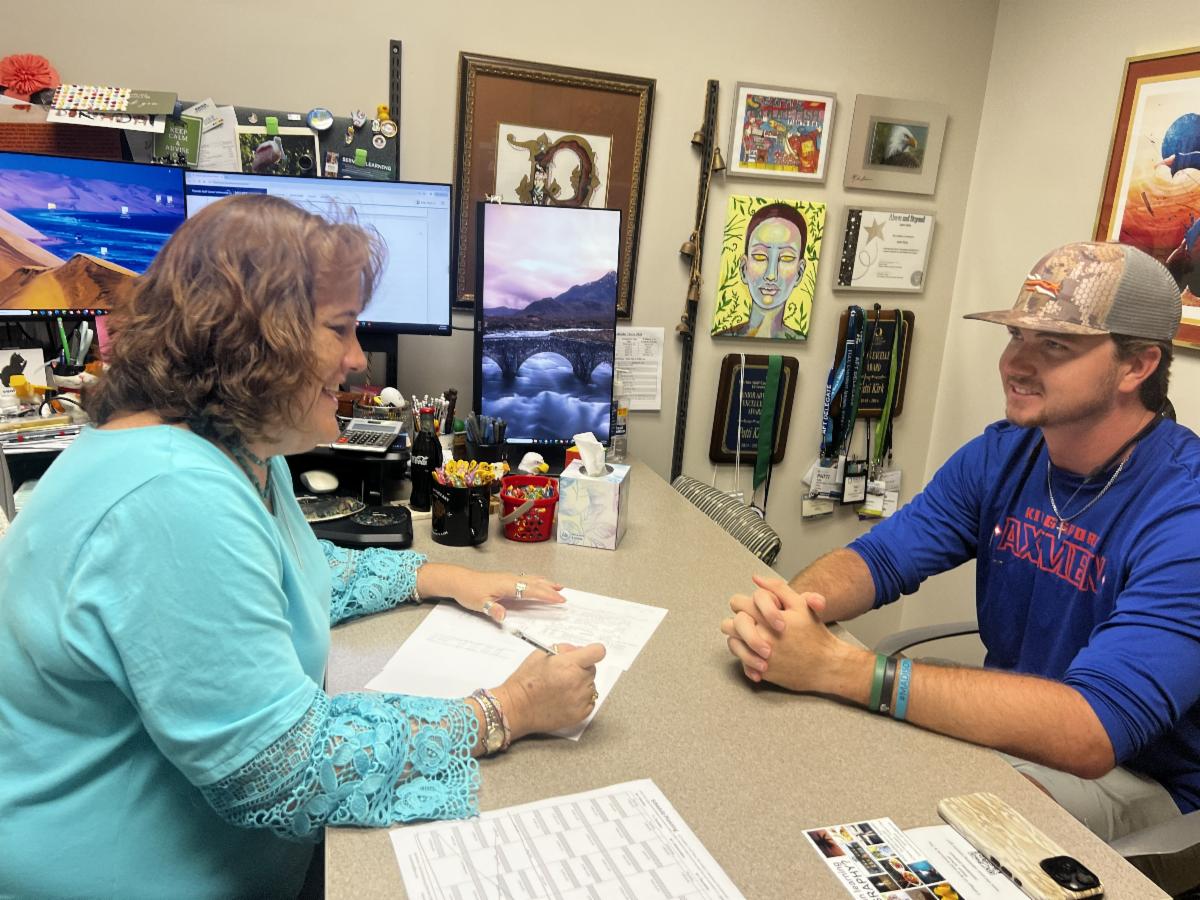
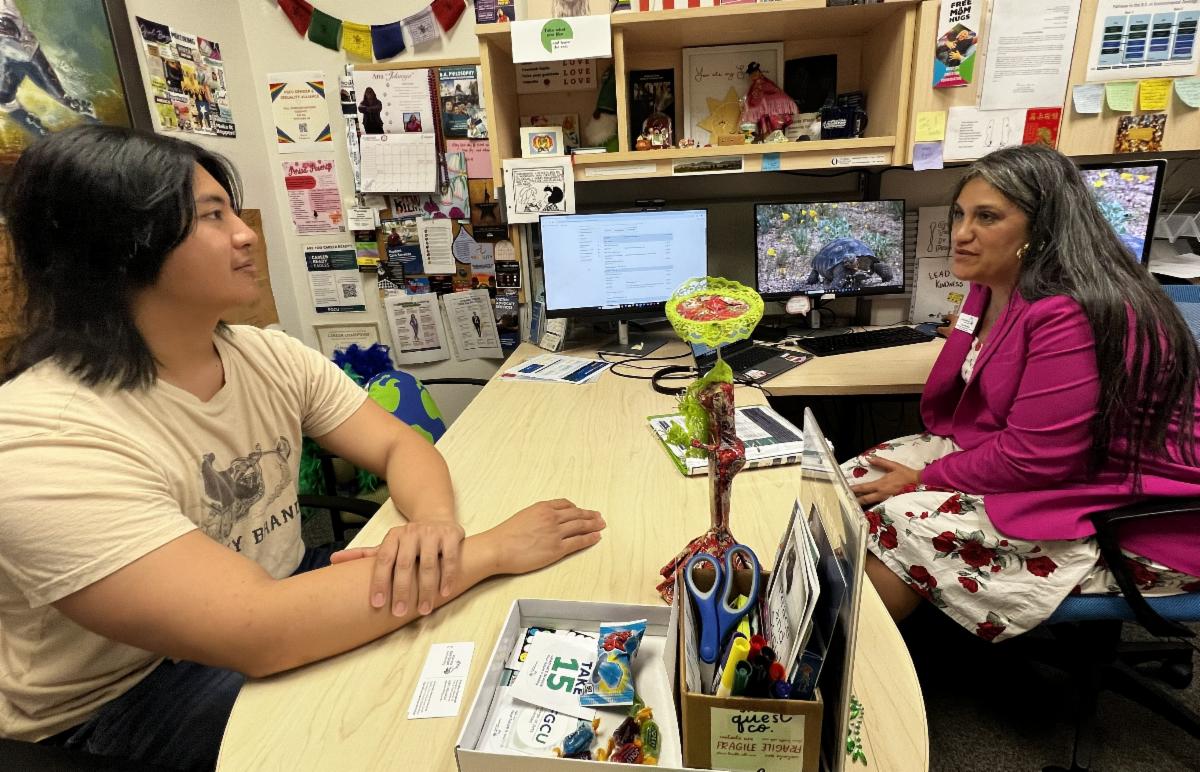
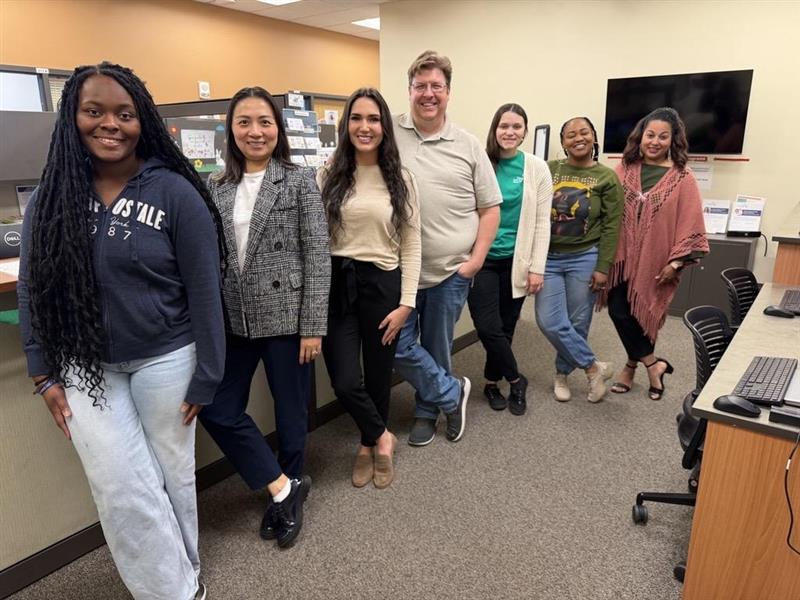
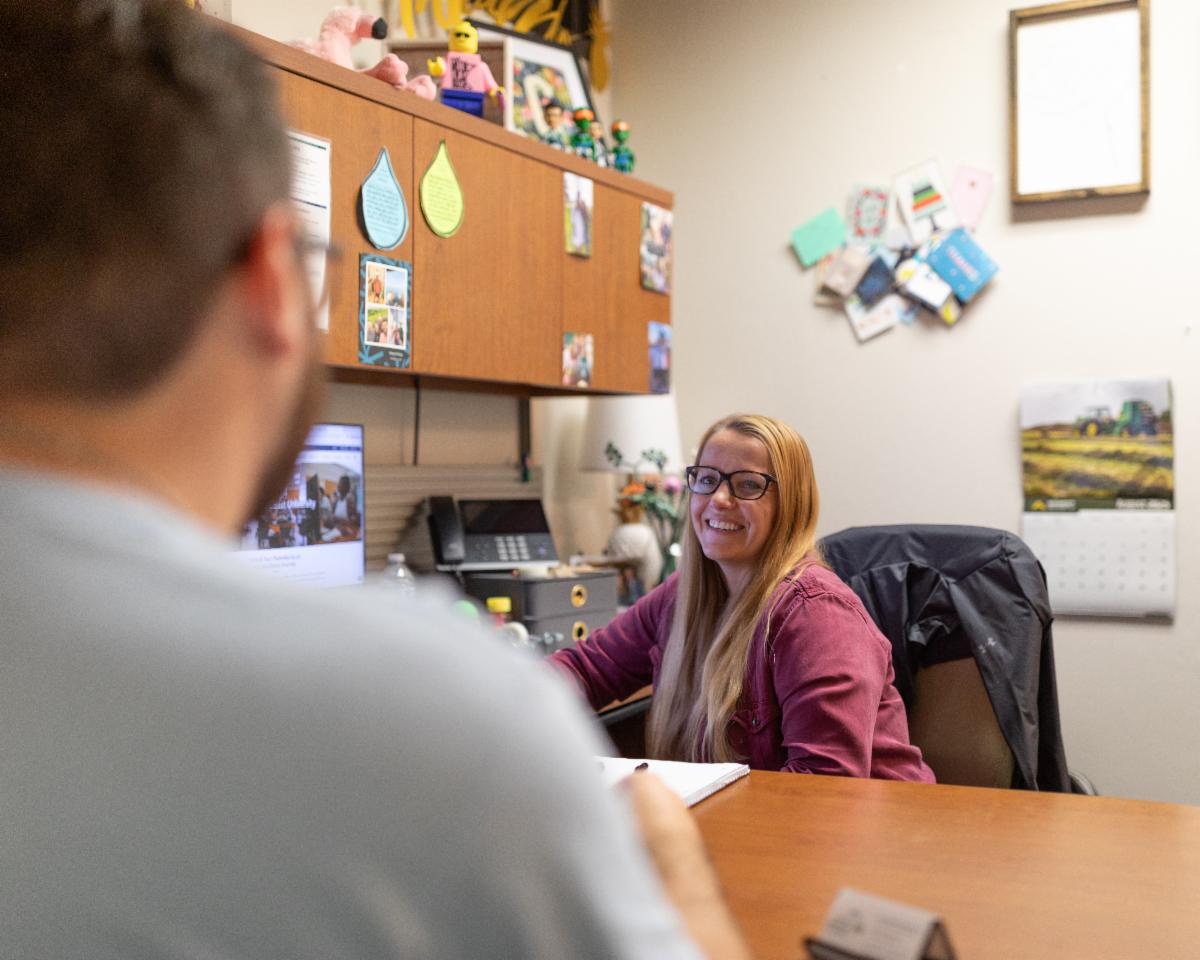
| Advisors from the College of Arts & Sciences (above) and The Water School (below) engaging with students during in-person advising sessions | | |
FGCU’s advising structure showcases the University’s commitment to student success.
From adjusting course loads to account for work, personal, and extracurricular commitments, to preparing for graduation, academic advisors demonstrate daily how partnership—between advisors, faculty, staff, and students—sustains academic excellence and student well-being at FGCU.
The advisors in this feature are a sample of the dedicated advising teams across FGCU’s colleges and schools.
| (Below) Marieb College of Health & Human Services advising team | (Below) U.A. Whitaker College of Engineering advisor in an in-person advising session with a student | |
Help your students succeed
Explore academic advising services to connect with an advisor who can guide your students’ academic path. Click on each link to learn more:
| | Faculty Resources & Best Practices | |
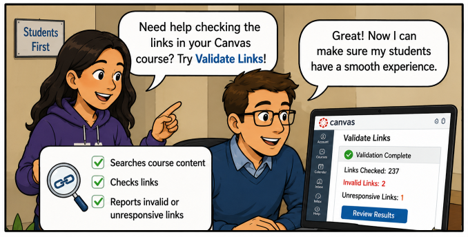
Reduce student frustration: validate links in your Canvas course!
Canvas Validate Links feature helps identify broken, invalid, or unresponsive links before students encounter them. As courses are updated and reused, links can become outdated, unpublished, or deleted.Rather than checking links manually, Validate Links scans both published and unpublished course content and identifies potential issues. Reduce student frustration and support requests while helping create a smoother, more reliable learning flow.Validate Links is especially useful before the start of a semester, after importing course content, or whenever significant course updates are made.
To learn more on how to use the Validate Links feature, visit the Canvas Guides: How do I validate links in a course?
| Missed a tip? Bookmark Digital Learning's Canvas QuickTip Archive and access expert guidance whenever you need a refresh to use Canvas more efficiently and effectively. CLICK to browse the Archive. | |
Next Academic Affairs Newsletter Deadline
Content submission deadline for the next edition: Monday, 5 p.m., August 24. The newsletter will run on Monday, August 31.
| | |
CALLING ALL FACULTY!
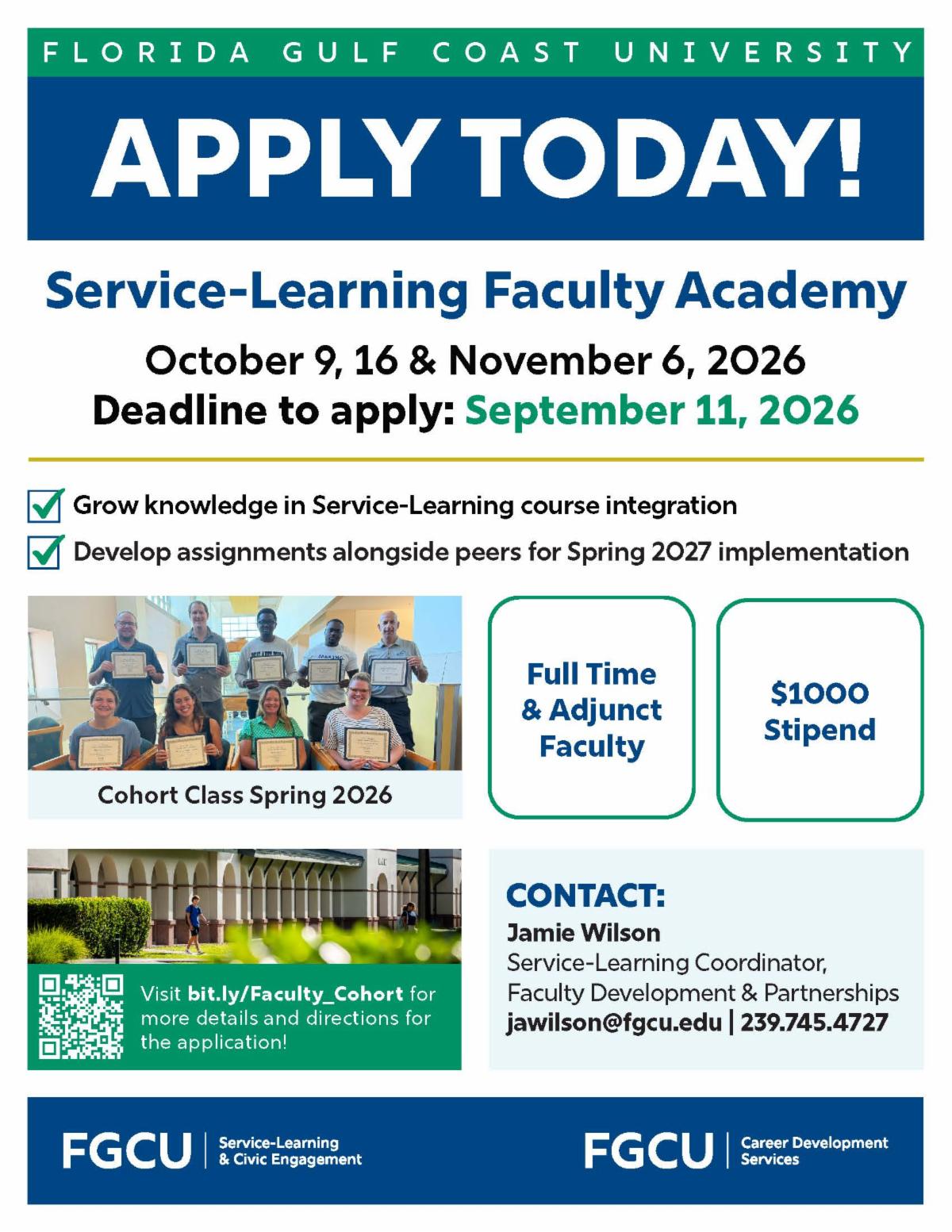
Join over fifty of your colleagues of Service-Learning Faculty Academy graduates and apply to the Fall 2026 Cohort!
The Office of Service-Learning and Civic Engagement welcomes all full-time and adjunct faculty members to apply today!
The Fall 2026 Cohort will be held October 9th, 16th, and November 6th. Faculty must apply by September 11, 2026. Participants will receive monetary compensation of $1000 for attending all in-person sessions along with integrating an approved Service-Learning assignment within their course.
What can Cohort members expect?
· Explicit instruction on Service-Learning best practices and terminology
· Exploration of Service-Learning methods and applications
· Panel discussion from past cohort members and community partners
· Assignment, project, and syllabus development
Application package includes:
· Current CV
· Description of course in which you propose integrating-service learning
· Letter of support from department chair along with confirmation of course
Questions and application materials can be sent to Jamie Wilson, Coordinator of Faculty and Community Partnerships at jawilson@fgcu.edu to be considered for the Fall 2026 Service-Learning Academy.
Cohort Criteria & Compensation
Faculty currently teaching course(s) with a Service-Learning attribute or those who are interested in integrating Service-Learning for the first time are encouraged to apply. $1,000 to be awarded after the completion of the Cohort Workshops and Spring 2027 syllabus assignment has been reviewed and approved by the Office of Service-Learning and Civic Engagement.
| | |
Career Advancement Assistance Program
The Office of Academic Affairs is pleased to announce the Career Advancement Assistance Program. The purpose of the Career Advancement Assistance Program is to provide time for faculty members to engage meaningfully in activities that yield outputs and impacts enhancing FGCU’s scholarly impact and timely promotion of faculty members.
- Faculty categories included in this initiative are those on the professor and instructor tracks. The Career Advancement Assistance Program partially relieves teaching obligations to provide time for scholarly, research, or career development endeavors. During the Career Advancement Assistance Program, faculty teaching load and/or other assignments will be reduced, and no overload teaching will be permitted.
- The number of awards is contingent on the availability of funding through the Provost’s office.
-
The deadline for the Spring 2027 Career Advancement semester is Tuesday, September 15, 2026. Please submit your application in its entirety to Julie Leyden (jleyden@fgcu.edu).
-
The deadline for the Summer 2027 Career Advancement semester is Monday, November 16, 2026. Summer semester is now available for 12-month AND 9-month faculty. Please see the guidelines for details.
Access the application cover page and detailed information about the program here:
| |
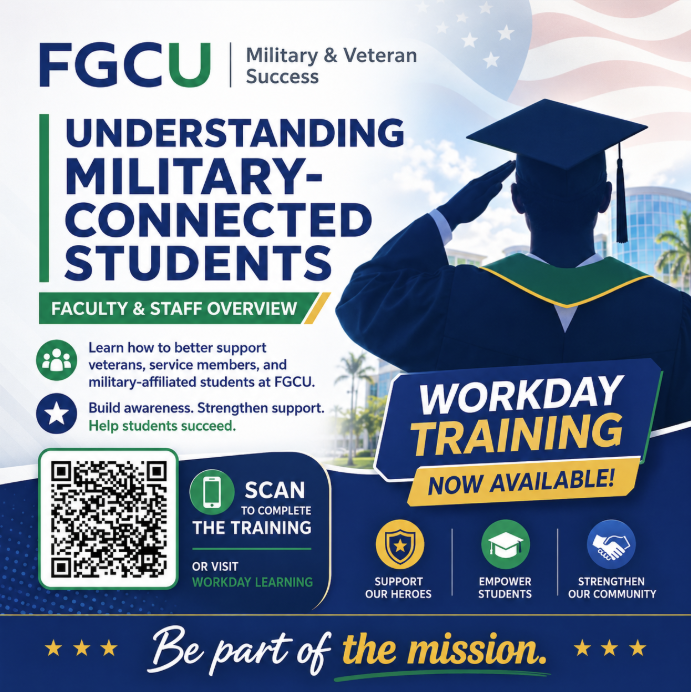
Military & Veteran Success Office Launches Faculty and Staff Training to Support Military-Connected Students
Florida Gulf Coast University’s Military & Veteran Success Office is inviting faculty and staff to complete a professional development training designed to strengthen campus-wide support for military-connected students. The training, Understanding Military-Connected Students: Faculty & Staff Overview, is now available in Workday Learning and provides an introduction to the experiences of student veterans, active-duty servicemembers, reservists, National Guard members, and military-affiliated family members.
As a Florida Collegiate Purple Star Campus, FGCU is committed to creating an environment where military-connected students feel recognized, supported, and empowered to succeed. This training supports that commitment by helping faculty and staff better understand the unique strengths, challenges, and transitions that may shape the student experience for veterans, servicemembers, and military-affiliated families. Participants will gain a broader understanding of military-connected student populations, learn ways to build awareness and strengthen support, and identify practical approaches for helping students connect with campus resources.
The Military & Veteran Success Office encourages all FGCU faculty and staff to complete the training as part of the university’s ongoing mission to support student success and foster an inclusive, informed campus community. The training is available through Workday Learning. Faculty and staff may access it by scanning the QR code on the promotional flyer or by searching for "Understanding Military-Connected Students: Faculty & Staff Overview" in Workday. For more information, contact the Military & Veteran Success Office. Be part of the mission.
| |
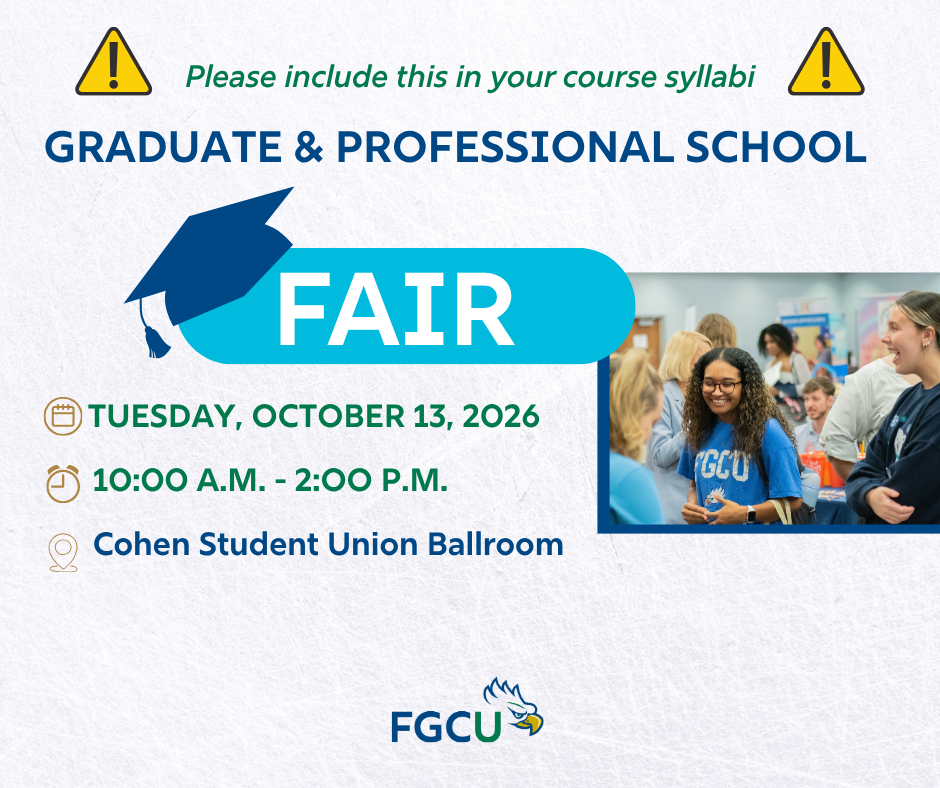
SAVE THE DATE!
Graduate & Professional Schools Fair
Cohen Student Union Ballroom
October 13, 2026
10:00 a.m.- 2:00 p.m.
The entire Eagle community is invited! Please include this in your
course syllabi.
This fair is open to all FGCU students interested in exploring graduate and professional school opportunities. Three easy ways you can help:
- Promote the event by adding it to your undergraduate course syllabi as an assignment, a class activity, extra credit, or an announcement.
- Encourage attendance by highlighting the value of early graduate and professional (law, medicine, etc.) school exploration.
- Showcase your graduate program by attending the fair and engaging with prospective students who are eager to learn more about FGCU’s graduate offerings.
Visit the event page Graduate & Professional School Fair for the latest information.
Questions? Contact Dr. Dawn Kirby, Shannon Acosta, and Jessica Rhea.
| |
|
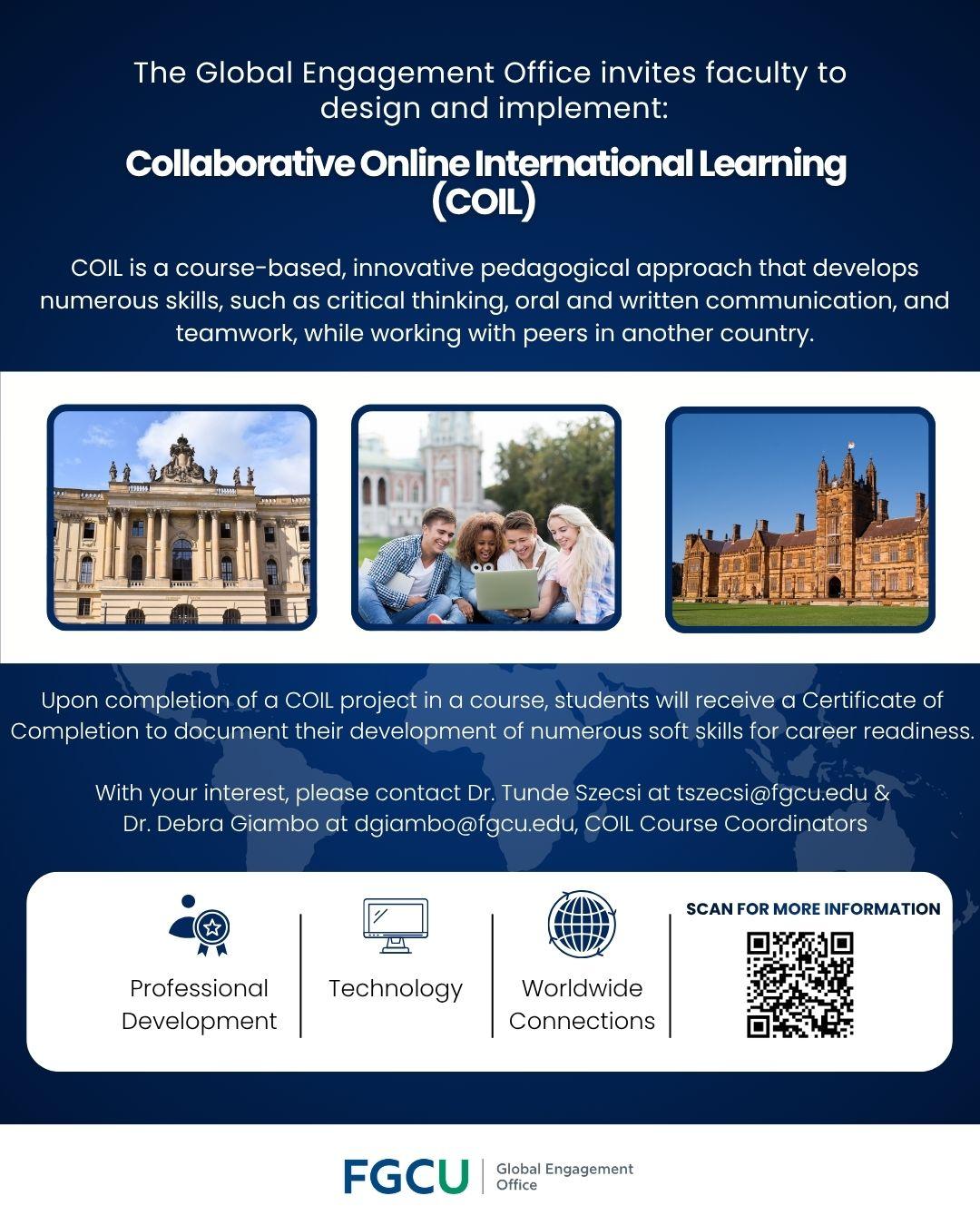
The Global Engagement Office (GEO) invites you to design and implement -
Collaborative Online International Learning (COIL)
| |
Office of Research & Sponsored Programs (ORSP) | | |
Webinar: Hanover Resources
Navigating the Changing Landscape of the Federal Proposal Review Process
ORSP invites you to join Hanover Research for a webinar on best practices for navigating the evolving federal funding landscape. During this session, we will review major changes in funding practices, with a particular focus on the impact on the proposal review process. Using examples from NSF and NIH, we will explore key considerations, encourage discussion, and address questions. Come prepared to engage and feel free to bring questions specific to your work. Contact Julie Leyden at jleyden@fgcu.edu to RSVP.
Tuesday, August 25
12:00 p.m. - 1:00 p.m.
In Person SRHM225 or Microsoft Teams
| |
Why Research Compliance Education Matters?
Understanding export controls, foreign influence, conflict of interest reporting, and research compliance helps protect your research, your collaborators, and your professional reputation. These requirements are designed to support open scholarship while ensuring compliance with federal laws that govern international collaborations, funding sources, data sharing, and technology use. Staying informed allows you to engage confidently in global research partnerships, avoid unexpected delays or disruptions to your projects, and reduce personal and institutional risk. Ultimately, research compliance education empowers faculty to focus on what they do best—advancing knowledge and discovery, while safeguarding academic freedom, research integrity, and continued eligibility for external funding.
Read more here: FGCU - Research Compliance
| |
|
Notice of Hanover Grant Academy 2026-2027
The Office of Research and Sponsored Programs (OSRP) is soliciting nominations for the 2026-2027 Hanover Grant Academy. The goal is for eight faculty to undergo an intensive proposal development plan over a one year time frame. The Academy consists of approximately 4-6 in person meetings during the year and one on one meetings with the Hanover experts.
The requested information for application can be accessed here. A key factor in selection will be the goal of submitting a proposal for extramural funding. Hanover will provide grantsmanship training, proposal critique, guidance on project and alignment with grant opportunities, and proposal revision assistance. Faculty selected are expected to submit a proposal for extramural funding at the completion of the grant academy. Faculty are permitted to apply for an additional round of intensive proposal development assistance provided an application for extramural funding was submitted during their previous participation.
The application submission deadline is September 14, 2026 by 5 PM. Please submit the application as a single pdf to Dr. Rosemary Higgins rhiggins@fgcu.edu. Questions can be referred to Dr. Higgins.
| |
Notice of Intent for Extramural Proposals
The Office of Research and Sponsored Programs (ORSP) has Streamlyne in place for PreAward Applications. If you are unsure about a submission and not quite ready to enter your request into Streamlyne, ORSP has developed a Notice of Intent (NOI) for Principal Investigators or Project Directors to complete to request a consultation for proposal submission for extramural funding. The NOI requests information for the investigator, proposal, and agency. This will assist applicants and ORSP in facilitating the process of applications.
ORSP can also review the request for proposal for details regarding required information to guide investigators on required elements for a submission. Some proposals are quite simple; others require a significant number of documents.
The NOI can be found at: https://fgcu.formstack.com/forms/notice_of_intent_form.
| |
SciENcv Update
NIH and NSF now require that the PI and all Key Personnel generate their Biosketches and Current & Pending Support documents for every proposal submission through SciENcv. They also require an ORCID iD to be linked to SciENcv.
If you have not yet signed up for an ORCID iD number, please do so as soon as possible to avoid any delays at the time of proposal submission. If you have not yet created a SciENcv account to maintain your Biosketch and Current & Pending, ORSP suggests that you do so now.
There are several ways to log in to SciENcv; however, the most efficient method is through login.gov. If you do not already have a login.gov account, you should first create one using your FGCU email address and then use it to set up your SciENcv account.
To create an ORCID iD, go to this link and sign up where indicated. If you already have your SciENcv and ORCID ID accounts, the SciENcv site will prompt you to link the accounts.
ORSP is aware of ongoing issues and delays in responses from the associated help desks. Please contact ORSP early so we can assist you with generating Biosketches and Current & Pending Support documents that are compliant with grant submission requirements.
| | |
Required Training for NSF and NIH Submissions
The U.S. National Science Foundation (NSF) has required training starting December 2, 2025. The new requirements set forth in NSF Important Notice No. 149 will take effect.
What you need to know:
- Proposals submitted before December 2, 2025, including those submitted during the recent lapse in appropriations, are not subject to those requirements originally set to take effect on October 10, 2025.
- As of December 2, 2025, such new certifications are required at the time of proposal submission within the Cover Sheet, Biographical Sketch, and Current and Pending (Other) Support forms. These include new certifications related to:
- Completion of research security training by all senior/key personnel; and
- An institution of higher education’s status regarding contracts or agreements with any Confucius Institute.
- Organizations are required to provide supporting documentation, including copies of grants, contracts, and agreements, upon request by NSF.
-
You are instructed to take this course, download and save your completion certificate and provide it to ORSP_preaward@fgcu.edu. This certificate must be uploaded with your proposal to NSF.
-
To assist research organizations and investigators, NSF has published a Frequently Asked Questions (FAQ) web page summarizing the new requirements, certification procedures, and relevant timelines. Access the FAQs here.
Training can be done using the following link and takes 45-60 minutes: https://www.secure-center.org/ctm.
NIH research security training (RST) becomes mandatory for applications submitted for due dates on or after May 25, 2026 - https://grants.nih.gov/grants/guide/notice-files/NOT-OD-26-017.html
If you have questions, please reach out to ORSP.
| |
The next regular edition will run on August 31.
Submit your content by Monday, 5 p.m. August 24.
| | | | |