|
Pediatricians depend on paramedics to care for their patients. They are often the first medical professionals to assess and stabilize a critically ill or injured child. Paramedics can manage the airway, provide oxygen, give medications, start IV/IO access, and transport the child to an Emergency Department or hospital safely.
Physicians at the hospital or ED receive the patient, review the care provided in the field, and set the treatment plan. Access to pediatric tertiary care often means transportation of ill and injured children from one hospital to another, often by paramedics.
Pediatricians depend on paramedics to provide competent care, to manage a smooth handoff, and we need them to have experience handling diverse pediatric emergencies. The best way for them to gain this knowledge is through clinical and field education with consistent and frequent exposure to all age groups. Ideally, this exposure comes during their paramedic education.
The reality is that less than 10 percent of EMS responses involve pediatric patients, which makes pediatric clinical education opportunities – in a hospital, clinic or private practice – so essential. It is these experiences, in relatively “controlled” environments staffed with pediatric experts, where paramedic students will get the necessary volume and variety of pediatric conditions while being appropriately mentored and supervised. This is also the best environment for paramedic students, many of them young adults themselves, to learn how to recognize both normal and abnormal conditions and practice how to engage with children and their parents.
Unfortunately, too many paramedic educational programs are struggling to maximize clinical learning experiences of pediatric patients.
The challenge is not limited to pediatrics: new survey data from the Committee on Accreditation of Educational Programs for the EMS Professions (CoAEMSP) revealed over half (55%) of the accredited paramedic education programs in the United States have experienced a decrease in access to clinical facilities. To make matters worse, this survey demonstrated that exposure to the following pediatric age groups were the most challenging ones for paramedic programs to access with: 80% have trouble accessing and evaluating neonates, 65% infants, 52% toddlers and 41% preschool aged children.
Paramedic education accreditation standards require programs to ensure that students are able to demonstrate competency to enter the profession, and meaningful clinical and field experiences are critical. That is the value of accreditation. Those standards ensure high quality education that results in a reliable, consistent, and competent workforce, which in turn can enhance healthcare outcomes.
We know pediatricians want to be helpful but it’s increasingly difficult due to a combination of time pressures, lack of awareness, patient concerns, and institutional priorities that limit their time and availability. That said, we also know that when pediatricians give paramedic students more access to learn, they help improve patient outcomes while building provider confidence when caring for children and their families.
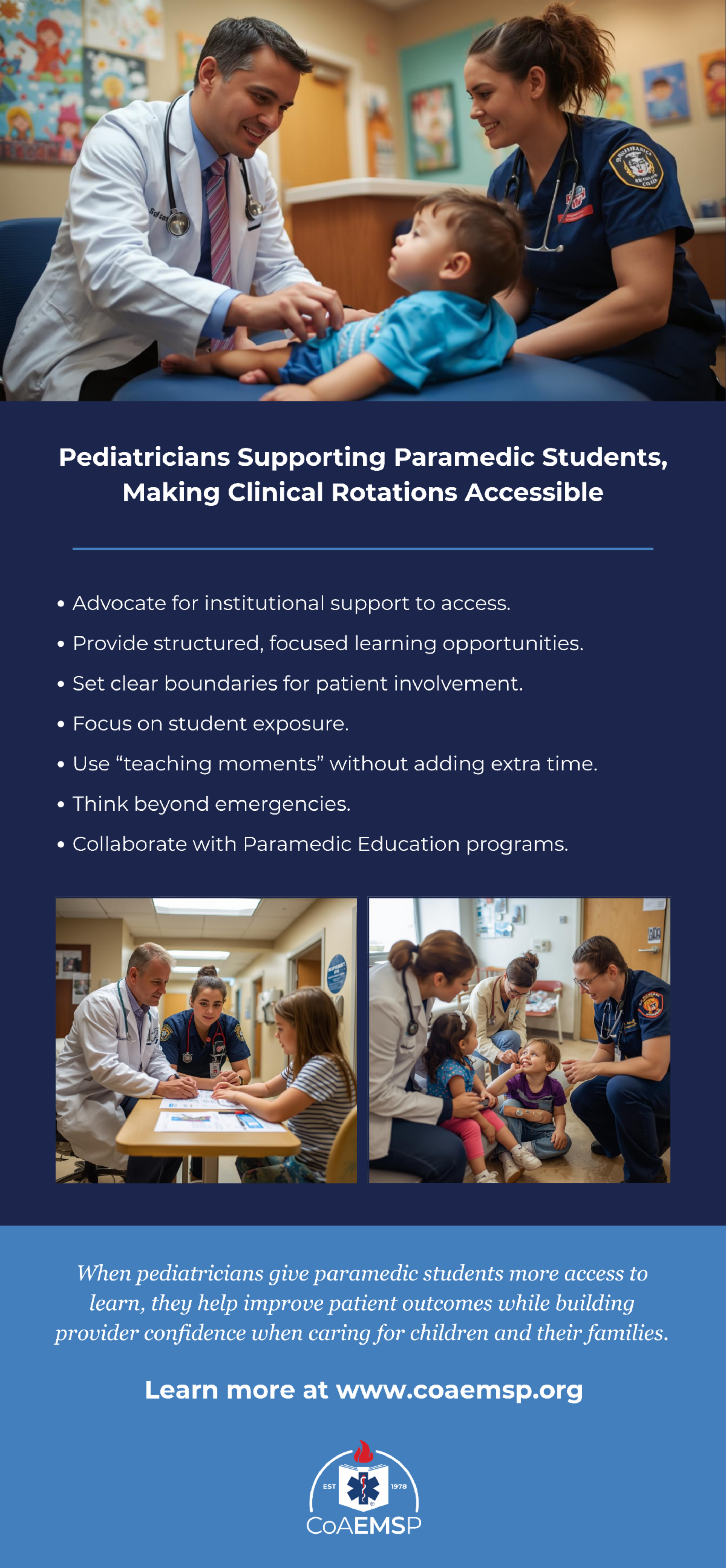
So how can pediatricians help make clinical rotations more accessible and meaningful for paramedic students?
|