Advisor Solutions - Summer 2026 | | |
Hello and Happy Summer! 🍨
At the CFMC, we know that summer often brings a fresh perspective and a closer look at what clients truly value. Whether you’re navigating clients’ complex life events, exploring advanced planning strategies or responding to changes in the tax landscape, your role is critical in shaping outcomes that benefit both your clients and the community.
In this edition, we’re exploring important planning opportunities that are often overlooked in charitable giving. From understanding how life transitions such as divorce can affect charitable assets to learning about time-tested giving strategies like Charitable Gift Annuities and Charitable Remainder Trusts, our goal is to help you navigate these decisions with confidence. The CFMC team is here to provide guidance, answer questions and help your clients create a charitable plan that reflects their values while supporting the causes they care about most.
-
Looking Ahead: be sure to check out upcoming CFMC Events and Announcements
We hope you're enjoying the summer and encourage you to make the CFMC your first call whenever charitable giving conversations arise. We look forward to continuing our work together.
Thank you for your partnership!
| | What happens to charitable assets in a divorce? | | |
As you work with charitable clients over the course of your career, you’ll likely help dozens of married couples establish donor advised funds and other types of funds at CFMC, structure charitable gifts in wills and trusts, establish charitable remainder trusts and everything in between.
But what happens to charitable assets in the event of divorce?
For some couples, philanthropy is deeply personal and reflects shared values developed over time. For others, keeping finances, trusts and charitable giving separately is the preferred approach. The key is engaging with clients in the way they are most comfortable and acknowledging each donor as they wish to be recognized.
From a legal standpoint, however, charitable giving during marriage is not purely personal, it is often subject to the same rules that govern other marital assets. Because California is a community property state, assets acquired during marriage are generally considered jointly owned and spouses owe fiduciary duties to one another regarding the use of those assets. That framework can create complications when one spouse makes a significant charitable gift without the other's knowledge or consent. Unilateral gifts of community property may be challenged, and in some cases, the full value of the gift may be attributed back to the donating spouse in a divorce proceeding. This may surprise clients who assume charitable intent alone resolves questions of ownership or control.
The implications extend beyond outright gifts. Philanthropic vehicles such as donor advised funds, private foundations and charitable trusts can also become points of negotiation in divorce. These structures may no longer be considered part of the marital estate once funded, but questions about control, governance and ongoing advisory privileges can still create tension between spouses.
The key takeaway is that charitable planning should be coordinated with a client's broader legal and financial planning. At the CFMC, we understand that discussing significant gifts with both spouses, documenting shared intent and involving legal and tax counsel when appropriate can help prevent future disputes while preserving philanthropic goals. As clients navigate life transitions, we are here to help implement charitable strategies alongside their professional advisors.
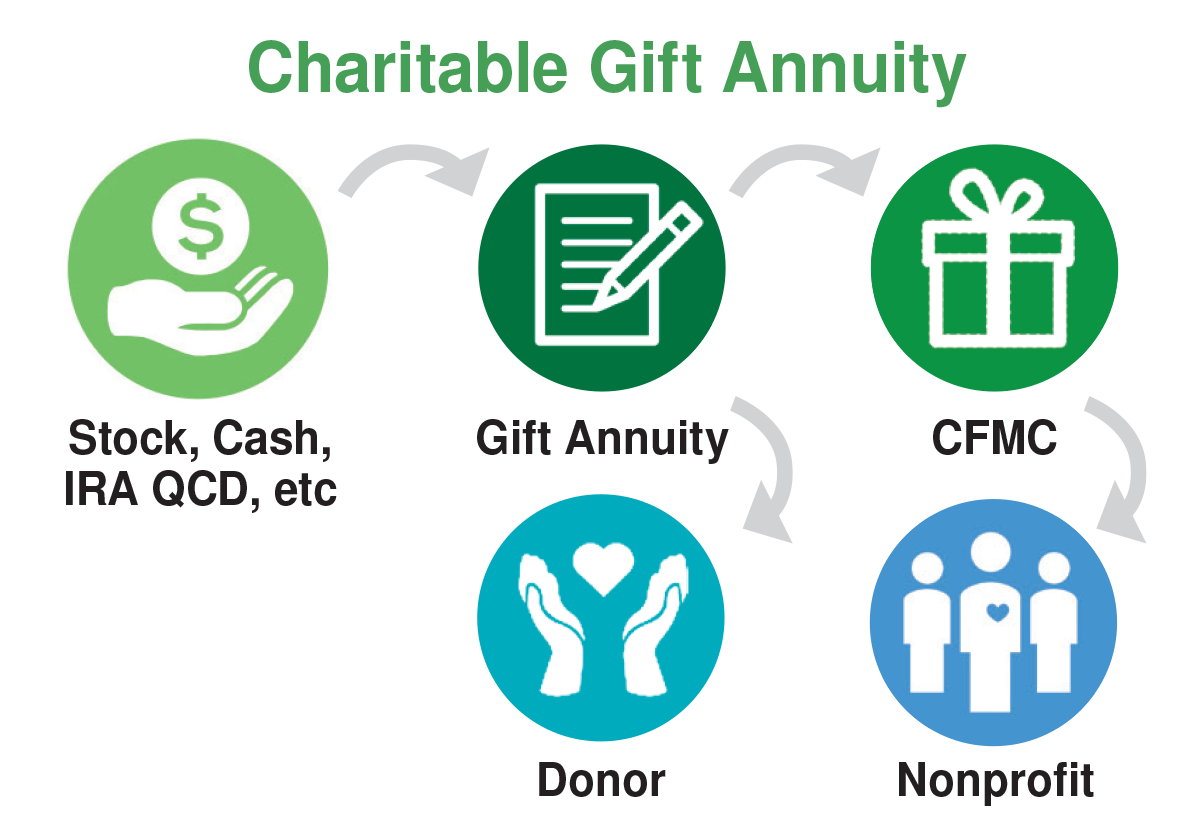
| | Split-interest Charitable Gifts: Need-to-know FAQs and Scenarios | | | | As charitable planning conversations become more sophisticated, many advisors are revisiting so-called “split-interest gifts” to help clients balance philanthropic goals with income needs. Two of the most common strategies, a charitable gift annuity (CGA) and a charitable remainder trust (CRT) can both provide clients with lifetime income while ultimately benefiting charitable causes. | | |
What do CGAs and CRTs do for a client?
Both a CGA and a CRT allow your client to make an irrevocable charitable gift while retaining an income stream for life or for a term of years. In both cases, your client may qualify for an immediate charitable income tax deduction and a portion of future payments may receive favorable tax treatment. In short, people use CGAs and CRTs to save taxes, make a gift to charity and create an income stream.
CGA Scenario: Sample Gift - Taylor Alvarado
On her 75th birthday, Taylor reached out to the CFMC to establish a Charitable Gift Annuity. With a $50,000 appreciated stock donation and a $10,000 cost basis, Taylor will create a CGA with a 7% fixed return and:
- receive an immediate income tax deduction of $20,389.50
- receive $3,500 fixed payment for life
- reduce and extend the reportable capital gains over 12.4 years, the expected lifetime of the donor age 75
- fund her charitable legacy by creating an endowed fund to benefit her favorite nonprofit
- may enjoy reduced probate costs and estate taxes
CRT Scenario: Sample Gift - Joe and Mary Alvarado
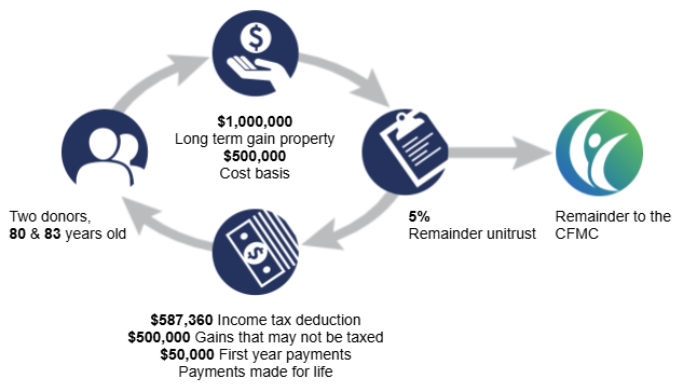
Joe and Mary Alvarado are 80 and 83 years old, they own a rental home in Salinas appraised at $1 million that they no longer want to manage, but they like the income the property produces. The cost basis of property is $500,000. By establishing a CRT funded with real estate they:
-
receive an immediate tax deduction of $587,360 (can be spread out over 5 years)
- receive variable payment for life ($50,000 in the first year; future payment will vary with trust value)
- reduce a large portion of the capital gains taxes
- fund their charitable legacy by creating an endowed fund to benefit their favorite nonprofits
- may enjoy reduced probate costs and estate taxes
| |
Which option is better for clients contributing larger assets?
CRTs are often better suited for clients contributing larger more complex assets. Because the trust can sell appreciated assets without triggering immediate capital gains tax within the trust, CRTs are frequently used in connection with highly appreciated real estate, concentrated stock positions, or even business interests prior to a sale.
Clients who want greater flexibility, longer-term wealth planning opportunities, or inflation-sensitive income may prefer a unitrust structure over the fixed nature of a CGA.
When is a CGA better?
A CGA is an administratively easier one to set up over a CRT, requiring just a simple contact between the CFMC and the donor. You may also recall that a technique called a “Legacy IRA” was created by the SECURE 2.0 Act, allowing taxpayers aged 70 ½ or older to make a one-time election for a tax-free Qualified Charitable Distribution to certain CRTs or CGAs. Clients who want to take advantage of the Legacy IRA may find that a CGA is better suited to their needs.
| |
What's the first step in exploring CRTs and CGAs?
Start the conversation early. Because split-interest gifts involve multiple financial, tax and charitable considerations, we often collaborate with advisors to evaluate the client's goals, funding assets, gift size, income needs, beneficiaries and overall strategy. These solutions aren't just for ultra-high-net-worth clients, they can help many donors create lifetime income while making a meaningful charitable impact.
Whether you're discussing split-interest gifts or helping clients navigate life's many transitions, our team at CFMC is here to help. If you've made it this far, give us a call and mention "banana split" to Anna or Ceci and we'll treat you to one the next time we get together. It's our way of thanking attentive readers.
| | Looking Ahead: Upcoming CFMC Events and Announcements | | Women, Wealth & Impact: Financial Planning and the Power of Charitable Giving on September 23 & 24, 2026 | | | | Join us on September 23 & 24 for an inspiring two-part event at the CFMC Monterey and Salinas offices. Discover how women are shaping the future of philanthropy and creating lasting community impact through charitable giving. Gain valuable insights from leading experts in finance, estate planning and tax strategy including Julie Roth, Advisor, Integris Wealth Management, Jennifer L. Walker, Attorney and Shareholder, Leach & Walker, A Professional Corporation and Gina Cochetti, Managing Principal, CLA (CliftonLarsonAllen LLP) and learn practical ways to align your financial goals with the causes you care about most. Be on the lookout for more details to come soon. | | On June 24th, the CFMC held a Scholarship panel sharing how scholarship funds address real gaps for local students and deliver measurable impact, offering a clear path for clients who want to invest in education. You can learn more by watching the video recording HERE or by clicking below. | | | | It is now easier than ever to answer donors’ questions about opening a charitable fund. Your clients can get started directly through the "Create a Fund" button on our CFMC website. | |
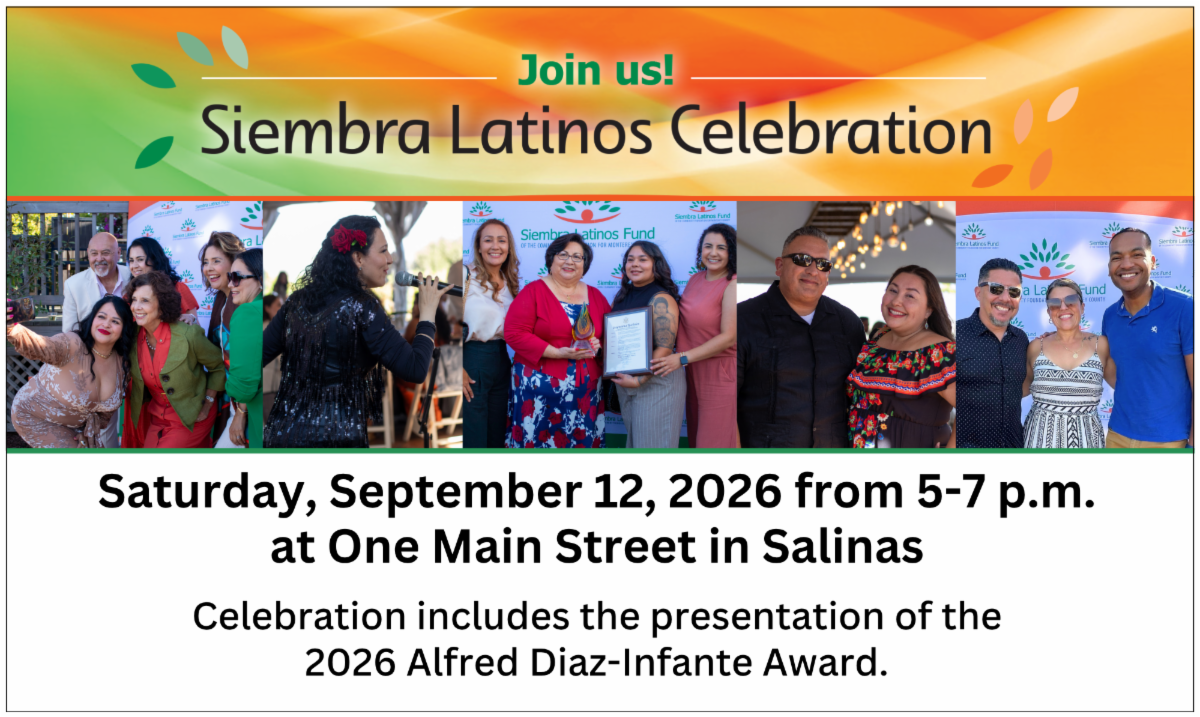
The 9th Annual Siembra Latinos Celebration on Saturday, September 12th will celebrate the impact of the Latino community and the power of collective giving. The event includes delicious food and wine, live music performed by Nancy Cordiel and inspiring stories, all leading to the presentation of the 2026 Alfred Diaz-Infante Award. You won't want to miss it! | | The team at CFMC is pleased to be a resource and sounding board. We understand the charitable side of the equation and are happy to help you find the best solutions to meet your clients’ needs. Please contact us if we can be of assistance. | | |
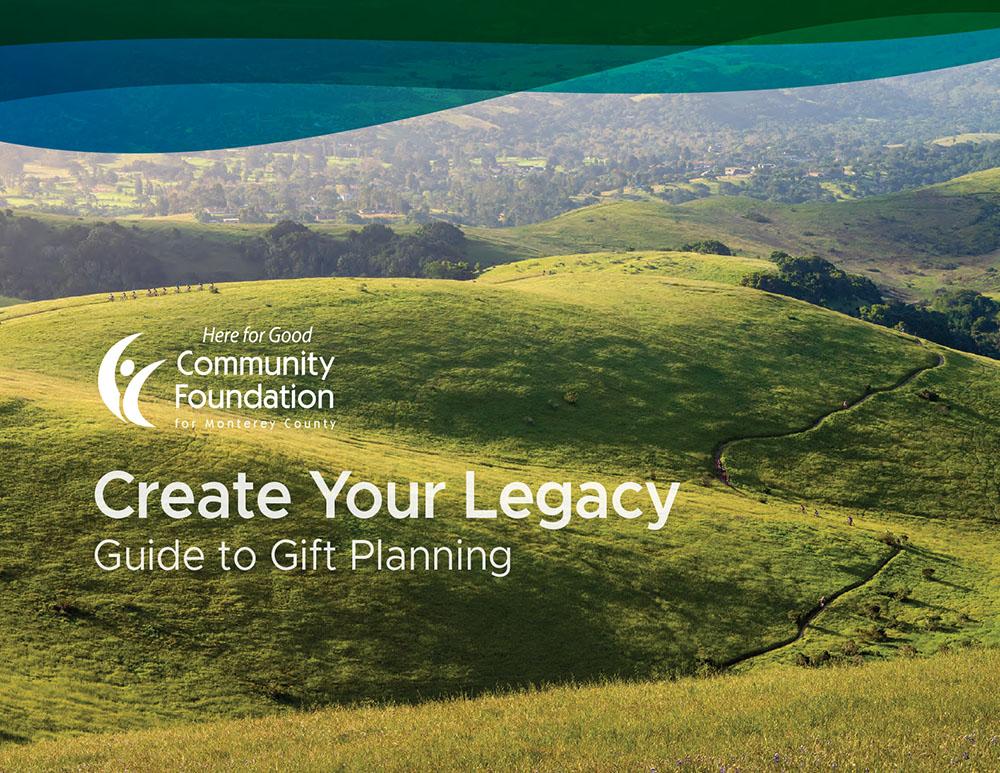
This useful guide covers many ways donors can give during their lifetime or through their estate including:
| | | This newsletter is provided for informational purposes only.
It is not intended as legal, accounting or financial planning advice. | | To inspire philanthropy and be a catalyst for strengthening communities throughout Monterey County | | | | |