| | |
POLICY & ADVOCACY UPDATE
Issue #52, 14 August 2025
| | | |
- Engagement and advocacy update
- Tourism & hospitality careers and jobs site eeger fully launched
- Latest ACCC report on domestic airline capacity
- Capital city preliminary data 7 months to July
- Overseas arrivals June 2025
| |
| | |
3 things for you to do today to support the industry's jobs and careers platform eeger.com.au:
- Register on eeger to build your employer profile
-
Follow eeger on LinkedIn to stay in touch
- List your job vacancies on the site that has been developed for industry by industry
| | | | | |
Engagement and advocacy update
As the national political focus switches to the Productivity roundtable scheduled for next week, AA continues to advocate on the key issues impacting our sector. Of frustration to the business community, the government stated that workplace relations was off the agenda for discussion, but this did not stop the ACTU calling for a 4-day working week without loss of pay. How that will help in lifting productivity only the ACTU can tell. Meanwhile, the PM and Treasurer are both playing down expectations of the roundtable, focusing on red tape issues and saying in the media that the roundtable was about providing advice and not making decisions. Concurrent to this build up to the roundtable, AA has taken the opportunity to engage with both the Prime Minister Anthony Albanese (pictured left with AA Chair David Mansfield and CEO James Goodwin) and the Treasurer Jim Chalmers (below and left).
| | | In the last two weeks we have also raised concerns about the extension of the NABERs building rating system to hotels to the Minister for Climate Change and Energy, Chris Bowen. It was clear from our meeting last Thursday that he was aware of the plans and indicated it should happen as part of the government's ambition to achieve net zero emissions. However, the Minister indicated that he was willing to work with us on implementation in order to get it right for hotels. Yesterday, we also met with the Assistant Minister for Immigration, Matt Thistlethwaite (pictured bottom right with myself) where we had the opportunity to raise skilled migration, chef shortages and the definition of specified work for working holiday makers. He recognised the important role WHM played in the workforce, particularly in industries such as hospitality, but noted that the unions still wished to see changes to address exploitation concerns arising from the farming sector. AA was also made aware that some stakeholders (particularly those who would benefit) are agitating for WHM's to undertake English language tests. AA would oppose such a move as it would add to costs, build additional barriers for the WHM, and would be contrary to the important cultural exchange aspect of the visa. Many WHM come here to improve their English language skills. | | | From L to R: AA Chair David Mansfield, Treasurer Dr. Jim Chalmers and AA CEO James Goodwin. | |  | AA National Policy Director Jenny Lambert with Assistant Minister for Immigration Matt Thistlethwaite. | | |
Eeger fully launched
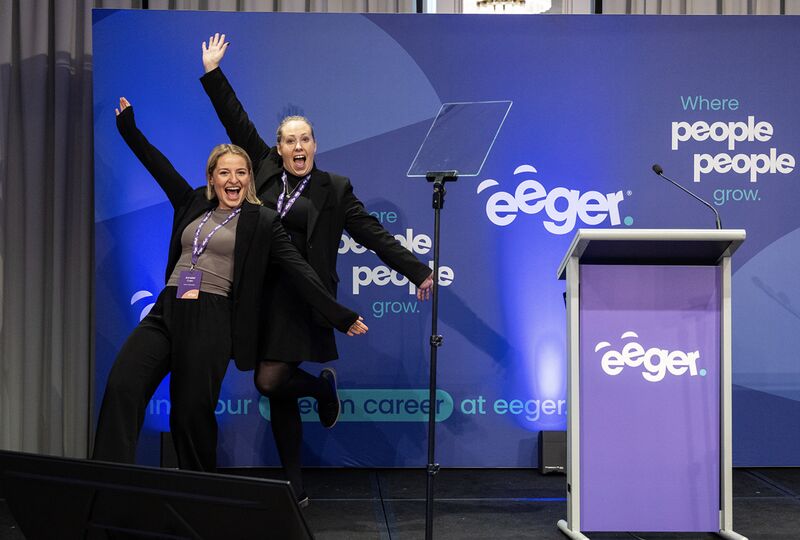
After an exhausting two weeks on the road launching eeger.com.au to industry around Australia, the eeger team led by Emilie Howe are back at homebase and ready to assist members with any queries about the new site, and encourage as many employers across tourism, travel and hospitality to register and list their job vacancies. The new website has been developed with the support of a government grant which includes a significant investment in marketing to job seekers and students seeking more information about careers and jobs in the industry. It is important we all get behind this important initiative as it is in everyone's interest that it is a success. You are encouraged to take three actions today, and if not you, then please pass it on to the person responsible:
- Register on eeger to build your employer profile
- Follow eeger on LinkedIn to stay in touch
- List your job vacancies on the site that has been developed for industry by industry
| | Attendees at the Sydney eeger launch having a look at the new website created by industry for industry. | | Time for the industry to celebrate the new jobs, training and career platform for the tourism, travel and hospitality industry. . | |
Latest ACCC report on domestic airline capacity
The ACCC's latest Domestic Airline Competition Report has found that the number of passengers flying domestically in Australia each month as returned to pre-pandemic levels but growth in the total number of seats provided by domestic airlines has not kept pace with demand. In June 2025, the number of seats flown by the major airlines was 2.8 per cent lower than in June 2019. Although both the Qantas Group and Virgin Australia have increased capacity since 2019, the industry has not yet filled the gap left by Tigerair’s exit from the market in 2020. Furthermore, Rex has reduced capacity on its regional services over this time. The ACCC said that the lack of growth in seat capacity to meet rising demand has likely meant consumers are paying more than they would have in a more competitive, better-supplied market. Despite jet fuel prices falling by 12.3 per cent in the year to June 2025, the average airfare across all fare types was slightly higher in June 2025 than it was a year earlier. After several years of delays in the delivery of aircraft and global supply chain issues, both the Qantas Group and Virgin Australia are expected to receive new aircraft in the second half of 2025. The Qantas Group’s fleet will also increase following its decision to close Jetstar Asia, resulting in the redeployment of 13 aircraft to Australian and New Zealand routes.
In terms of service reliability the ACCC reported that the on-time performance rate for domestic air travel reached a three-year high in April 2025 following sustained industry efforts to improve the reliability of arrival times. Domestic flights arrived at their destination on-time 82.4 per cent of the time in April, with Jetstar, Qantas and Virgin Australia all beating the long-term industry average of 80.7 per cent. In April and May, Virgin Australia recorded the best on-time arrival rate for any domestic airline since February 2022, when its flights arrived on-time 84.4 per cent and 84.8 per cent of the time, respectively. Cancellation rates have also improved and were below the long-term industry average of 2.2 per cent in April and May before increasing slightly to 2.4 per cent in June.
| | |
Capital city preliminary data 7 months to July
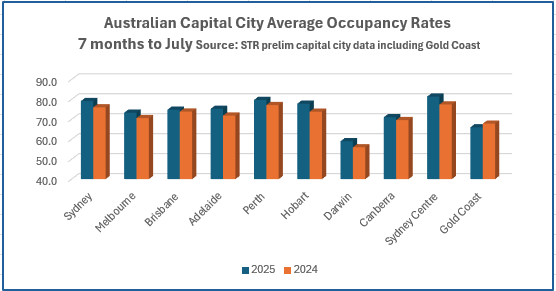
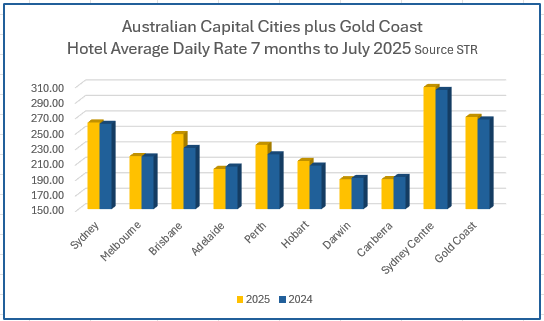
Preliminary capital city STR data for the seven months to July 2025 show that average occupancies were higher in all cities over the period compared to last year, although Gold Coast is still lagging due largely to the cyclone effect in March. The average daily rate picture improved due to a bumper July (see last Advocacy Update for the stats for capital cities in July) and was on average down only in Adelaide, Darwin and Canberra compared to the first seven months in 2024. Brisbane remained the best performer for ADR, up 7.8%, with Perth up 5.6% and Hobart 2.9% for the seven months to July compared to 2024. As noted in the last advocacy update, there is no doubt the Lion's tour was a significant positive factor in stronger occupancies and ADR in July in those cities that hosted games.
Preliminary data for the first nine days of August indicates a continuation of the strong performance in July with all capital cities except Perth experiencing an increase in occupancy compared to the same time last year. With the Lions final test on 2nd of August, Sydney was particularly strong, up 7.5% on occupancy and 17.1% on ADR. Occupancy was also strongly up in Melbourne (+10%) although the ADR rise was a more modest 2.5%. Brisbane's experience was the opposite to Melbourne, with occupancy up 1.2% but ADR up 15.1%.
The graphs below derived from the STR preliminary capital city data show the average performance of occupancy and ADR in the seven months to July 2025 compared to the previous year.
| | |
Overseas arrivals for June 2025
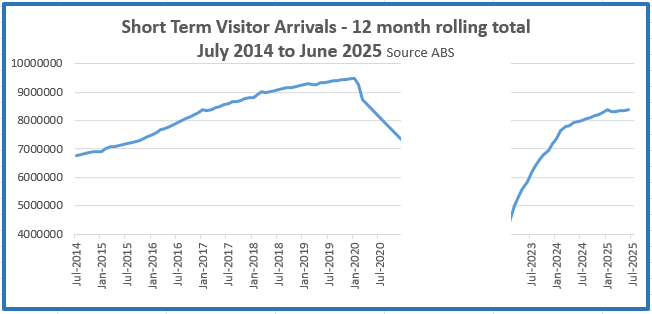
According to the ABS data released today, there was an increase of 6.3% in short-term visitor arrivals in June 2025 to 624.510 compared to the same month last year. Although this is an improving trend, the arrival number is still 5.4% below pre-COVID, when 660,340 short term visitors arrived in Australia in June 2019. New Zealand was the largest source country in June 2025, accounting for 19.0% of all short term visitor arrivals. NZ was followed by Singapore and China. Of the top ten origin countries, New Zealand, Singapore and Japan had more arrivals than June 2024. In June 2025 there were 46,560 international student arrivals to Australia, an increase of 7,330 students compared with the corresponding month of the previous year. The number of student arrivals in June 2025 was 1.1% higher than the pre-COVID levels in June 2019..
The 12-month rolling total arrivals tell a more useful story, illustrating how far we still need to go to return to pre-COVID visitors, particularly for holidaymakers. In the year to June 2025, there were 8.4 million arrivals up by 5.5% on the year to June 2024. As the graph below shows, you need to go back to 2017 to see a similar yearly total (excluding all of the COVID-impacted years). For international holiday makers the picture is even more sobering as you need to go back to early 2016 to see a similar yearly total to the 3.65 million holidaymakers that arrived in the year to June 2025. Between June 2016 and May 2020, the yearly rolling total of holidaymakers was over 4 million, reaching 4.5 million in the year to Jan 2020.
| | |
Drop me an email at policy@accommodationaustralia.org or give me a call on 0418 277 919 if you have any national policy issue that you think AA should be following up. If you know an AA member who is not receiving this advocacy report but wants to, then encourage them to email me and we can add them to the distribution list. Back issues of the fortnightly advocacy updates can be found here.
Kind Regards
Jenny Lambert OAM
National Policy Director
Accommodation Australia
| | | | |