| | |
POLICY & ADVOCACY UPDATE
Issue #61, 18 December 2025
| | | | |
- From the AA CEO James Goodwin
- Activity around STRA ramps up
- Tourism contribution to economy driven by international tourist spend
- Characteristics of employment - casuals preferring to work as casuals
- International airline capacity increasing
- Capital city hotel performance in early December 2025
- Overseas arrivals for October 2025
The next Advocacy Update will be 15 January 2026.
| |
| |
From the AA CEO
The terror attack at Bondi this week has shocked and saddened us all.
Our thoughts are with the victims, their families and loved ones, as well as the brave bystanders, police and emergency services who responded.
| | | |
|
The events at the weekend have now cast a sombre mood across the country as we head into the holiday season. Forward bookings in the capital cities were very strong on the back of some very positive months in most regions for the hotel industry.
The focus right now, though, is the safety of our communities, particularly in Sydney, as we head into what would normally be a period of celebration and social gathering including New Years’ Eve.
Longer term we will need to consider the effect this might have on tourism and to this end I have met this week with other tourism organisations and airline representatives to understand any changes in demand and to assist in coordinating any public messaging.
This will be the final Advocacy Update for 2025 so I take the opportunity to thank you for your support throughout the year. I wish you all a Merry Christmas and a safe New Year.
James Goodwin
Chief Executive Officer
| | | | |
Activity around STRA ramps up
In the last two weeks, AA has met with Sydney City Council to discuss plans to better regulate STR, with councillors aligned with the Greens keen on implementing policies consistent with our national AA policy. AA has met with STRAA, being a breakaway association representing STRA owners. Although it is clear that our policies will be at odds in many respects, the STRAA has taken a strong position on supporting a robust and national registration system, a prerequisite in our view to aid in regulation and enforcement. Also this week, a report released by the Australian Housing and Research Institute (AHURI) included a number of observations and recommendations which are aligned with our positions:
- There are now more STRA listings for entire, non-hosted homes than there are for hosted STRA, in which residents share their principal place of residence with visitors. Non-hosted STRA can reduce the availability of long-term rental housing by converting residential properties into tourist accommodation.
- Non-hosted STRA is increasingly concentrated in regional tourist towns, whereas growth in capital cities has slowed or declined.
- The ongoing housing crisis has intensified pressure on policy makers to manage the impacts of STRA upon housing affordability and availability.
- Local governments are best positioned to apply STRA-related regulations where needed, as STRA impacts are highly localised.
- State and territory governments should support local governments by implementing STRA registration systems. This already occurs in New South Wales, Western Australia and some local government areas.
- Accurate and consistent registration data helps councils enforce existing rules and determine whether additional STRA regulation is required.
- Australia is experiencing a rental affordability crisis. The conversion of properties from the private rental sector to the STRA sector is one contributing factor—particularly in popular tourist regions. The Australian STRA market is lightly regulated by international standards.
- Another observed trend is that STRA has professionalised over time, with higher standards of accommodation offered. It is also now common for STRA to be managed and maintained by third parties.
In other related news, the Spanish government has fined AirBNB Euro 65 million for continuing to advertise short-term rental properties that were banned or lacked proper licences to operate. Officials said more than 65,000 Airbnb adverts breached Spanish consumer protection rules, including listing properties without licences or with licence numbers that did not match official registers.
In the light of an increased focus on the impact of STRA, a meeting of AA State Managers this week identified the opportunity in the new year to put additional pressure on governments to more effectively regulate STRA, particularly in those jurisdictions that have done very little in this area.
| | | |
Tourism contribution to economy driven by international tourist spend
Tourism Satellite accounts released yesterday by the ABS reveal that in 2024-25 tourism GDP rose 3.8% to $81.1b in current price terms. Of this, tourism Gross Value Add was $69.5b and tourism net taxes on products $11.6b. In current prices, international consumption increased 10.1% to $42.3b, the highest level in the time series of the satellite accounts. In contrast domestic tourism consumption only rose 1.9% in current prices. The satellite accounts also attributed 696,000 filled jobs to tourism in 2024-25, a rise of 2.0% compared to the previous year. The largest increase in filled jobs occurred in Accommodation (up 11,700 jobs).
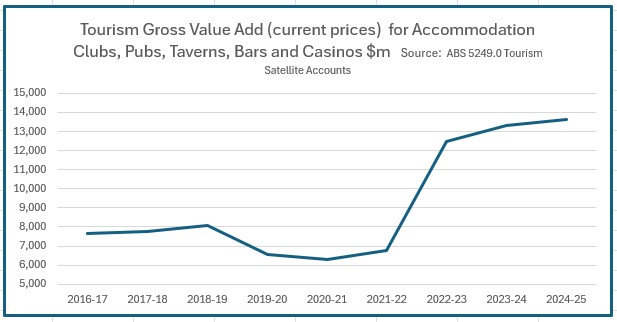
The Gross Value Add to tourism from sectors that the AA and AHA represent for 2024-25 was close to $14 billion. As can be seen in the graph below, the impact of COVID was profound, with the contribution dropping to a low point of $6.3 billion in 2020-21, before recovering so that in 2023-24, the value add to tourism was 69% more than pre-COVID. The three sectors contribute almost one fifth of all tourism GVA. Most of this was contributed by the accommodation sector, at $9.9 billion with $3.4 billion from the pubs, tavern and bars sector, reflecting that most of the economic activity in accommodation is connected to tourism, whereas pubs and clubs service a higher proportion of local customers.
| | |
Characteristics of employment - casuals preferring to work as casuals
ABS data released last week showed that there were 2.4 million employees who considered their main job to be casual in August 2025 out of 12.3 million employees, or 19%, This share of casual employees has dropped by around four percentage points over the last nine years. In 2016, around 23 per cent of employees were casual, dropping to 20 per cent during the COVID period in 2020. Women are more likely to work in a casual job than men, with 21 per cent of female employees working as casuals. This was 18 per cent for male employees. Of the 2.4 million casual employees, just under half were aged 15 to 24 years, and 61 per cent weren’t guaranteed a minimum number of hours of work. The Accommodation and food services industry was the most casualised, with 58% of employees working in that industry in their main job employed as a casual.
Contrary to public advocacy by some, particularly the unions, almost three quarters (73 per cent) of casual employees preferred casual employment. The main reasons were flexibility (53 per cent) and higher hourly pay rate (23 per cent).
| | |
International airline capacity increasing
Announcements this week of new air services opening up have highlighted the increasing airline capacity opening up greater opportunity for growth in international tourism. Melbourne welcomed the arrival of the first Hong Kong Airlines service this week, with the Airline scheduled to operate the route three times a week on Tuesdays, Thursday and Saturdays, adding around 93,600 additional seats each year between Victoria and Hong Kong. In SA, the first ever direct passenger flight between the United States and South Australia has touched down this week, with the new United Airlines aircraft from San Francisco landing at Adelaide Airport. Starting at three flights each week until the end of March 2026, United Airlines will arrive in Adelaide on Mondays, Wednesdays and Saturdays. This follows a suite of new and expanded international airline services into Adelaide this year, from carriers including Emirates, Cathay Pacific, China Eastern (starting mid-2026), Qantas, and Air New Zealand.
In the latest statistics released by the Department of Transport, in August the number of available seats rose by 9.4% to 4.6 million compared to August 2024, with an 8.5% increase in aircraft movements. According to aviation consultants LEK, future growth will still be somewhat constrained by availability of wide-bodied planes which will continue to see demand outstrip supply. That said, seat capacity on international flights has surged past pre-COVID levels this month. According to Cirium, Qantas and Jetstar together make up 29 per cent of Australia’s international seat capacity, with Singapore Airlines and Air New Zealand at around seven per cent each.
| | |
Capital city hotel performance in early December
Preliminary capital city STR data for the month to December 13th shows that hotel performance remained relatively strong for most capital cities compared to the previous corresponding period last year with the Brisbane Ashes test match finally turning around a recent slump in occupancy in that city. Sydney experienced an average occupancy across the whole city 87.8% (up 3.2%), and 90.7% (up 2.9%) in the city centre. Sydney's ADR rose strongly by 14.6% to $317.31 and RevPAR was up strongly by 18.3% to $278.70. Melbourne's occupancy strongly rose 12.4% to 83.2%, and ADR up 15.5% to $237.00; Brisbane occupancy was up 6.3% to 83.2%, and ADR very strongly up by 30.5% to $310.13; Adelaide occupancy was down 4.9% to 73.6% and ADR down 11.6% to $198.90 (the Adelaide test against India was in early December last year); Perth occupancy up 3.8% to 86.2% and ADR strongly up 16.7% to $273.53; Hobart occupancy up 1.2% to 80.9% and ADR up 8.3% to $218.16; Darwin occupancy up 4.7% to 47.5% but ADR down 1.8% to $148.01; Canberra occupancy up 6.0% to 82.2% and ADR strongly up 14.5% to $223.67; and Gold Coast occupancy down 1.7% to 68.9% but ADR up 5.5% to $280.42.
| |
| | |
3 things for you to do today to support the industry's jobs and careers platform eeger.com.au:
- Register on eeger to build your employer profile
-
Follow eeger on LinkedIn to stay in touch
- List your job vacancies on the site that has been developed for industry by industry
| | | | |
Overseas arrivals for October 2025
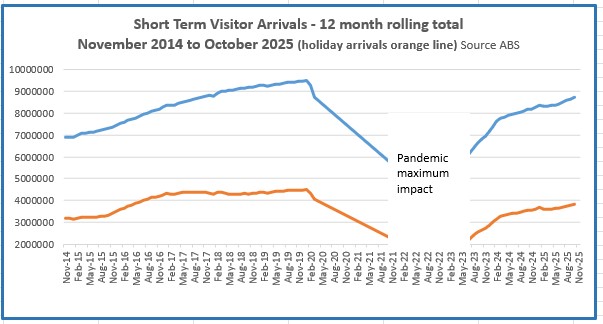
According to the ABS data released last Friday, there was an increase of 9.3% in short-term visitor arrivals in October 2025 to 740,650 compared to the same month last year. The arrival number was down on the pre-pandemic 774,020 short term visitors who arrived in Australia in October 2019. New Zealand was the largest source country in September 2025, accounting for 19.0% of all short-term visitor arrivals which was about the same market share as the previous month. NZ was followed by China (78,170) and then the UK coming in third with 59,700 visitors. It is particularly good news to note that holiday arrivals are improving on the back of TA's latest promotional campaign (Come and Say G'Day Chapter 2) with an increase in holiday arrivals - up over 13% for two months in a row compared to 2024. Of the top ten origin countries only South Korea and India had arrivals greater than October 2019, with Korea particularly strong with 39,730 arrivals compared to 19,820 in October 2019.
The 12-month rolling total arrivals tell a more useful story, illustrating the recent improvement as well as the difference with pre-COVID visitors, particularly for holidaymakers. In the 12 months to October 2025, there were 8,710,200 arrivals up by 6.6% on the year to October 2024, with holiday arrivals at 3,833,490 up 8.0% on the previous year. Holiday arrivals historically peaked at 4.48 million in the year to December 2019. If holiday arrivals grow in the remaining 8 months of 2025-26 similar to the growth in the last three, then total year holiday arrivals will be over 4.78 million for the year to June 2026. The graph below shows rolling 12-month totals for total short-term arrivals and holiday arrivals
| |
Drop me an email at policy@accommodationaustralia.org or give me a call on 0418 277 919 if you have any national policy issue that you think AA should be following up. If you know an AA member who is not receiving this advocacy report but wants to, then encourage them to email me and we can add them to the distribution list. Back issues of the fortnightly advocacy updates can be found here.
Kind Regards
Jenny Lambert OAM
National Policy Director
Accommodation Australia
| | | | |