| | |
POLICY & ADVOCACY UPDATE
Issue #46, 22 May 2025
| | | |
- Post-election follow up
- NABERS Commercial building disclosure regulation
- National operation to target migration exploitation in hospitality industry
- Overseas tourism arrivals in March
- Number of tourism businesses
- Hotel performance improves in April
- AFS Industry business turnover falls in March
| |
Post-election follow up
Accommodation Australia has been busy this week connecting our members to the Prime Minister and all of our relevant Ministers and Assistant Ministers, including a number who are in our portfolio orbit for the first time, and congratulating them on the election and their (re-)appointment. We will aim to meet with all of them in the coming weeks and months, with that task to commence in earnest once their ministerial staffing has been finalised. We have also reached out to the new leader of the Liberal Party, Sussan Ley, who is well known to us through her work in previous relevant areas including skills and training. The new Liberal leader has certainly taken on a huge task given the landslide election loss, and this week, the split in the coalition with the Nationals. Through the media and in the political backrooms there is plenty of speculation about the cause of the election loss and the implications of the coalition split. Through all of that "noise" we will be firmly focused on ensuring politicians of all parties understand the importance of our sector, its continuing growth and the major issues that continue to hold us back, including workforce skills and migration, planning, STRA, business costs and tourism demand issues.
In related post-election wash up activities, the AA CEO James Goodwin and I attended the AHA National Executive meeting in Queensland last week. It was clearly acknowledged by all that, although the return of the Labor Government was predicted, no one foresaw the extent of the outcome. The implications for policy outcomes that did not necessarily form part of the election campaign, such as workplace relations, will be something we will be watching closely.
| | |
NABERS Commercial building disclosure regulation
Despite our joint AHA/AA submission in September last year, the Department of Climate Change, Energy, the Environment and Water has sent an updated draft roadmap including the proposed extension of compulsory NABERS energy ratings to CBD large hotels. In our response this week, we stated that AHA/AA remain fundamentally opposed to this for a number of reasons including:
- Hotels are already responding to direct customer expectations, as well as through the increased cost of energy, to significantly reduce their environmental impact and emissions.
- the key proposed reason in seeking to make it compulsory, being that it will drive hotel behaviour through customers using NABER ratings to make decisions, is flawed or at best optimistic.
- the current national mechanism for searching the NABERS CBD program does not even enable the searching of the database of rated buildings via building type.
- There is no mechanism in the draft roadmap of identifying the NABERS rating in search tools in constant use by hotel customers including major hotel and travel websites.
- A mandatory system will add a regulatory burden in no way equalled by the benefit either to the hotel or the environment. A voluntary system including improved education to hotels and better mechanisms of ensuring the customer is aware of the NABERs rating when making purchasing decisions, will have just as much success without the downside of imposing the requirement on all hotels.
- We totally refute the suggestion that “Large hotels utilise similar heating and cooling systems and have similar requirements for comfort as large office buildings” as being erroneous due to the room specific plumbing, air conditioning and energy use in hotels which is simply not an issue for office buildings.
- Specifically in relation to heritage buildings, the paragraph added to the draft roadmap does not alleviate our concerns as it does not propose withdrawing the mandatory approach for heritage buildings. The wording “exemption category may be required” does not go far enough.
- Heritage hotel buildings are still at risk of being excluded from government procurement guidelines when the same government is effectively prohibiting them from gaining the required NABERS rating.
We will be following up with both the department and the minister to further advocate against this additional regulation. We are also seeking the definition of what would quality as a "large hotel".
| | |
National operation to target migration exploitation in hospitality industry
Last week it was announced that Australian Border Force (ABF) officers from the Department of Home Affairs, working with the Fair Work Ombudsman, have launched a national operation targeting exploitation and abuse of migrant workers in the hospitality industry. The operation will take place over six months with over one hundred workplaces scheduled to be visited, with the officers meeting with employers and migrant workers to closely inspect sponsorship arrangements. In compliance operations to date, officers have discovered suspected migrant worker exploitation among more than 30 employers with investigations now under way into matters of under payment, unlawful deductions and excess hours. There will also be a special focus on ensuring employers are not financially abusing migrant workers by charging back costs of their sponsorship. New rules and tougher penalties were introduced on 1 July 2024 to deter employers from using a person's immigration status to exploit them in the workplace.
Visa holders and foreign workers in Australia hold the same workplace entitlements and protections as other employees — regardless of their migration status.
| | |
Overseas arrivals in March
When the ABS starts noting a change in actual numbers rather than percentage change, you know that the increase in short term visitor arrivals has been inconsequential. In March 2025, short-term visitor arrivals were 761,230 which was an increase of 190 arrivals on one year earlier - effectively 0% growth. This arrival number is still 9% below pre-COVID, when 836,350 short term visitors arrived in Australia in March 2019. New Zealand was the largest source country, accounting for 14.0% of all visitor arrivals, followed by the USA and the UK. However, all of these markets contributed less visitors in March 2025 compared to the previous year. On the plus side, the return of the China market is still trending, with 70,990 arrivals in March compared with 58,240 in March 2024. Visitors from Japan, India, Singapore, Canada and Indonesia all grew compared to 2024, with growth from Indonesia particularly strong (25,800 visitors compared with 14,730 in March 2024). In March 2025 there were 54,660 international student arrivals to Australia, an increase of 10,080 students compared with the corresponding month of the previous year. The number of student arrivals in March 2025 was 24.2% lower than the pre-COVID levels in March 2019.
| |
Number of tourism businesses
Recently Tourism Research Australia (TRA) published its annual summary of the number of tourism businesses in Australia. The summary, drawn from the Australian Bureau of Statistics (ABS), showed that the number of tourism-related businesses in Australia was 360,202 in June 2024, which was an increase of 2,588 or 0.7% on June 2023. Of the total in June 2024, 203,264 businesses (56%) were in tourism characteristic industries (such as accommodation, where visitors consume at least 25% of output) and 56,938 businesses (44%) were in tourism connected industries (where products are consumed by visitors in volumes considered to be significant. but less than 25% of consumed output). Tourism-related businesses comprise 13.5% of all Australian businesses, or around 1 in 7. Characteristics of tourism businesses include:
- There were 87,000 cafes and restaurants, 35,000 taxi businesses, 14,000 accommodation, 10,000 clubs and pubs, 9000 travel agencies and 3,000 directly tourism connected businesses.
- 95% of tourism businesses in Australia are small businesses, with fewer than 20 employees.
- 4 in 5 (78%) tourism-related businesses were non-employing (i.e. sole operator) or micro businesses (with 1–4 employees).
- Nearly half (49%) of all tourism businesses have a turnover under $200,000, while 5% of tourism-related businesses had a turnover of more than $5 million. By contrast, 57% of all Australian businesses had a turnover under $200,000, while 4% had a turnover over $5 million.
- Seventy per cent (253,000) of tourism businesses are in Australia’s capital cities or the Gold Coast.
- Of the 333,000 tourism-related businesses operating in June 2020, 192,000 (58%) were still operating 4 years later in June 2024. This is lower than the survival rate for all Australian businesses over this period (64%). Clubs, pubs and bars (71% survival rate) and accommodation (66%) fared better than travel agency and tour operator services (57%) and taxi transport (40%).
| | |
Hotel performance in April
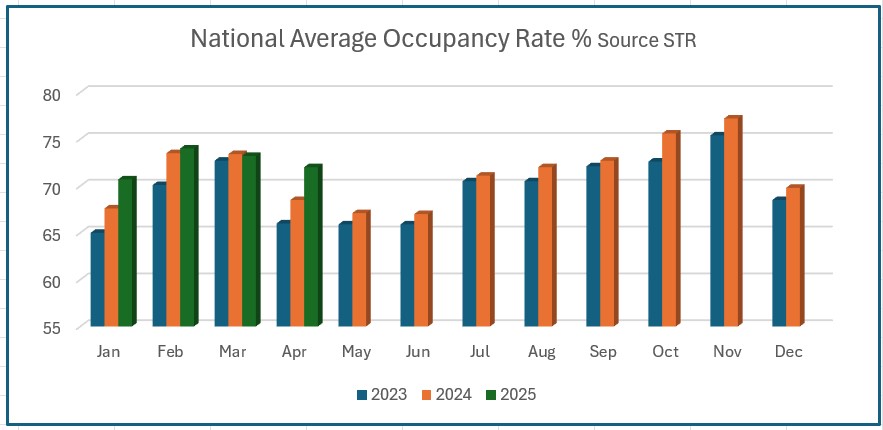
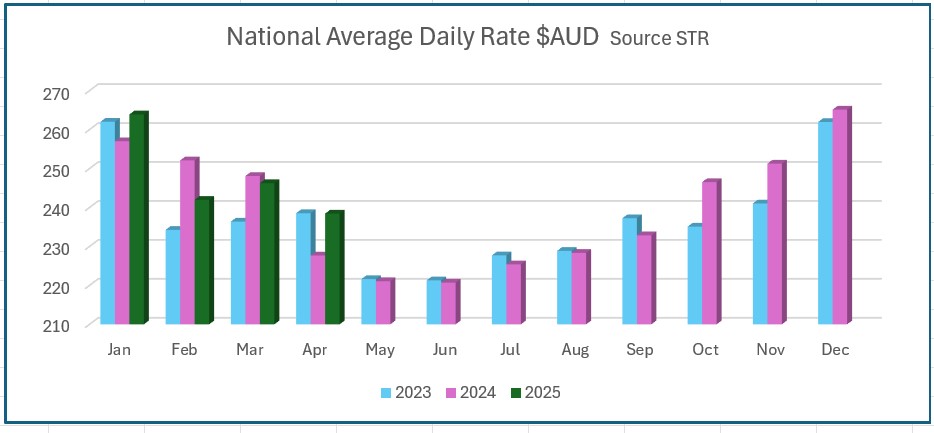
The latest STR accommodation data released for April 2025 shows one of the strongest yearly improvements for some time in both occupancy and average daily rate. The average occupancy in the month of April across Australia was 72.0% compared with 68.5% in 2024, and the Average Daily Rate was 4.7% higher at $238.43 compared with $227.67 in April 2024. Revenue per available room in April 2025 was $171.62, a significant rise of 10.1% from $155.86 in 2024. Occupancy rates for April 2025 were up compared to last year in all States and Territories, with a particularly strong performance in ACT, NSW followed by Tasmania. ADR was up in most states except for South Australia (-2.8%) and NT (-6.7%). New Zealand also saw a rise in average occupancy rates in April 2025, from 65.6% to 66.4%, with ADR up 2.7% to NZD218.98 compared to last year. In the year to April 2025, Australia's average occupancy rate was 72.5% compared to 70.8% for the same time last year, and the ADR average up 0.9% to $247.69.
Preliminary capital city STR data for the month to 17th of May indicates an improvement in occupancy compared to the previous year in all capital cities and the Gold Coast, except for Darwin and Canberra. The ADR averages compared to last year were more mixed, with Sydney up 4.9% to $253.19, Melbourne down 0.3% to $198.64, Brisbane significantly up 25.7% to $299.31 (probably largely due to ATE), Adelaide down 1.6% to $186.99, Perth up 6.7% to $232.86, Darwin down 8.8% to $200.86, Hobart up 0.3% to $194.33, Canberra down 9.8% to $177.21, and Gold Coast up 6.6% to $250.97.
The graphs below derived from the STR data show the monthly average performance of occupancy and ADR across Australia since January 2023.
| | |
AFS Industry business turnover falls in March
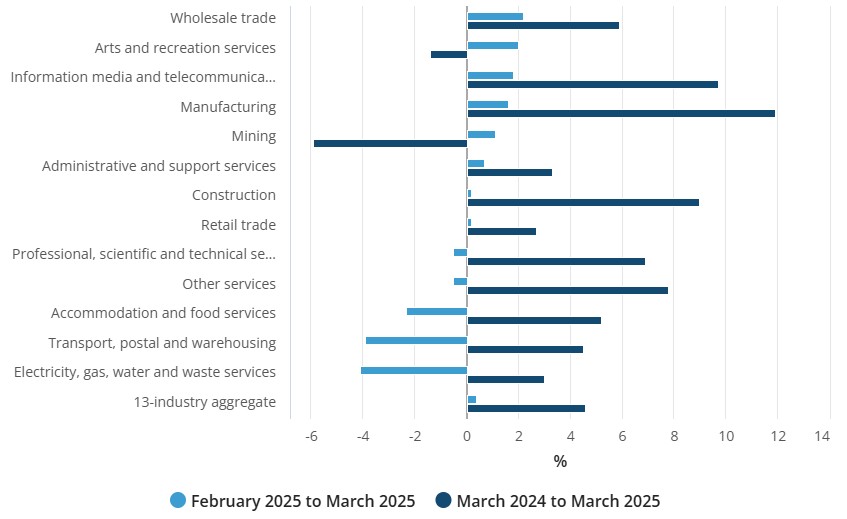
Reflecting the fall in household spending in March on hotels, cafes and restaurants (see last Advocacy update), business turnover for the Accommodation and Food Service (AFS) Industry also fell by 2.3 per cent (seasonally adjusted) compared with February 2025, which was against the average rise of 0.4% across the 13-industry aggregate measured by the ABS using BAS statements from the ATO. For the year to March 2025, business turnover in the AFS rose by 5.2% which is now only slightly above the 13-industry average of 4.6%. As the diagram below shows, industries that performed comparatively strongly in March were Wholesale trade, arts and recreation, media and manufacturing. Industries that experienced even bigger declines than AFS were energy and transport.
| | |
Drop me an email at policy@accommodationaustralia.org or give me a call on 0418 277 919 if you have any national policy issue that you think AA should be following up. If you know an AA member who is not receiving this advocacy report but wants to, then encourage them to email me and we can add them to the distribution list.
Kind Regards
Jenny Lambert OAM
National Policy Director
Accommodation Australia
| | | | |