|
|
|
POLICY & ADVOCACY UPDATE
Issue #24, 27 June 2024
| | | |
- AA back in Canberra on migration and STRA
- International action and local push back on STRA gathers momentum
- Apprenticeship numbers continue to fall
- Inflation up and job vacancies down
| |
|
AA back in Canberra on migration and STRA
Following on from the AHA/AA joint submission to Jobs & Skills Australia (found here) we headed back to Canberra for meetings with the offices of the Immigration Minister and the Minister for Home Affairs. These were very constructive discussions and did much to provide some assurance that occupations such as chef will remain accessible for migration sponsorship. The evidence provided by members through the national accommodation salary survey, as well as the member feedback during consultations were particularly useful in our advocacy, particularly for hotel and restaurant managers given the extensive member feedback of the loss of experienced staff during COVID. There also seemed to be a strong understanding of the need for a transition, rather than a hard stop for occupations that were previously available for sponsorship.
We also met with both the Minister for Housing and the Shadow Minister to progress arguments over short term rental accommodation. To aid our advocacy, we updated our STRA policy as a joint position of the AHA and AA, and have made it available on our website. The Minister was very receptive to our arguments and keen to further engage. Of particular interest was the recent actions of the Canadian Government, given that their constitutional structure and powers are so similar, as the regulatory power is with the provinces (state) and municipal governments. The Canadian government has provided a fund to support the enforcement of state and local regulations as well as proposing a change to the tax laws to deny deductions to all STRA property owners who breach the STRA rules. The Shadow Minister, and the Coalition in general, will be more difficult to win over to the arguments for stronger STRA regulation, as we saw in the WA Liberal opposition's lukewarm response to the very modest WA Government changes to STRA regulation.
| |
|
International action and local push back on STRA gathers momentum
While most of Australia's governments sit on their hands in relation to STRA, we are seeing a lot more action internationally as well as local interest in further regulation. Although we are yet to see any outcome from the NSW government's review of STRA regulation, we are at least pleased that it did not result in a bed tax announcement in the recent NSW state budget. Action on the STRA levy set to commence on 1 January 2025 in Victoria seems to have slowed to a halt, with media reports that it is "in doubt". This is yet to be confirmed by the Government. In contrast, we have seen recent media reports of major concern expressed by residents in the Victorian town of Daylesford, where long term rentals have become very scarce and according to a recent report, in the Hepburn Shire area that includes Daylesford, 74.2 per cent of new housing supply in the past decade was consumed by short-term rentals.
in contrast to the inaction or very limited action in Australia, internationally governments at all levels are bringing in significantly more stringent regulation on STRA. Apart from the actions of the Canadian government (see story above), there has been a lot of attention on the decision of New York City to ban all non-hosted STRA. This has seen a dramatic drop in listings in New Yort or Air BNB, and those that do still list on AirBNB are mostly offering on terms greater than 30 days. Most recently, Barcelona has announced plans to ban all holiday apartments by 2028. STRA in that city already is subject to a licensing scheme, but the city plans to scrap the 10,101 apartment licences currently issued. According to media reports, the city government has also ordered the closure of 9,700 illegal tourist apartments since 2016.
| |
Apprenticeship numbers continue to fall
The latest data for December 2023 from the National Centre for Vocational Education Research shows that the number of apprentices in training across Australia continues to fall, with 343,640 apprentices and trainees in-training as at 31 December 2023, a decrease of 8.8% from 31 December 2022. There were 12,346 food trades apprentices in training as at 31 December 2023, compared with 13,965 as at 31 December 2022. The numbers in training are higher than for 2019, as the commencements made when the extra incentives were in place are still working their way through their training.
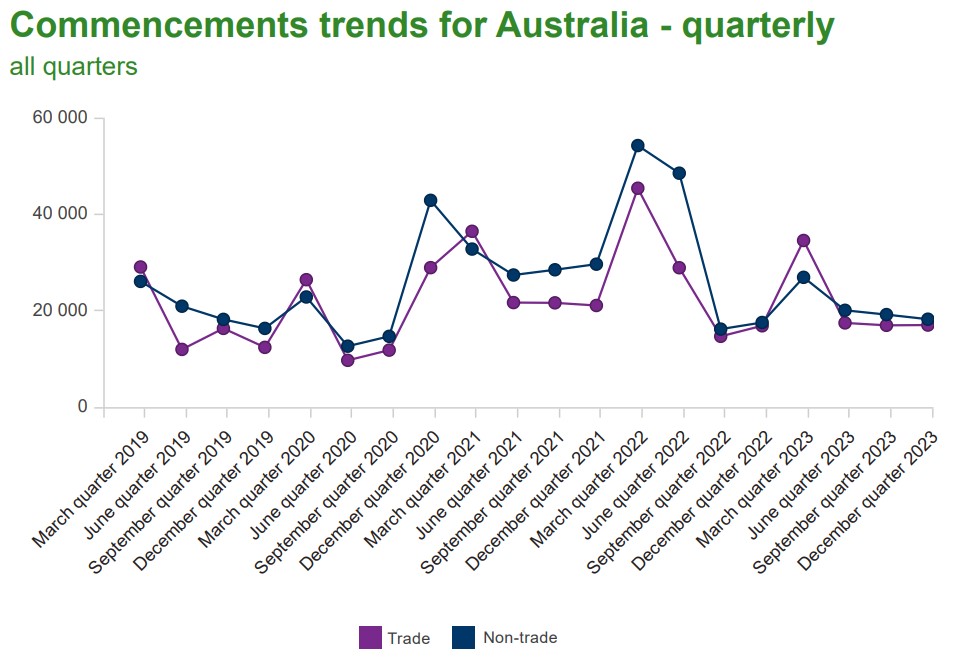
Of even greater concern, in the 12 months ending 31 December 2023, compared with the 12 months ending 31 December 2022 commencements decreased by 29.7%, to 170,370, indicating that the pipeline is slowing at a fast pace. The falls were largest in the ACT, Tasmania and South Australia. Commencements of food trades apprentices were actually up in the December 2023 quarter (at 1,175) compared to the previous corresponding quarter in 2022, but still down compared to December quarter 2019 (pre- COVID). The fall of 3.8% compared with 2019 compares to an all trade-apprentice increase of 37.3%, with the significant increases unsurprisingly coming in electrotechnology, automotive and construction. The graph below which shows quarterly commencements of apprentices across all occupations since 2019 illustrates what a significant impact the extra incentives made even in the tough times around COVID.
AA argued strongly in its recent submission that higher apprenticeship and traineeship incentives for our industry need to be restored. We will be engaging further with that review later this month. AA CEO, Michael Johnson, also had the opportunity to talk directly with the Skills Minister, Brendan O'Connor, on apprenticeships as well as the Core Skills Occupation List, and raise the concerns about apprentice numbers. The Minister is also eagerly awaiting the review's findings - it is never a good look for a Labor Government to oversee apprenticeship falls.
| |
|
Inflation up and job vacancies down
As widely reported in the media, the consumer price index rose by 4.0% in the 12 months to May, which was higher than expected and will put more pressure on the Reserve Bank Board to raise interest rates when it meets next month. The most significant price rises were Housing (+5.2%), Food and non-alcoholic beverages (+3.3%), Transport (+4.9%) and Alcohol and tobacco (+6.7%). A balancing factor which may cause RBA to continue to keep rates on hold are the figures out today that job vacancies have dropped further in May. May 2024 marked two years since the peak in job vacancies in May 2022. Since then, vacancies have fallen by 26.0 per cent. However, job vacancies were still well above their pre-COVID-19 pandemic level. There were still around 54.8 per cent, or around 125,000, more vacancies than in February 2020. Job vacancies remained higher than their pre-pandemic levels in 15 out of 18 industries. This continued to be particularly pronounced in customer-facing industries, including Accommodation and food services, and Arts and recreation services, where vacancies are still more than double pre-pandemic levels
| |
|
Drop me an email at policy@accommodationaustralia.org or give me a call on 0418 277 919 if you have any national policy issue that you think AA should be following up. If you know an AA member who is not receiving this advocacy report but wants to, then encourage them to email me and we can add them to the distribution list.
Kind Regards
Jenny Lambert OAM
National Policy & Research Advisor
Accommodation Australia
| | | | |