|
|
|
POLICY & ADVOCACY UPDATE
Issue #30, 3 October 2024
| | | |
- Visitor Economy Roundtable
- New STRA Regulations for WA
- Business failures highest since January 2021
- A busy NoVacancy 2024
- Hotel performance for August
- Latest ABS tourism satellite jobs data
- Next advocacy update 3 weeks away
| |
Visitor Economy Roundtable
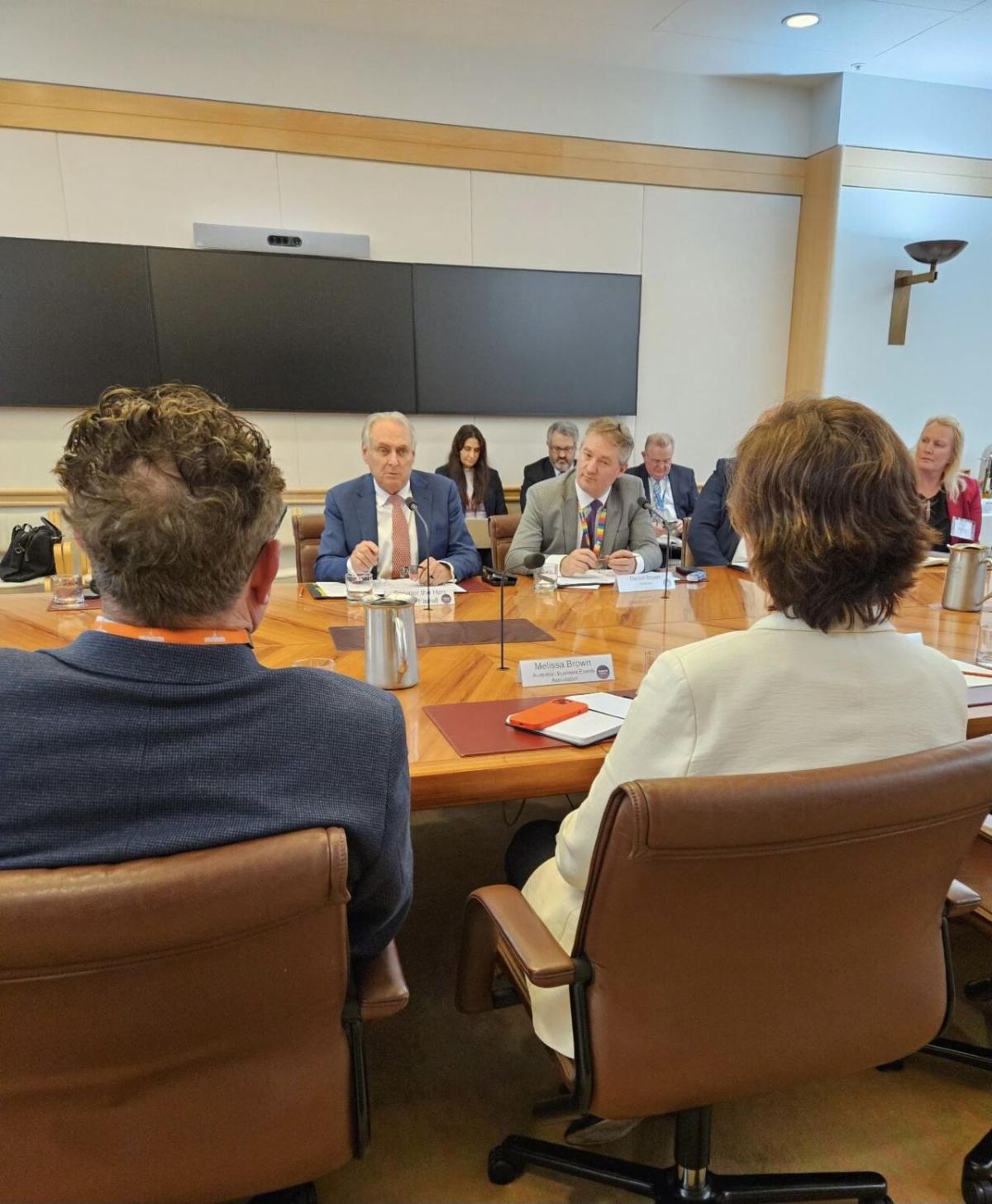
The Austrade Visitor Economy Roundtable was held at Parliament House in Canberra and attended by AA Chief Executive James Goodwin on Monday 30 September.
The meeting was attended by Minister for Trade and Tourism, Don Farrell, and a range of tourism groups and government officials. The meeting discussed the issues affecting and influencing the travel and accommodation sectors. Workforce challenges and that we are awaiting the Core Skills Occupancy List to be released were raised by AA as well the need to encourage more international tourism and concerns about cost-of-living pressures and airline competition being noticed amongst members. The Roundtable also had presentations from the Australian Small Business Ombudsman Bruce Billson and the ACCC on new climate reporting and anti-greenwashing legislation. It was noted by AA these might have an impact on accommodation providers but more likely to affect other parts of the tourism sector.
| |
New STRA Regulations for WA
New regulations introduced in September, which follow the Short-Term Rental Accommodation Act 2024 that was passed by the WA Parliament earlier this year, aim to clarify how the sector is managed. The regulations will ensure a consistent set of rules for hosted properties – where the host lives onsite – and unhosted properties where guests have exclusive use of the accommodation.
Metropolitan local governments will be required to amend their planning schemes to include the
requirement for a development approval for STRA over the next 12 months. Regional local governments that do not already require development approval for STRA may choose to amend their planning schemes to require approval. Planning approval will be required for unhosted STRA's over 90 nights.
Unfortunately, the changes do not include limitations or 'caps' on the number of nights that a STRA property can be leased on the short-term market. All providers of hosted and unhosted STRA properties within Western Australia must be registered on the STRA Register by 1 January 2025 to lawfully advertise and take bookings.
| | |
|
Business failures highest since January 2021
Credit reporting bureau, CreditorWatch, recently released the August results for its Business Risk Index (BRI) revealing that the rate of business failures is at its highest level since January 2021, when Australia was in the midst of the COVID-19 pandemic. The failure rate for Australian businesses currently sits at an average of 4.95 per cent and has increased 17.3 per cent since January. CreditorWatch’s forecast is for the rate to increase to 5.20 per cent over the next 12 months. Food and Beverage Services (particularly take away and restaurants) is the industry currently experiencing the highest rate of business failures among all industries, recording a rate of 8.2 per cent for August, followed by Administrative and Support Services at 5.8 per cent. CreditorWatch pointed out that the Food and Beverage sector, in particular, is facing a ‘perfect storm’ of continued rising costs as demand declines. At the same time, the ATO is actively chasing tax debts, many of which sit with businesses in this sector. Also in many instances, businesses in the Food and Beverage sector pay rent on retail space that is typically located in high foot traffic retail precincts. It is very difficult for restaurants and cafes to move premises to get a better rent deal, therefore rents and the associated increases are an added burden on this industry.
| |
A busy NoVacancy 2024
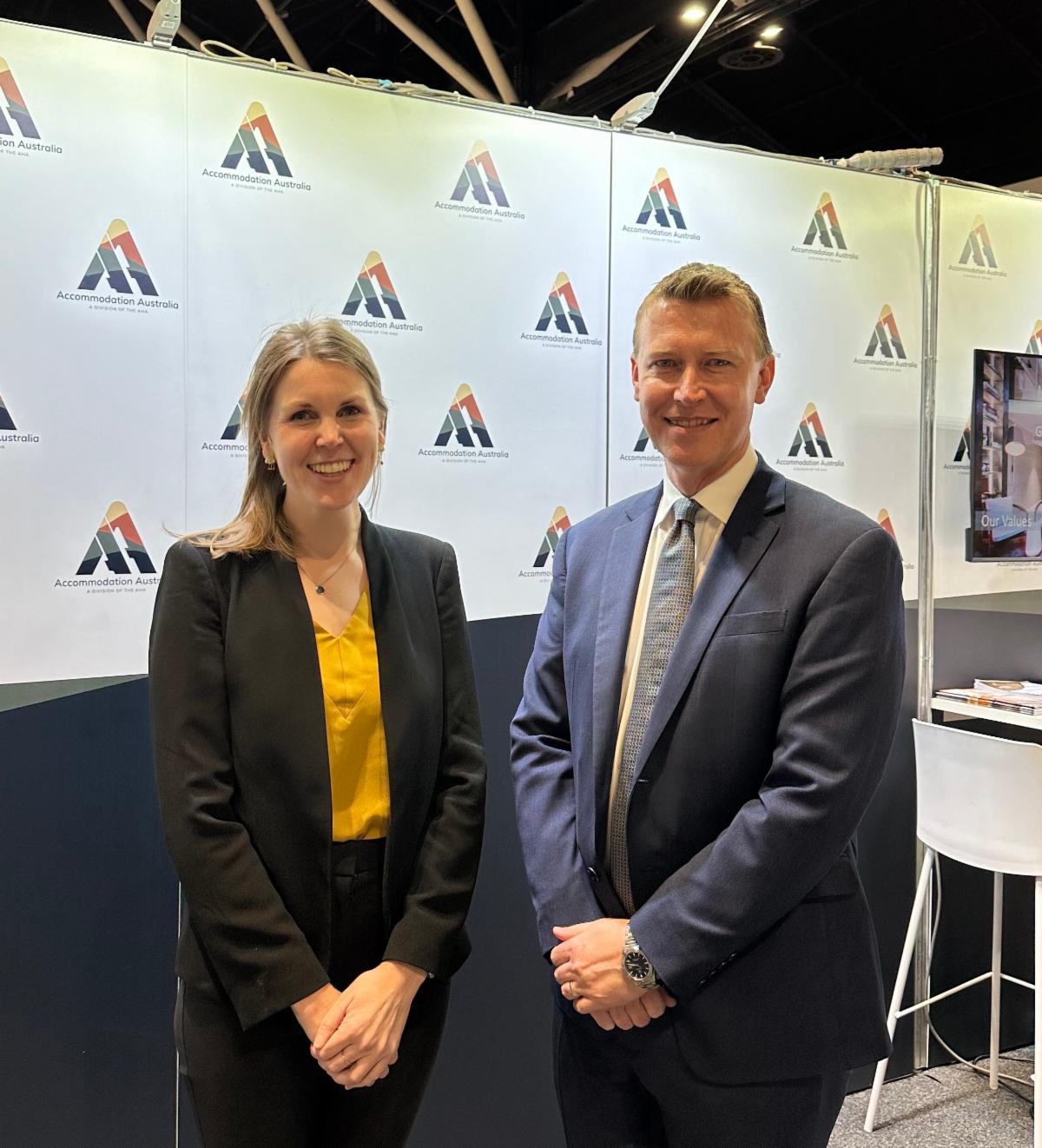
Although we will need to wait for the final figures, activity at No Vacancy last month appeared to be brisk. Plenty of interest in some of the presentations, particularly the tech and AI information. Pictured right in our new CEO James Goodwin, along with AA NSW manager Stacey McBride on the AA stand at the Sydney exhibition.
| |
|
|
Net Overseas Migration figures released
The ABS recently released data on the national population for the March 2024 quarter, showing a population as at end of march of 27.1 million people. Net Overseas Migration (NOM) for the March quarter was 133,800 – 27,700 more than the December 23 quarter, but less than the NOM of 165,500 in March 2023. These figures will continue to drop with the fall in student numbers, and the beginning of the major influx of students post-COVID starting to return home.
The Government’s forecasts for 2023-24 as outlined in the Budget papers refer to a NOM figure of 395,000, so it is likely to be surpassed based on these and previous quarter figures. However, annual NOM has in the year to March 2024 was 509,800 people, down from a peak of 559,900 in September 2023, so there has been some reduction overall.
| |
|
Hotel performance in August
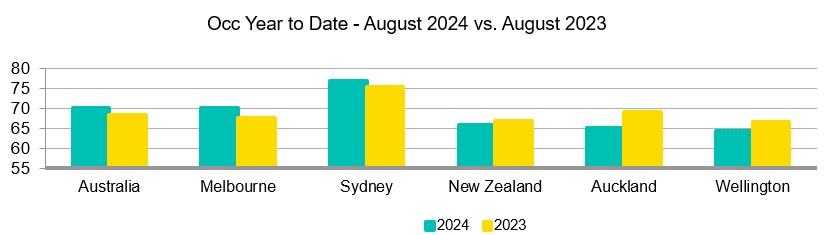
According to the latest STR data, average occupancy In August across Australia was 72.0% compared with 70.5% in August 2023, but repeating the performance of the last two months, the ADR for August 2024 was slightly down at $228.36 compared with $228.87 in August 2023 particularly if you take into account the inflation rate. Revenue per available room in August 2024 was $164.42, an increase from $161.42 in August 2023. For the year to August 2024, the average Australian occupancy rate was 70.1% compared with 68.3% in 2023. The rise in the ADR over this period was a modest $1.23 to $234.75, which is below the inflation rate. Growth in revenue per available room increased from $159.39 in 2023 to $164.50 in the year to August 2024. Occupancy rates for August 2024 were up in most of the capital cities except for Sydney and Adelaide. In contrast to the rise in occupancy rates in Australia, New Zealand continues to struggle, with an occupancy rate for August 2024 dipping below 60% at 59.5% compared with 66.3% in August 2023. The average rate for the year to August in NZ was also down against last year, at 65.8% compared with 66.7% in 2023. Graph Source: SDR.
| |
|
Latest ABS tourism satellite jobs data
Last month the ABS released the latest data which measures the economic contribution of tourism by assessing how much of each industry's revenue and employment is attributed to tourism activity. This has long been necessary as tourism is not an industry in itself, but a demand driven activity that creates revenue across many industries. In June quarter 2024, there were 634,400 tourism jobs which being
11,500 (-1.8%) less jobs than March quarter 2024, 12,300 (2.0%) more jobs than June quarter 2023 and represents 1 in 25 (4.0%) filled jobs in the economy. Interestingly they only attributed around 75% of the jobs in accommodation to tourism, which we have questioned a number of times as it appears lower than the high percentage of guests and customers which would be tourists rather than locals. Across all tourism jobs, there are marginally more full-time jobs than part-time/casual jobs, with the number of full-time jobs rising by 3.8% to 318,900 compared to the previous year. There are more female tourism workers than male, but in the last 12 months male tourism workers increased at a faster rate.
| |
|
Next advocacy update three weeks away
I am currently on leave until the 21st of October, so please keep your eye out for the next update in 3 weeks' time, (on 24 October) instead of the usual fortnightly delivery. I am sure there will be plenty to report by the time I get back
| |
|
Drop me an email at policy@accommodationaustralia.org or give me a call on 0418 277 919 if you have any national policy issue that you think AA should be following up. If you know an AA member who is not receiving this advocacy report but wants to, then encourage them to email me and we can add them to the distribution list.
Kind Regards
Jenny Lambert OAM
National Policy & Research Advisor
Accommodation Australia
| | | | |