| | |
POLICY & ADVOCACY UPDATE
Issue #45, 8 May 2025
| | | |
- Resounding Labor election victory
- Apprenticeship outcomes
- TA Increasing its focus on Asia
- Successful AHICE in Adelaide
- Observations on the current hotel market
- Hotel performance improves in April
- Household spending falls in March
| |
Resounding Labor election victory
Although a number of lower house seats and five Senate seats remain in doubt, there can be no doubt of the emphatic victory of the Labor Party who retains government with a significantly increased majority in the lower house, and the Greens still likely to be the chief party for negotiating legislation through the upper house. Some of the implications for our industry of a Labor Government over the next few years will be:
- continued pressure on migration policy (although not as severe as the Coalition would have been), with likely reduction in international student numbers.
- further reforms for the regional migration program, which hopefully will be on balance more favourable including hopes for a change to the current postcode definition of regional and remote for working holiday makers.
- implementation of their commitment to freeze beer excise increases on draught beer
- a battle to ensure skills for the hospitality industry feature in government priorities for migration and VET funding
- concerns about further workplace relations changes including the potential removal of the ability to offer a salary of 25% above the award to smooth out the calculations and penalty and overtime as well as the possibility of the introduction of portable long service leave adding costs to employers particularly for casuals.
- no commitment as yet to make instant asset write off at a threshold of $20,000 a permanent feature of the tax system for small business, although it will be allowable in 2025/26.
- potential for energy costs to remain high as the existing energy policies will remain.
| | | | | |
AA has passed on our congratulations to the government and will seek further engagement on the key issues for the accommodation sector once the new Ministry is announced, which will not be until all seats are decided. Although the Greens holding the balance of power in the Senate may put pressure on a range of business issues, it may help us as we continue to press for a national framework for the regulation of Short Term Rental Accommodation.
Pictured left, AA CEO James Goodwin with the Prime Minister Anthony Albanese.
| | |
Apprenticeship outcomes
This week AA has undertaken an analysis of survey results released on 25 March 2025 by the National Centre for Vocational Education Research on the outcomes of trade apprentices aged 15 years or over who completed their training (completers) and those who cancelled or withdrew (non-completers) during 2023 with a particular focus on food trades apprentices, of which cooks and chef make up about half. Across all occupations and industries, 95.4% of all apprentices were employed after completion, with an average of 74.4% employed in the same occupation as the apprenticeship. For Food Trades apprentices, the number employed afterwards was still high at 92.5%, but the number in the same occupation was significantly lower at 64.9%. This loss of skilled chefs after they complete their apprenticeship is concerning. However, of those employed after training, the number of food trades apprentices with the same employer after the apprenticeship was pleasingly slightly higher than the national average at 73.6% compared with 71.1%.
The data for non-completers provides some challenges to often-heard presumptions as to why chefs drop out of their apprenticeship. Dealing with the most often mentioned issue up-front, according to the survey only 25.2% of those not completing their food trades apprenticeship cited low pay and working conditions as their main reason for discontinuing, compared with 29.7% for the average. Also, only 11% said that not liking the type of work was their main reason, which was only marginally higher than the average of 10.2%. The two reasons given which were most significantly higher than the average was the lost/job or apprenticeship discontinued (17.9% compared with 12.4%) and personal reasons (20.3% compared with 16.5%).
For the full analysis, including comparisons to trades such as electrical and construction, click here.
| | |
Tourism Australia increasing its focus on Asia
Last week, at the largest Australian Tourism Exchange ever held over its forty years, Tourism Australia announced that there will be an increasing strategic focus on Asian markets with the aim on increasing international arrivals from promising Asian markets such as India, Japan, South Korea and Vietnam. Managing Director, Phillipa Harrison, said that TA is hoping to capitalise on improved aviation links and the strong growth from these markets in the last two years. Speaking to the travel media, Harrison also said that TA is enthusiastic about agri-tourism, the next area of focus delivered through showcasing case studies, mentoring operators, and coordinating with tour companies to build regional food and farm trails. The aim of this strategy is to ensure international visitors travel to the regions. During ATE over 1,600 members of the Australian tourism industry met with more than 700 global tourism distributors across around 60,000 one-on-one business appointments. The announcement was also made that the next ATE will be held at the Adelaide Convention Centre between Sunday, 10 May 2026 and Thursday, 14 May 2026.
| | |
Observations on the current hotel market
Speaking at AHICE 2025 in Adelaide this week, the regional director for STR, Matthew Burke made a number of important observations about the hotel market:
- globally, hotel demand has been slowing after an initial eclipse of pre-pandemic levels by February 2023.
- In Australia, supply growth is moderating but demand growth continues, and it is predicted there will be stable future occupancy
- In terms of new hotels, construction and debt costs remain elevated and the average size of hotels has reverted to around 150 rooms. Of those under construction, luxury holds the greatest share.
- An Australian leisure holiday in terms of ADR is price competitive with regional resort markets, and so is Sydney and Melbourne compared with other global cities.
- Almost double the number of Australian properties are showing a reduced ADR over the last six months compared to the previous year.
- Average forward occupancy for 2025 is tracking in line with 2024, with some spikes on the horizon driven by the Lions tour, Sydney marathon and the Ashes tour.
| |
Successful AHICE in Adelaide
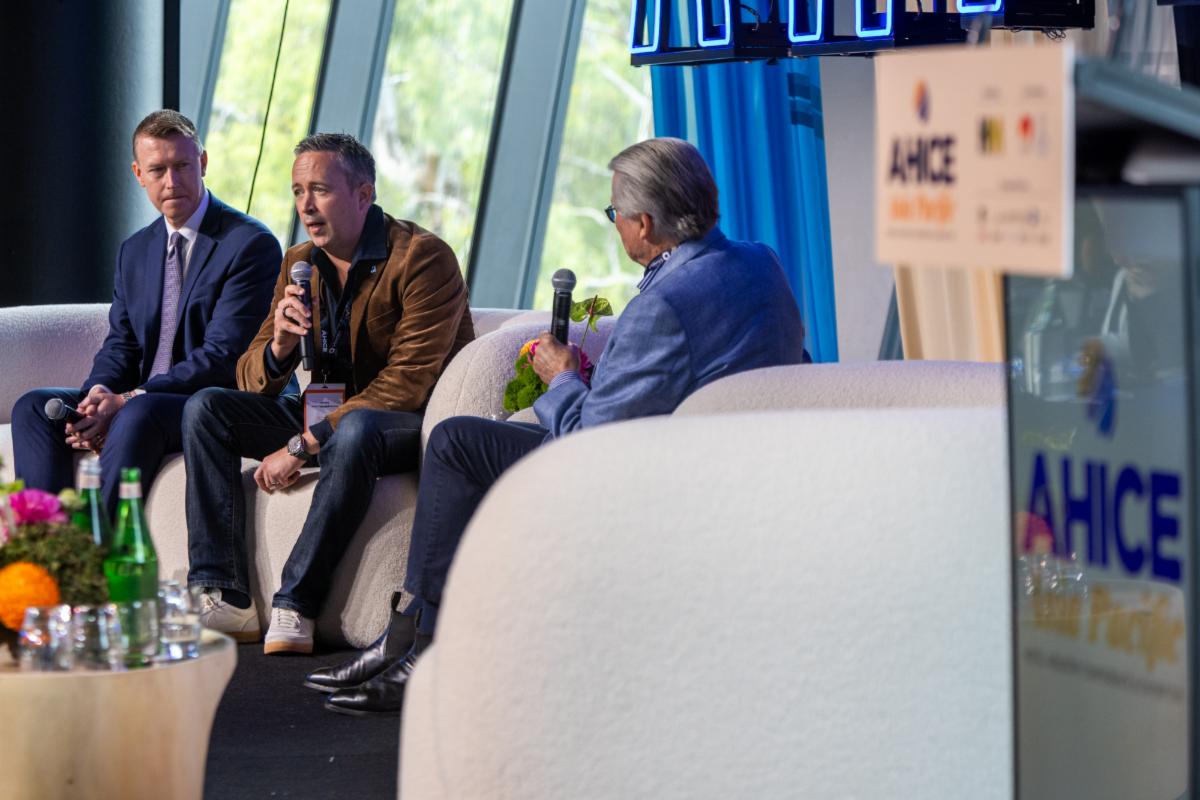
Hundreds of delegates from AA member properties convened at the AHICE Asia Pacific Conference in Adelaide this week. Key themes included the outlook and changing nature of tourism in Australia, the region and globally. Managing new technology and the guest experience, property investment and challenges of major redevelops as well as sustainability and aviation and cruise ship access were also featured issues. South Australian Premier Peter Malinauskas spoke passionately about the vital contribution the hotel sector makes to the economy and his hope that the new direct Adelaide - San Francisco flights will see increased inbound demand.
AA CEO James Goodwin (pictured left on the panel shot below right) spoke with his New Zealand counterpart, James Doolan, about the key policy and regulatory issues facing the sector. James emphasised the work with the new Federal Labor Government to ensure we continue to have a sector that can thrive and grow. Whilst at the conference James was able to hold side meetings with the Premier and the Tourism Minister Zoe Bettison.
| | |
Hotel performance improves in April
Preliminary capital city STR data for the month to 26th of April indicates a strong performance in occupancy and ADR for all capital cities, with Sydney's occupancy rate being 78.8% compared to 74% for the same period last year; Melbourne, 72.9% compared with 68.3%, Brisbane 71.9% (69.0%), Adelaide 80.0% (77.7%), Perth 80.9% (76.7%), Darwin 57.5% (56.4%), Hobart 79.5% (73.15), Canberra 73.1% (65.6%). After a cyclone-impacted March, it was great to see Gold Coast also doing well at 70.9% compared to 66.3% for the same period last year. The ADR for the Gold Coast was also up 9.2% to $293.78 for the month to 26 April compared to last year. Perth and Brisbane also saw a good increase in their ADR, whereas the ADR fell in Adelaide and Darwin despite three high performing nights in Adelaide for Gather Round.
| |
Household spending falls in March
Household spending fell 0.3 per cent in March, according to seasonally adjusted figures released this week by the Australian Bureau of Statistics. Queensland saw a 1.3 per cent fall in spending, as ex-tropical cyclone Alfred impacted parts of the state. Spending fell in New South Wales (-0.3 per cent) and South Australia (-0.3 per cent) but rose in the Australian Capital Territory (+0.6 per cent) and Victoria (+0.4 per cent). Spending on alcoholic beverages and tobacco fell by 2.6 per cent, and for Hotels, cafes and restaurants spending was also down below average at -1.1 per cent.
| | |
Drop me an email at policy@accommodationaustralia.org or give me a call on 0418 277 919 if you have any national policy issue that you think AA should be following up. If you know an AA member who is not receiving this advocacy report but wants to, then encourage them to email me and we can add them to the distribution list.
Kind Regards
Jenny Lambert OAM
National Policy Director
Accommodation Australia
| | | | |