|
|
|
POLICY & ADVOCACY UPDATE
Issue #36, 9 January 2025
| | | |
|
- Positive beginning to 2025
- Short Term Rental Levy for the ACT
- Apprenticeships continue to fall
- Overseas arrivals for October 2024
- Hotel share of visitor nights continues to rise
| |
|
Positive beginning to 2025
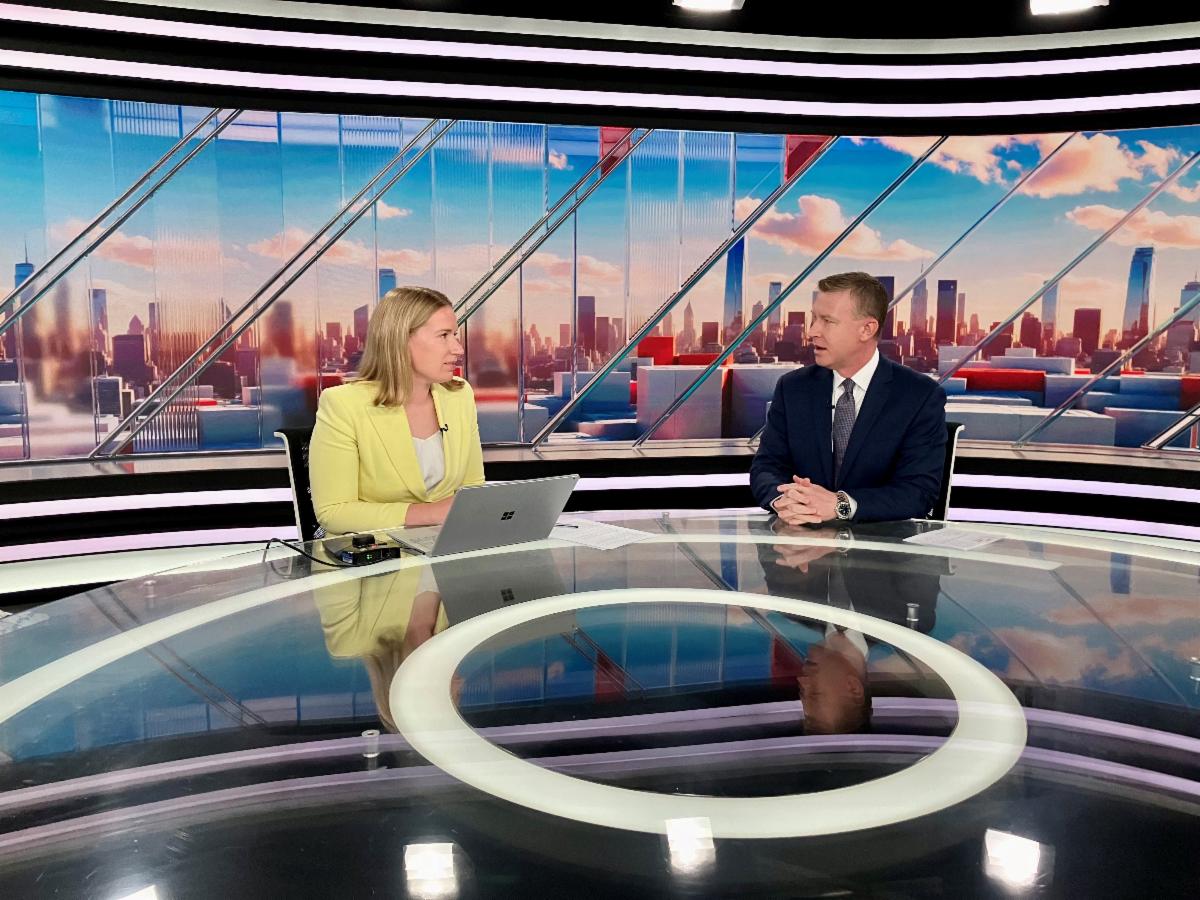
Australia's capital city accommodation sector is bucking cost of living trends with solid bookings for the busy January school holiday period, according to an analysis of forward booking data compiled by STR Global. In a media release issued this week, CEO of Accommodation Australia James Goodwin (pictured below discussing the holiday period on Sky News) said January was looking positive, on the back of a solid December Christmas period. Heading into the new year, Sydney is up two percent compared to the previous Dec/Jan period, Melbourne three percent, Brisbane four percent, Adelaide one percent and Hobart up 18 percent. As reported in the last update, both October and November saw both occupancy and average daily rates being higher than in 2023. Early data released for December shows a strong performance last month, although both ADR and occupancy rates were slightly below December 2023 for most capital cities with the exception of the final week over New Year's Eve where both occupancy and ADR was up across all capitals. The fireworks and NYE celebration again delivered for Sydney this year, with occupancy at 94.5% on December 31st similar to last year. Other capitals, with the exception of Darwin and Canberra, were in the 85 to 91% range.
| |
The positive picture of the holiday period painted by the STR data is also reinforced by air passenger movements. For example, in December Sydney Airport forecasted 5.8 million passengers set to travel through its terminals from Friday 13 December 2024 to Monday 27 January 2025, making it the busiest holiday period since 2019. During the period 2.5 million international passengers were predicted to pass through the international terminal, which will make it the busiest Christmas season for international travel on record, with 300,000 more passengers forecast than the same period in 2019. Of course, this also reinforces the strong growth in outbound tourism as well as a reflection of increased airline capacity and promotion by international airlines to bring tourists here, | |
|
|
Short Term Rental Levy for the ACT
The ACT government has established a process of consultation to inform the introduction of a 5% Short Term Rental Accommodation levy to apply from 1 July 2025. The proposed levy legislation, which will not apply to commercial accommodation such as member hotels, will be informed by the approach of the Victorian Government which introduced a 7.5% levy from 1 January 2025. After the consultation period, legislation to enact the ACT Levy will be introduced in early 2025. Although it is indicated that the proposal may not be the final position, the government's statement says that:
"The short stay levy may be payable in respect of each short stay of less than 28 days in premises in the ACT that are defined as short stay accommodation. Premises that are occupied as the principal place of residence of the owner or renter of the premises will be excluded from the definition of short stay accommodation, as will commercial residential premises and certain other specified types of premises (e.g. boarding houses, residential parks, backpackers' accommodation).
"The levy in the ACT may apply only to whole (unhosted) properties. Where there is more than one self-contained dwelling on a property, the short stay booking could be considered “unhosted” if the guest has exclusive use of the second self-contained dwelling (i.e. the owner lives in one dwelling on the property and the second dwelling is used for short stay bookings, and the guest/s have exclusive use of the self-contained second dwelling).
It is interesting that the ACT government is going ahead with a levy, when only a year earlier they stated in response to a review of STRA that they had no intention of introducing a levy.
| |
|
Apprenticeships continue to fall
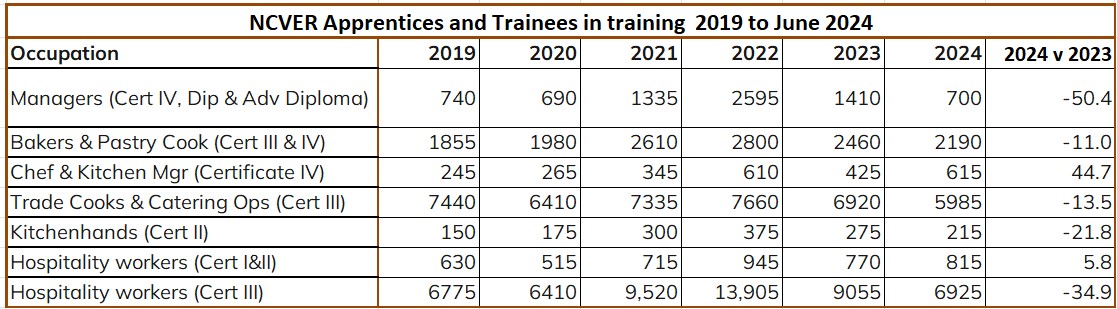
The latest data for apprenticeships released late last year showed that for the year to June 2024 of the seven categories of trade apprenticeships used by the NCVER, only food trades (including cooks, butchers and bakers) had less apprentices in training as at June 2024 compared with 2020. Compared with more than 10,000 food trades commencements in 2014, and 9,060 in 2022 (when the Boosting Apprenticeship Incentive was in place during COVID), in the 12 months to June 2024, only 5,905 commenced. In at least some positive news, commencements for food trades apprenticeships in 2024 were 13.5% better than 2023 when there were only 4,980 commencements. The table below, which summarises hospitality apprentices and trainees in training over the last five years, illustrates the success of the substantial subsidies available during COVID, and the dramatic fall as financial support dropped. For trainees undertaking Certificate III in hospitality the 35% fall in the year to June 2024 is expected to decline even further as the employer incentive was discontinued on 30 June.
| |
|
Overseas arrivals for October
The latest statistics from the ABS for October 2024 show that there were 677,410 short-term visitor arrivals in Australia, an increase of 11.4% compared to October 2023 but 12.5% below pre-COVID October 2019 arrivals, with this last comparison a deterioration from last month. New Zealand was the largest source country, accounting for 21% of all visitor arrivals, followed by China and the UK. In terms of State or Territory where visitors indicated they were staying, higher growth in visitors were experienced by WA (up 31.2%), Queensland (up 15.4%) NT (up 7.9%), and Victoria and NSW both up around 8% compared to October 2023. For the year ending November 2024, there were 8.17 million short term visitor arrivals compared with 6.8 million in the previous corresponding year, but still down by 13.4% from the 9.4 million arrivals in the year to October 2019.
In October 2024 there were 39,530 international student arrivals to Australia, an increase of 740 students compared with the corresponding month of the previous year. The number of student arrivals in October 2024 was 22.2% lower than the pre-COVID levels in October 2019.
| |
|
Hotel share of visitor nights continues to rise
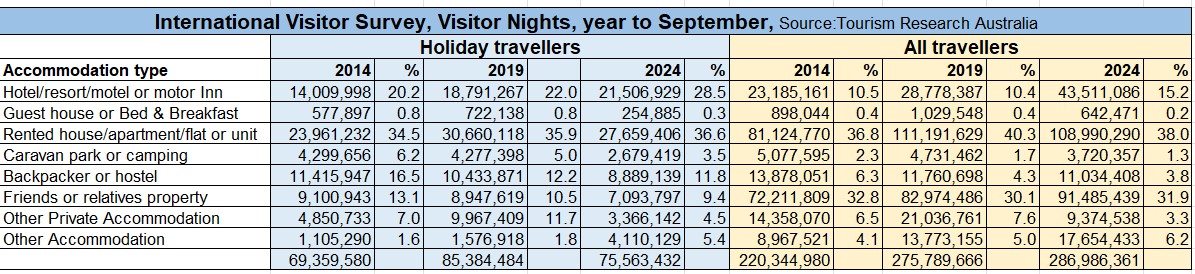
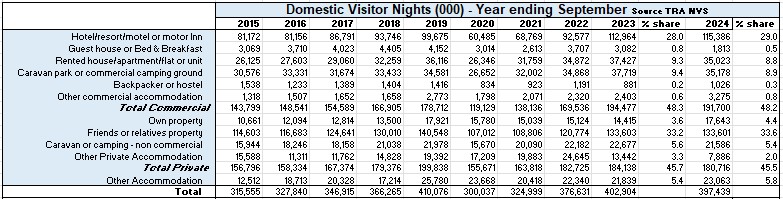
As reported in the last update, according to the latest Tourism Research Australia IVS data, in the year to September 2024, 43.5 million visitor nights (15% of total nights) were spent in a hotel, resort or motel. which was a significant increase on the 28.8 million nights (10%) spent in a hotel, resort or motel in the year to September 2019. As shown in the table below, the share of nights also compares favourably to ten years ago in 2014. The table also shows that the 28.5% share of nights spent by holiday travellers is also well up on 2019 and 2014. In contrast, the share of domestic tourist nights held by hotels only rose by one percentage point for the year to September 2024 compared to the previous year. However, it has risen from the 25.7% share in 2015.
| |
|
Drop me an email at policy@accommodationaustralia.org or give me a call on 0418 277 919 if you have any national policy issue that you think AA should be following up. If you know an AA member who is not receiving this advocacy report but wants to, then encourage them to email me and we can add them to the distribution list.
Kind Regards
Jenny Lambert OAM
National Policy Director
Accommodation Australia
| | | | |