| | |
POLICY & ADVOCACY UPDATE
Issue #56, 9 October 2025
| | | |
- Addressing the chef shortage
- Australian airports activity July 2025
- TTF Australian holiday intentions survey
- The economic and workforce contribution of international students
- Capital City hotel performance in September
- Job Vacancies in the AFS industry
| |
Addressing the chef shortage
As mentioned in issue #54 of the Advocacy Update, Accommodation Australia has been consulting with members and other key stakeholders on how we can address the chef shortage. We have had two highly valuable on-line forums as well as presentations in Sydney and the Gold Coast. Thank you to all who participated including those that have emailed with ideas in response to the discussion paper issued in August. It is not too late to have your say in response to the proposed solutions - just email your comments to policy@accommodationaustralia.org.
We are currently compiling all of the input to update the paper, and to use as a basis for working with bodies such as Service and Creative Skills Australia (SaCSA), Restaurant & Catering Australia and Tourism Training Australia on how we can best address this important workforce challenge.
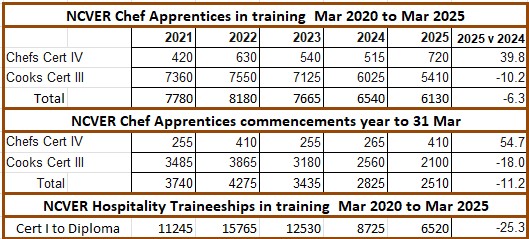
In the meantime, the latest apprenticeship figures released by NCVER for the year to March 2025 only serve to reinforce the urgent need to address the chef shortage. In the year to March, the number of apprentices commencing as cooks and chefs fell by 11.2% to 2,510 compared to the 2,825 that commenced the previous year. As the table below shows, the numbers commencing a Certificate III apprenticeship fell even more dramatically by 18%, and it is only a rise in Certificate IV apprenticeships in commercial cookery or kitchen management that made up some of the shortfall. These numbers compare unfavourably to the pre-COVID levels when the number of cooking apprentices in training in September 2019 were 7,685 with 3,725 commencing their training in the year to September 2019.
The table also reveals that hospitality traineeships continued to dramatically fall following the removal of employer incentives on 1 July 2024. Commencements in the most popular industry traineeship, the Certificate III in hospitality fell by 26% to 4,195 in the year to March 2025 compared to the previous year, and as the table shows, there were only 6,520 in training as at March 2025.
| | |
Australian airports activity July 2025
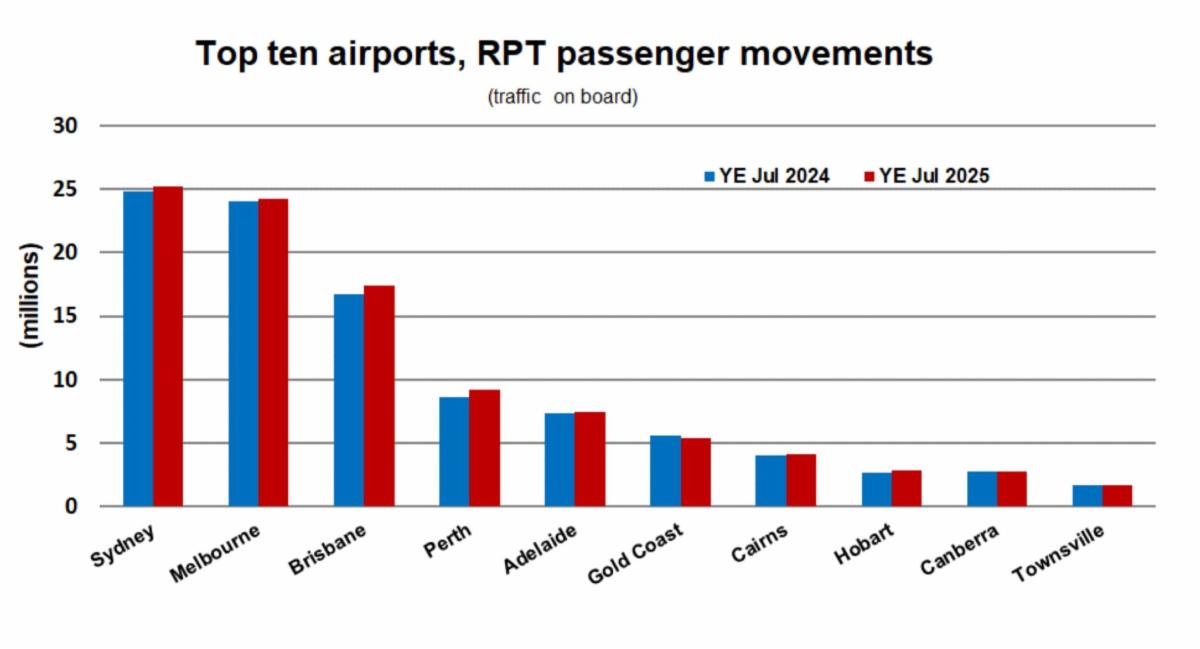
The latest BITRE data released from the office of the Interim Aviation Ombuds reveals Australian domestic aviation reaching significant milestones in July. In record-breaking passenger growth, 5.77m passengers flew domestically in July 2025, up 3.9% from July 2024 and crucially, 1.1% above pre-COVID July 2019 levels. Load factors climbed to 83.4% in July 2025, up from 81.5% in July 2024 showed that airlines are maximising every seat and reflecting strong consumer demand. The highest load factor (94.1%) was recorded on the Canberra - Gold Coast route. Regional airports handled 2.36m passenger movements, an increase of 3.5% from July 2024 and Melbourne - Sydney was Australia’s busiest route with 683.9k passengers, followed by Brisbane – Sydney with 388.8k passengers and Brisbane – Melbourne with 326.6k passengers. Sydney was Australia’s busiest domestic airport with 2.20m passenger movements in July 2025, followed by Melbourne with 2.14m passenger movements and Brisbane with 1.58m passenger movements. The graph below shows regular passenger transport movements for the year ending July 2025 compared with 2024. Although Sydney and Melbourne are almost on equal terms, Sydney saw 1.7% growth during the period compared with 0.5% for Melbourne. Perth and Hobart saw the biggest relative increases in passenger movements, with Gold Coast the biggest decline (with cyclone activity undoubtedly a big negative during this period).
| | |
TTF Australian holiday intentions survey
Last week TTF released their holiday survey for Spring school holidays showing that Australians are finding cost to be the biggest barrier to travelling, with 44% of Australians citing it as their main obstacle. Younger generations feel this most acutely, while older Australians (55+) are more likely to be held back by family commitments. The nationally representative survey of 1,546 Australians, conducted by Pureprofile between 19 and 22 September found that a majority of Australians are planning to travel this Spring (67%). This is down slightly from the 71% who planned to travel in Spring 2024. Of those who are travelling these school holidays, over one in ten (11%) plan to head overseas, with New Zealand topping the list (14%). Japan is also back near the top with 13% of travellers planning a Spring trip, and 10% plan to soak up the last of the European sun. Domestic travel remains the most popular option this Spring, with 55% of Australians planning a local trip. One in five (20%) plan to head interstate, while 35% will holiday in their own state or territory. The most popular state for domestic travellers is NSW (29%), followed by QLD (25%), VIC (22%) and WA (10%). The most popular city destinations for Australian travellers are Sydney (13%), then Melbourne (10%), followed by Brisbane (7%). Leading regional destinations include QLD’s Gold Coast (7%), then Sunshine Coast (4%), as well NSW’s South Coast (4%), and VIC’s Mornington Peninsula (3%). 41% of those planning a Spring holiday intend to spend less than $2,000 on their entire trip. Meanwhile 36% look to spend between $2,001 - $5,000 (down 3% from previous survey). 18-24s are set to spend the most with 30% budgeting over $5,001.
| |
The economic and workforce contribution of international students
A new study released last week by Jobs and Skills Australia has confirmed international students are significantly boosting the Australian economy and workforce. The International Students Pathways and Outcomes Study examines the experiences, study choices and labour market outcomes of international students who began studying in Australia in 2010-11 and subsequent years, tracking their progress to the end of 2023. JSA said international education contributed more than $50 billion to the Australian economy in 2023-24. After study with an Australian higher education or vocational education and training (VET) provider, many students wish to stay here. Analysis of the Australian Census and Migrants Integrated Dataset (ACMID) data from 2021 indicates that many graduates who achieved a permanent residence visa required around 2 or 3 consecutive visas before they gained a permanent residence visa, with a smaller proportion going through 5 or 6 different visas before being granted permanent residence. Permanent residence required around 5 years to attain post-graduation, with higher education graduates generally achieving permanent residence faster than their VET graduate counterparts.
International VET graduates are more likely to work in occupations and earn incomes that are aligned with their qualifications than international higher education graduates. In 2021, almost 80% of VET Temporary Graduate visa holders worked in one of three sectors: accommodation and food services, construction, and health care. Registered nurses and chefs are two of the most successful occupations to study and transition into permanent residency here. This success is attributed to the ease of course access and completion for students, available visa pathways via skills lists, education settings that prioritise work readiness, and employer appetite for international graduates. However, in the medium to long term chef retention is not as high as for nurses with the attrition rate for International Graduate Chefs just under 50% over a 5-year period, or an annual average of just under 10%, compared to 2 to 5% for nurses.
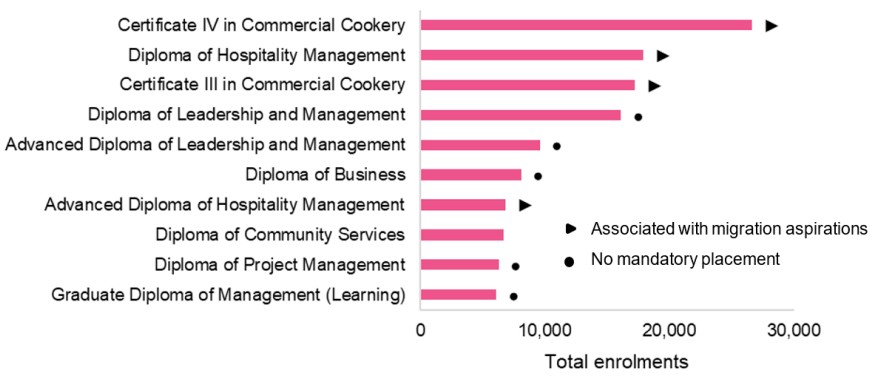
The graph below shows international VET enrolments in the most popular courses 2022 (before the current impact of caps), indicating the popular hospitality choices.
| | |
Capital City hotel performance in September
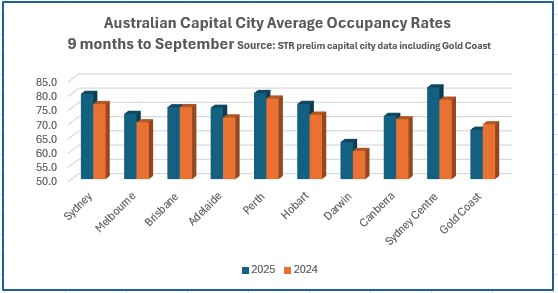
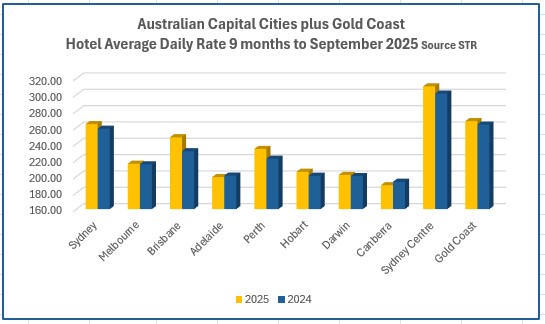
Preliminary capital city STR data for the month of September shows that hotel performance remained relatively strong for most cities compared to the previous corresponding period last year but with some modest falls in occupancy in three cities including the Gold Coast. Sydney had another good month with a 4.4% improvement in September occupancy to 80.8%, and ADR rose by 1.1% to $257.35 compared to September 2024. Melbourne's occupancy rose 3.1% to 69.1%, but ADR down 0.6% to $208.29; Brisbane occupancy was down 3.7% to 74.7%, but ADR was again up by 5.3% to $248.98; Adelaide occupancy up by 4.4% to 76.6% and ADR up 2.9% to $195.72; Perth occupancy slightly down 0.5% to 84.4% but ADR up 7.8% to $240.83; Hobart occupancy up 3.6% to 74.7% and ADR up 1.7% to $188.78; Darwin occupancy up 7.6% to 73.2% and ADR strongly up 8.8% to $231.79; Canberra occupancy slightly down 0.4% to 79.8% and ADR also down 4.4% to $199.23; and Gold Coast occupancy down 1.6% to 73% but ADR up 5.4% to $276.18.
The graphs below show the average occupancy rates and ADR capital city results for the nine months to September 2025 compared to last year.
| |
| | |
3 things for you to do today to support the industry's jobs and careers platform eeger.com.au:
- Register on eeger to build your employer profile
-
Follow eeger on LinkedIn to stay in touch
- List your job vacancies on the site that has been developed for industry by industry
| | | | |
Job Vacancies
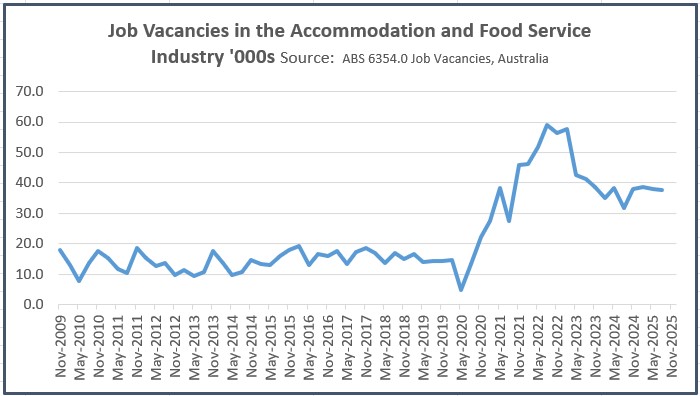
In job vacancy data released by the ABS last week, the Accommodation and Food Service Industry had 37,700 vacancies in August 2025, which was significantly higher than the 31,700 in August last year but around the same as the November to May period. This number of vacancies is again second only to the Health Care industry and almost twice as many as industries such as manufacturing. The change in vacancies since pre-COVID (August 2019) was 160%, which is the highest change of all industries, and compared to the all-industry average increase of 44%. Demonstrating the difficulty still being experienced by members and also the growth in the industry, as the graph below shows, the average quarterly vacancy figure for the AFS industry pre-COVID was much lower than it is today. Since February 2021, job vacancies have been consistently higher each quarter than the larger retail industry. Members are reminded that our industry now has the ideal vehicle for finding new staff. eeger.com.au has been developed to promote careers in hospitality and tourism. See above for suggested action you can take to support the industry's own website.
| | |
Drop me an email at policy@accommodationaustralia.org or give me a call on 0418 277 919 if you have any national policy issue that you think AA should be following up. If you know an AA member who is not receiving this advocacy report but wants to, then encourage them to email me and we can add them to the distribution list. Back issues of the fortnightly advocacy updates can be found here.
Kind Regards
Jenny Lambert OAM
National Policy Director
Accommodation Australia
| | | | |