CBVE® Newsletter 16 - November 2026
| | |
All About Assessment
This newsletter focuses on assessment including a brief history, some tips for best practice, a spotlight on clinical assessment and articles on the CBVE Toolkit, student perceptions of assessments and an evaluation instrument for clinical students. Additional sections include an update from AAVMC on the CBVE ITER, an Announcement about the next Community of Practice meeting organized by the CBVE Collaborate Working Group, and links to some Upcoming Events.
But first, something near and dear to all, what's happening to the COE and accreditation?
| |
Update on Program Accreditation:
Many of you may have heard about the AIM (Accreditation, Innovation and Modernization) Committee and the recent changes brought forth by the Department of Education (DE) related to the accreditation process for higher education programs.
The regulations that will be finalized by November 2026 will almost certainly require that programmatic accrediting bodies operate fully separately and independently from their affiliated professional organizations. These regulations will likely become effective July 1, 2027. As you may know, the AVMA Council on Education (COE) has operated under the AVMA umbrella for years and that will now need to change. The DE has proposed granting a 365-day grace period to allow physical separation of any accrediting agency from sponsoring parent organizations.
Currently, there is much discussion in the DVM community about the possibilities for how this DE mandate will impact our veterinary educational programs. At present, the AVMA COE is planning for continued support of veterinary program accreditation while a new agency or renewed version of the COE is stood up. The AAVMC is working closely with the COE to help avoid an accreditation gap for graduates and to make sure that new schools in the pipeline can continue to progress.
Despite all the challenges that this accreditation upheaval might bring to our profession, there is cause for excitement with a greater emphasis now being placed on student outcomes and assessment.For those of us working to support competency-based education – this is music to our ears! The CBVE Newsletter will keep you updated on relevant information related to accreditation of DVM educational programs and continue to provide support for programs as we navigate how to best determine, track, and assess student outcomes.
Every cloud has a silver lining...
| | | |
Back to Assessment
Assessment plays a vital role not just in the evaluation of student performance, but also in the quality of student learning experiences, teacher instructional activities, and the evaluation of curriculum, program quality, and system performance. Learning programs depend on assessment systems.
Assessment is not just about the students!
Assessment - then and now:
|
- Early records of organized academic assessment date back to the Civil Service examinations of Imperial China, 2,500 to 3,000 years ago where a standardized, universal system of assessments was used to identify students across the empire with high levels of literacy and memory competencies to operate the Emperor’s bureaucracy.
|
- The Greco-Roman Empire, around 2500 yrs ago, from which modern western education draws many of its foundations, relied on immediate, informal individualized assessment rather than standardized universal assessments.
|
- The informal individualized feedback of the GrecoRoman Empire gave way to competitive oral debates in European universities in the 12th century. These lengthy assessments were soon supplanted by written arguments which were graded by subject matter experts.
|
- These became shorter over time, eventually giving way to short form tests which predominated the assessment landscape for the next several centuries until, in the 19th century, school reformers, Horace Mann and Samuel Gridley, introduced standardized written testing into Boston City schools, modeling their approach on the Prussian educational system.
Some best current practices:
-
Design Realistic, Relevant Tasks: Frame assessments around authentic scenarios.
-
Align Outcomes, Tasks and Criteria: Begin with the learning outcomes you want to assess, then create or choose tasks that directly measure them.
-
Incorporate Feedback Loops: Use formative feedback from debriefing sessions, peer reviews, reflective exercises and/or entrustable professional activities to reinforce learning before final grading/evaluation.
-
Blend classroom and clinical applications: Explicitly link classroom concepts to clinical experiences through feedback loops and reflective exercises.
-
Make Assessment Criteria Explicit: Provide students with clear goals and expectations. Provide examples of excellence to build their confidence and ensure fair evaluation. CBVE Milestones for the CBVE competencies are good examples of goals and expectations that can be incorporated into assessment tools.
-
Create multiple opportunities to assess the student and skills: Incorporate any given skill into many scenarios for assessment to ensure that students receive a well-rounded overall evaluation. Well-designed programs of assessment are essential for comprehensive evaluation of students.
CBVE assessment links:
Grab and Go kits:
Just-In-Time Videos:
| | | |
Spotlight on Assessment of Students in the Clinic
Multiple assessment tools are needed to create
the complete picture!
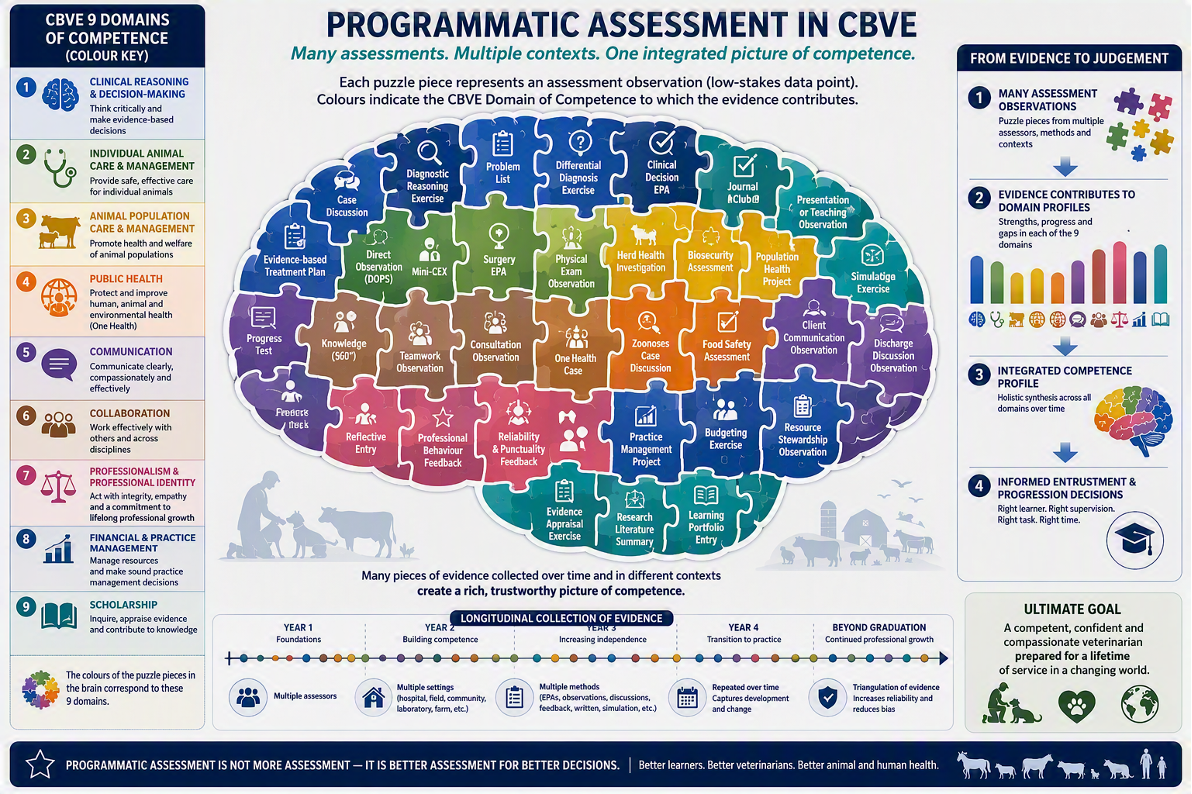
One of the five core components that define competency-based educational models is programmatic assessment (van Melle et al, 2019). Put simply, this component requires multiple assessment tools, used over time, to evaluate a learner’s achievement of competence. This principle holds true both over the entire duration of a veterinary program as well as in the clinical phase.
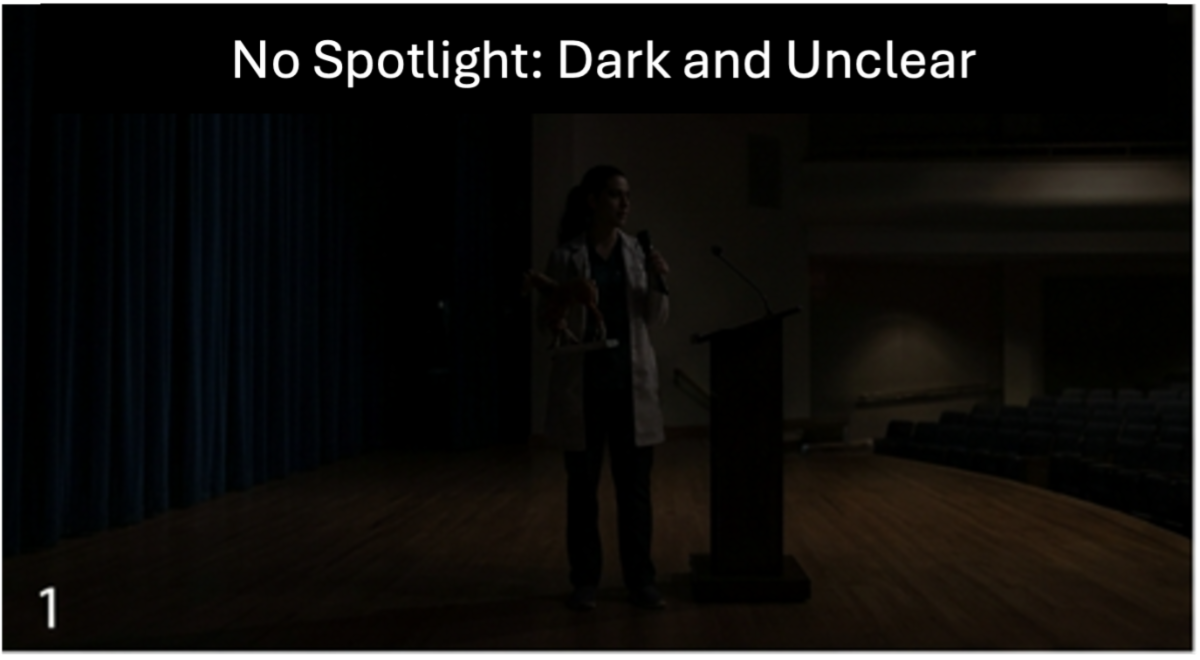
To help illustrate this concept, we can think of a veterinary clinical student on a stage. If we have no assessment tools to evaluate this student, we are “in the dark” regarding their competence.
| If we use a single assessment tool to evaluate the student during their clinical program, we get an improved evaluation (image) of the student, but this is not comprehensive. | If we use multiple assessment tools to evaluate the student, but these are not part of a well-designed program where the assessments complement each other and gather different information about the student’s performance, we get an improved evaluation of the student, but it is not comprehensive. | If, instead, we use multiple assessment tools that are aligned and complementary in a well-defined program of assessment, then we get the best evaluation of the student and their competence to perform the required tasks of a veterinarian at graduation. | |
The types of assessment tools that can be used in veterinary clinical training can vary from program to program, but may include:
- In-Training Evaluation Reports (ITER) conducted at the end of the clinical rotations to help identify a learner’s progression towards achievement of competence for each of the CBVE competencies through milestones;
- Entrustment-Supervision Scales used to evaluate performance of Entrustable Professional Activities (EPAs) multiple times during a rotation and provide in-the-moment feedback;
- Direct Observation of Procedural Skills (DOPS), which may provide more specific feedback on a given procedure e.g., spay or neuter;
- Mini-Clinical Evaluation Exercises (mini-CEX), which can be used to evaluate learners engaged in authentic clinical encounters in a workplace-based setting;
- Case-based discussions or written assignments for more in-depth evaluation of clinical reasoning;
- Multiple Choice Questions to evaluate specific knowledge, such as in a diagnostic (i.e., radiology or clinical pathology) rotation.
Further information regarding these and other assessment tools that could be used to evaluate students in clinical rotations can be found at CBVE Toolkit.
This important concept of programmatic assessment throughout the veterinary training program is also illustrated in the following diagram that further highlights these principles and links them to Competency-Based Veterinary Education.
| |
Exciting News:
CBVE ITER - An invitation to collaborate
The CBVE® ITER assesses veterinary student performance at the end of each clinical rotation using competencies and milestones in the AAVMC CBVE 2.0 Model. In 2026, AAVMC completed an initial study of the ITER in partnership with a psychometrics firm. The ITER is now the cornerstone of AAVMC’s newly established CBVE ITER Initiative. This Initiative invites AAVMC member institutions to collaborate with AAVMC on implementing the ITER, inform the development of training resources, and contribute to ongoing research related to the ITER. If your institution is interested in learning more about the ITER and participating in the Initiative, please complete this interest form. Please contact Dr. Jessica Brodsky at jbrodsky@aavmc.org with any questions.
| |
Must Reads:
Development and Use of the Competency-Based Veterinary Education (CBVE) Assessment Toolkit. Foreman J.H. et al. (2023) JVME 51(2):203-208. doi: 10.3138/jvme.2023-0021
The CBVE Assessment Toolkit is a resource designed to help instructors choose from an array of assessment tools to evaluate learners’ progress through the curriculum. Twenty-one tools are described, including examples, documented uses, evidence for efficacy, pros and cons (where available), and selected references.
Perceptions of Assessment Literacy among Current and Prospective Veterinary Students. Marsh S.J., et al. (2021) JVME 48(2):163-169. doi: 10.3138/jvme.2019-0023
This study examined students’ perceptions of assessments undertaken in a veterinary program. A survey was used to evaluate 3 groups; applicants, students early and late in the program. The study showed that students enter the program with little idea of what assessments would be like at University, approximately half perceive they have gained a good understanding of assessments during early phases of the program, but this understanding does not improve during the program. A proposed assessment literacy curriculum is outlined.
Adaptation and Validation of an Evaluation Instrument for Student Assessment of Veterinary Clinical Teaching. Gordon-Ross P.N., et al. (2025) JVME 52(6):830-847. doi: 10.3138/jvme-2024-0050.
This study developed and validated the SFDP-Vet22, a veterinary-specific adaptation of the Stanford Faculty Development Program teaching evaluation tool, to assess clinical teaching by veterinary educators. The researchers found strong evidence that the instrument is reliable and valid. The domains of session control, communication of goals, and support for self-directed learning were particularly stable, while learning climate, evaluation, and feedback were less consistent. Overall, the findings suggest that key concepts used to evaluate clinical teaching in medical education can be successfully transferred to veterinary education, and that the SFDP-Vet22 is suitable for low-stakes evaluation and professional development of veterinary clinical educators.
Empowering medical students: Peer-Led OSCE reduces anxiety and may enhance test performance. Mateus de Lima M. et al. PLOS One: Published: February 12, 2026. doi: 10.1371/journal.pone.0340407
Objective Structured Clinical Examinations (OSCEs) are commonly used to assess the acquisition of clinical skills in preclinical curricula. This paper reports on the use of peer-led mock OSCEs to address students' anxiety associated with these exams and the potential for them to improve outcomes and wellbeing.
| |
Announcing:
-
The CBVE Collaborate Working Group announces our next Community of Practice meeting scheduled on Thursday, 19th November at 5 pm ET with a theme of "Identifying and Remediating Professionalism Issues". To register, click here.
| | |
|
Upcoming Events
- CBVE CoP on-line session, Nov 2026, Click here to register.
- AAVMC Catalyze 2027, April 15-17, Washington DC.
- VetEd Down Under Symposium, Feb 2-5, 2027, Melbourne, Australia. Click here for more information.
| | | | | |