|
Stocks Up Again
The NASDAQ set a record high on Tuesday and the S&P 500 and Dow followed suit the next day, lifted by fresh data on inflation and a brighter outlook for eventual interest-rate cuts. On Friday, the Dow closed above the 40,000-point mark for the first time —finishing at 40,003.6—to cap its fifth positive week in a row.
U.S. stock indexes rose around 1% on Wednesday and bond yields fell after an inflation report showed that consumer prices increased less than most economists had expected. In April, the Consumer Price Index rose 0.3% over the previous month and 3.4% over the same month a year earlier, interrupting a recent trend of hotter-than-expected inflation data.
The latest inflation data lifted investors’ expectations for interest-rate cuts later this year, and government bond yields fell sharply, with most of the week’s decline coming in response to Wednesday’s better-than-expected inflation report. The yield of the 10-year U.S. Treasury bond closed at 4.42% on Friday, down sharply from 4.69% at the end of April.
Amid slumping housing prices, China on Friday announced measures designed to lift the struggling commercial and residential property markets in the world’s second-largest economy. Among other things, China’s central bank reduced the minimum down payment for mortgages and removed the floor on interest rates for first and second homes.
An index that measures investors’ expectations of short-term U.S. stock market volatility fell into negative territory year-to-date and slipped to the lowest level in five months. The CBOE Volatility Index (VIX) has fallen about 38% from a recent high on April 15.
U.S. retail sales were unexpectedly flat in April, marking a slowdown from the previous month, when sales climbed 0.6%. Most economists had been expecting an April sales gain of around 0.4%, rather than the unchanged result, which came amid elevated interest rates and persistent inflation.
Source: John Hancock Investment Management
| |
All-Time High for Household Net Worth | |
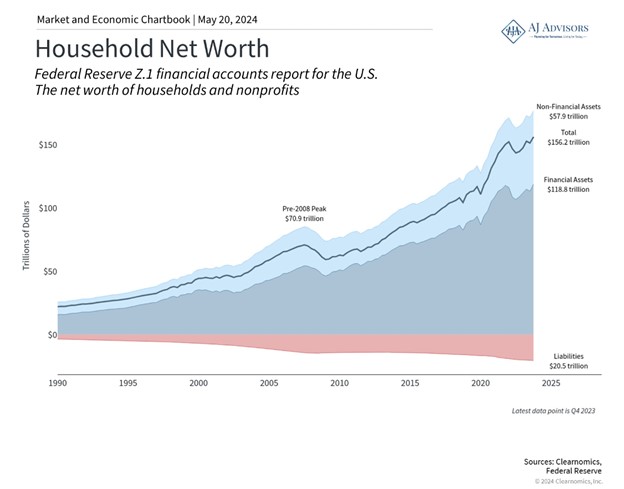 | |
The Dow Jones Industrial Average reached 40,000 for the first time last week. While this has felt like a difficult year for many investors due to inflation, high interest rates, and growth concerns, the reality is that the broad market has achieved 23 new all-time highs. Other asset classes, including international stocks, commodities, and even gold, have surged alongside the U.S. stock market as interest rate expectations have fallen.
As the chart below shows, household net worth is at an all-time high, eclipsing the previous peak before the 2008 global financial crisis. Household net worth grows with the value of assets such as cash, stocks, bonds and real estate, and it declines with liabilities such as credit card debt and auto loans. The strong economy and bull market have led overall household net worth to more than double since 2007, despite the pandemic and the 2022 bear market.
Rising household net worth can drive consumer spending since the more money people have, the more they feel they can spend – a phenomenon known as the “wealth effect.” When people feel like they are in a good place financially, they tend to spend more which can then drive business profits, higher wages, and ultimately boost stock prices. The wealth effect can occur even when illiquid assets such as homes or retirement investment accounts increase in value.
This increase in net worth has occurred despite high inflation rates over the past couple of years. This is an important reason for investors to hold a portfolio that can grow over time and outpace inflation, rather than holding only cash. History shows that long-term wealth creation is the result of holding the right mix of stocks, bonds, and other asset classes. The strong consumer is one reason markets have achieved new all-time highs this year.
| | |
Which State Looks the Most Like the United States? | |
|
Fifty states joined the Union from 1787 through 1959. Every one of them has a distinct history and culture. States’ names originated from Latin, English, Spanish, French, Polynesian, Algonquian, Siouan, Iroquoian, Uto-Aztecan, and other languages. In Alabama, there are deep sea fishing rodeos and in Arizona there are sidewalk egg-frying contests. In Georgia, they like salted peanuts in cola, and in Michigan they call soda “pop.” Nebraska cheers for the Cornhuskers, while Oregon flies with the Ducks.
There are a lot of differences between U.S. states, but which state is most like the United States? That’s the question Lenny Bronner and Andrew Van Dam of The Washington Post wanted to answer. Bronner crunched U.S. Census data to create indices that compare U.S. states to one another and to the nation. Some of their findings can be found in this quiz.
1. Which state most closely resembles the United States when it comes to income? (Hint: Its state flower is the violet.)
a. Arizona
b. Illinois
c. Georgia
d. Nevada
2. Which state is most like the United States when it comes to residents’ educational achievement? (Hint: It has the oldest state park in the nation.)
a. Rhode Island
b. West Virginia
c. Georgia
d. Texas
3. Which state most closely mirrors the country when it comes to employment? (Hint: Its known for a tasty sandwich.)
a. Pennsylvania
b. Utah
c. Mississippi
d. Ohio
4. Bronner constructed a similarity index using 30 variables to predict which states are likely to vote similarly. Which states are the closest match to one another? (Hint: You may have a hard time believing it.)
a. Arkansas – New Mexico
b. California – Texas
c. Florida – Wisconsin
d. New Hampshire – Ohio
Financial plans are a lot like states. They reflect the unique characteristics and needs of individuals and families. If you have any questions about whether you are on track to achieve your financial goals, get in touch.
Answers: 1) b; 2) c; 3) a; 4) b
| | |
AJ Advisors
www.ajadvice.com
|
|
|
Phone: (615) 709-8709
Fax: (615) 505-3306
| |
| |
John Stauffer, CFP®
Partner
| |
Andrew Quinn, CFP®
Partner
| |
Past performance does not guarantee future results. Different types of investments involve varying degrees of risk, and there can be no assurance that the future performance of any specific investment, strategy, or product (including those recommended or undertaken by AJ Advisors, LLC), or any non-investment related content, made reference to directly or indirectly in this communication will be profitable, equal any indicated historical performance level(s), be suitable for your portfolio or individual circumstances, or prove successful. Due to various factors, including changing market conditions and/or applicable laws, the content may no longer be reflective of current opinions or positions. You should not assume that any discussion or information contained in this communication serves as the receipt of, or as a substitute for, personalized investment advice. To the extent that a reader has any questions regarding the applicability of any specific issue discussed above to their individual situation, they are encouraged to consult with the professional adviser of their choosing. AJ Advisors, LLC is neither a law firm nor a certified public accounting firm and no portion of the content herein should be construed as legal or accounting advice. If you are an AJ Advisors, LLC client, please remember to contact the firm, in writing, if there are any changes in your financial situation or investment objectives or if you wish to impose, add, or modify any reasonable restrictions on our investment advisory services. Until so notified, AJ Advisors, LLC will continue to rely on the most recent information provided. A copy of our current written disclosure statement discussing our advisory services and fees continues to remain available upon request. | | | | |