Aligned Grey and White.png


Weekly Update


March 15, 2024

Education omnibus fueled by compromise

The Missouri Senate tackled a school choice priority this week after hours of lengthy debates and behind the scenes negotiations. Despite giving Democrats several concessions, it may not be enough to sway support from key House members who oppose the underlying bill.


SB 727, sponsored by Senator Andrew Koenig (R-St. Louis County) expands the Missouri Empowerment Scholarship Accounts Program statewide and increases the maximum tax credits from $50 to $75 million.


During the floor debate, Senator Koenig offered a substitute bill adding provisions that:


  • Expand charter school eligibility to Boone County; 
  • Increase the percentage of students a school district can draw state dollars down to provide preK; 
  • Establish a literacy fund for home reading programs; 
  • Change the calculation of attendance for students in the Missouri Course Access and Virtual Schools program; 
  • Establish alternative education program for homeschooled families;
  • Modifies the process for filling vacancies on urban school boards; 
  • Add weighting factors for school enrollment calculations; 
  • Increase the minimum teacher salary; 
  • Increase the cap on the maximum number of credits available in the Empowerment Scholarship Account Program; 
  • Establish certain teacher preparation and retention programs, and
  • Authorize school boards to approve a differentiated pay scale annually for hard-to-staff schools or hard-to-fill positions.


After a healthy discussion and rejecting several attempts by Senator Mike Moon to require school districts to insert pro-life lessons into their curriculum, the bill passed by a vote of 20-13 which three Republicans joining the 10 Democrats in opposition.


The bill moves onto the House for further consideration.

About Aligned


Aligned is the only state-wide non-profit, nonpartisan business group working in Kansas and Missouri on educational issues impacting the full development of our children, from supporting high-quality early learning to solid secondary programs that provide rigorous academic programs and real-world learning opportunities.


Our vision is that our public education systems in Kansas and Missouri have the resources and flexibility to prepare students to pursue the future of their choice.


We are currently focused on education policies that will strengthen early childhood education, teacher recruitment and retention, and school finance reform.


Learn more about our work.

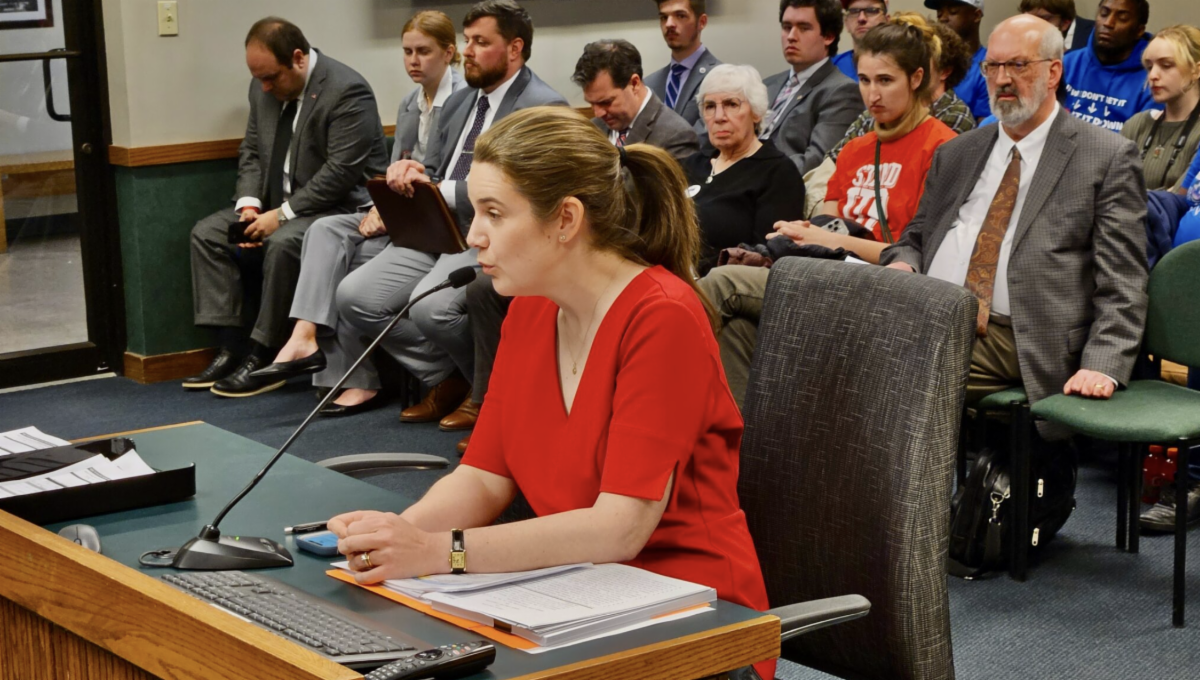
Senator Mary Elizabeth Coleman presents her initiative petition reform bill to a House committee this week. PHOTO CREDIT: Rudi Keller/Missouri Independent

Missouri News

"I want candy" says senator


Following the perfection of SB 727 (Koenig) on Wednesday, the bi-partisan spirit of of compromise quickly faded after Senator Mary Elizabeth Coleman presented her Initiative Petition Reform bill (SJR 74) to the House Committee on Elections and Elected Officials. In a move that outraged Senate Democrats, Coleman urged the House committee to restore the "ballot candy" that the Senate stripped during their negotiations and suggested she could help organize an effort to use the Previous Question to keep the restored provisions.


The PQ, a cloture parliamentary procedure, swiftly ends debate and prompts an immediate vote on the pending measure. Coleman's comments drew ire from Senate Democrats, who expressed their frustration by refusing to engage in further debates. Minority Leader John Rizzo and other Democrats criticized Coleman for hours until Majority Floor Leader Cindy O’Laughlin abruptly adjourned the session for the day.


Meanwhile, the House continued to Perfect and Third Read bills. On Wednesday morning, after Perfecting three bills during the morning session, Majority Floor Leader Jon Patterson announced that there would be no afternoon session.


House Committee Activity


  • Career Academic Plans - The House Workforce and Infrastructure Development Committee passed HB 2794 (Bangert), a bill that requires eighth graders to complete career assessments and develop academic and career plans by a 10-1 vote.


  • Cursive Writing Instruction - The House Special Committee on Education Reform passed HB 2852 (McGaugh), which requires school districts instruction on cursive writing by a 5-0 vote.


  • Externships – Career and Educational Experience - The House Elementary and Secondary Education Committee passed HB 1945 (Shields), which removes the expiration on a voluntary vocational, career and technical externship program for professional educators to experience, participate in, and gain knowledge of the available career pathways, educational requirements, and emerging fields of study available to high school students entering college or the workforce in Missouri by a 15-0 vote.


Senate Committee Activity


  • School Start Date Restriction Exemptions - The Senate Select Committee on Empowering Missouri Parents and Children heard SB 882 (Razer), which provides a school start date exemption to any public school district operating where there is a charter school in its boundaries. Charter schools are not required to wait until 14 days before the first Monday in September.


  • Tax Credit – Child Care - The Senate Government Accountability Committee heard HB 1488 (Shields), the House companion to SB 742 (Arthur), and authorizes three tax credits for child care. Specifically, the "Child Care Contributor Tax Credit Act," "Employer-Provided Child Care Assistance Tax Credit Act," and "Child Care Providers Tax Credit Act." There was no opposition. Immediately after the hearing, the committee passed the bill by a 5-0 vote.


Reports


Read the full unabridged legislative report here.


See all tracked legislation here.

Budget News


The House Budget Committee finally convened this week to allow Chairman Cody Smith (R-Carthage) to present his proposed changes to the FY25 budget. 


The Chairman's budget substitute reflects a $2 billion decrease over the Governor's recommendations for a total of $49.9 billion ($13.325 billion, which comes from general revenue funds). Reductions to HB 2002 (Department of Elementary and Secondary Education), HB 2010 (Department of Health and Senior Services), and HB 2011 (Department of Social Services) represented the most significant portion of cuts. 


The Chairman's substitute does include full funding for PK-12 education by using the Classroom Trust Fund ($72 million), Lottery Proceeds Fund ($42 million), and the State School Moneys Fund ($6.5 million) to pay for the $120.5 million increase to the foundation formula for FY25. 


The substitute also includes full transportation funding and the Governor's recommendation for universal voluntary Pre-Kindergarten for low-income children. 


The most significant change from the Governor's recommendation is for the childcare subsidy piece. The Chairman's Budget Substitute proposes using federal funds instead of general revenue to cover a bump in the reimbursement rate for infants and toddlers at the 100th percentile of the federal poverty level (FPL) and the 65th percentile of the FPL for pre-K and school-age children. He based his decision on the fact that actual childcare subsidy utilization rates are about 3/4th of what the Governor's assumptions reflect. Under this plan, the state can serve 23,403 total children.


The deadline for any additional amendments is next Tuesday, March 19th, at 5 p.m. No amendments submitted after the deadline will be considered. The committee is scheduled to begin the mark-up process at 10 a.m. on March 25th


A link to the entire proposed Chairman's substitute can be found here

In other news


Aligned Priority Bills Report for Missouri


House childcare tax credit bill heard and voted out of Senate committee this week.


Early Childhood Education and Childcare


Free and voluntary Pre-K for all students who qualify for free- and reduced lunch


HB 1486 (Shields) - Reported to Senate and First Read on 3/7/24. NO CHANGE


Child care tax credit package

  • HB 1488 (Shields) - Heard in Senate - Government Accountability on 3/14/24. Voted Do Pass 5-1.
  • SB 742 (Arthur) - Placed on Senate Informal Calendar 2/27/24. NO CHANGE.


Teacher Recruitment and Retention


Differentiated Pay

  • HB 1447 (Lewis) - Reported Do Pass from Rules-Administrative Oversight on 3/4/24. NO CHANGE


School Finance Reform


Alternative Poverty Metric

  • SB 1080 (Arthur) - referred to Senate - Select Committee on Empowering Parents and Children on 1/25/24. NO CHANGE.


Other education legislation


Open Enrollment

  • HB 1989 (Pollitt) - Referred to Senate Committee on Education and Workforce Development on 3/7/24. NO CHANGE.


Accountability Measures

  • HB 2184 (Haffner) - Scheduled for committee hearing in Rules-Administrative Oversight on 3/7/24. Returned to committee: House -Elementary and Secondary Education on 3/11/24
  • SB 1366 (Trent) - Voted Do Pass as substituted. 2/21/24. NO CHANGE.


See status of all Aligned priority bills here.

Kansas News

Tax Credits for Private Education Advance in Kansas Senate Committee


This week, the Committee on Assessment and Taxation recommended the passage of SB 509 as amended. This bill establishes the education opportunity tax credit for families who send children to accredited private schools or home schools. 


The proposed bill would allow up to $75 million in tax credits in its inaugural year. Under provisions in the legislation, taxpayers with students enrolled in accredited private schools could receive a refundable tax credit amounting to 75% of the state's base student aid, equating to $3,815 per student. Similarly, students in non-accredited private schools, including home schools, would be eligible for a tax credit of 50% of the base aid, totaling $2,544 per student.


According to the fiscal note, Kansas had approximately 26,700 students enrolled in accredited private schools and potentially 54,300 in unaccredited private schools during the 2022-2023 academic year.


Proponents of the bill say the legislation would provide parents with financial resources to make the best choice for their children's education. Opponents argue that the bill is a tax incentive with little to no oversight and could jeopardize funding for public schools and potentially interject the state into homeschooling.


Americans for Prosperity - Kansas, Holy Savior Catholic Academy, Kansas Policy Institute, and yes. every. kid testified in support. 


Game On for Kansas Schools, the Kansas Association of School Boards, the Kansas State Board of Education, Kansas Interfaith Action, the Kansas PTA, the United School Administrators of Kansas, and five private citizens testified in opposition. 


Along with the tax credit bill, the Senate is also considering alternative measures, such as the Sunflower Education Equity Program, to provide education savings accounts for less affluent students. 


Kansas House Passes Bill for Alternative Teacher Certification


This week, by a vote of 79-43, the House passed HB 2521, a bill requiring the state board of education to authorize teaching licenses for individuals who complete an alternative teacher certification program. 


During the floor debate, Representative Jason Goetz, R-Dodge City, highlighted that the bill draws inspiration from successful models implemented in 14 other states, such as Missouri, Nebraska, and Oklahoma. Goetz stressed that the intention is not to compete with traditional higher education routes but to offer a viable option for those with existing credentials to serve in public schools.


The bill outlines clear criteria for alternative certification programs, requiring them to operate in multiple states for at least a decade and encompass comprehensive subject-area content and pedagogical training. Applicants must also pass subject area and pedagogy exams to qualify for the restricted license.


Under the proposed legislation, applicants with a bachelor's degree from an accredited institution would be eligible to apply for a restricted license. This license would require two years of participation in a district-based mentorship program, ensuring continuous support and development.


However, the bill faced opposition from sides of the aisle. Critics argued that it undermines the authority of the State Board of Education and may compromise the quality of instruction in classrooms. They also raised concerns about the potential impact on current teachers and the overall educational experience for students, particularly at the elementary level.


Proponents of the bill highlighted the pressing need to address teacher shortages in Kansas. With districts using emergency substitute licenses for long-term positions due to a lack of qualified educators, there's an urgent call to diversify pathways into teaching.


The Senate may also consider a similar bill, SB 407, which has also sparked debate within the education community. 


Data shows enrollment on the decline


The Kansas Association of School Boards published a story this month highlighting enrollment data compiled by the Kansas State Department of Education. According to the report, there were approximately 5,200 fewer students this year.


Key takeaways:


  • Kansas's school-age population is dwindling, with a 5.2 percent decline in those under 18 from 2010 to 2024, significantly impacting the under-five demographic.


  • Before the COVID-19 pandemic, public school enrollment in Kansas rose partly due to students shifting from accredited private schools. However, public and private schools experienced enrollment declines during the pandemic, with public school enrollment not yet returning to pre-pandemic levels and private school enrollment remaining nearly 9 percent lower than in 2011.


  • During the pandemic, alternative schooling options increased but have leveled off; estimates suggest that the percentage of children aged 5-17 not attending public or accredited private schools peaked above 6 percent in 2021


  • The number of students eligible to receive free meals is rising, as is the number of students requiring special services due to disabilities.


Read the report from KSDE.


Read our full legislative report.


Key 2024 Legislative Deadlines


  • March 22 - Last day for non-exempt committees to meet 
  • March 28 - Last day for non-exempt bills in either Chamber 
  • April 5 - First Adjournment (Drop Dead Day) 
  • April 29 - Veto Session begins


In other news


Put 'em to work

Woodman Elementary School in Wichita is conducting an experiment to help with student behavior issues.


The program Meaningful Work pairs a student with an adult mentor to participate in a constructive activity. Program consultant Jessica Sprick says, "For a lot of students who struggle with behavior, they're getting so much attention for negative behavior, we actually see that behavior get worse. "If you can create structures that allow adults to see the students as someone valuable and give them that positive feedback, it really becomes a snowball effect."


Read more here.


The Missouri General Assembly has adjourned for its annual Spring Break - we hope lawmakers get some rest and relaxation so we can have a "meaningful" second half.


Enjoy the weekend,

Torree Pederson Signature.png

Torree Pederson

President

Aligned

Torree@WeAreAligned.org

(913) 484-4202

SIgnature_No_Background.png

Linda Rallo

Vice President

Aligned

Linda@WeAreAligned.org

(314) 330-8442

Torree_Pederson_WEB-3 closeup.jpg
Linda_Rallo_Headshot.png
Visit our Website