|
Dear Colleagues,
In the Northern Hemisphere, our days are almost at their shortest, and many of you are experiencing a prolonged period of very cold weather. As a reminder of the very varied locations of our schools, a colleague in the Los Angeles area reported yesterday that it was 80 degrees there! The shortest days of the year are marked in most cultures by festivals that bring light into darkness. Many of these are beloved in Waldorf communities - lantern walks, spirals of light, Diwali, Hanukkah, and more.
Festivals are almost synonymous with Waldorf communities - they are expected, beloved, and nurturing for many. It is interesting to reflect on the evolution of our portfolio of festivals; Public Waldorf schools have been an active agent in that process. For many years, the festival calendar remained unchanged in most Waldorf schools; I know that, when I became engaged in Waldorf in the 1980s, it didn’t occur to me to question them. This was what we did, it was beautiful, and I was enriched by it. I took their Eurocentric, largely Christian origins for granted and assumed the way they were was “Waldorf.” We have learned a great deal, especially this century, about cultural responsiveness, inclusion, belonging, and diversity. Alongside those lessons, our festival traditions have been - and continue to be - examined. Some aspects have been rightfully rejected. Others have been adapted. Still others have been added and continue to be developed to best reflect local cultures, ethnicities, history, and landscapes.
It is important that we continue to review and evaluate our festivals. A few questions to consider: as we do so:
-
Why do we celebrate this festival? What is its purpose? (The response, “Because it is Waldorf,” does not suffice.)
- Is the festival connected to the rhythm of the seasons and year or does it have a different purpose?
- Where does knowledge of the festival live? Is this knowledge shared?
- Was this festival started by and carried by an individual for whom it had particular meaning? Is this person still part of the school and festival? Does it have meaning for others?
- How is the festival reflective of the school, its students and families, and location?
- What age group is the festival designed for? Do we ask students who are too young or too old to participate out of a sense of tradition?
- Who is carrying the festival, the preparation, and the enactment? Is this reasonable?
- Do we review our festivals after they have taken place? Do we keep notes?
- Do we provide background information and explanations to our community ahead of the festival?
- If we are adding new festivals or celebrations to better reflect our community, are we also giving something up to avoid overload?
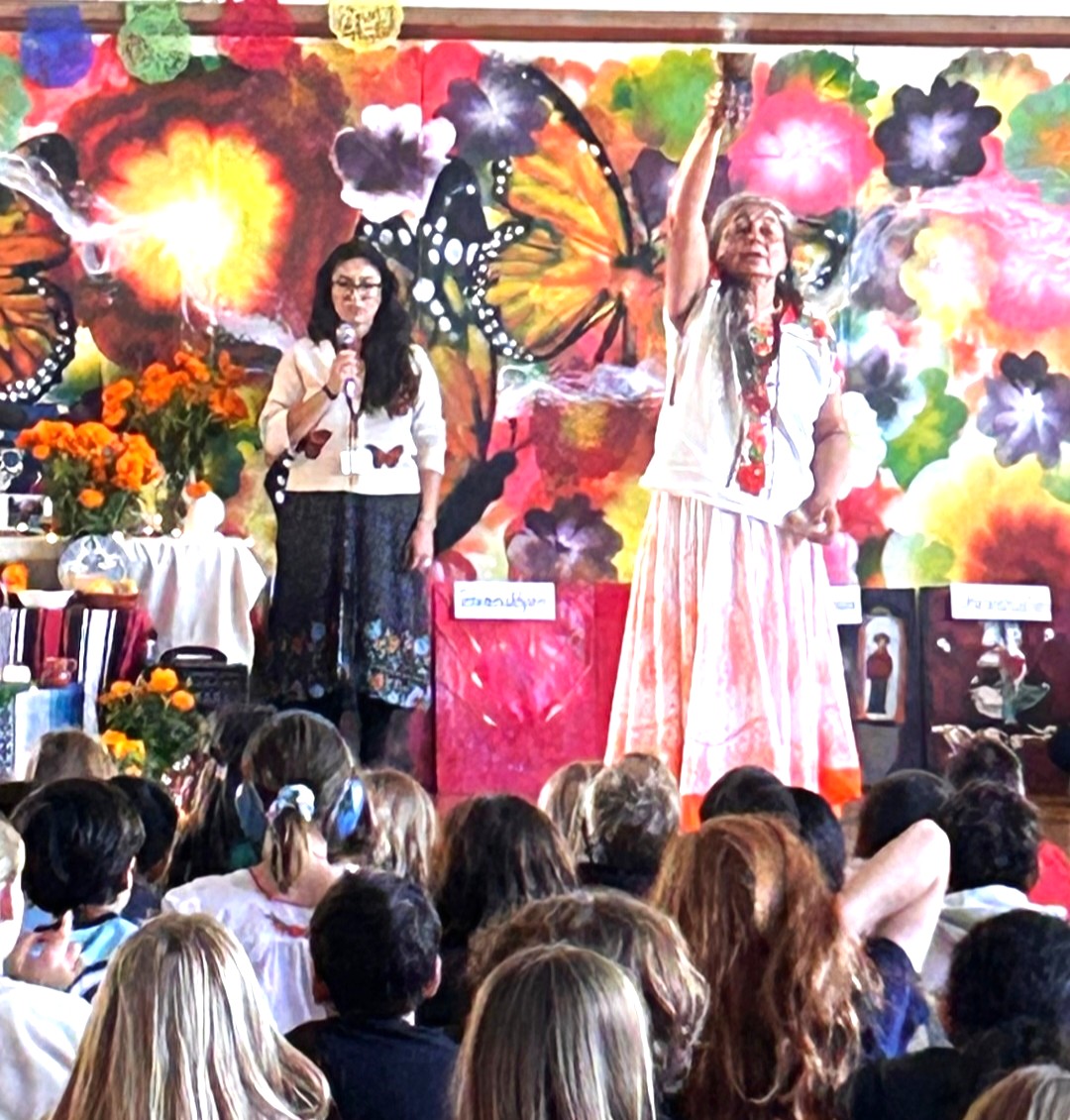
There are many incredible festivals in our schools with new traditions being established. Over the next few editions of our E-news, we will bring descriptions of several of these. We are starting today with a description of the beautiful weaving of strands of meaning and connection of Día de los Muertos at Woodland Charter School in Glen Ellen, Northern California. Many thanks to Teresita Landin, the school’s Spanish maestra, for sharing this celebration with us.
Día de los Muertos, one of Mexico’s most valued holidays, where reuniting and honoring beloved ancestors, family and friends takes place. It is an ancient and enduring ritual when the living remember and celebrate their loved ones who have passed. No two towns celebrate this tradition the same, for the stories and rituals are kept alive through oral tradition, passed down from generation to generation. Yet, the general feeling and idea is one that has been kept alive for hundreds of years. The historical roots of this celebration date back to more than 3,000 years, before European cultures and traditions influenced the Indigenous peoples of Mesoamerica.
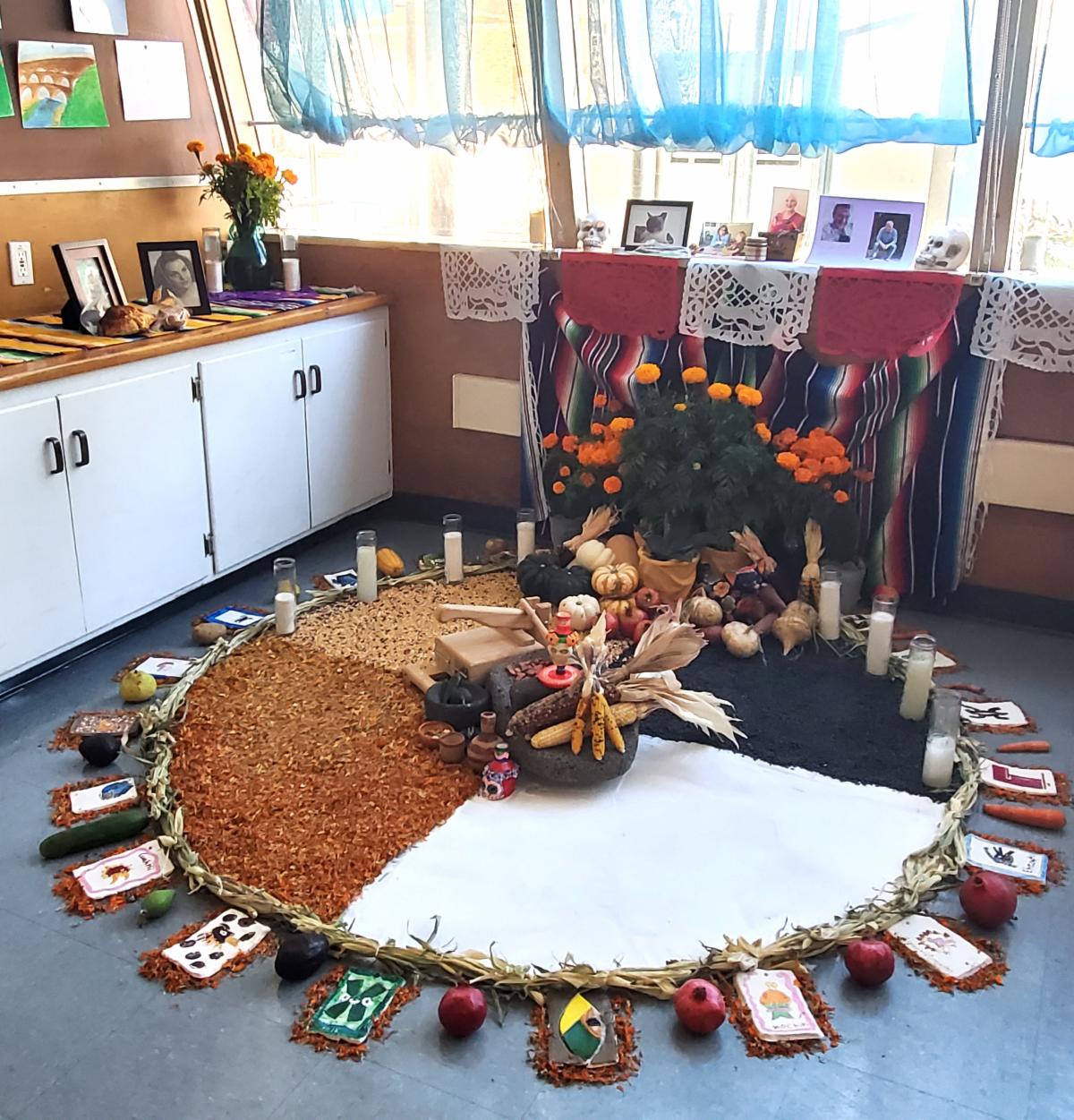
Día De Los Muertos celebrates the cycles of Life and Death through color, art, music, storytelling, feasts, and fiestas. It is a time for communities, big or small, to come together in great celebration and put together ofrendas (offerings), altars to commemorate their dearly departed. Altars are created with photos, mementos, fruit, bread, and other favorite things of the ancestors being welcomed and honored. Marigolds and incense are offered in abundance because it is believed their aromatic scents guide their loved ones back to the place where the feast is being held. The artifacts of these altars also provide the opportunity to teach children about those who came before them. Día De Los Muertos is a time of celebration and remembrance.
For this reason, we gather every year as a community of educators and students, to learn about the history of the land and the people that came before us. In doing so, we honor not only the land and the people, but also the roots of so many within our own school community. Together we keep this important history alive. It is an honor for us to embrace these traditions and make them our own as a school that values and celebrates multiculturalism.
|