|
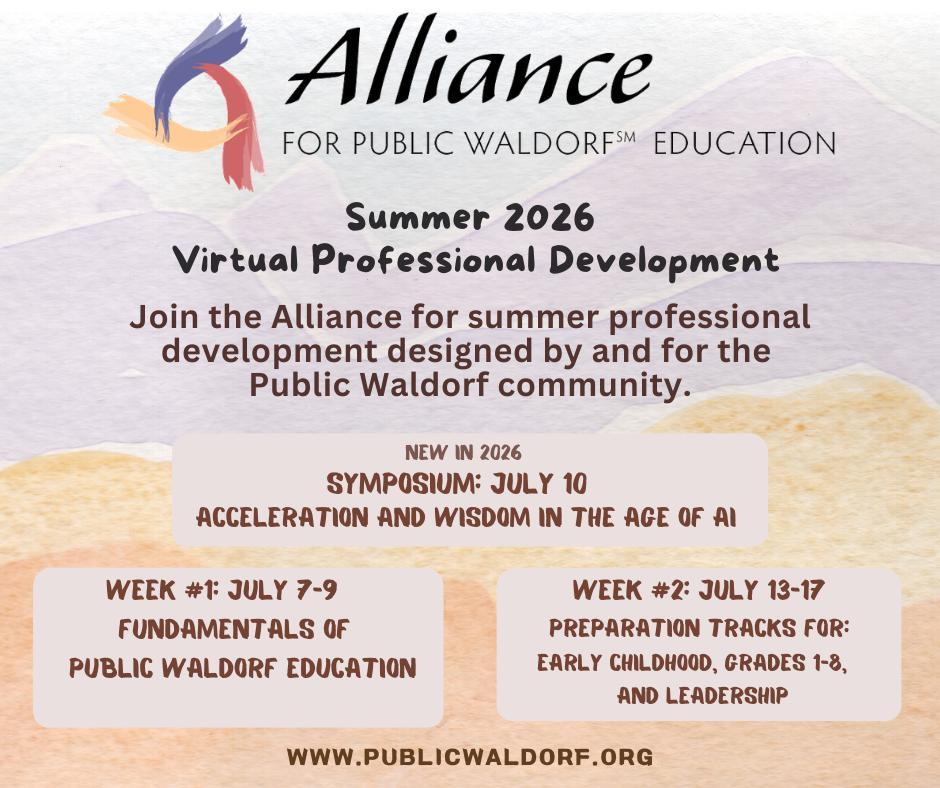
This year, we are very excited to be adding a one-day symposium to explore a topic that is on our minds: AI. Our keynote speaker, Ben Klocek, will address this in the context of his intriguing title: Acceleration and Wisdom: Education in the Age of AI. Ben works at an intersection of Waldorf education, anthroposophy, and technology. He is a web designer, teacher, and Waldorf alum and he is thinking deeply about the gifts and challenges of this “age of AI.” Ben has a forthcoming article in Lilipoh Magazine, aptly titled Ground then Glass: Educating for Presence in a Screen-Filled World. This symposium will be offered for anyone enrolled in our professional development, but will also be open to anyone, as we anticipate a thought-provoking, informative, and hopeful day. See here for details on our symposium and our professional development series.
AI is already very much part of our lives and schools, a reality brought home to me in a couple of recent international meetings on Waldorf education when someone said in the course of the meeting: “I just checked that on Chat GPT and…” AI is a hugely powerful tool that is developing in unpredictable and rapid ways, yet, in education, it can also be viewed as the newest manifestation of a pattern that dates back at least to the ancient Greeks - a desire to control the pesky impact of teachers. Recent examples include a 1960s drive for a television in every classroom, and this century’s desire for a tablet in every student’s hands and school-wide Chrome books for all. Given that AI is here to stay, is part of our lives and undoubtedly will be a very significant force in our students’ lives, what is the right approach? Are we called to protect and defend our students in line with Waldorf’s somewhat Luddite reputation? Should we embrace it? Engage and learn as quickly as possible? Most of us are unsure. There is peril in locking down, raising the drawbridge and remaining in an isolated bubble, yet we wish to protect our students and equip them as well as possible for their futures. As in most things we do, child development is an important determinant: we need to interrogate the what and when of engagement with AI.
As Ben suggests in his titles, we are called on to be fully present and to form a conscious, thoughtful relationship to this new reality. Perhaps more than at any earlier time, we need to ensure that our students have a thorough, solid grounding. Direct experience must come first; earth beneath their feet and, hopefully on their hands, knees, and under their nails. Our emphasis on experiential education, gardening, engagement with nature, clay, crafts, and arts are now more essential than ever. Our young people will need a strong sense of self, feeling for the truth, and an inner compass - best gained through heartfelt relationships, imagination, story, imagery, and strong, integrated social-emotional education. The traditional model of education, the transmission of information, is deeply familiar but will become less and less important. Now, the emphasis needs to be on building capacities and releasing abilities including flexible thinking, imagination, creative problem solving, social and team skills, discernment, the will to act, and a strong moral compass - the "twenty first century skills” that were headlined as we entered a century that is now over one-fourth done. In some ways, the reality has been the exact opposite: more and earlier assessment and the unintended consequences of universal pre-school movements including earlier academics, literacy and numeracy, and distrust of teachers and school. “Twenty first century skills” can also be seen as core Waldorf strengths and skills. It is time to lean in and to center Waldorf as a source of inspiration and a guide to practice. We see our symposium as an important support for doing just that and we warmly invite you to register and join us to learn from Ben and from one another. Our symposium will provide new insights, thoughts, and, undoubtedly, questions.
“Affairs are now soul-size” - it is an exciting, challenging time to be alive.
Liz Beaven
Executive Director
|