Welcome to the Social Prescribing Newsletter, your resource for a comprehensive roundup of all the exciting activities taking place in the realm of social prescribing across Ontario. Here we will be bringing you a curated collection of noteworthy initiatives, success stories, and innovative approaches. To share your stories, please contact: socialprescribing@allianceon.org | | Research Focus: Longwoods Publishing: Healthcare Papers Vol. 23 No. 4 | | |
This Longwoods issue is focused on Social Prescribing. Including:
by Sara Allin and Audrey Laporte
"Health and social complexity is increasing in Canada, burdening health systems, health workers, families, caregivers and communities. Over 25% of adults and 60% of seniors now meet criteria for multimorbidity, with complex cases doubling since 2001 (Ferris et al. 2025; Steffler et al. 2021). Nearly half of physicians and nurses report burnout (CMA 2025; Duong and Vogel 2023). Reviewing commonly reported social indicators shows a worrying trend: food insecurity rose from 16.8% to 22.9% between 2019 and 2023 (St-Germain et al. 2025), and chronic homelessness and drug-poisoning deaths have both climbed sharply (Statistics Canada 2025, 2026).
Alongside these trends, healthcare spending consistently grows at a rate that exceeds economic growth and continues to prioritize hospitals, physicians and pharmaceuticals. Spending on healthcare was projected to reach $399 billion in 2025 (CIHI 2025), while access barriers to primary and specialist care have reached record levels.
We Need a Paradigm Shift
In this current issue, Kate Mulligan, in her lead essay, “Social prescribing as strategic infrastructure,” provides a compelling diagnosis of the current crisis that emphasizes the supply side: the health system was built for acute care with no formal channel for addressing upstream drivers (Mulligan 2026a). Community organizations already provide much-needed social supports, but they remain underfunded and disconnected from the health system.
Specifically, her proposed remedy is social prescribing: healthcare providers refer patients to trained “link workers” who connect them to community resources, including housing supports, food programs and peer networks, rather than treating symptoms in isolation. She frames this as a shift from the Welfare State era, when we achieved universal coverage but of a narrowly defined scope of health services, toward a new “Enabling State,” where public investment flows to the community infrastructure that produces health."
Other articles include: Commentaries
Gary C. Bloch and Nassim Vahidi-Williams
Sandi Pelly and Liv Mendelsohn
and more! Read the full issue here
| | |
Professional Learning Event Reflection by Meron Afewerki, Social Prescribing Team Practicum Student
| | |
The Alliance for Healthier Communities’ Social Prescribing and Health Promotion Professional Learning Event (PLE) left me inspired and gave me a deeper appreciation for the power of collaboration. The presentations, workshops, and discussions reinforced for me the importance of learning and knowledge-sharing in health care. As Sandi Pelly of the Walton’s Trust shared when describing the impact of social prescribing across Canada, we have seen significant improvements in clients' health, and this has led to increased government recognition and funding. The power of social prescribing to make such an impact is, in part, a result of knowledge-sharing amongst the people, organizations, and sectors that practice it, emphasizing the need for continuous collaborative learning.
“Progress moves at the pace of trust” was a quote that stuck with me from the presentation by Rebekah Clause and Lillian Souliere-Lamb of the Indigenous Primary Health Care Council (IPHCC), who spoke on building meaningful relationships with Indigenous communities. Without trust, sustainable change is not possible. This quote resonated with me because it can be applied to so many aspects of our lives. In any relationship, workplace, or community, trust is a core component that can influence how much progress is made, and the quality of it. When working with Indigenous communities in particular, it is important to work in partnership, having meaningful Indigenous leadership throughout the process.
After the presentations, we had an opportunity to make rounds in table discussions about a variety of topics. I listened in on Dr. Grace Spiro’s table discussing Measuring Complexity and Intersectionality to Improve Health Care. The participants were engaged in an insightful discussion about the benefits of using an intersectionality analysis. Intersectionality was also discussed in Dr. Jennifer Rayner’s earlier presentation on the power of sociodemographic data. Dr. Rayner provided a visual that showed how individuals’ different identities overlap, resulting in different experiences across various situations and environments. At Dr. Spiro’s table, participants noted that an intersectional lens gives us a better view of the various barriers people experience. This then allows us to use that information to better understand and respond to the needs of the populations we serve. One participant who works in a rural community health centre (CHC) noted that their organization is doing a needs assessment for their newcomer population in the rural town they work in. They noted that an intersectional lens would help them better identify the specific needs of the individuals, as well as the different barriers they experience, allowing the CHC to develop and provide meaningful and effective supports.
Following the round-table discussions, PLE attendees participated in an experiential activity of their choice: group singing, dancing, or writing. Although I do enjoy singing and dancing, I was curious to see how a writing activity could contribute to health and well-being. The Writers Collective of Canada (WCC) gave us notebooks and pens and read out a prompt for us to write whatever came to mind within a set amount of time. We were then given the chance to share aloud what we had written. As someone who does not journal regularly, I found this a nice way to write down and express my thoughts and experiences. I felt a genuine sense of relaxation as I sat in a quiet room and allowed myself the time and space to simply write. Being among others and hearing about their experiences was eye-opening. It showed me how human needs are so similar yet expressed so differently. Participating in this activity has reshaped my perspective on writing and has sparked a newfound appreciation for it.
Overall, my main takeaway from this year’s PLE is that collaborative learning and sharing is a concept that can be applied to almost every aspect of health care and community work. This idea was also discussed in the Participatory Evaluation presentation by Kisa Hamilton and Denise Bishop-Earle of Transform Practice, who emphasized the importance of collaborating deeply with communities when conducting research and evaluating our work. As the saying goes, “Knowledge is power,” but knowledge becomes even more powerful when it is shared. The PLE reminded me that the most meaningful change does not happen when we work in isolation. Transformative, sustainable change happens when people, organizations, and communities come together to learn from one another and use that knowledge to create better outcomes.
| | |
Next Ontario Social Prescribing Community of Practice:
Cross-Canada Perspective
Thursday, December 17, 2026 | 1:00pm - 2:30pm
| | |
Practitioners and supporters of social prescribing from across Ontario are invited to join the Ontario Social Prescribing Community of Practice to connect, share knowledge and resources, and explore collaborative opportunities.
Jointly hosted by the Alliance for Healthier Communities and the Older Adult Centres Association of Ontario, this community of practice is open to anyone involved or interested in social prescribing work.
Mark your calendars for Thursday, December 17! Sandi Pelly of the Walton's Trust will share the cross-Canada perspective from the many social prescribing programs the Walton's Trust funds across Canada. In addition, our colleagues from CISP will share learnings from their National project.
Register here to join the community of practice and receive access to future meeting details and resources. Participants are encouraged to share their questions and ideas during registration.
| |
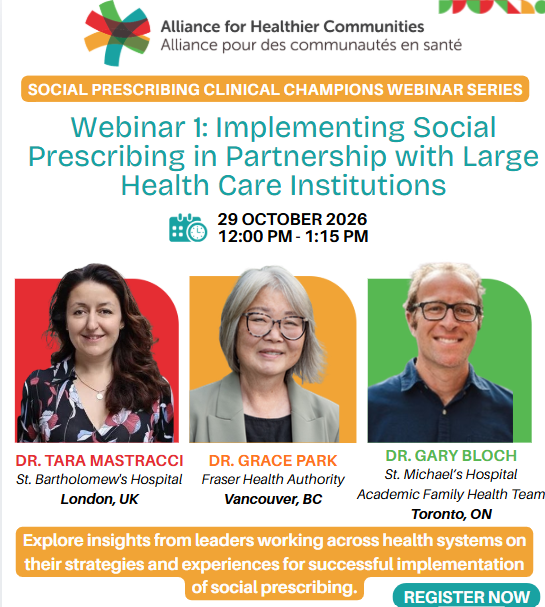
Social Prescribing Clinical Champions webinar series: Implementing Social Prescribing in Partnership with Large Health Care Institutions
| | |
Join Dr. Tara M Mastracci, MD FRCSC (St. Bartholomew's Hospital, London, UK) as she presents on implementation successes with social prescribing in a large hospital. Dr. Mastracci will be joined by Dr. Grace Park who will share implementation experiences from Fraser Health Authority and Dr. Gary Bloch, who will discuss the experience at St. Michael’s Hospital Academic Family Health Team.
This event is presented by the Alliance for Healthier Communities as part of our "Social Prescribing Clinical Champions" Webinar Series
Thursday, October 29, 2026 - 12:00
12:00-1:15 pm
Cost: Free
Registration and More Information here
|
|
PHO Rounds: Celebrating 40 years of the Ottawa Charter
| | |
This event is presented by Public Health Ontario.
In 1986, the Ottawa Charter for Health Promotion was adopted, fundamentally changing how health is viewed and promoted. This is the first part of a four-part series which will celebrate 40 years of the Charter by exploring the origins of health promotion and how it’s practiced in Ontario today.
Session Details: Part One - Health Promotion in Practice
This first session in this four-part series will feature Andrea Bodkin from Public Health Ontario who will provide an overview of health promotion and the Charter. We’ll then explore two case studies:
- Stephanie Ross, Program Manager will provide an overview of how health promotion is structured at the Simcoe Muskoka District Health Unit,
- Brittany McBeath will introduce us to culturally grounded Indigenous health promotion, what it looks like and how it is implemented.
Register for other sessions in this series
- Part Three: Setting Community Priorities, Tuesday November 10, 2026. Registration opening soon; watch for it here
- Part Four: Details coming soon. Hosted in partnership with Health Promotion Ontario, Thursday November 19, 2026. Registration opening soon; watch for it here.
| |
CCSMH Webinar: 94 Voices in Practice
| | |
Join the Canadian Coalition for Seniors’ Mental Health (CCSMH) virtually on November 18, 12:00–1:00 PM EST for 94 Voices in Practice: A Case-Based Workshop on Social Isolation and Loneliness in Older Adults.
Building on CCSMH’s 94 Voices report and the 2024 Canadian Clinical Guidelines on Social Isolation and Loneliness in Older Adults, this interactive workshop brings Health Care and Social Service Professionals together to explore practical practice responses to social isolation and loneliness in older adults.
Through facilitated small-group discussion, participants will consider how different roles, disciplines, and care settings can contribute to identifying and responding to social isolation and loneliness. The session is designed to create space for meaningful exchange, shared problem-solving, and practical learning that participants can bring back to their own work.
For more information and to register: here
| |
Social Prescribing Newsletter Submissions
Do you have a social prescribing announcement or event to share with our community? You can send us a short blurb with all relevant details and images for consideration for inclusion in the Social Prescribing Newsletter. The newsletter goes out monthly, so please be mindful of the dates when you share submissions. We will do our best to include as many as possible.
Email socialprescribing@allianceON.org
| | | | |