|
|
PacIOOS Instruments and Tools
|
|
|
|
|
|
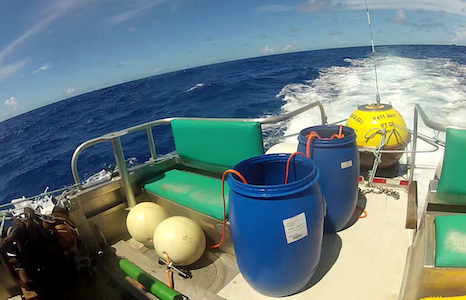
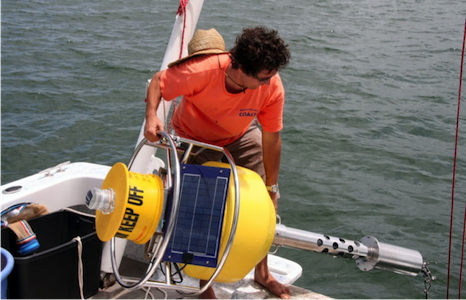
The PacIOOS wave buoy on its way to the deployment site off Aunuʻu, American Samoa. Credit: Dan Fitzgerald. |
Aunu'u Wave Buoy Back Online
PacIOOS successfully redeployed the Aunu'u wave buoy in American Samoa with the support of the National Park of American Samoa and the Department of Marine and Wildlife Resources (DMWR). The buoy broke free in November 2016, after intentional tampering. Data collected by the wave buoy play a critical role to protect lives and properties in the territory. It is the only wave buoy across Samoan waters and agencies such as NOAA's National Weather Service rely on the accurate and reliable information. In time for Flag Day celebrations in April, the wave buoy will also provide important information to assess ocean conditions for the annual Fautasi Races (traditional longboat canoes). Located more than three miles off Aunu'u, the buoy provides information on wave height, direction, period, and sea surface temperature every 30 minutes.
|
|
|
|
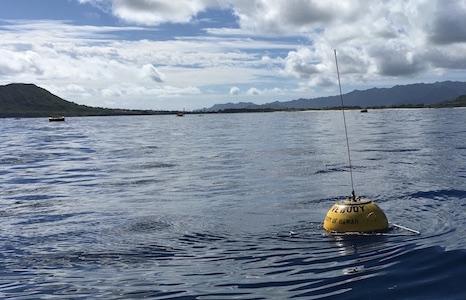
PacIOOS wave buoy in Kāneʻohe Bay.
Credit: Kimball Millikan. |
Wave Buoy Maintenance in Kāneʻohe Bay
Wave buoy maintenance was underway this month in Kāneʻohe Bay. The Kāneʻohe WETS wave buoy was redeployed, and the Kāneʻohe Bay wave buoy was swapped out. Wave buoy batteries have a life span of about two years and need to be replaced on a regular basis to ensure continuous operation and data streaming. PacIOOS maintains a network of 14 wave buoys throughout the Pacific Islands region.
Data are managed by the Coastal Data Information Program (CDIP) at Scripps Institution of Oceanography. Long-term partnerships with the U.S. Army Corps of Engineers and CDIP enable data streaming.
|
|
|
|
|
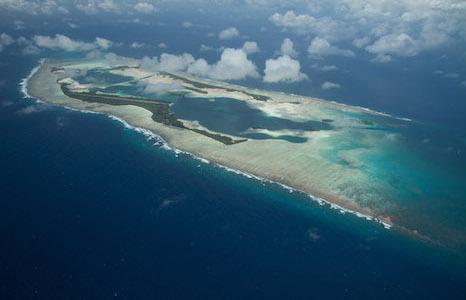
Aerial of Palmyra Atoll. Credit: FWS. |
Coral Reef Recovery at Palmyra Atoll
As part of the PacIOOS Water Quality Sensor Partnership Program (WQSPP), the U.S. Fish and Wildlife Service (FWS) recently entered into a Memorandum of Understanding (MOU) with PacIOOS to utilize one of the WQSPP water quality sensors at Palmyra Atoll National Wildlife Refuge. In 2013, FWS removed a large destructive shipwreck from a nearby reef. Post-removal surveys of coral growth, health, and recolonization have been conducted, but drastic fluctuations in turbidity due to resuspension and occasional temperature elevations have triggered seasonal coral bleaching. The Seabird SEACAT will support this coral reef recovery project by collecting important oceanographic parameters, including temperature, salinity/conductivity, depth, turbidity, and chlorophyll. All data will be managed by FWS and made available through PacIOOS.
|
|
|
|
PacIOOS water quality buoy in Hilo Bay. |
Partner Engagement on Hawaiʻi Island
PacIOOS staff visited with partners on Hawaiʻi Island to learn about ongoing and new projects and associated ocean observing needs. Topics of discussion included the placement of the PacIOOS water quality buoy in Pelekane Bay. To make sure buoy data benefit the community and partners, PacIOOS will work with the South Kohala Coastal Partnership and other partners to address local needs and questions. A similar water quality buoy is currently located in Hilo Bay. PacIOOS also toured Liquid Robotics' facilities and learned about wave glider operations and capabilities. The Kohala Watershed Partnership, Coral Reef Alliance, Kampachi Farms, LLC, and Forever Oceans Corp. shared updates on ongoing initiatives and priorities with PacIOOS.
|
|
|
|
|
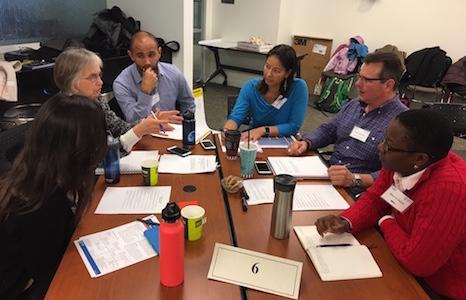
Meeting participants gathered in break-out groups for in-depth discussions.
Credit: Abbey Wakely. |
Combined IOOS Spring and DMAC Meeting
The Integrated Ocean Observing System (IOOS), the IOOS Association, and Directors from the regional associations came together for the annual IOOS Spring meeting in Silver Spring, Maryland. NOAA National Ocean Service (NOS) Assistant Administrator shared NOS priorities and activities, followed by IOOS program updates and priorities for the coming year. Along with members of the Interagency Ocean Observation Committee, meeting participants focused on IOOS Strategic Planning. This year's Spring Meeting coincided with the annual IOOS Data Management and Communications (DMAC) meeting, allowing for joint discussions to define a national data management vision for the next five years.
|
|
|
|
|
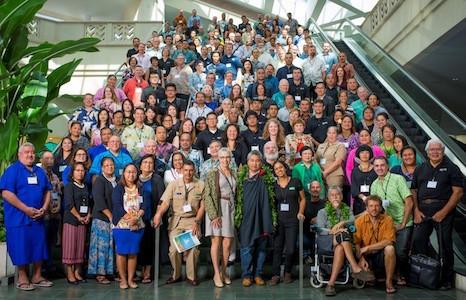
2017 PRiMO conference participants.
Credit: PRiMO. |
15th Annual PRiMO Conference
More than 200 participants gathered for the annual Pacific Risk Management ʻOhana Conference (PRiMO) in Honolulu this month. In its 15th year, PRiMO brings together community leaders, agency officials, non-profits, academia and industry partners from the Pacific Islands region and beyond to discuss and learn from ongoing resiliency efforts, disaster management, climate change adaptation strategies, and more. This year's conference, "Navigating Toward Security and Sustainability", featured an impressive set of keynote speakers, including the Honorable Hilda Heine, President of the Republic of the Marshall Islands, and the Honorable Eddie Baza Calvo, Governor of Guam.
|
|
|
|
Collecting Data to Inform Citizens
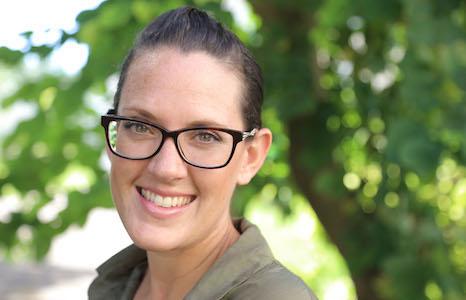
Laura Biggs serves as the PacIOOS liaison on Guam. For the past five years, Laura and her staff have maintained the PacIOOS nearshore water quality sensor located in Pago Bay. Necessary maintenance and the retrieval of data is conducted on a bi-monthly basis to transfer data into PacIOOS' data servers. The sensor is an important monitoring asset to characterize and better understand the water quality of Pago Bay and Pago River.
As an Assistant Professor in the Biology Department at the University of Guam, Laura's main research focus examines environmental factors that impact human health. She is particularly interested in empowering citizens to make informed decisions regarding their natural resources based on sound environmental data. Such as in 2012, when the Pago Bay nearshore sensor data was essential in identifying the cause of a fish kill incident. Residents feared the intrusion of chemical contaminants; however, the data revealed that the fish kill resulted from a combination of natural factors. Laura also enjoys working with her students and is looking forward to bringing new research opportunities to the University of Guam that enable students to excel.
|
|
|
|
|
|
|