|
|
|
|
PacIOOS was awarded $2.32 million in competitive grant funding through U.S. IOOS. |
Year 2 Funding for PacIOOS
For the second year of a five-year cooperative agreement with NOAA's Integrated Ocean Observing System (IOOS), PacIOOS received a total of
$2.32 million
in competitive grant funding. This year's
funding will support ongoing efforts to enhance and sustain coastal and ocean observations in the U.S. Pacific Islands region.
T
hrough stakeholder input and the guidance of its Governing Council, PacIOOS strives to empower ocean users, agency officials, non-profit organizations, industry, and other partners with accurate and reliable coastal and ocean data to support safe decision-making. PacIOOS is one of eleven regional associations to receive funding through IOOS
. Regional associations address national and local observation, forecasting, and data management needs by collaborating with partners, data providers, and other stakeholders.
|
|
|
|
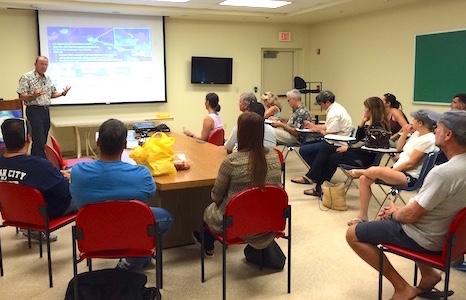
Governing Council members participating in last yearʻs annual meeting. |
Welcome to New Governing Council Members
PacIOOS is pleased to welcome the newest regional members on the Governing Council, Dr. Carlos Villacis, Director of Applied Science at the Pacific Disaster Center, and Tom Smith, Senior Coastal Engineer at the U.S. Army Corps of Engineers. Elected by other Memorandum of Agreement (MOA) signatories, the incoming members will serve for three-year terms. The Governing Council is comprised of five regional members, six Hawaiʻi members, and one member each from Guam, the Commonwealth of the Northern Mariana Islands, American Samoa, Republic of the Marshall Islands, Federated States of Micronesia, and Republic of Palau, as well as one ex-officio member from the fiscal sponsor organization.
|
|
|
|
|
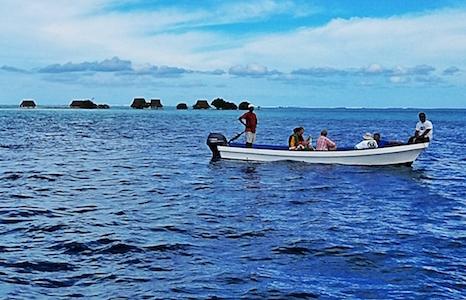
Coastal reef environment off Pohnpei, Federated States of Micronesia. |
Funding for Micronesia Region
The U.S. Department of Interior's Office of Insular Affairs awarded multiple organizations across the U.S. island jurisdictions in the Micronesia region with a total of $635K to protect natural and cultural resources. The Micronesia Conservation Trust (MCT) received funding to send conservation officers from each of the Micronesian island jurisdictions participating in the Micronesia Challenge to take part in the first Marine-Terrestrial Conservation Enforcement Academy course.
The Nature Conservancy Micronesia (TNC) will pilot a community-based fisheries management program in the Chuuk Lagoon.
The University of Guam (UoG) received funding for a post-doctoral entomologist to address
Coconut Rhinoceros Beetle issues in Guam and Palau. For a full list of funded projects, please visit the Department of Interior.
|
|
|
|
Workshop participants assemble low-cost tide gauges for Hawaiian fishponds. Credit: KUA. |
Hawaiian Fishponds Explore DIY Technology
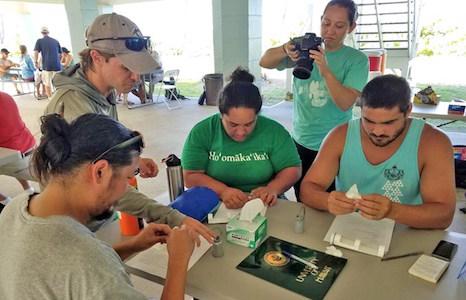
Caretakers and guardians of 18 loko iʻa, Hawaiian fishponds, from four islands met with faculty and students from the University of Hawaiʻi at Mānoa for a 3-day workshop to share resources and exchange ideas. In order to support fishpond restoration and preservation, participants explored low-cost monitoring sensors and instruments to collect valuable data. In a hands-on session, participants assembled do-it-yourself tide gauges and learned about other technologies and practices of interest. The workshop was organized by Kuaʻāina Ulu ʻAuamo
(KUA
) and the University of Hawaiʻi School of Ocean and Earth Science and Technology (SOEST), with funding support from the National Science Foundation.
|
|
|
|
Heʻeia watershed. Credit: Manuel Mejia. |
Heʻeia National Estuarine Research Reserve
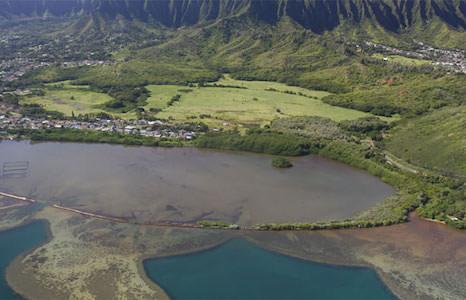
NOAA designated Heʻeia in Kāneʻohe Bay, Oʻahu, as the 29th National Estuarine Research Reserve (NERR). Distinguished guests gathered for a designation ceremony to acknowledge the historic, cultural, and ecological importance of the area. The 1,385-acre Heʻeia reserve encompasses forests and grasslands, wetlands, reefs and seagrass beds, as well as the largest sheltered body of water in the Hawaiian Islands. The new reserve will be managed in partnership with the State of Hawaiʻi through the Hawaiʻi Institute of Marine Biology, which is located on Moku o Loʻe (Coconut Island) within the reserve.
|
2017 Nutrient Sensor Action Challenge
Building upon the 2014 Nutrient Sensor Challenge, which helped to develop affordable, high-performing
continuous
nutrient sensors and analyzers, the 2017 challenge strives to demonstrate the successful implementation of such low-cost sensors.
The Nutrient Sensors Action Challenge is open to communities and organizations interested in incorporating two or more sensors into ongoing water quality monitoring efforts. The main goal of the challenge is to effectively integrate low-cost continuous sensors through innovative partnerships, and to demonstrate how the collected information can be used in state and local decision-making. Submissions are due before September 20, 2017.
|
|
IOOS Deputy Director Vacancy
The U.S. Integrated Ocean Observing System (IOOS) Program Office is seeking applicants to fill the Deputy Director position. Based in Silver Spring, the Deputy Director is responsible to direct the execution and day-to-day operations of the IOOS Program Office, and to supervise the IOOS Division Chiefs. The successful candidate will also coordinate with leadership on a range of administrative, operational, and organizational policies and issues. The U.S. IOOS Program Office is housed within NOAA's National Ocean Service. View the full position description and information on how to apply. Please apply before September 5, 2017.
|
|
|
|
What Does the Future Hold for the Ocean?
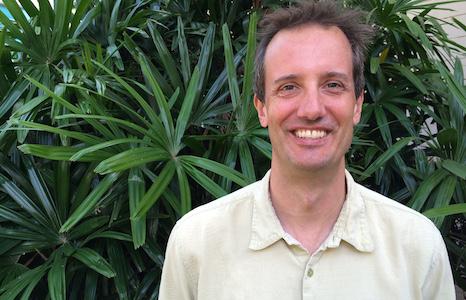
Dr. Brian Powell is the lead for PacIOOS' ocean modeling and forecasting efforts. Under his supervision, a team of researchers produces nowcasts and 7-day forecasts for various grid sizes in the main Hawaiian Islands, Western North Pacific, and Samoa. The Regional Ocean Modeling System (ROMS) generates outputs every three hours for parameters such as currents, salinity, and water temperature.
Brian is an Associate Professor of Physical Oceanography at the University of Hawaiʻi at Mānoa within the School of Ocean and Earth Science and Technology, Department of Oceanography. His research focuses on the question of ocean predictability over different time scales and spatial extents--from tomorrow's swim forecast to
the impact of climate in Antarctica, from turbidity plumes at the Ala Wai Canal, Oʻahu, to El Niño research
. Brian is also interested in biogeochemistry effects, including the prediction of ocean bacteria concentrations and how corals can inform our understanding of past climate. When not at his computer, you may find Brian snorkeling various reefs around the island or woodworking at home.
|
|
|
|
|
|
|