ACA NEWS

Alzheimer's Updates & News for Families and Caregivers

June 19, 2026


📣 Alzheimer's of Central Alabama Announcements

1 Week Away!!
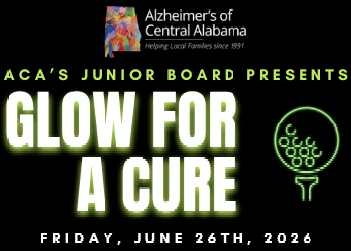
ACA’s Junior Board
hosts 
Glow for a Cure!


ACA’s Junior Board invites you to Glow for a Cure.


This exciting event combines golf, Livewire band, Full Moon BBQ, silent auction and community to benefit Alzheimer’s research at UAB.


A few silent auction items:

  • 1 week at a townhouse in 30A
  • Sony noise canceling headphones
  • Tito's bucket of goodies - driver cover, Tito's, and more!


📅 Friday, June 26, 2026

⏰ 5:00pm Tee Time

6:30pm Silent Auction & Dinner

📍 Highland Park Golf Course


Glow for a Cure supports the Lindy Harrell Predoctoral Scholars Program in Alzheimer’s research at UAB.


Team and sponsorships are limited, so register today: alzca.org/glow


🧩 Caregiver Support Group Meetings

undefined

Support groups have been updated and few new ones have been added to More Support Groups!


ACA’s Coffee Talk with Miller & Vance, Tuesdays, 11 – noon CT. 
Join us:
https://us02web.zoom.us/j/85247427423

Questions? (205) 871-7970 or
aca@alzca.org


💬 Caregiver Corner: Don't Overlook Dehydration

If your loved one seems more confused, tired, irritable, or unsteady than usual, dehydration could be part of the problem. People living with dementia are at higher risk for dehydration because they may not recognize thirst, remember to drink, or be able to communicate that they need fluids.


Watch for signs such as a dry mouth, dark urine, dizziness, weakness, constipation, or sudden changes in behavior. The good news is that small steps can help. Offer drinks regularly throughout the day, provide water-rich foods like fruit and soup, and make fluids easy to see and access.


What This Means for Families

  • Don't wait for your loved one to ask for a drink
  • Offer fluids often, especially during hot weather
  • Watch for sudden changes in energy, mood, or confusion
  • Contact a healthcare provider if you have concerns about dehydration


Staying hydrated supports overall health, comfort, and brain function—and can help prevent unnecessary medical complications. 


🌟 Happenings: AFA Care Connection Webinar

Alzheimer's Foundation of America is hosting a webinar presentation, “Statins and Dementia: Friend, Foe, or Neutral” on July 9th. Ambar Kulshreshtha, MD, PhD, MPH is an associate professor in the family and preventive medicine department at Emory University.


Dr. Kulshreshtha will speak about the evidence of statin therapy for heart and cognitive health. The session will discuss prior evidence regarding whether statins play a protective, harmful or no role in dementia risk and progression. Ongoing studies and evolving research in this area will also be presented.


📅 Thursday, July 9, 2026

⏰ 12pm-1pm CT

💻 Online through Zoom

✅ Free, registration required


📌 Reading: "The Pain of Caring for a Parent Who Abused You"

The full article will require you to use your email address.


Most caregiving stories focus on love, devotion, and family bonds. But a recent article in The New York Times Magazine explored a more complicated reality: many adult children are caring for parents who hurt them deeply in childhood.


The article follows several caregivers whose parents are now living with dementia or other age-related illnesses. As these parents become increasingly dependent, their adult children find themselves facing a painful question: What do we owe someone who failed us—or even abused us—when we were young?


One caregiver, stepped in to help her father after discovering he could no longer safely live on his own. Over time, she became responsible for managing his medical appointments, medications, finances, housing, and daily needs. Yet every caregiving task forced her to confront memories of a childhood marked by physical and emotional abuse. Although she provided extraordinary care, she struggled with feelings of anger, resentment, obligation, and grief.


Research cited in the story found that nearly one in five adult children providing care for aging parents reported experiencing verbal, physical, or sexual abuse by a parent during childhood. Millions of Americans may be navigating these complicated caregiving relationships.


Experts interviewed for the article note that healthcare providers often assume family relationships are loving and supportive. Terms like “loved one” are commonly used in healthcare settings, but they may not accurately reflect every family dynamic. For some caregivers, assisting a parent with dementia can reopen old trauma, trigger painful memories, and create intense emotional stress.


The story also sheds light on a larger issue: the United States relies heavily on unpaid family caregivers. Long-term care services are often difficult to access and expensive to afford, leaving many families with few options. As a result, adult children frequently become caregivers—even when the relationship has been strained, distant, or harmful.


One of the most powerful messages in the article is that caregiving does not always lead to reconciliation. Some parents never apologize. Some relationships never heal. Yet many caregivers continue to provide care because of personal values, compassion, family expectations, or simply because there is no one else available to help.


For those caring for a loved one with dementia, the article offers an important reminder: caregiving relationships are often more complicated than they appear. Feelings of frustration, guilt, anger, sadness, resentment, and even love can exist simultaneously. There is no “right” way to feel. If caregiving is bringing up difficult emotions, know that support is available. Counseling, caregiver support groups, respite services, and trusted friends or family members can help caregivers process these challenges and protect their own well-being.


At Alzheimer's of Central Alabama, we understand that every caregiving journey is unique. Whatever your family history, you do not have to navigate it alone.


We've included a share link to the article below. If you have any trouble opening the article, please let us know, and we'll work with you to access the full article.


Here is the link to one of the Research Articles.


🧠 Activity of the Week: Caregiver Check-In

Take five minutes this week to reflect on these questions:


  • What helps me stay grounded during difficult caregiving moments?
  • Who can I call when I need support?
  • What is one boundary that helps protect my well-being?
  • What is one thing I'm doing well as a caregiver right now?


Remember: Caring for yourself is not selfish—it's part of caring for your loved one.


❓ Newsletter & Website Feedback

Send us an email with your comments and questions.


🤝 How You Can Help

Every contribution makes a difference - support Alzheimer's of Central Alabama.

 
Facebook  Instagram  LinkedIn