The American Society of Le Souvenir Français Inc.
Monthly Bulletin - Vol. II. No 1 - January 2022
|
|
FRENCH MEMORIES
600 sites with a French historical presence in the USA
|
|
There is much more in common between the two nations
than the same Blue-White-Red colors!
|
|
EDITORIAL
Chers Amis,
Happy New Year! We hope you enjoyed a safe and relaxing holidays. We are starting this new year 2022 with several new announcements:
First, the completion of our much anticipated website!
This website aims at introducing our association to a wide audience, showcase its activities, highlight its missions and values, and make it easy to update one's membership and support us with donations.
- One of our pages, "Honor Roll", lists the names of all the French officers, soldiers, sailors who died and are buried in the United States, as well as the American volunteers who join the French armed forces in the two world wars, served under French uniform, and died for France. We invite you to visit these lists, which echo the physical marble and bronze plaques and monuments that exist in various sites in the United States, and discover their names, so that "they do not die a second time".
Our website is still imperfect and a work in progress. We thank you in advance for your comments and suggestions.
It is available in English and in French.
- Another page you will notice on the website's top menu is named "Memorial Places". Only a few locations are listed on a map of the United States, as an introduction, or teaser, to a book which we hope to publish soon.
This book, called "French Memories" is a "Register of French Sites in the United States", and destined for print and digital publication. It will be made available in electronic format to our Members in good standing, and available, we hope, in print, for sale to a wider public. Proceeds and possible royalties will go entirely to our association.
Think of it as a "Dictionnaire Amoureux", or, loosely translated, "Postcards of love compilation" paying tribute to all the explorers, soldiers, missionaries, entrepreneurs of French origin, whether illustrious or long-forgotten, who discovered and helped fashion our great Nation.
This bulletin for the month of January will be a small sampler of these sites, adorned with markers, plaques, or statues, all "postcards" left by our forebears. Some are quite well known, some dramatic, some raising smiles, some long-forgotten, and all deserving of our remembrance and respect for their courage, vision, endurance, and love of their newfound country.
A special and warm word of Welcome to our first new Regional Delegates who have accepted to be our official representatives in the following regions:
-
Nicole Yancey, former Honorary Consul of France in Virginia, Regional Delegate for Virginia and Mid-Atlantic States
-
Jacques Besnainou, Regional Delegate for the Great Lakes and the Midwest
-
Marc Onetto, Regional Delegate for the West Coast
Finally, as always in our monthly bulletins, we will strive to report on lectures, conferences, activities from other associations who share with us their dedication to history, patriotic events and remembrance endeavors, as it pertains to French-American alliance and friendship.
Again, all best wishes for a happy, healthy, and prosperous New Year 2022, the 244th year of our shared, and uninterrupted, history.
Vive le Souvenir Français et vive l'amitié franco-américaine!
|
|
A FEW HAND-PICKED SITES ... |
|
Lafayette Memorial
Brooklyn, N.Y.
|
|
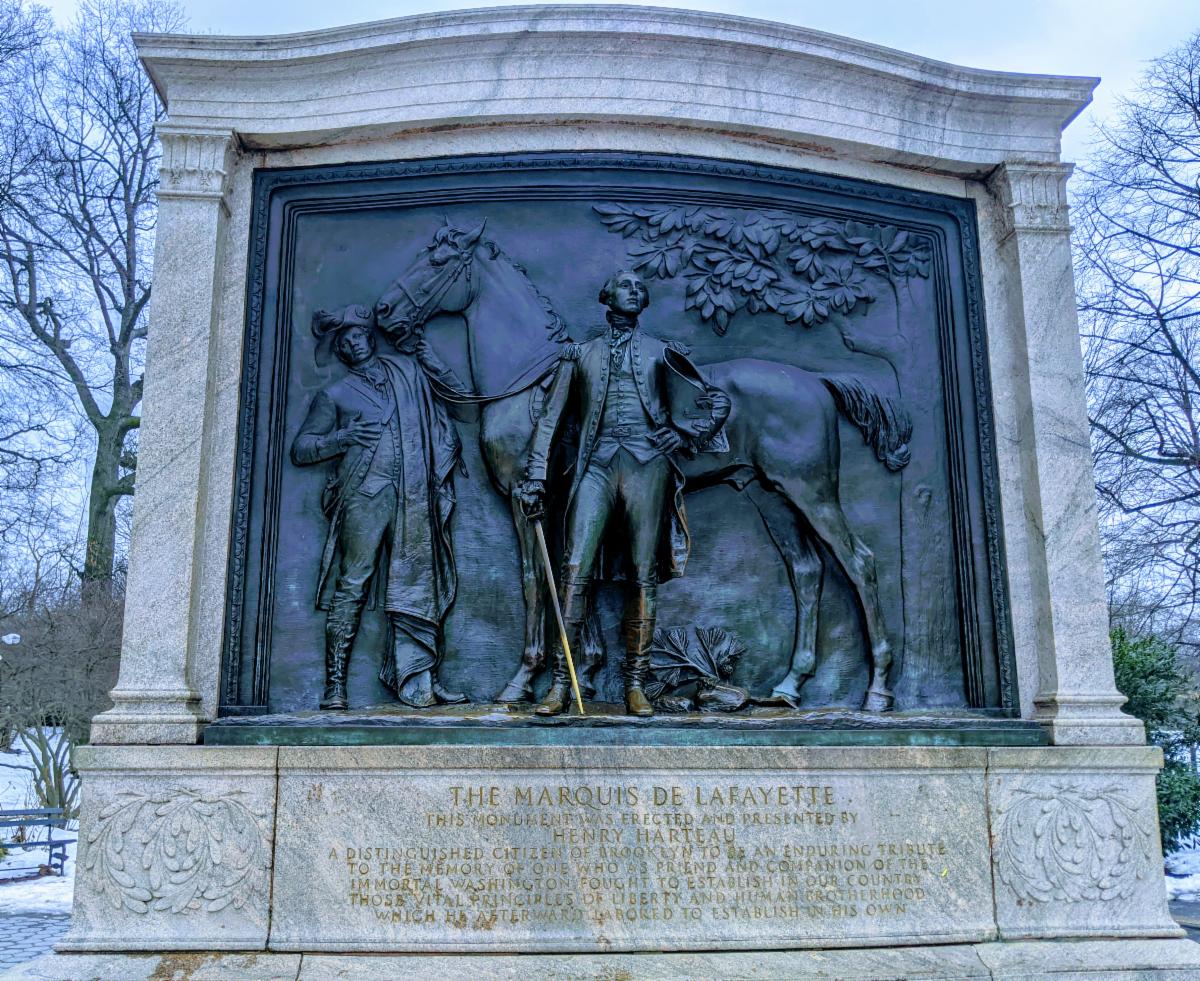
• Inscription:
"The Marquis de Lafayette //
This monument was erected and presented by //
Henry Harteau //
a distinguished citizen of Brooklyn to be an enduring tribute //
to the memory of one who as friend and companion of the //
immortal Washington fought to establish in our country //
those vital principles of liberty and human brotherhood //
which he afterward labored to establish in his own.
This memorial was unveiled and dedicated by Marshal Joffre and
M. Viviani of the French War Commission May 10, 1917"
138 Prospect Park West (9th Street Entrance), Brooklyn, NY 11215
Photo: By CaptJayRuffins - Own work, CC BY-SA 4.0, https://commons.wikimedia.org/w/index.php?curid=99961736
|
|
• The Lafayette Memorial is a public memorial located in Brooklyn's Prospect Park in New York City at the Ninth Street entrance on the park's west side.
• Designed by sculptor Daniel Chester French (1850–1931) and architect Henry Bacon, it consists of a bas-relief of Gilbert du Motier, Marquis de Lafayette alongside a groom (speculated by most historians to be James Armistead Lafayette) and a horse. The nearly ten-foot-high relief was a gift of Henry Harteau, a Brooklyn glass insurer (and NYC Parks Commissioner) of French ancestry, and was unveiled by French Marshall Joffre and former Prime Minister of France René Viviani, (1914-1915) who came to the States as members of the French War Commission (the oft-forgotten "Mission Viviani Joffre", from April 24, 1917 to May 14, 1917, which facilitated the creation of the modern American army and the entry into the war of the United States).
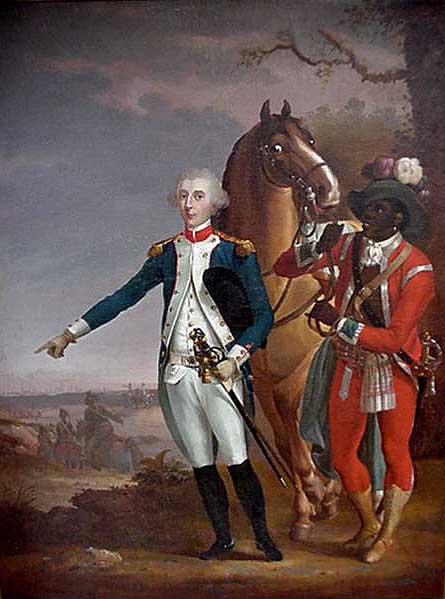
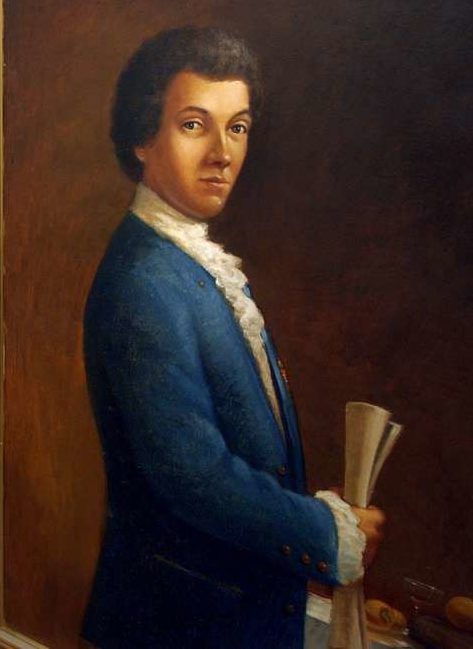
• The sculpture shows General Lafayette at center with stoic demeanor, while to his left the horse appears to nip at the groomsman who seems to recoil to avoid injury, giving humanity to the otherwise formal narrative. The bas-relief is based in part on a painting Lafayette at Yorktown by Jean-Baptiste Le Paon, as dictated in the bequest by Harteau. Some historians have speculated that the figure of the groomsman in Le Paon’s painting and other related engravings of the time is James Armistead.
• James Armistead (c. 1748 – 1830) was born into slavery in Virginia, taking his last name from his owner William Armistead. He volunteered for military service during the Revolution, and served Lafayette as a spy, posing as a runaway slave to gain information beyond enemy lines, which was instrumental in the successful Yorktown campaign. On January 7, 1787, in acknowledgement of his valor, Armistead was granted freedom by the Virginia legislature. In gratitude to the Marquis, who was a staunch abolitionist, he adopted Lafayette as his last name. He later became a prosperous farmer in Virginia, owning slaves himself.
Artist: Jean Baptiste Le Paon, 1738 - 1785; Sitter: Marquis de Lafayette, 6 Sep 1757 - 20 May 1834: James Lafayette, c. 1748 - 9 Aug 1830 Lafayette College Art Collection, Public Domain, https://commons.wikimedia.org/w/index.php?curid=43910499
|
|
Marker & Mural
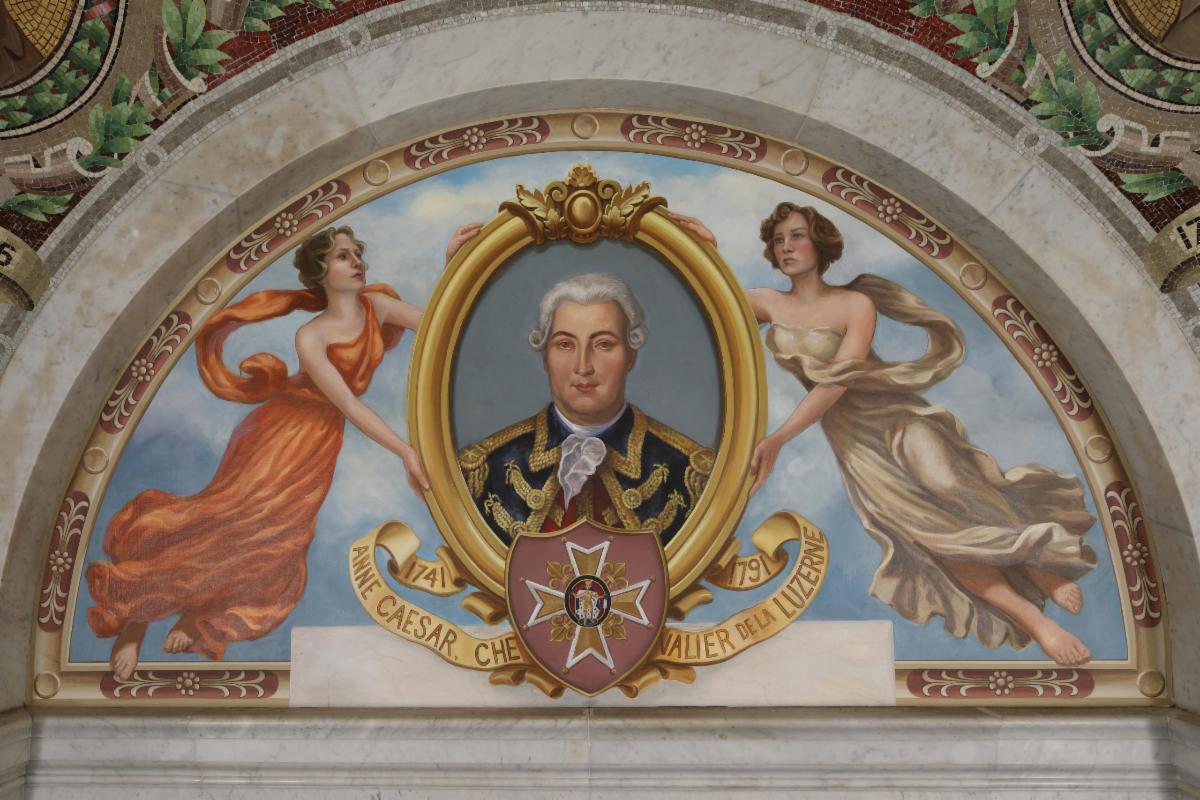
"Chevalier de la Luzerne"
Luzerne County, Pennsylvania
|
|
• Inscription:
”Formed September 25, 1786 from Northumberland County.
Named for Chevalier de la Luzerne.
Wilkes-Barre, the county seat, was settled 1769.
A center of the Yankee-Pennamite Wars (begun 1769) and
1902 Anthracite Strike, conflicts that changed America.
Erected 1981 by Pennsylvania Historical and Museum Commission.”
Dome mural inside Luzerne County Courthouse
200 North River Street, Wilkes Barre PA 18711
|
|
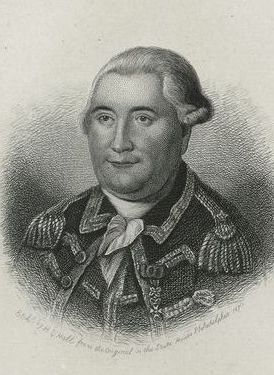
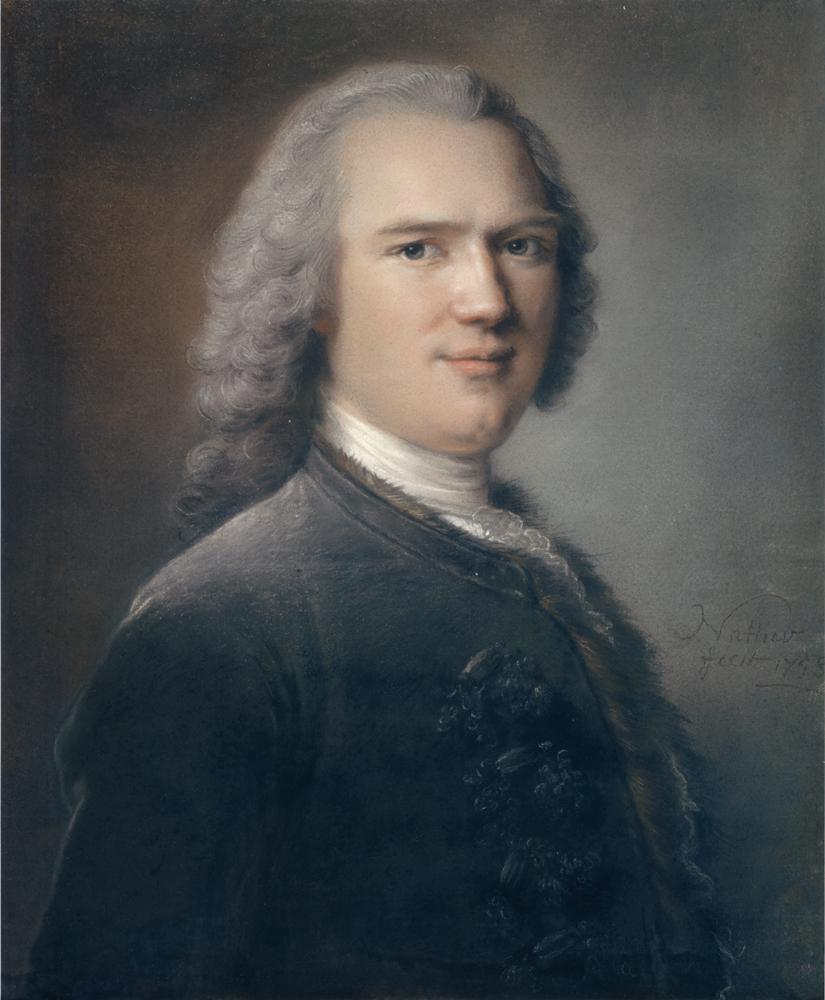
Anne-César de La Luzerne (15 July 1741 – 14 September 1791) was an 18th-century French soldier and diplomat who had an influential role to the Continental Congress and new government of the United States of America after it gained independence from Great Britain.
• He entered diplomatic service as French Minister Plenipotentiary, first to Bavaria (1777–1778), and then in the United States.
• In 1779 La Luzerne succeeded Conrad Alexandre Gérard de Rayneval as the French Minister to the United States and later served as the official Ambassador of France until 1784.
• During his time in Philadelphia, established as a base for the Continental Congress, when the British occupied New York City, he never failed to show his sympathy for the young Republic.
• He guaranteed a personal loan to buy food for the troops in 1780. In 1783 he was a Founding Fellow of the Society of the Cincinnati.
• The town of Lake Luzerne in NY is also named for him (no known marker there).
• King Louis XVI made him a Marquis in 1785.
By Unknown author - NYPL Digital Library Public Domain, https://commons.wikimedia.org/w/index.php?curid=3422970
|
|
Marker, “Fort Duquesne“
Pittsburgh, Pennsylvania
|
|
• Inscription:
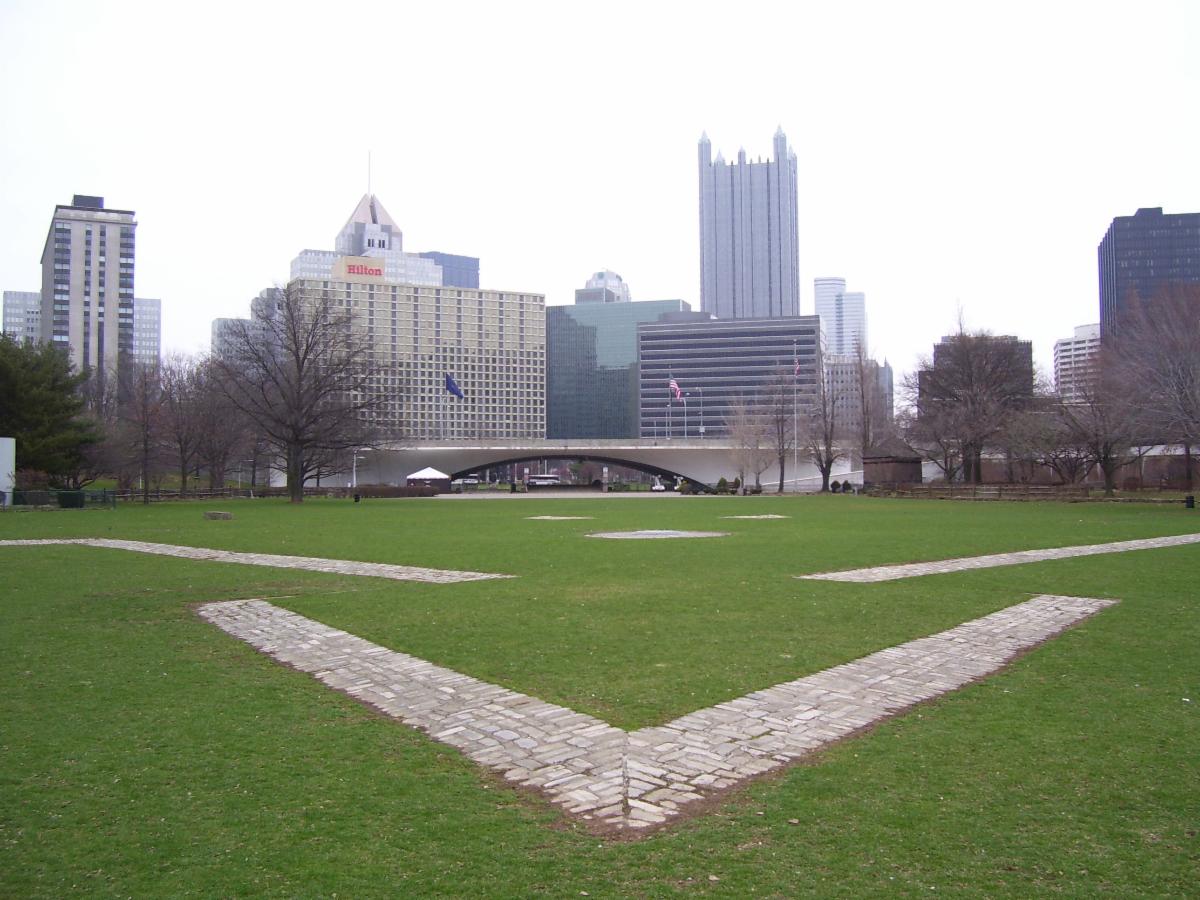
“This marks the exact site of Fort Duquesne, built by the French in 1754. The Fort was destroyed by the French on the approach of the English Army in 1758”
At Point State Park in downtown Pittsburgh, bricks mark the outline of the former site of Fort Duquesne
3 Rivers Heritage Trail System, Downtown, Pittsburgh, PA 15222
Photo: Kevin Myers at the English-language Wikipedia, CC BY-SA 3.0 <hpp://crealvecommons.org/licenses/by-sa/3.0/>, via Wikimedia Commons
|
|
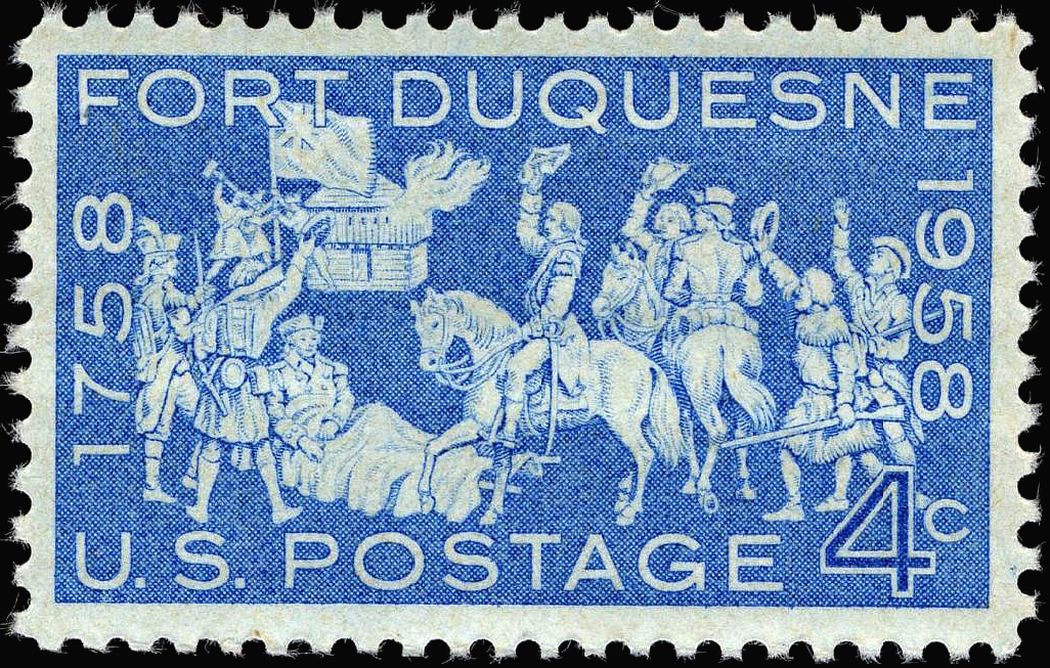
• Fort Duquesne, originally called Fort Du Quesne, was a fort established by the French in 1754, at the confluence of the Allegheny and Monongahela rivers.
• As the area was within the drainage basin of the Mississippi River, the French had claimed it as theirs. They controlled New France (Quebec), the Illinois Country along the Mississippi, and La Louisiane (the ports of New Orleans and Mobile, Alabama, and environs).
• In the early 1750s, the French began construction of a line of forts, starting with Fort Presque Isle on Lake Erie followed by Fort Le Boeuf, near Waterford, PA, and Fort Machault, near Franklin, PA. Built on marshy lands and vulnerable due to surrounding highlands, Fort Duquesne was destroyed by the French, prior to British conquest during the Seven Years' War, known as the French and Indian War on the North American front. It was rebuilt under the name Fort Pitt, hence ”Pittsburgh”.
Since the late 20th century, this area of downtown Pittsburgh has been preserved as Point State Park, or simply, "the Point." The park includes a brick outline of the fort's walls, as well as outlines to mark the later Fort Pitt.
Photo by Sébastien Paquin - Own work, CC BY-SA 3.0, https://commons.wikimedia.org/w/index.php?curid=16658921
|
|
Memorial
“Pierre Samuel DuPont de Nemours ”
Wilmington, Delaware
|
|
• Inscription:
“Sacred to the memory of
Pierre Samuel DuPont de Nemours
Knight of the Order of Vasa,
of the Legion of Honor and
of the Order of Du Lis,
Counselor of State,
Member of the First Constituent Assembly, President of the Council of Ancients and
member of the Institute of France.
Born in Paris December 14th A.D. 1739
Died at the Eleutherian Mills August 7th A.D. 1817”
Inside the DuPont Family cemetery, 205 Buck Road, Wilmington DE 19807
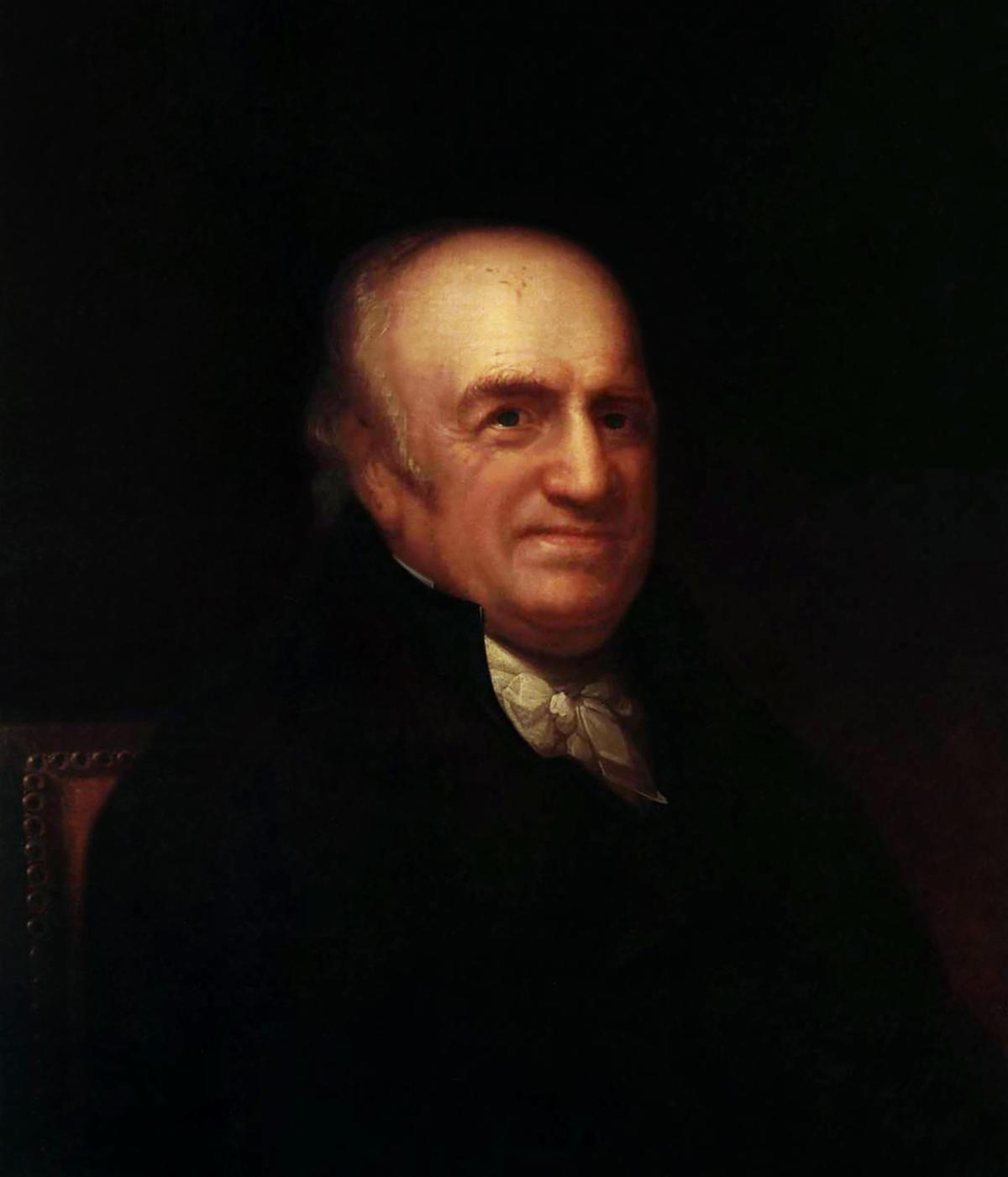
Pierre Samuel du Pont de Nemours (1739-1817), By Unknown author - Hagley Museum and Library, Wilmington, Public Domain, https://commons.wikimedia.org/w/index.php?curid=111801128
|
|
• Pierre Samuel du Pont de Nemours (14 December 1739 – 7 August 1817) was a French-American writer, economist, publisher and government official.
• He helped negotiate the treaty of 1783 on France’s side consecrating American Independence as well as the Treaty of Commerce between France and England of 1786. He was the president of the National Constituent Assembly in the early days of the French Revolution and was a close friend of Thomas Jefferson.
• He, his two sons and their families immigrated to the United States.
His son Éleuthère Irénée du Pont who studied chemistry in Paris under Lavoisier, founded with Major Louis de Tousard (later general in the US Army, and instrumental in the creation of the Military Academy of West Point), a gunpowder manufacturing plant, E. I. du Pont de Nemours and Company.
• He was the patriarch and progenitor of one of the United States' most successful and wealthiest business dynasties of the 19th and 20th centuries.
|
|
Memorial Bench
“Jean-Jules Jusserand, Ambassador of France“
Washington, D.C.
|
|
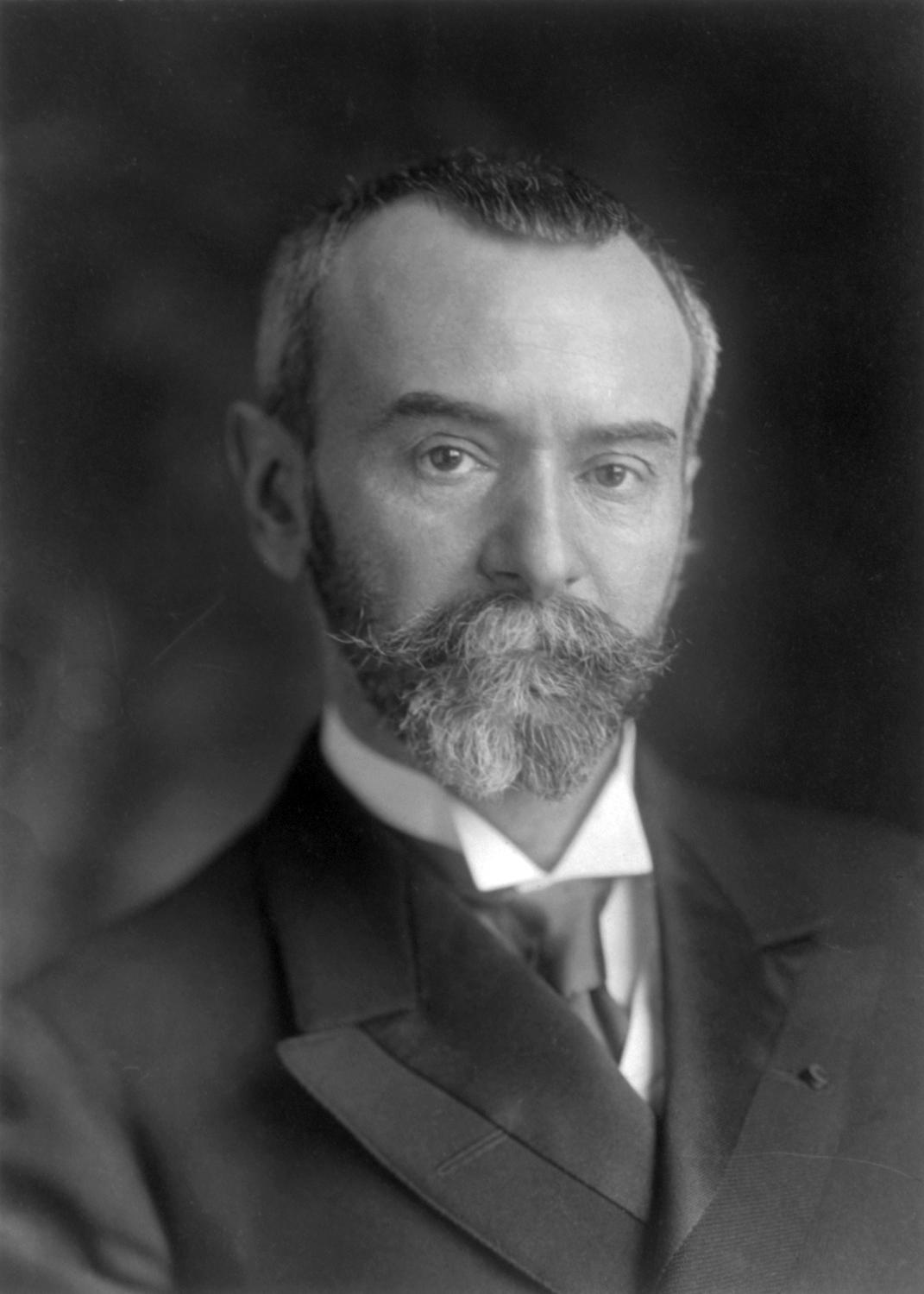
Jean Jules Jusserand, French Ambassador to the United States from 1902 to 1925
By Harris & Ewing - This image is available from the United States Library of Congress, Public Domain, https://commons.wikimedia.org/w/index.php?curid=25054019
|
|
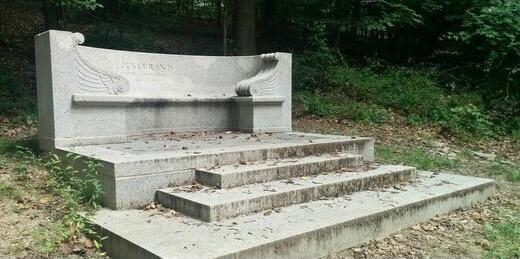
A 10 feet long bench of pink granite, semi-circular with 4 steps. Erected under an Act of Congress without expense to the United States.
It is the first memorial erected on Federal property to a foreign diplomat.
• Inscription:
“The granite bench before you commemorates the scholarship, wisdom and skilled diplomacy of Jean Jules Jusserand, French Ambassador to the United States from 1902 to 1925.
"The memorial's inscription, "Personal Tribute of Esteem and Affection" reflects the admiration felt for him locally, nationally and internationally. Jusserand loved Rock Creek Park and frequently walked here with family and friends."
"Born in Lyon in 1855, Jean Jules Jusserrand was ambassador to the United States from 1902 to 1925. In 1924, he created the American Society of the Legion of Honor, the highest French distinction, of which he was Grand Cross. His American friends erected this bench in his memory near his death in Paris in 1932."
"The bench marks the place where the Ambassador and President Theodore Roosevelt, who had a great friendship with him, rested during their walk in Rock Creek Park. Created by Joseph Friedhandler, this bench was dedicated on November 7, 1936 by President Franklin Delano Roosevelt with his dedication."
"Jusserand's writings earned him recognition at home and abroad. He won the first Pulitzer Prize in History for With Americans of Past and Present Days, a book recounting the key contributions of many Frenchmen to the history of the United States, including Pierre Charles l'Enfant, designer of the city of Washington."
"Almost we can say--that he was a great American as well as a great Frenchman. We shall link Mr. Jusserand's name forever with the names of Lafayette and Rochambeau and De Grasse and the other valiant Frenchmen whose services in this country entitle them for all time to the grateful remembrance of all Americans." —Franklin Delano Roosevelt at the Jusserand Memorial dedication, November 7, 1936.
"Erected by: The City of Lyon; The American Society of the French Legion of Honor; The Touraine Litteraire, Inc.; Rock Creek Park, National Park Service, U.S. Department of the Interior"
Rock Creek Park, 3550 Williamsburg Lane Northwest, Washington DC 20008
National Park Service photo.
Note: Jules Jusserand was also instrumental in the creation of the Alliance Française in 1884, which is today the largest non-governmental cultural institution in the world with 1000 establishments in 136 countries.
|
|
Antoine de Lamothe Cadillac (1658–1730)
Founder of the City of Detroit
|
|
• Inscription:
"The Landing of Cadillac"
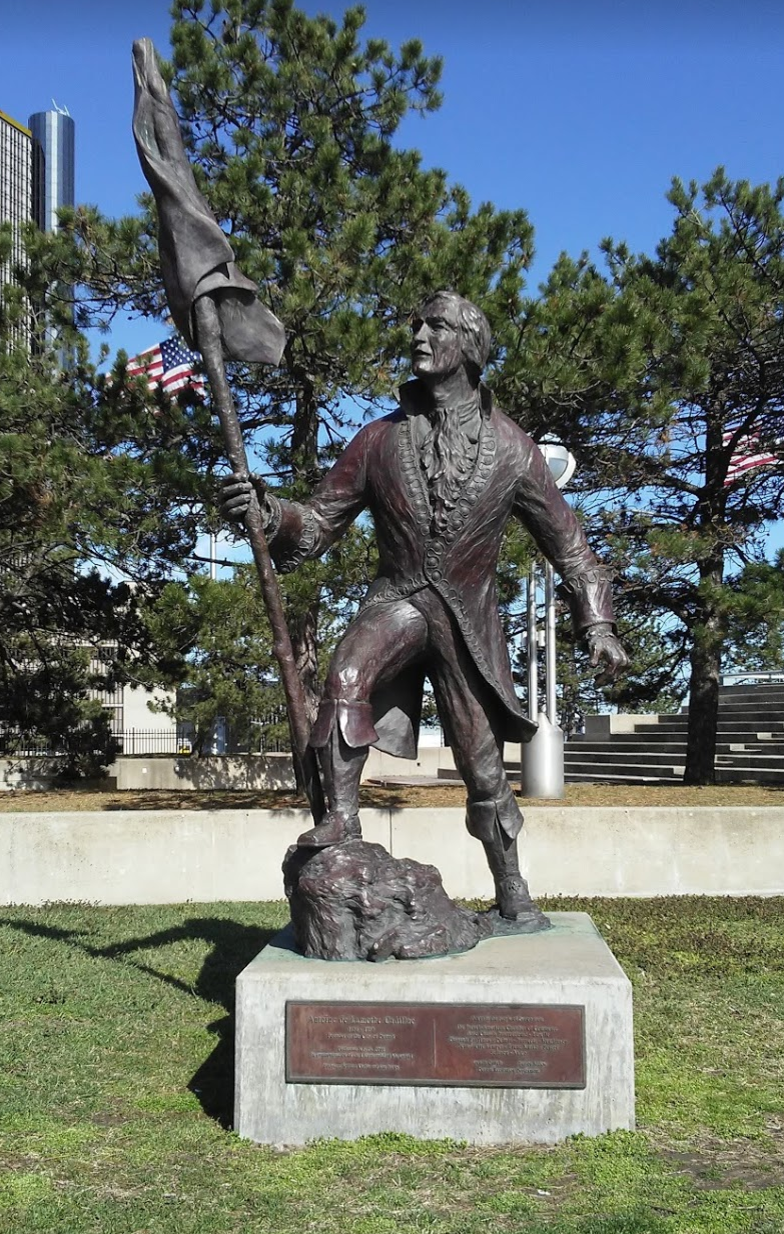
“After departing Montreal June 5, 1701, Antoine de la Mothe Cadillac and his convoy of 25 canoes sailed down this river and on the evening of July 23 camped 16 miles below the present city of Detroit on what is now Grosse Ile. On the morning of July 24, Cadillac returned upriver and reached a spot on the shore near the present intersection of West Jefferson and Shelby. Pleased with the strategic features, the bank towering some 40 feet above the level of the river, Cadillac landed and planted the flag of France, taking possession of the territory in the name of King Louis XIV. The erection of a fortress was immediately begun. The stockade, formed of 15 foot oak pickets set 3 feet in the ground, occupied an area of about an acre. The fortress was named Fort Pontchartrain du Detroit (the Strait) in honor of Count Jerome de Pontchartrain, Minister of Marine. From this fort and settlement, Detroit, the Renaissance City, takes its origin.
Erected 2001 by Michigan Historical Commission-Michigan Historical Center. "
One Hart Plaza, Detroit MI 48226
By Michipedian - Own work, CC BY-SA 4.0, https://commons.wikimedia.org/w/index.php?curid=61880441
|
|
• Antoine de la Mothe, sieur de Cadillac (March 5, 1658 – October 16, 1730), born Antoine Laumet, was a French explorer and adventurer in New France, which stretched from Eastern Canada to Louisiana on the Gulf of Mexico.
• He rose from a modest beginning in Acadia in 1683 as an explorer, trapper, and a trader of alcohol and furs, achieving various positions of political importance in the colony.
• In 1701, he founded Fort Pontchartrain du Détroit (which became the city of Detroit); he was commandant of the fort until 1710. Between 1710 and 1716, he was the governor of Louisiana, although he did not arrive in that territory until 1713.
• His knowledge of the coasts of New England and the Great Lakes area was appreciated by Frontenac, governor of New France, and Pontchartrain, Secretary of State for the Navy. This earned him various favors, including the Order of Saint Louis from King Louis XIV. The Jesuits in Canada, however, accused him of perverting the Indians with his alcohol trading, and he was imprisoned for a few months in Quebec in 1704, and again in the Bastille on his return to France in 1717.
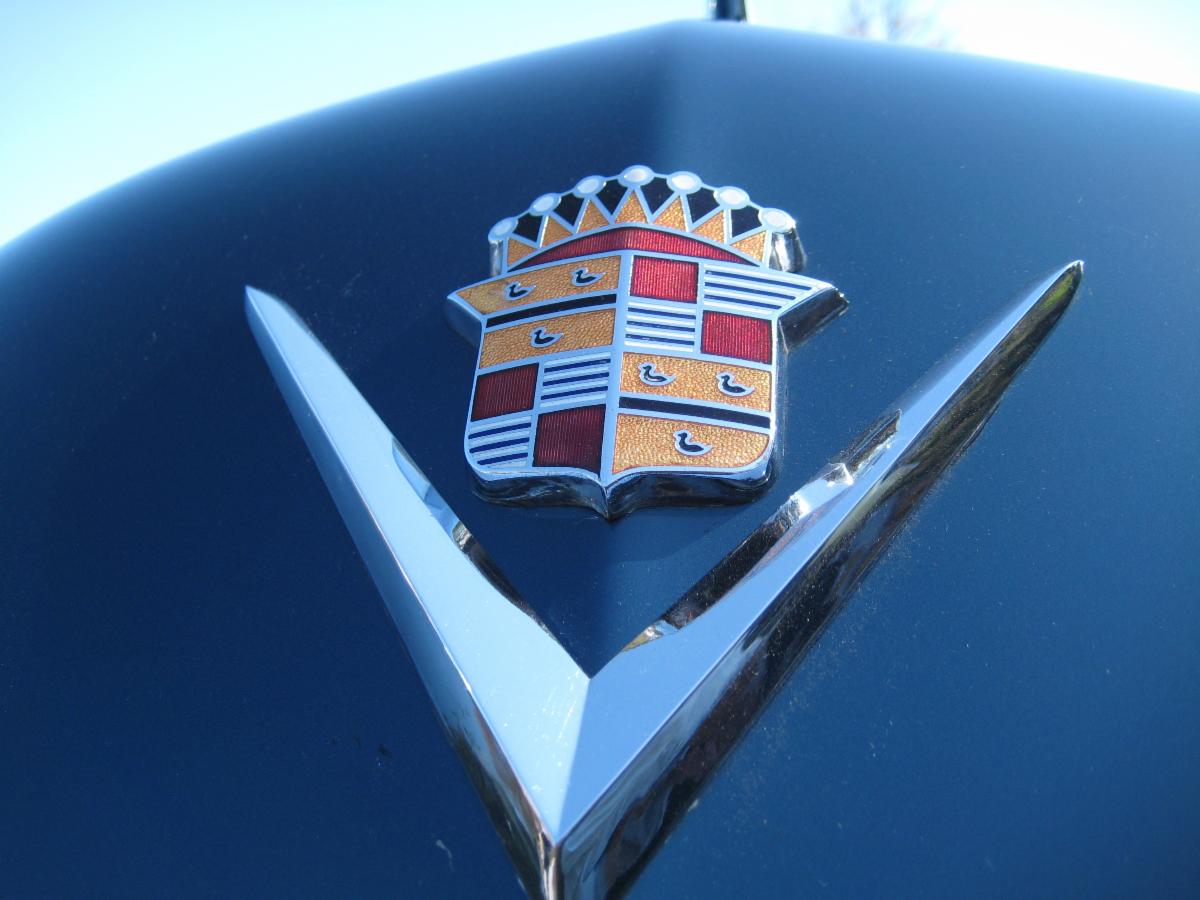
• William H. Murphy and Henry M. Leland founded the Cadillac auto company and paid homage to him by using his name for their company and his armorial bearings as its logo in 1902.
• Various places bear his name in America, in particular Cadillac Mountain in Maine and the town of Cadillac, Michigan.
Photo of Cadillac motor car logo, c.1950s, being the coat of arms of Antoine Laumet de La Mothe, sieur de Cadillac; by JOHN LLOYD from Concrete, Washington, United States - Cadillac, CC BY 2.0, https://commons.wikimedia.org/w/index.php?curid=66346291
|
|
Statue of King Louis XVI
Louisville, Kentucky
|
|
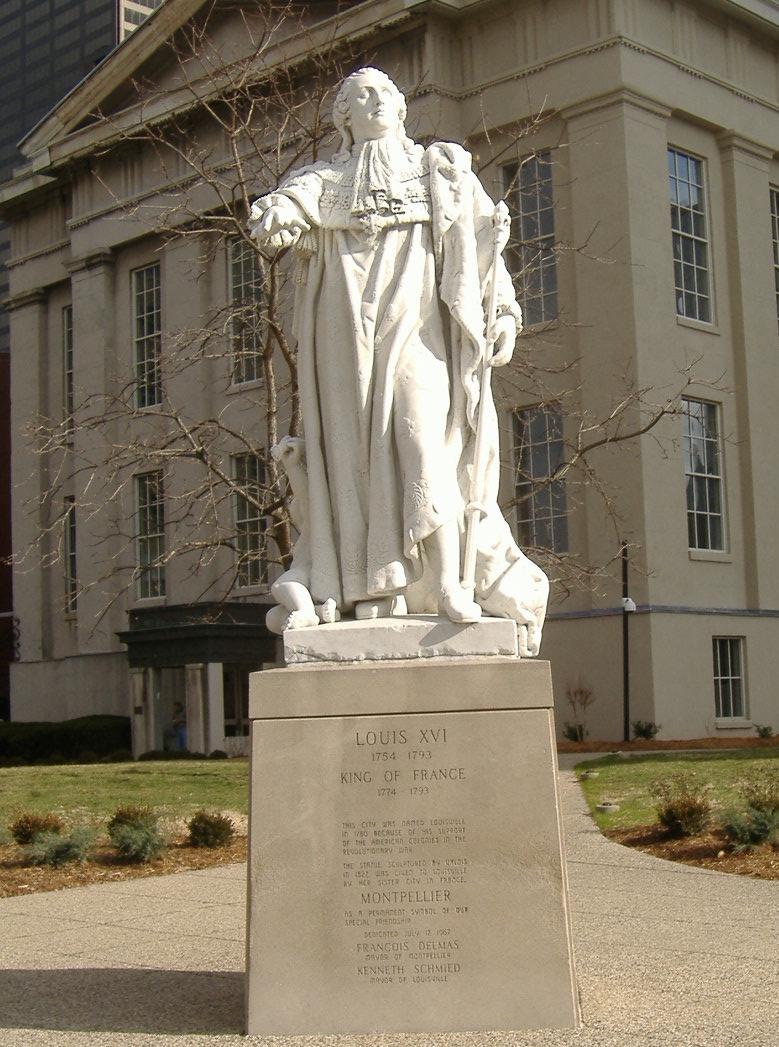
• Inscription:
Louis XVI
1754 – 1793
King of France
1774 – 1793
"This city was named Louisville in 1780
because of his support of the American Colonies in the Revolutionary War.
The statue, sculptured by Valois in 1827, was given to Louisville
by her sister city in France, Montpellier
As a permanent symbol of our special friendship.
Dedicated July 17, 1967
Francois Delmas, Mayor of Montpellier
Kenneth Schmied Mayor of Louisville"
Jefferson County Courhouse, 527 West Jefferson Street, Louisville, KY 40202
This statue has been damaged during the protests of summer 2020, however the City Council recently passed a resolution to restore it and reinstall it at its original location.
Photo: Bedford at English Wikipedia, Public domain, via Wikimedia Commons
|
|
• In order to thank King Louis XVI for his actions to help the United States become an independent nation, the Virginia legislature named a Virginia settlement in his honor. The town of Louisville was officially chartered by the Virginia Legislature in 1780, and became part of Kentucky upon the commonwealth’s statehood in 1797.
• The statue is 12 feet tall and weighs 9 tons. This marble representation of Louisville’s namesake was commissioned by the king’s daughter, Marie-Therese, and originally unveiled in the 1820’s in Montpellier, France, 36 years after his beheading. Louisville and Montpellier had become sister cities in 1956, and the then-138-year-old Achille-Joseph Valois sculpture was presented to Louisville Mayor Kenneth Schmied as a gift of friendship between the two cities.
• King Louis XVI holds a special place in the memories of patriotic Americans. His portrait hangs in the dining room of Mount Vernon, the home of George Washington, who also decreed that a mass would be said every year in perpetuity to thank France, and its King, for their help during the War of Independence.
|
|
Statue “Timothy Demonbreun“
Nashville, Tennessee
|
|
• Inscription on the pedestal:
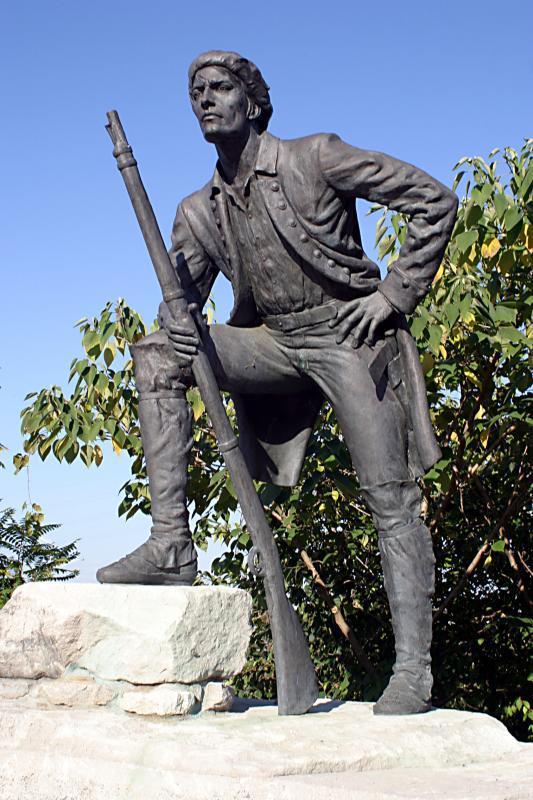
Jacques Timothe Boucher de Montbrun (Timothy Demonbreun)
1747-1826
French Canadian Fur trader and Explorer
Officer of the American Revolution
Lieutenant Governor of the Illinois Territory
Honored as Nashville’s First Citizen”
|
|
• Inscription of the marker:
"Nashville's monument to Jacques Timothe Boucher, Sieur de Montbrun (Timothy Demonbreun) was sculpted by Alan Lequire.
Timothy Demonbreun lived many lives, held many offices, and accumulated much wealth in the standards of that era. He had dealings with important men like Colonel George Rogers Clark, James Robertson, and Andrew Jackson.
He slept in comfortable beds in his house as a governor and also made the earth his bed during uncountable nights during the hunting seasons. He dealt with Spanish governors, frontier governors, and Indian leaders. He had a noble Catholic wife and a frontier mistress that some thought was half-Indian.
He brushed death many times, but the nobleman of New France died without fanfare in a place that he had helped raise from an Indian hunting ground to a growing city in a new state.
His name is synonymous with courage, honor, and self-sacrifice that is the hallmark of the pioneers that sealed the Cumberland.”
|
|
• Jacques-Timothée Boucher, Sieur de Montbrun (March 23, 1747 – 1826), anglicized as Timothy Demonbreun, was a French-Canadian fur trader, a Lieutenant in the American Revolution, and Lieutenant-Governor of the Illinois Territory.
He is known as the "first citizen" of Nashville, Tennessee.
• Born in Québec, Demonbreun traveled extensively, became a successful trader with many employees, and managed two careers and two families. He fulfilled his duties as lieutenant governor of the Illinois Territory and maintained a family in Kaskaskia, Illinois.
• Demonbreun had five children by his wife, Therese Archange Gibault, in Illinois. During his time in Nashville, he took a mistress named Elizabeth Bennett and had three children by her.
• He entertained the Duke of Orleans (later King Louis Philippe) when he visited Nashville in 1798.
Marquis de Lafayette visited Nashville on May 4, 1825, during his farewell tour of the United States. Andrew Jackson presided over a banquet in his honor at the Nashville Inn. Jacques-Timothée, by then very elderly, conversed with the Marquis in their native French.
• When he died in 1826, Demonbreun divided his substantial fortune among his children.
Bicentennial Park, 101 Union St & Gay Street Connector, Nashville, TN 37201
36.166433,-86.776433
WPLN News . “Sculptor Alain Lequire. Plaque donated in memory of Dr. Truman Weldon Demonbrun, president of the Timothy Demonbreun Heritage Society 1977-1996”
|
|
Marker “Odet Philippe”
Tampa, Florida
|
|
.• Inscription 1st marker:
“As the first European settler in Pinellas Count he established St. Helena Plantation, now Philippe Park. dPhilippe was the first to cultivate grapefruit in Florida and introduced cigar-making to Tampa.
His descendants populated this frontier.
He was said to be a doctor and of noble birth.”
• Inscription 2nd marker:
“On this promontory Count Odet Philippe, a native of Lyon, France, and surgeon in the French Armed Forces under Napoleon Bonaparte settled in 1842, arriving at this point in his sailing vessel "The Ney."
In this area he established St. Helena, his plantation, and upon it he was the first to adapt the grapefruit to Florida culture.
Here he raised a large family, many descendants of which now reside in Pinellas County.
He pioneered in the development of this area and endowed this site with a history rich in colorful atmosphere. His remains are interred not far from this spot.”
"Erected 1948 by Pinellas County Park Board"
Philippe Park, 2525 Philippe Pkwy Safety Harbor, FL 34695
|
|
• Doctor Odet Philippe, considered the founding father of Safety Harbor, Florida, near current-day Tampa.
• Widely acknowledged as the first non-native person to permanently settle in Pinellas County, Philippe is credited with introducing grapefruit to Florida and is recognized as the first cigar maker in Tampa.
• At his plantation, located in what is now Philippe Park, he cultivated citrus groves and developed new methods of budding and grafting.
• Today, he is considered responsible for the growth of Florida’s citrus industry.
|
|
Père Marquette National Memorial,
Saint Ignace, Michigan
|
|
• Inscription:
“French traders established themselves in the Upper Great Lakes region after 1644 and were welcome among the Indians. They sought harmony with the native people, learning their language and respecting their customs.
The French adopted useful Indian products like snowshoes and canoes. At the same time, European trade goods slowly replaced traditional Indian wares. Cotton and wool supplanted buckskin and European glass beads replaced beads made of shell and bone.
Stone arrowheads gave way to iron arrowheads and eventually guns began to replace the bow and arrow altogether. To obtain such European trade goods, Indians traded furs to the French and began to function increasingly as trappers.”
National Memorial:
145 White Pine Dr, St Ignace, MI 49781
Marker located at 499 North State Street, Saint Ignace MI 49781
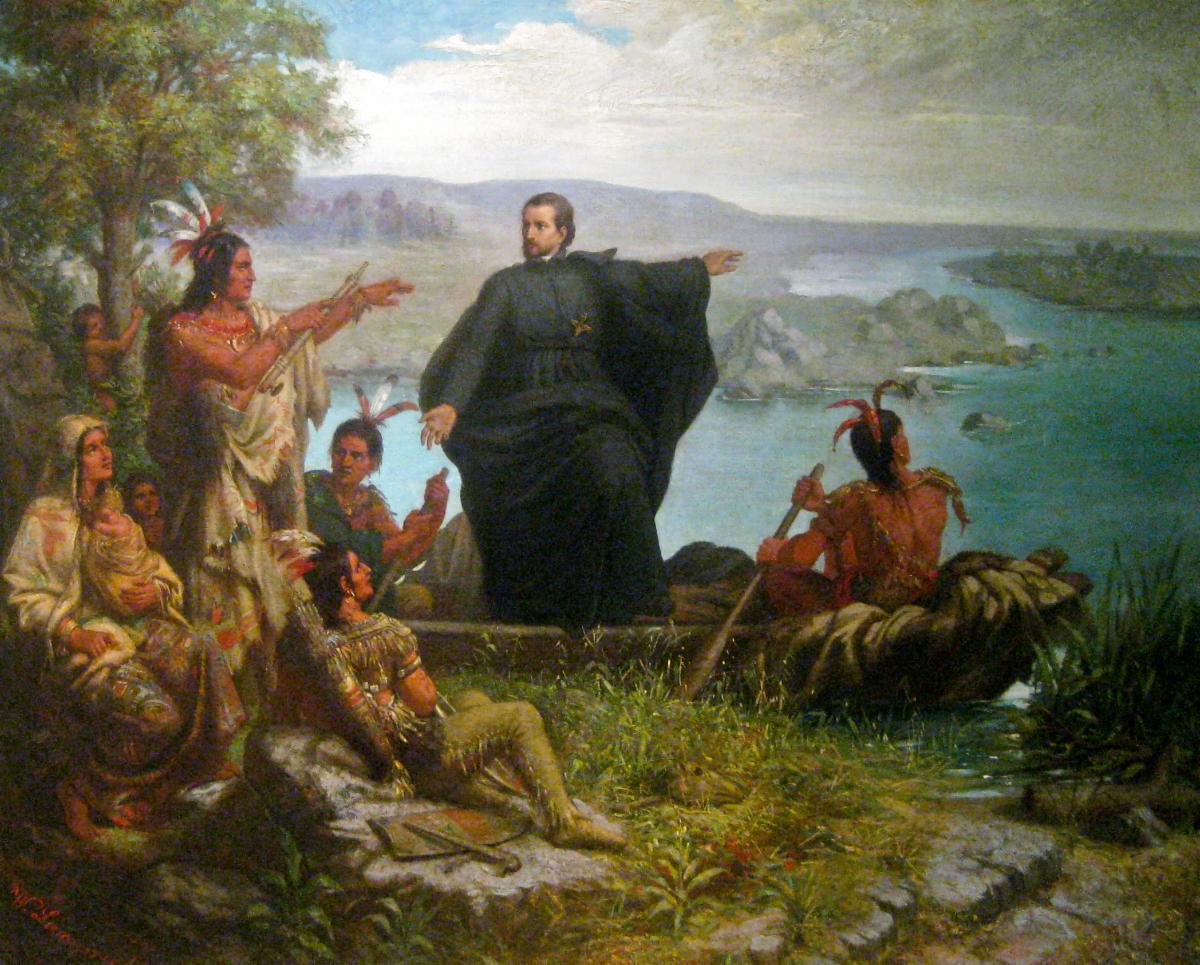
By Wilhelm Lamprecht (German 1838-1922) - The original hangs in the Raynor Memorial Library at Marquette University, Milwaukee, Wisconsin. Public Domain, https://commons.wikimedia.org/w/index.php?curid=8041258
|
|
• Jacques Marquette, French Jesuit missionary and explorer, was born in Laon, France, on June 1, 1637. After years of preparatory study and teaching, he arrived in Quebec in 1666, and studied Indian language and culture.
• Marquette established Michigan's earliest European settlements at Sault Ste. Marie and St. Ignace near Mackinac Island in 1668 and 1671. He lived among the Great Lakes Indians from 1666 to his death in 1675. Father Marquette mastered several native languages and joined Louis Jolliet in his expedition to explore and map a navigable route to the Pacific Ocean, which resulted in the French discovery of the Mississippi River.
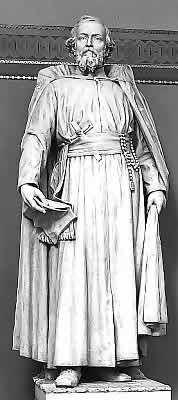
• Dozens of places and monuments are named after him, and his statue is placed in the National Statuary Hall of the United States Capitol in Washington, D.C.
• Jacques Marquette is a statue by Gaetano Trentanove of Jacques Marquette, the best-known version being the 1896 marble one installed in the National Statuary Hall Collection in the US Capitol. It is one of two donated by the state of Wisconsin. The work was accepted into the senate in 1896. Another version of the statue is the 1897 bronze casting located in Pere Marquette Park, Marquette, Michigan. In 1909, a third version was dedicated in Marquette Park on Mackinac Island, Michigan. A plaster version of the statue is located at the State Historical Society of Wisconsin
National Statuary Hall, House connecting corridor, 2nd floor US Capitol, Washington, D.C.
Photo: By The Architect of the Capitol - http://www.aoc.gov/cc/art/nsh/marquette.cfm, Public Domain, https://commons.wikimedia.org/w/index.php?curid=10059341
|
|
Monument, « The Discoverers”
Chicago, Illinois
|
|
• Inscription:
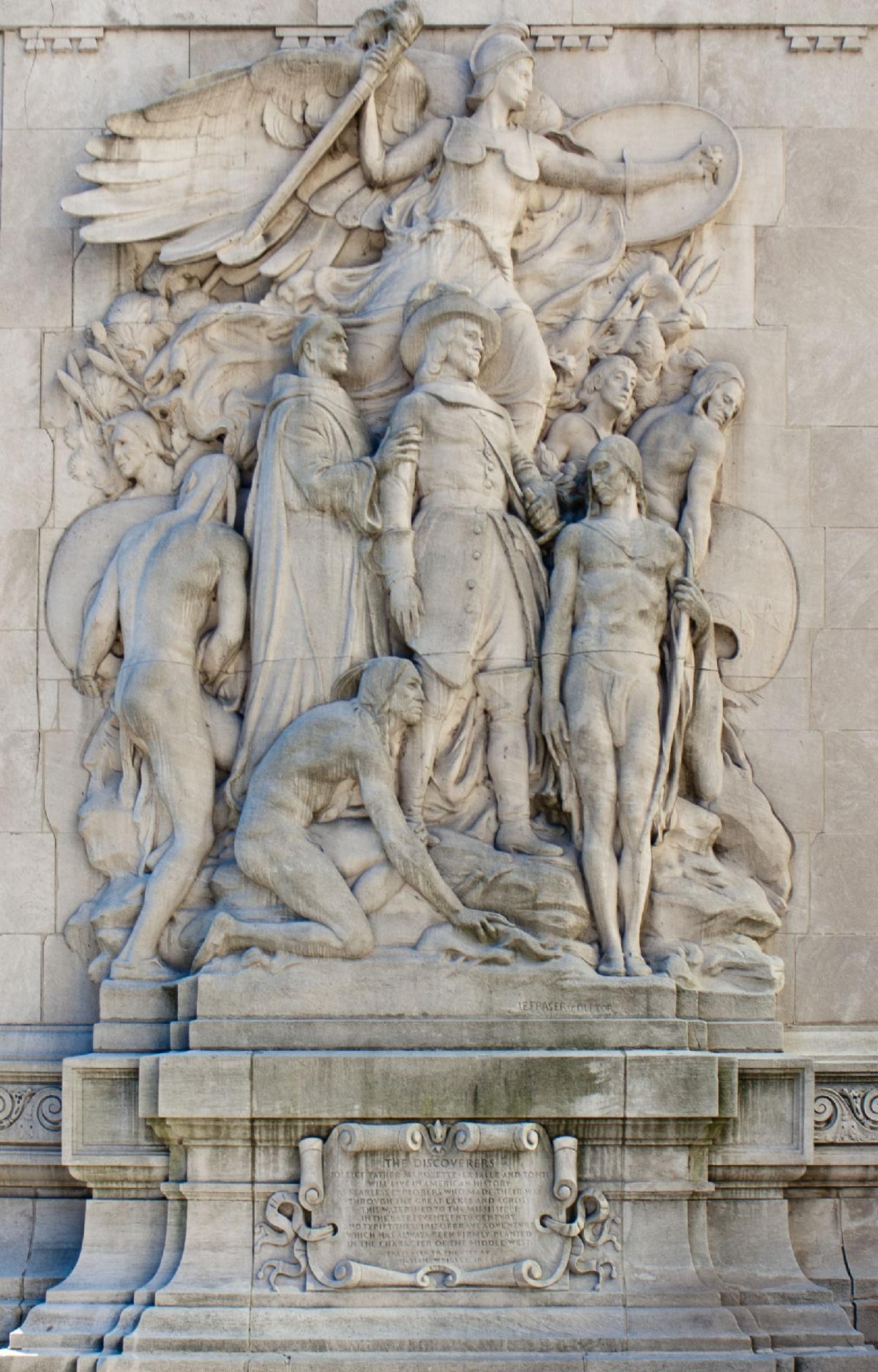
“Jolliet, Father Marquette, La Salle and Tonti will live in American history as fearless explorers who made their way through the Great Lakes and across this watershed to the Mississippi in the late seventeenth century and typify the spirit of brave adventure which has always been firmly planted in the character of the middle west.”
Presented to the city by William Wrigley Jr. 1928
Erected 1928 by William Wrigley Jr.
DuSable (formerly Michigan Avenue) Bridge, Chicago IL 60611
The Discoverers by James Earle Fraser, 1928. This sculpture adorns the wall of the north eastern bridge tender's house on DuSable bridge in Chicago, Illinois. By User:JeremyA - Own work, CC BY-SA 3.0, https://commons.wikimedia.org/w/index.php?curid=11743388
|
|
• The bridge is situated in a historically significant area. The northern end of the bridge covers part of the Jean Baptiste Point Du Sable Homesite, which is commemorated by a National Historic plaque in Pioneer Court. In 1928, sculptures depicting scenes from Chicago's history were added to the outward-facing walls of the four bridge houses.
• “This relief portrays French explorers Louis Joliet and Jacques Marquette, who determined in 1678 that Chicago was the site of the passage between the Great Lakes and the Mississippi River system, and Rene Robert Cavelier - Sieur de La Salle, and his lieutenant, Henri de Tonti, who explored the entire Mississippi River area between 1679 and 1682. Although Marquette was a Jesuit priest, he is depicted in the robes of a Franciscan monk. There is a profile of a kneeling Indian in the foreground. An allegorical female figure floats above the more boldly carved, Beaux-Arts figure group” (Smithsonian Institution Research)
• The name Chicago is derived from a French rendering of the indigenous Miami-Illinois word shikaakwa for a local variety of the onion. The first known reference to the site of the current city of Chicago as "Checagou" was by Robert de la Salle around 1679 in a memoir.
• The first known non-indigenous permanent settler in Chicago was trader Jean Baptiste Point du Sable. Du Sable was of African descent, perhaps born in the French colony of Saint-Domingue (Haiti), and established the settlement in the 1780s. He is commonly known as the "Founder of Chicago”.
• Point du Sable married a Potawatomi woman named Kitihawa (Christianized to Catherine) on 27 October 1788, in a Catholic ceremony in Cahokia in the Illinois Country, a longtime French colonial settlement on the east side of the Mississippi River. They had a son named Jean and a daughter named Susanne.
Michigan Bridge has been renamed DuSable Bridge, and Lake Shore Drive has been renamed on June 25, 2021 "Jean Baptiste Point du Sable Lake Shore Drive"
|
|
Markers,
“Expedition of Bernard de la Harpe"
|
|
• Inscriptions:
“Authorized by French authorities to explore, trade with the Indians, and establish trade relations with Spanish settlements in New Mexico,
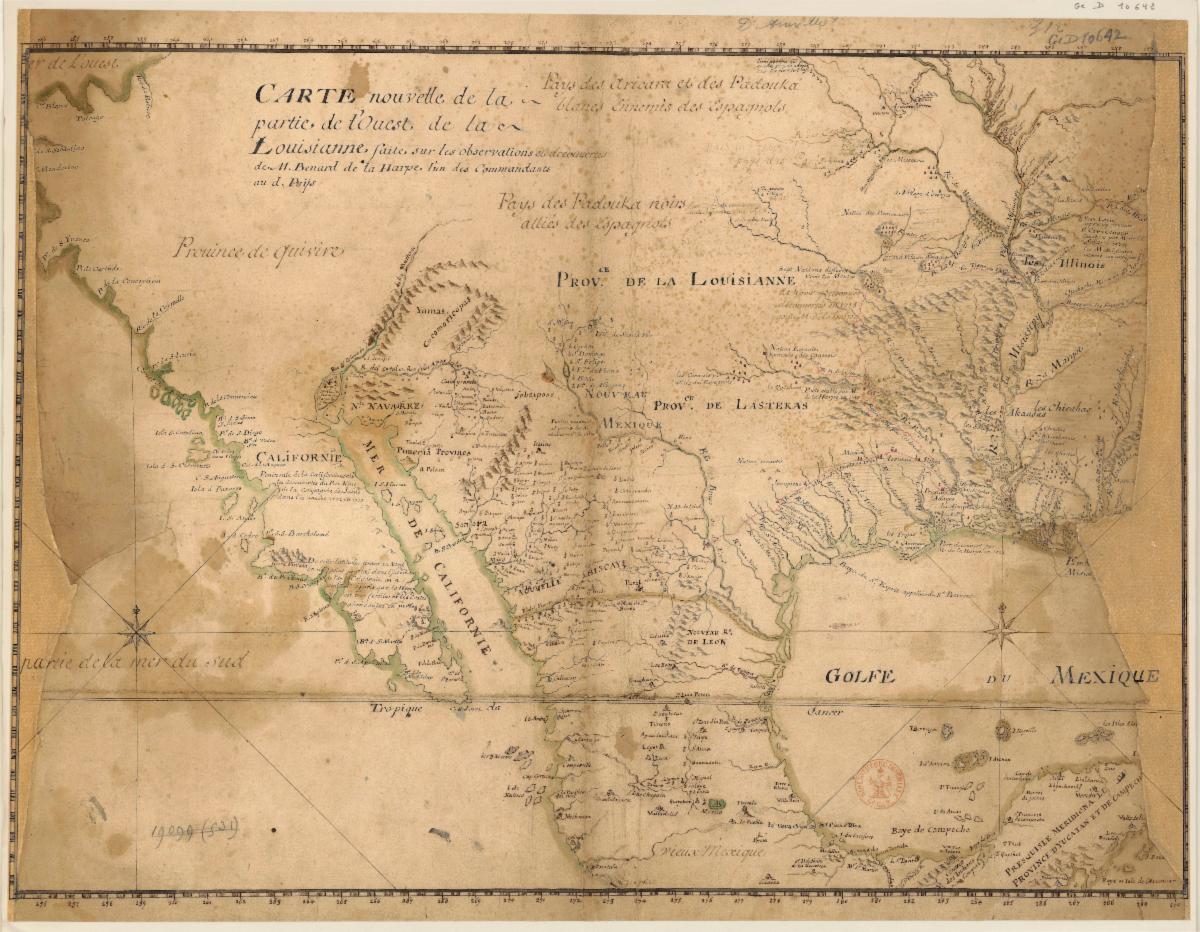
Jean-Baptiste Benard de la Harpe made an extensive tour of eastern Oklahoma in 1718-1719. The Caddo guided the la Harpe Expedition to a Wichita village along the "Alcansas" river near present-day Tulsa, Oklahoma. Along the way the explorer noted the bounty of flora and fauna. La Harpe established a formal relationship with both the Caddo and the Wichita that would ensure decades of trade. Moreover, he sent geographer Gaston du Rivage 180 miles up the Red River and established a thriving trade and successful alliance with the tribes on the upper Red River.”
Across from Oklahoma’s Governor Mansion, Capitol View, Oklahoma City, OK 73105
Map of the new part of western French Louisiana / made on the observations and findings of Mr. Benard de La Harpe one of the commanders of. Countries; Copied by Jean-Baptiste d'Anville. By Jean Baptiste Bourguignon d'Anville - Bibliothèque nationale de France, Public Domain, https://commons.wikimedia.org/w/index.php?curid=40961582
|
|
• Jean-Baptiste Bénard de la Harpe (1683 in Saint-Malo –1765) was a French officer, trader and explorer who is credited with the discovery of Little Rock, Arkansas. He was also the first known French explorer to set foot in the future state of Oklahoma.
• In 1718, La Harpe left France, along with 40 men, and established a trading post in April 1719 on the Red River near what is now Texarkana, Texas. after 23 days of traveling, La Harpe and his party reached a large settlement 13 miles south of Tulsa, OK.
• The importance of La Harpe's exploration is that it was one of the two first-known French contacts with the Wichita and Apache Indians and the first known French expedition to set foot in the future state of Oklahoma.
• In 1722, La Harpe ascended the Arkansas River and found two distinct rock formations on the Arkansas River, the smaller one the South bank he named Le petit rocher and the larger on the North bank le rocher francais.
• Later in 1722, he presided over the transfer of Pensacola, Florida to the Spanish. In 1723 he returned to France and never came back to the Americas.
Portrait: Jean-Baptiste Bénard de la Harpe By AuxArcRazorback - Own work, CC BY-SA 4.0, https://commons.wikimedia.org/w/index.php?curid=45012116
|
|
Monument
“René Robert Cavelier Sieur de la Salle”
Port Lavaca, Texas
|
|
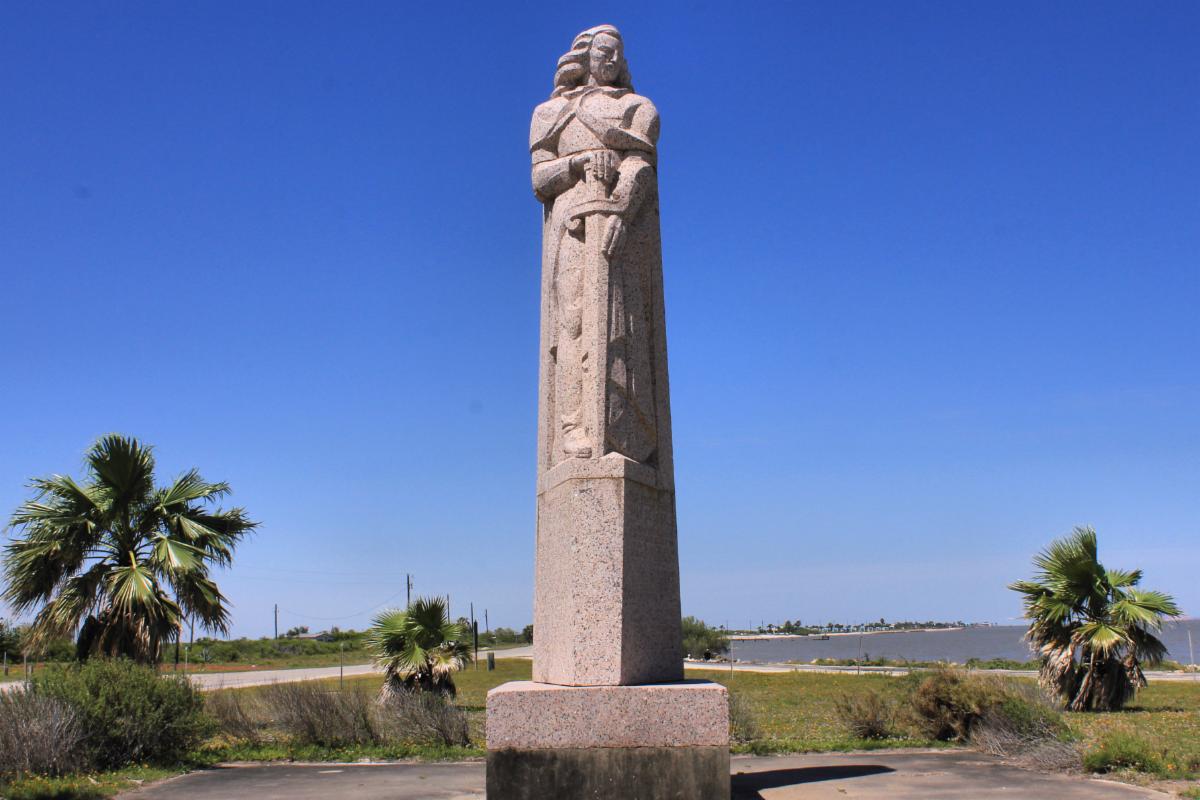
• Inscription:
“Born in Rouen France November 22, 1643. Came to Canada in 1668. Founded a first settlement near Montreal. Led several expeditions on the Great Lakes and the Ohio and Illinois rivers. Completed the exploration of the Mississippi, 1682. On July 24, 1684, La Salle sailed from France to establish a colony at the mouth of the Mississippi. Landed at Matagorda Bay February, 15, 1685. There established Fort St. Louis. While on his way to Canada he was murdered near the Trinity River March 19, 1687.”
(side 2)
“A gentleman but not a courtier, a proud independent yet timid nature, an explorer of bold vision and untiring energy. La Salle's colony on Matagorda Bay gave the United Statues its first claim to Texas as a part of the Louisiana Purchase.
America owes him an enduring memory for in this masculine figure she sees the pioneer who guided her to the possession of her richest heritage.
Francis Parkman”
"Erected 1936 by State of Texas"
2 TX-316 Road, Port Lavaca, TX 77979
By Larry D. Moore, CC BY-SA 4.0, https://commons.wikimedia.org/w/index.php?curid=48099060
|
|
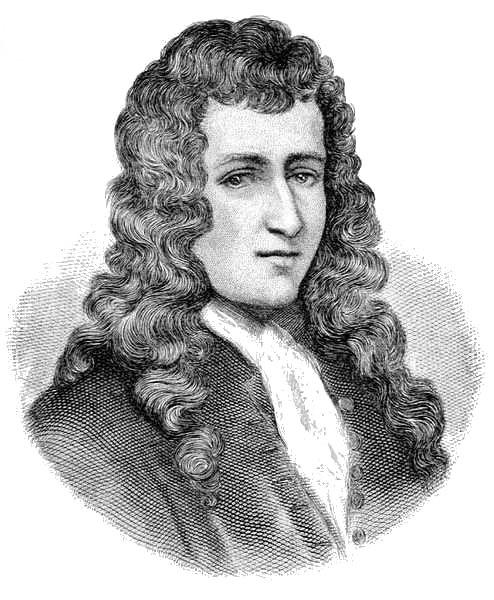
• Robert Cavelier was born on November 22, 1643, into well-off family in Rouen. He became a jesuit and sailed for New France in the spring of 1666 but was soon released from the Society of Jesus after citing "moral weaknesses”.
• He received the title Sieur de La Salle with his seigneurial purchase of Lachine near Montréal and soon learned several native languages, such as the Iroquois and Seneca.
• He began to plan for expeditions to find a western passage to China. He built ships such as the Griffon to navigate the Great Lakes and build forts such as Fort Conti and Fort Miami.
• In 1679, with a party of 40 men, he went on to explore the Mississipi River, taking him to today’s Peoria, IL, (Fort Crevecoeur) Memphis, TN, (Fort Prudhomme), reaching the Gulf of Mexico in 1682 where he named the basin Louisiana in honor of King Louis XIV. In 1684 he went on an ill-fated mission to Texas (see further down the expedition of La Belle shipwreck) and after wandering for two years lost in the marshes of the Mississipi delta, he was killed during a mutiny near Navasota, TX on March 19, 1687.
• Dozens of sites throughout the United States bear the name of La Salle, with monuments and markers in several States.
By Unknown author, Public Domain, https://commons.wikimedia.org/w/index.php?curid=25673
|
|
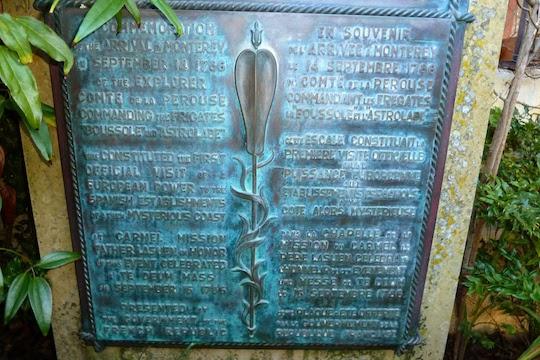
La Pérouse in Monterey, California
1786
|
|
• Inscription:
“In memory of the arrival at Monterey on September 14, 1786, of the explorer Comte de La Perouse, commanding the frigates Boussole and Astrolabe. This constitutes the first official visit of a European power to the Spanish establishments on a then mysterious coast. In this chapel of the Carmel mission, Father Lasuen in honor of the event celebrated a te deum mass on September 16, 1786.”
San Carlos de Borromeo church in Carmel, CA
3080 Rio Rd, Carmel-By-The-Sea, CA 93923
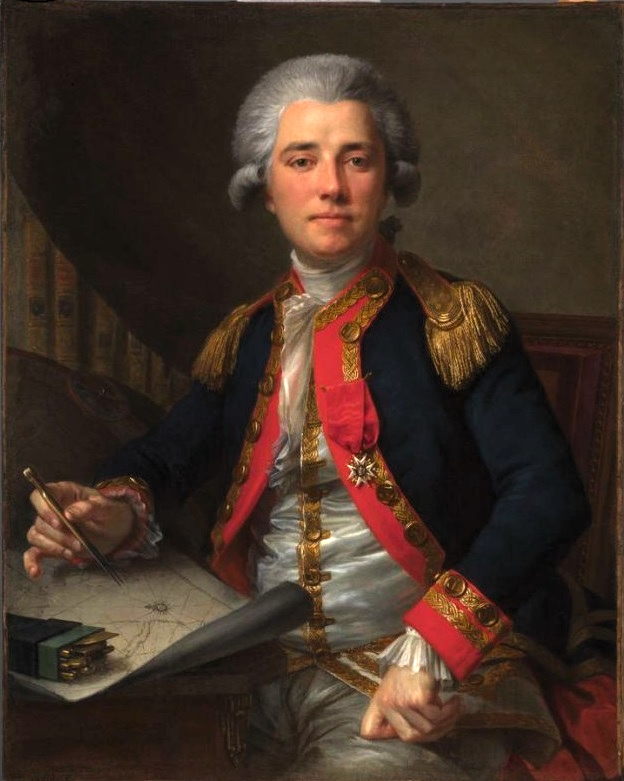
Jean-François de Galaup de La Pérouse by Geneviève Brossard de Beaulieu, Fine Arts Museums of San Francisco - Public domain, via Wikimedia Commons
|
|
• Jean-François de Galaup de La Pérouse (August 23, 1741 - 1788?) was born near Albi in Southwest France.
• Having enlisted in the French Navy at the age of 15, he had a successful naval career and in 1785, was appointed to lead a scientific expedition around the world. His ships stopped in Chile, Hawaii, Alaska, California, Macau, Japan, Russia, and Australia, before wrecking on the reefs of Vanikoro in the Solomon Islands.
• He first distinguished himself during the Revolutionary War of Independence, commanding the frigate Amazone.
• La Pérouse and his ships were the first non-Spanish European visitors to this region of Alta California. On 15th September 1786 the Boussole and the Astrolabe dropped anchor in the Bay and were given an enthusiastic reception. The fort of Monterey fired a seven-gun salute in welcome. During their ten-day visit, the French visitors received generous offers of supplies for their voyage. There is a memorial plaque commemorating La Pérouse's visit at the entrance to the present-day San Carlos de Borromeo church in Carmel, presented by the French government in 1948.
• La Perouse Bay in Maui, Hawaii, is named after him, (he was the first to set foot on Maui) as well as dozens of sites from Alaska to Australia.
•Excerpt from “Voyage around the world” de La Pérouse:
« Although the French are the first to have stepped onto the island of Mowee in recent times, I did not take possession of it in the King’s name. This European practice is too utterly ridiculous, and philosophers must reflect with some sadness that, because one has muskets and canons, one looks upon 60000 inhabitants as worth nothing, ignoring their rights over a land where for centuries their ancestors have been buried, which they have watered with their sweat, and whose fruits they pick to bring them as offerings to the so-called new landlords...Modern navigators have no other purpose when they describe the customs of newly discovered people than to complete the story of mankind. We would have felt ourselves well regarded from the great hardships this campaign has caused us if we had succeeded in eradicating the practice of human sacrifices that is common among most of the South Sea islanders.»
Photo: Marc Onetto, Regional Delegate, West Coast, the American Society of Le Souvenir Français, 2021
|
|
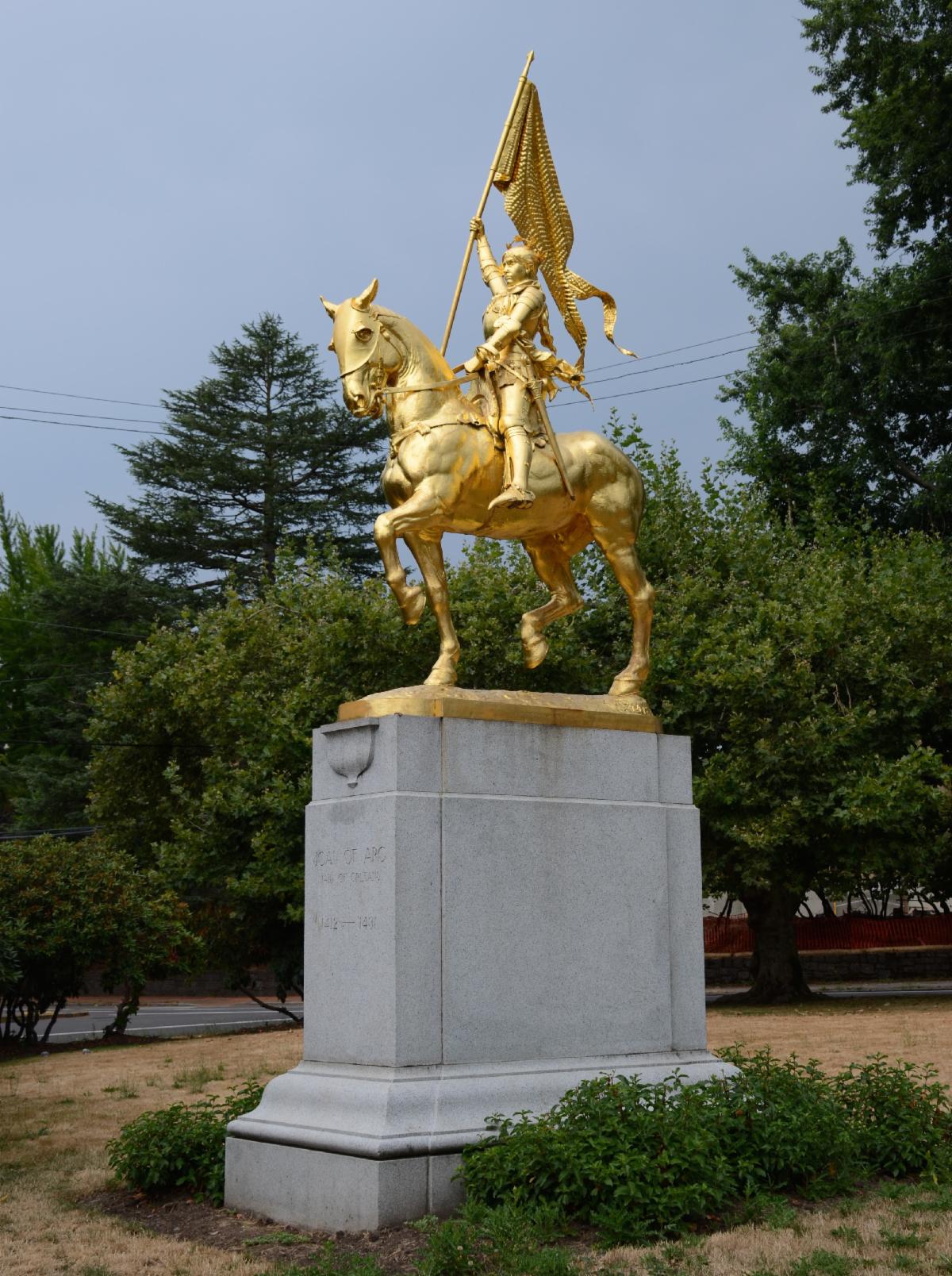
Statue of Joan of Arc
Portland, Oregon
|
|
Coe Circle (at NE 39th & Glisan), Portland, OR 97232
Photo: By Steve Morgan - Own work, CC BY-SA 3.0, https://commons.wikimedia.org/w/index.php?curid=42102142
|
|
• This statue if a replica of the gilt bronze equestrian sculpture of Joan of Arc by sculptor Emmanuel Frémiet, Place des Pyramides, Paris.
The sculptor took as his model Aimée Girod (1856–1937), a young woman from Domrémy, Joan of Arc's village in Lorraine.
• Dr. Henry Waldo Coe, a prominent Republican and friend of Theodore Roosevelt who went on hunting trips with him in the years 1884-86, donated the statue to the city in 1924 in honor of the doughboys of World War I. (He gifted three other statues to the city, including one of Theodore Roosevelt, one of Abraham Lincoln, and one of George Washington, the latter removed during the street protests of 2020).
• His son unveiled her during a patriotic ceremony on Memorial Day, 1926, a day that was also the anniversary of her martyrdom (May 31, 1431). Joan of Arc was the patron saint of the Doughboys while they fought in Europe during World War I.
• The statue was restored in 2005, thanks to The National Endowment for the Arts as well as Target Stores, who created made a 'Save Outdoor Sculpture' conservation award of $24,000 towards the work needed on the statue.
• It is one of 8 such replicas of this statue of Joan of Arc in the world: Paris, Nancy, Mircourt and Lille - all in France; and Melbourne, Australia; New Orleans, LA and Philadelphia, PA.
|
|
PAST MONTHLY BULLETINS
THROUGHOUT 2021
OUR GOAL: turn the spotlight on a famous, or less famous, episode of the long shared history between France and the United States, with illustrations and anecdotes.
Just click on the photos below to read the entire bulletin.
|
|
FEBRUARY 2021
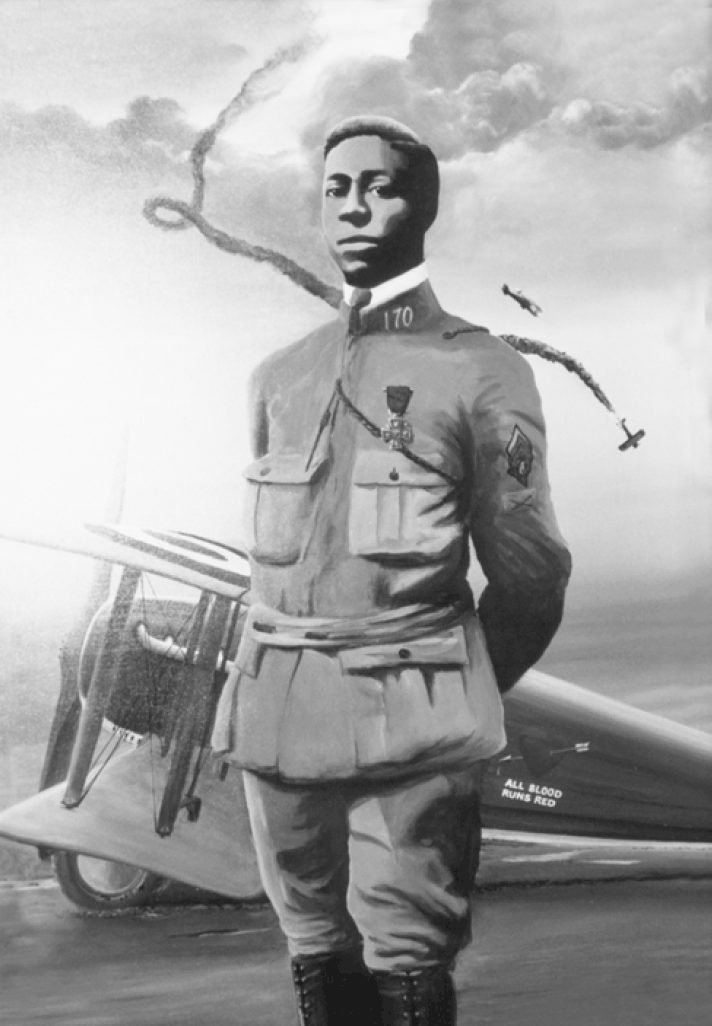
Honoring Eugene Bullard
America's First-ever Black Fighter Pilot
During "Black History Month" we paid tribute to Eugene Bullard, this long-forgotten American hero, who enrolled as a volunteer in the French Army,
|
|
MARCH 2021
Honoring two French Navy officers from Rochambeau’s army
buried in Newport, RI.
In March we told the story of these two gallant French Navy Officers who died for the cause of Freedom in 1780.
|
|
APRIL 2021
Bulletin on the “French Alliance Day”
Valley Forge, PA
In April we told the story of "French Alliance Day": General Washington ordered in 1778 that every year in perpetuity a mass be celebrated to thank France for signing the Treaty of Alliance, Friendship, and Commerce by which France was first to recognized the independence of the United States.
|
|
MAY 2021
WWII French aviators who died in the United States
In May we told the relatively unknown story of all the thousands of French Air Force cadets who came to train in US Air Force bases alongside British Royal Air Force pilots. 163 lost their lives during training and are buried in military cemeteries in Alabama and Michigan.
|
|
JUNE 2021
On the footsteps of Rochambeau
(Part 1 – Connecticut)
We started narrating the story of the French Army marching 690 miles from Newport to Yorktown in 1781, a logistical feat transporting 5,000 men and heavy siege artillery in grueling summer heat, to bring decisive help at a time when everything seemed lost for the Insurgents.
|
|
JULY 2021
On the footsteps of Rochambeau (Part 2 – Connecticut & New York)
We continued the story in July with many anecdotes of the march through Connecticut and the junction with the Continental Army in Westchester County in New York.
|
|
AUGUST 2021
On the footsteps of Rochambeau
(Part 3– New York/New Jersey to Philadelphia)
In August we narrated the brilliant strategy of the combined French and American forces to bypass New York, deceive British general Clinton, and rush to Yorktown through New Jersey to confront Lord Cornwallis.
|
|
SEPTEMBER 2021
On the footsteps of Rochambeau
(Part 4–Philadelphia to Yorktown, Battle of the Capes)
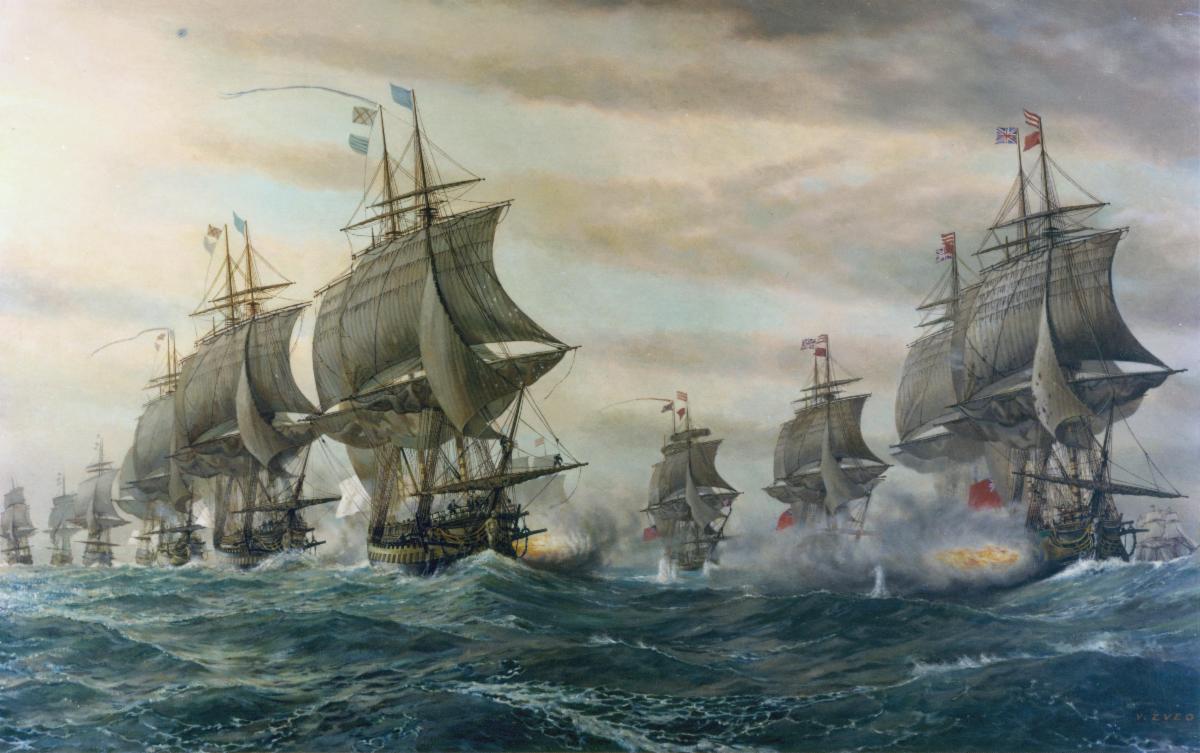
With the decisive Battle of the Capes off the coast of Virginia on September 5th, 1781, Admiral de Grasse ensured that the British army would be trapped in Yorktown and allowed the combined French and American forces to start the victorious siege the following month.
|
|
OCTOBER 2021
On the footsteps of Rochambeau
(Part 5 – Final episode: Victory in Yorktown!
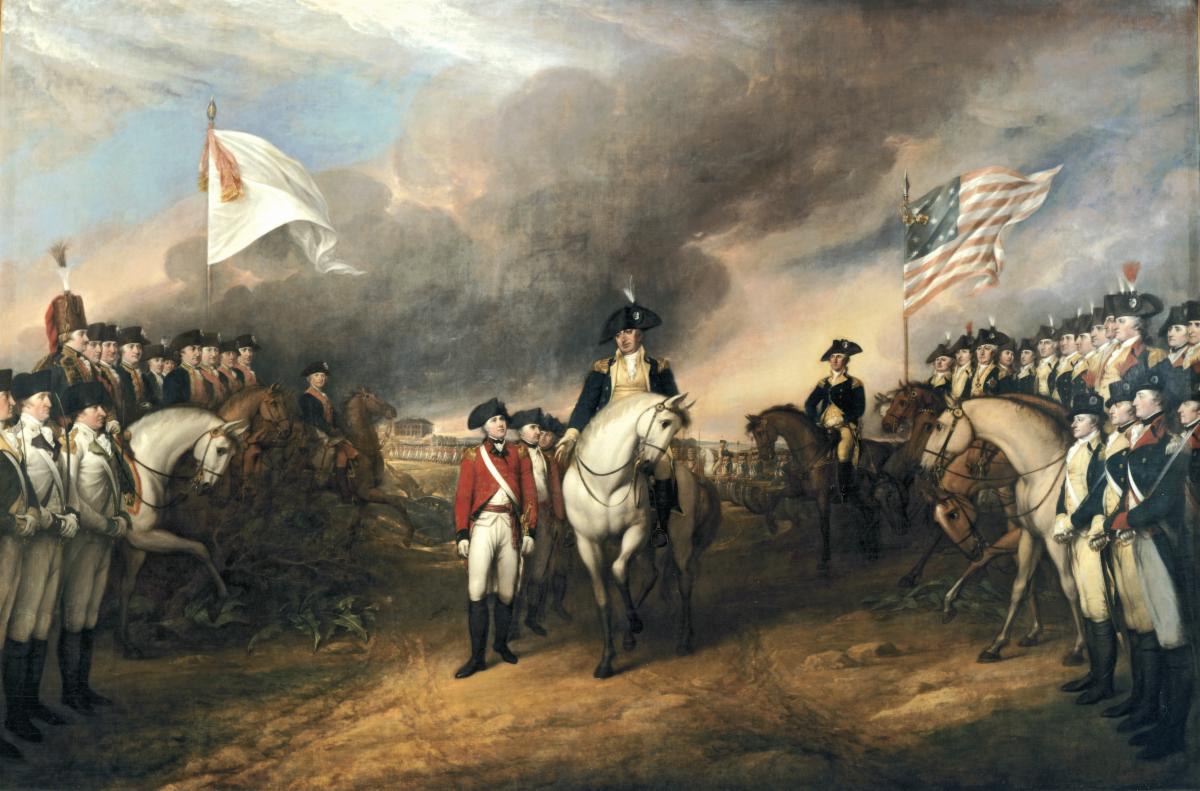
In October, we remembered the victorious siege in Yorktown of October 19, 1781 which paved the way for the Independence of the United States.
|
|
NOVEMBER 2021 - CENTENNIAL of the RETURN of the UNKNOWN SOLDIER
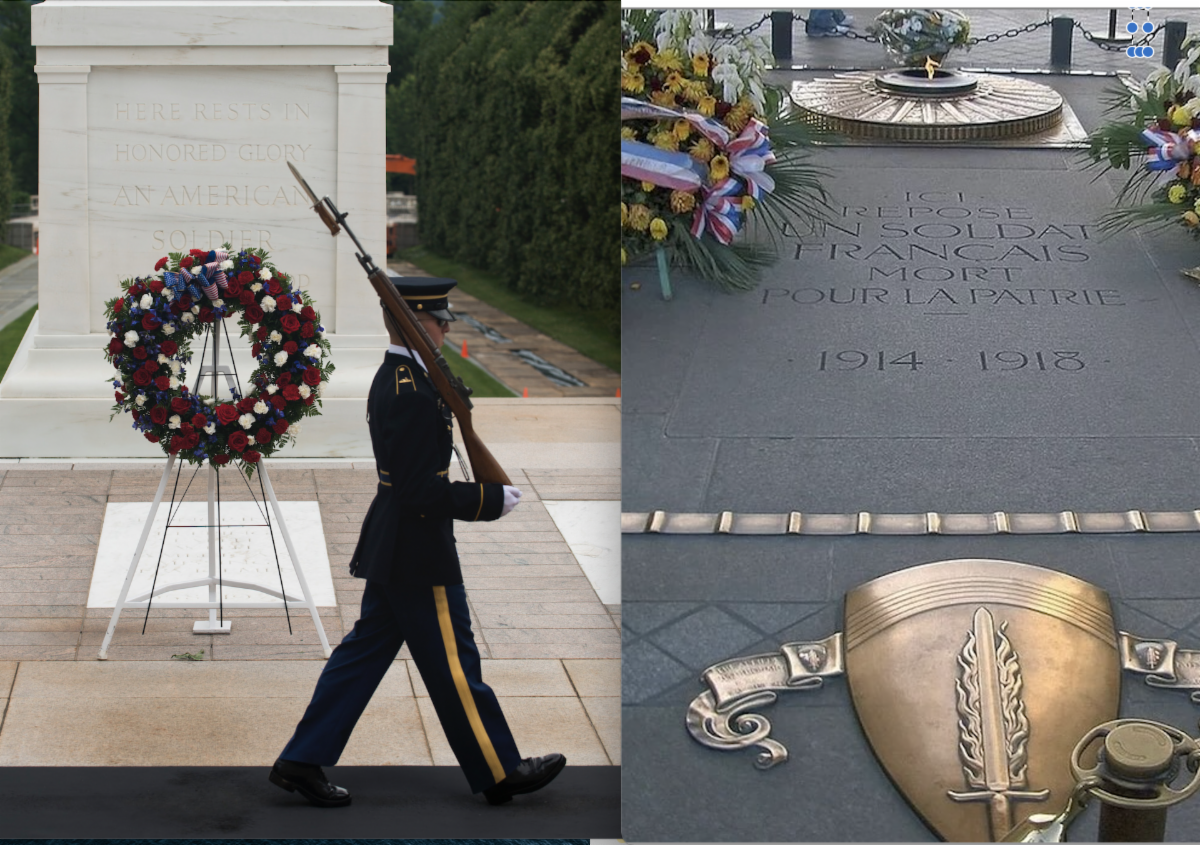
The Two Unknown Soldiers from WW1 side by side
In November, we narrated the selection of the US Unknown Soldier in France, a sister republic he came to defend, and its journey back home to the United States on board the USS Olympia.
|
|
DECEMBER 2021 - "The Year 2021 in Pictures"
A recap of our activities in our last 12 months.
|
|
Our next Bulletin in February, Black history month, will pay hommage to Joséphine Baker, whose entry at the Panthéon in Paris was recently celebrated. |
|
UPCOMING EVENTS ANNOUNCEMENTS
From our Board Member Francis Dubois, an invitation to attend:
"Le dernier voyage de Monsieur Claudel"
on March 14, 2022 at 6:30PM,
National Arts Club, Grammercy Park, New York NY
You are cordially being invited by our friend and board member Francis Dubois at the National Arts Club, 15 Gramercy Park South, New York , March 14, 2022 at 6:30pm for a play " Le dernier voyage de Monsieur Claudel" ( " The last voyage of Mr. Claudel " ) , a play written and performed by Sylvain Beltran Lamy.
Paul Claudel, French poet and diplomat attends his own funeral at Notre-Dame and comments about the mourners, and his life . This play was presented more than 300 times, in France, Belgium, and Japan and was extremely well received .
The play describes an exceptional artist as well as the literary environment of the Parisian " fin de siècle ".
The play will be in French: it is lively and humorous....and not to be missed !
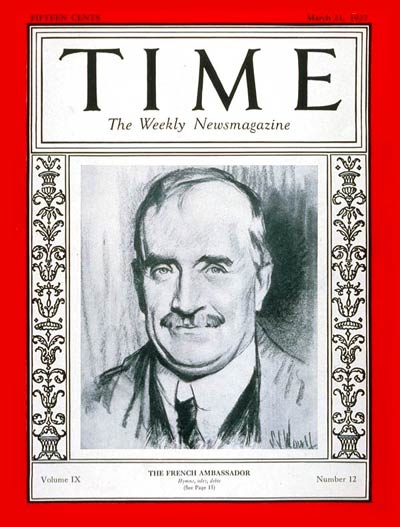
Paul Claudel, one of France's most celebrated writer, novelist and playwright of the XXth Century, had also been Deputy-Consul General of France in New York in 1893, and Ambassador of France to Washington from 1928 to 1933.
|
|
Paul Claudel, Cover of Time Magazine (21 March 1927)
By Artist: S.J. Woolf (Samuel Johnson Woolf, 1880-1948) - Public Domain
|
|
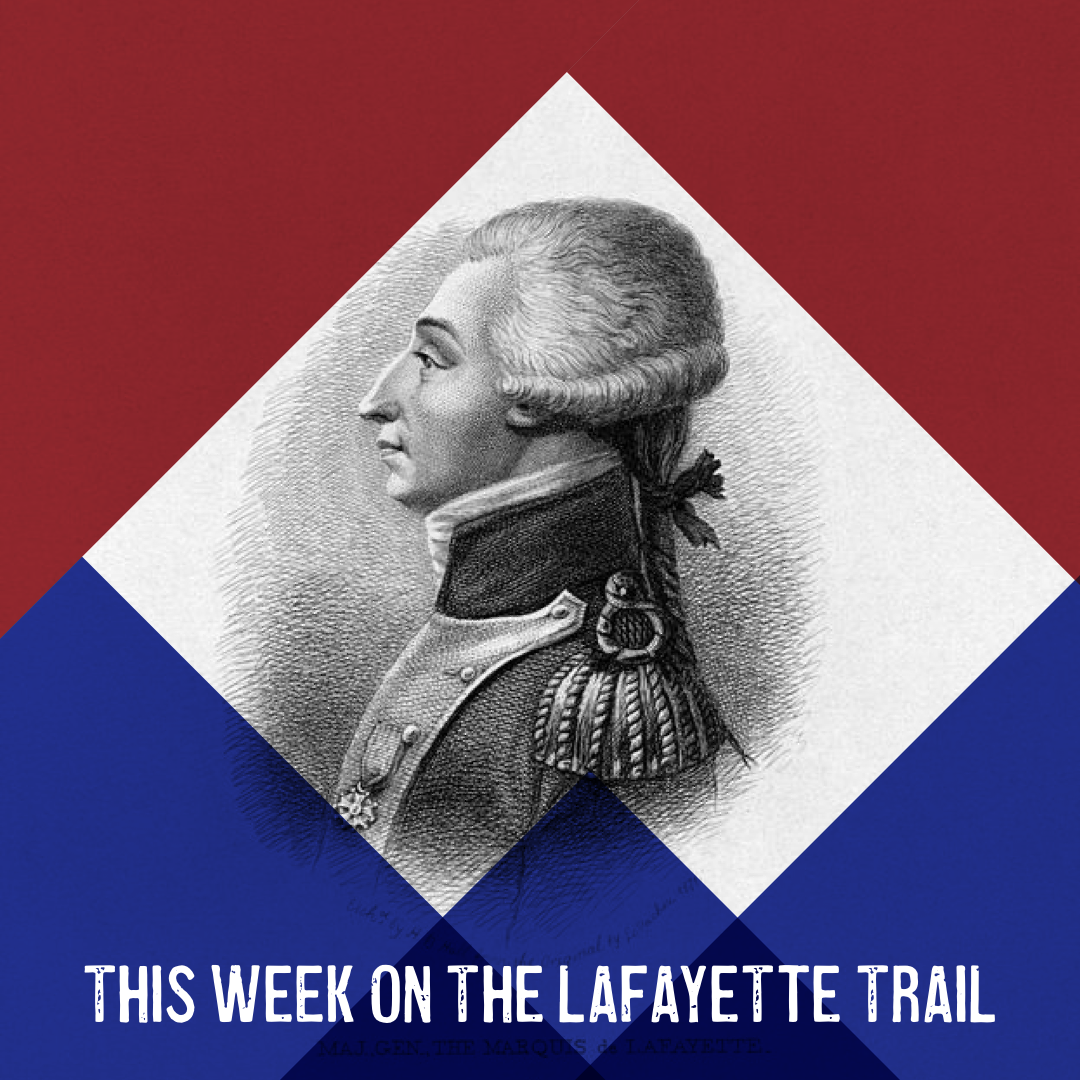
LafayetteTrail.org's latest marker
Washington's Navy Yard
|
|
In 1824, traditional warfare was no longer defined exclusively by ground operations such as the Army. The War of 1812 demonstrated that a well-equipped Navy could win a war on behalf of a nation.
Lafayette was a Revolutionary War veteran. In 1824-1825, he became concerned that his past service in the Continental Army would make the patriotic celebrations occurring for the 50th anniversary of the beginning of the American Revolution gravitate more toward the Army. The Frenchman sought to reinforce the Revolutionary War connection of the Navy, something that he had not been able to do during the American Revolution.
⚜️ How was he able to accomplish that?
⚜️ Are there any material reminders of his efforts to nurture a much-needed affection with the United States Navy and the Marine Corps?
⚜️ What do they say about how Lafayette and the Franco-American military alliance contributed to American Independence?
Let’s hit the Trail and Follow The Frenchmen to the Nation's capital, and find out now!
|
|
From the American Friends of Lafayette
Save the dates in 2022...
-
"Monday, March 14th is Lafayette Day in Virginia. Plans for this celebration are in the development stages as we try to navigate the impact the pandemic might have on gathering in March."
-
"Thursday, June 9th to Sunday, June 12th is our annual meeting at West Point."
|
|
Promoted maréchal de camp in 1780, Viomesnil served under Rochambeau in America during the Yorktown campaign.
Based on her recent discovery of the “Vioménil Papers” containing 550 documents on the American Revolution, Dr. Iris de Rode narrates the unknown but crucial role of the French Baron de Vioménil (1728-1792) during the last phase of the American Revolution, and especially during the battle of Yorktown.
|
|
OUR MISSIONS:
• To preserve the memory of the French soldiers, sailors and airmen who gave their lives for freedom, and who are buried in the United States.
• To honor French Citizens who did great deeds in the United States, or with a strong connection with the United States,
• To promote the appreciation for French culture and heritage in the United States, and the ideals that unite our two nations, in order to pass the torch of memory to younger generations.
• To strengthen the long-standing traditional bonds of friendship between the American and French peoples, and to this end: erect or maintain memorials and monuments and encourage historical research, public presentations and publications in the media.
Le Souvenir Français, a French association under the high patronage of the President of the Republic, was born in 1872 in occupied Alsace-Lorraine, and was founded in 1887 in Paris by Professor Xavier Niessen. The association has more than 300,000 members in France and in more than 45 countries.
In the United States, the American Society of Le Souvenir Français (Souvenir Français USA) has been represented since the First World War by a General Delegate, among whom were Dr Jules Pierre, MM. Bruno Kaiser, Colonel Roger Cestac, Christian Bickert, Mathieu Petitjean, and Jean Lachaud. The association is presided since November 2020 by CC(H) Thierry Chaunu (H) Lt Cdr., French Navy.
Board of Directors:
In alphabetical order:
Françoise Cestac, Honorary President
Thierry Chaunu, President
Yves de Ternay, Treasurer
Patrick du Tertre, 1st Vice-President
Henri Dubarry
Francis Dubois
Alain Dupuis, 2nd Vice Président
Daniel Falgerho, Secretary
Caroline Lareuse
Matthieu Mabin, Chairman, délégué général du Souvenir Français
Clément Mbom, Education Advisor
Jean-Hugues Monier, Audit Committee
Harriet Saxon
Antoine Treuille
Regional Delegates (in formation):
Nicole Yancey, Yorktown & Virginia, former Honorary Consul of France in Virginia
Jacques Baisnenou, Great Lakes and Midwest
Marc Onetto, West Coast
The American Society of Le Souvenir Français, Inc. is a 501(c)3 corporation established in 1993 in NY.
|
|
Did you know that a portion of every purchase you make on Amazon can benefit American Society of Le Souvenir Francais Inc, at no cost to you?
Simply go to: smile.amazon.com, designate American Society of Le Souvenir Francais Inc. as your beneficiary, and shop away!
|
|
Help us implement several historic commemorative projects celebrating the 244-year-old Franco-American friendship and alliance!
The American Society of Le Souvenir Français, Inc. is a registered NY State non-profit corporation and has full IRS tax exempt 501(c)3 status. All donations are tax deductible.
pt 501c3 status. All donations are tax deductibl
Contact: Thierry Chaunu, President
697 Third Avenue #341 New York, NY 10017
Email: info@SouvenirFrancaisUSA.org Tel: (212) 328-0150
|
|
|
|
|
|
|