The American Society of Le Souvenir Français Inc.
Bulletin Mensuel - Vol. II. No 4 - April 2022
|
|
Tribute to
Revolutionary soldier, military engineer and civil architect
Major Pierre Charles L’Enfant
The French visionary who designed Washington D.C.
|
|
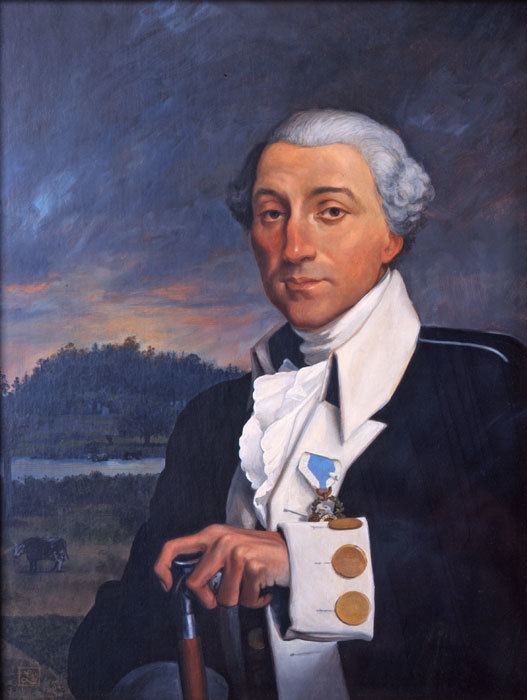
Pierre Charles L'Enfant - Painting by artist Bryan Leister, based on a silhouette of L'Enfant and a pastel of the Major's father. It currently hangs in the District of Columbia Historical Society in Washington, DC. |
|
EDITORIAL
Every tourist guide will tell you, Washington, D.C. is certainly one of the most beautiful cities to visit in the entire world, when cherry trees are blooming along its majestic Mall.
As a matter of fact, I would submit that it is one of the most beautiful cities in the world, in any season.
This past New Year, when celebrating overseas was out of question due to a spike of Covid, we decided to stay close to home in the United States and visit the nation's capital.
There were no fireworks by the obelisk, however the sheer wealth of museums, fancy restaurants, the awe-inspiring walks along the Mall, the proximity of Mount Vernon, made this four-day stay a sort of revelation: what an exciting, vibrant, majestic capital Washington D.C.really is.
Unfortunately, due to the times in which we live, no visit at the US Capitol, nor the White House, which so inspired me when I first came as a young student in 1976, were possible this time around.
However, I was able to visit, take photographs and get exact GPS coordinates at plenty of sites marking a French presence, such as the marble bench of French Ambassador Jean-Jules Jusserand in Rock Creek Park, where he used to stroll in company of his close friend President Theodore Roosevelt, the stately statues of Rochambeau and La Fayette across from the White House, which we visited after a memorable dinner with Chuck Schwam, COO of the American Friends of Lafayette, the Bartholdi electric Fountain in the Capitol gardens, the Lauzun Legion bridge marker, the bronze monument erected in honor of Louis Daguerre, the pioneer of photography, the equestrian statue of Joan of Arc Memorial, the La Fayette Hall plaque at George Washington University... which are all part of our upcoming "Repertory of French Memories in the United States".
And then, the special private tour to Arlington national cemetery, which was a high moment of our visit. Thanks to Richard Azzaro, co-Founder of the Society of Honor Guards/ Tomb of Unknown Soldier, himself one of the very few Tomb Guards, who are in so many ways the "moral elite" of the US Armed Forces, I was privileged to witness the incredibly moving choreography of the Tomb Guards ceremonial in front of the monument of the Unknown Soldiers. It is an absolute must to all visitors to Arlington. To think that they are on duty, 365 days a year, day and night, under all weather conditions, is a permanent testimony of some of the highest moral standards that are unique to our democracies.
Then, taking a stroll a bit further, certainly one of the "choicest" spot in the entire cemetery, with a view second to none, not far from John F. Kennedy's grave, stands the monumental tomb of Major Pierre L'Enfant.
Thanks again to Ambassador Jusserand, who pushed for his posthumous recognition in 1909 after more than 80 years of obscurity, and who, in his Pulitzer-Prize book "Of Americans Past and Present", devoted a chapter to the close relationship of George Washington with this French military engineer,
L'Enfant, who volunteered to fight for the "Insurgents" early on, and was commissioned as a Major by Continental Congress, who became a "protégé" of General George Washington, sadly died in total poverty and had faded from public memory, when in fact, among his many accomplishments, he developed the visionary design for the brand new capital of the young Republic.
Yes, like so many others, this French aristocrat fell in love with the United States and its values, to defend the cause of freedom, and fervently believed in the revolutionary concept of equality which he found embodied in his new nation. This is his story that we would like to tell this month, as a tribute to another prominent military Frenchman who, quite literally, built the United States capital with a vision that is resplendissent today.
Thank you for your support with our activities, which all aim to pay tribute to Frenchmen who accomplished memorable deeds in the United States.
On behalf of the Board of Directors.
Thierry Chaunu, President,
American Society of Le Souvenir Français, Inc.
Poor is the nation that has no heroes, but poorer still is the nation that having heroes, fails to remember and honor them. Marcus Tullius Cicero 106-43 BC
|
|
A FRENCH VOLUNTEER WHO FOUGHT
DURING THE REVOLUTIONARY WAR
|
|
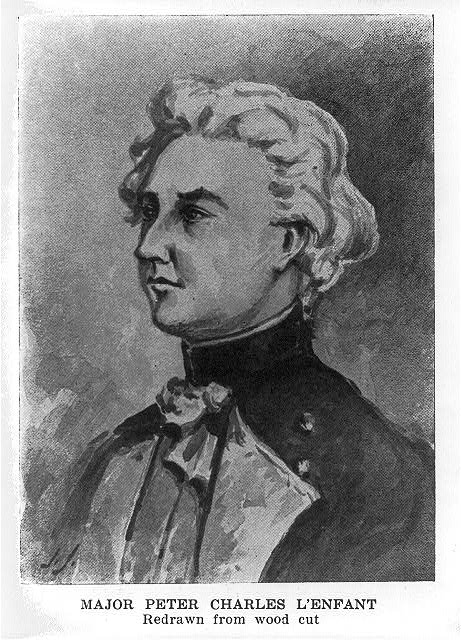
Portrait Pierre Charles L'Enfant by Unknown author - This image is available from the United States Library of Congress, Prints and Photographs division under the digital ID cph.3a43085.
|
|
A soldier, artist and architect
Pierre Charles L'Enfant was born in Paris (at the Manufacture des Gobelins) on August 2, 1754, and baptized at Paroisse Saint-Hippolyte the next day, as the second son of Pierre L'Enfant (1704–1787), who was "Painter in ordinary to the King in his Manufacture of the Gobelins" and professor at the Royal Academy of Painting and Sculpture. He was known for his panoramas of battles, and six of them are in Versailles, including the Battle of Lauffeld in the famous "Gallerie des Batailles", describing the 1747 French victory over a coalition of British, Dutch and Hanoverian armies... where a young officer named Rochambeau was wounded.
After studying architecture at the Royal Academy from 1771 until 1776, young Pierre Charles enlisted in the French Army with a commission of Lieutenant in the colonial troops.
Like many young aristocrats influenced by Enlightenments philosophers, and inflamed by the ideals of liberty, equality and human rights put forward by the Insurgents on the other side of the Atlantic. In 1777, at the age of 23, he was recruited by playwright activist Beaumarchais, author of Le Mariage de Figaro, who channeled through a fictitious company Hortalez & Co. ammunitions, war supplies, and volunteers to the American Insurgents.
"Some good engineers and some cavalry officers will soon arrive" Silas Deane, special envoy to the court of Louis XVI, wrote then to Congress. One of the engineers was Pierre Charles L'Enfant. The ship which transported him to America was named after the French Foreign Minister, "Comte de Vergennes", a name, wrote Beaumarchais, "fit to bring luck to the cargo, which is superb." Soon after, another ship, "La Victoire" would similarly bring La Fayette to America...
Military service in America for the cause of freedom:
Like La Fayette, he offered his services to Continental Congress at his own expense. He was commissioned as a captain in the Corps of Engineers retroactively as of February 18, 1778, when he anglicized his surname from Pierre to Peter. In a letter to George Washington, he wrote: "In February, 1778, I was honored with a commission of captain of engineers, and by leave of Congress attached to the Inspector-general".
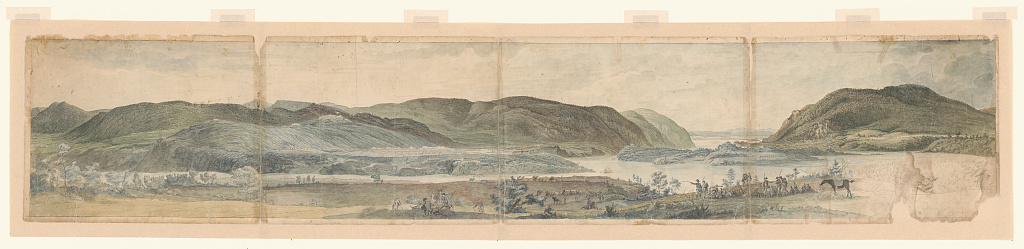
L'Enfant served on General George Washington's staff at Valley Forge. While there, the Marquis de Lafayette, now Major-General of the Continental Army, knowing his talents as an accomplished artist, asked L'Enfant to paint a portrait of Washington. Throughout the war, L'Enfant made a number of pencil portraits of George Washington and other Continental Army officers, as well as paintings of Continental Army encampments.
L'Enfant volunteered to join the ill-fated expedition in Savanah led by Admiral d'Estaing, and was wounded at the Siege of Savannah on October 9, 1779, while leading the assault of a vanguard column from the American contingent and, like d'Estaing himself, was grievously wounded. After escaping to Charleston, "I was," he said, "in my bed till January, 1780. My weak state of health did not permit me to work at the fortifications of Charleston, and when the enemy debarked, I was still obliged to use a crutch."
Made prisoner there, Rochambeau negotiated his exchange against a Hessian officer. "Your zeal and active services," Washington wrote to L'Enfant, "are such as reflect the highest honor on yourself and are extremely pleasing to me, and I have no doubt they will have their due weight with Congress in any future promotion in your corps."
Consequently, he served on General Washington's staff for the remainder of the American Revolution. L'Enfant was promoted by brevet to Major in the Corps of Engineers on May 2, 1783, in recognition of his service to the cause of American liberty.
He was not just an ordinary military engineer. In a letter to French Ambassador Comte de La Luzerne, he writes that he devised the earliest "system of discipline and exercises which was finally adopted in the American army", which today is often attributed to Steuben alone.
Finally, he was honorably discharged when the Continental Army was disbanded in December 1783.
|
|
Panoramic view of West Point, New York showing American encampments on the Hudson River, by Major Pierre Charles L'Enfant
Library of Congress Prints and Photographs Division Washington, D.C. 20540 USA http://hdl.loc.gov/loc.pnp/pp.print
|
|
RETURN TO FRANCE AND THE DESIGN
OF THE MEDAL
OF THE ORDER OF CINCINNATI
|
|
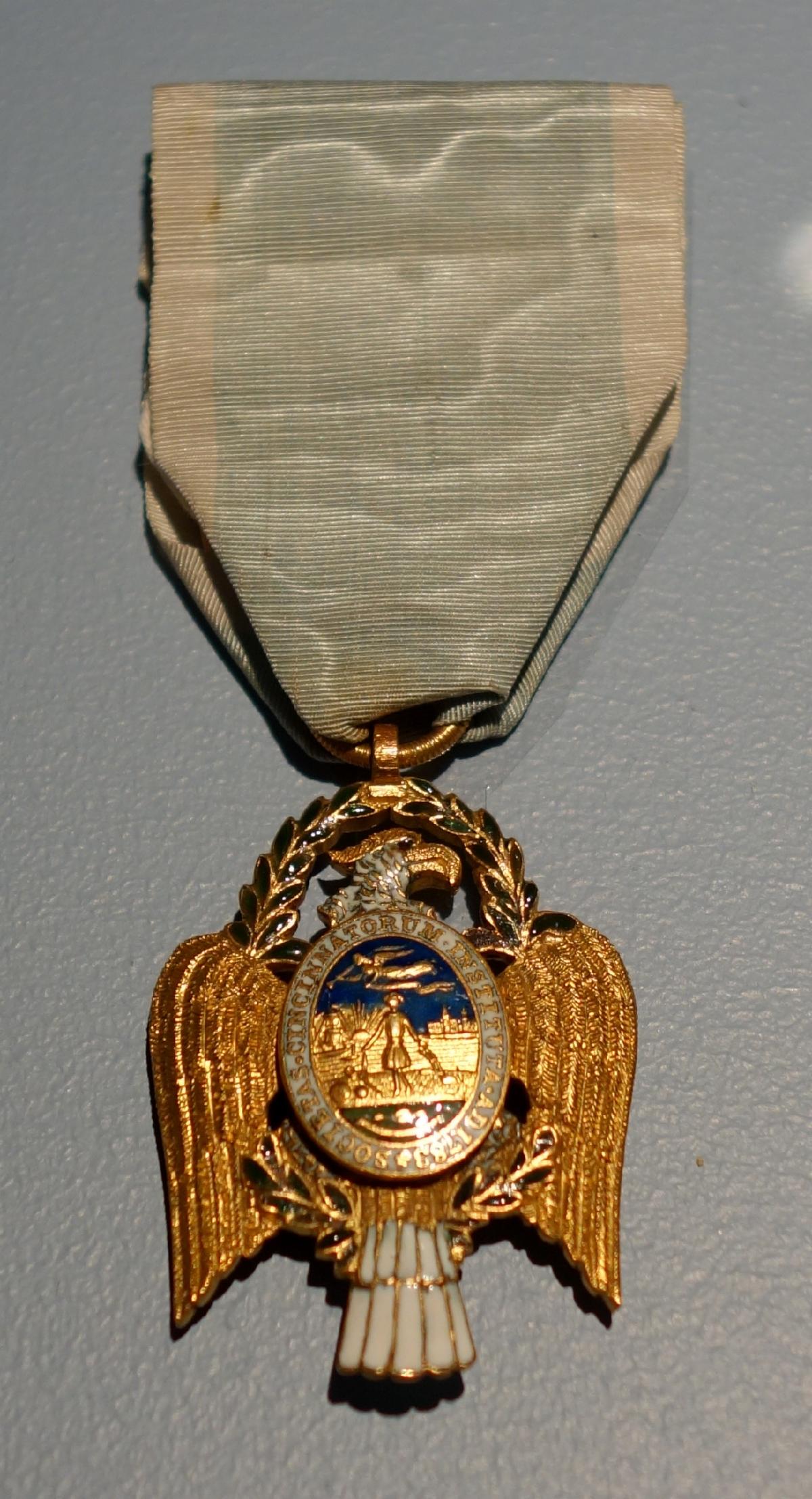
Medal of Cinncinati: The medal and diploma of the Society of the Cincinnati, an association of former American Revolution officers, were designed by L’Enfant, and upon returning to Paris he helped organize the French branch of the society.
|
|
Back to Paris, for family and a mission:
After 5 years spent in America, L'Enfant sailed back to France to care for his old father. King Louis XVI had given him a small pension on June 13, 1783 "in consideration of the usefulness of his services, and of the wounds received by him during the American war", prior to his landing at Le Havre on the 8th of December. In later years, he neglected to collect it, even though it was maintained throughout the French Revolution and available to him.
The Society of the Cincinnati a “hereditary, military, and patriotic organization formed in May 1783 by officers who had served in the American Revolution. Its objectives were to promote union and national honors, maintain their war-born friendship, perpetuate the rights for which they had fought, and aid members of their families in case of need” had just been founded in May 1783.
Exceptionally, King Louis XVI allowed his subjects to be part of an Order which was not created by the Royalty but a foreign government, and a republican one! Just another proof of the monarch's breadth of vision, and sincere fondness for the United States. In consequence, the Order was not perceived as a foreign society by the French, and had its own chapter in France, where the first French official meetings were held at the homes of Rochambeau and La Fayette in Paris.
In an unpublished letter to Rochambeau, Marshal de Ségur, Minister of War, said: "His Majesty the King asks me to inform you that he allows you to accept this honorable invitation (to be a member). He even wants you to assure General Washington, in his behalf, that he will always see with extreme satisfaction all that may lead to a maintenance and strengthening of the ties formed between France and the United States. The successes and the glory which have been the result and fruit of this union have shown how advantageous it is, and that it should be perpetuated." Concerning the institution itself the minister wrote: "It is equally honorable because of the spirit which has inspired its creation and of the virtues and talents of the celebrated general whom it has chosen as its president." (With Americans Past and Present, 1916 by JJ Jusserand, p.146)
When it became time to create a medal, it was normal that George Washington, as first president of the Society, asked L'Enfant to design the medal. It was L’Enfant who suggested the society adopted the bald eagle as its insignia. L'Enfant then ask Parisian jewelers Duval and Francastel to manufacture them. His design was met with applause.
Steuben wrote to L'Enfant on July 1, 1783, sending him "a resolution of the convention of the Cincinnati of June 19, 1783, by which I am requested," he says, "to transmit their thanks to you for your care and ingenuity in preparing the designs which were laid before them by the president on that day."
Another probable, and lesser-known contribution of Major L'Enfant is his design of the Badge of Merit, established by George Washington in 1782, and later revived in 1932 as the Purple Heart medal. The design of the badge inspired the modern Purple Heart. The heart is to represent courage and devotion. The color purple, associated with royalty, stands out on any uniform.
Since L'Enfant saw large (a personality trait that proved detrimental to his own financial interests, as we will see later), his aristocratic wealth had been severely diminished during his 5 years of service at his own expense. He sailed back to New York in April 1784 to ask the Society to reimburse him for the money advanced to the Jewelry Houses which had produced the medals, some $1,548, which went to pay off the Parisian jewelry workshops.
|
|
POST REVOLUTIONARY CIVIL ARCHITECT CAREER |
|
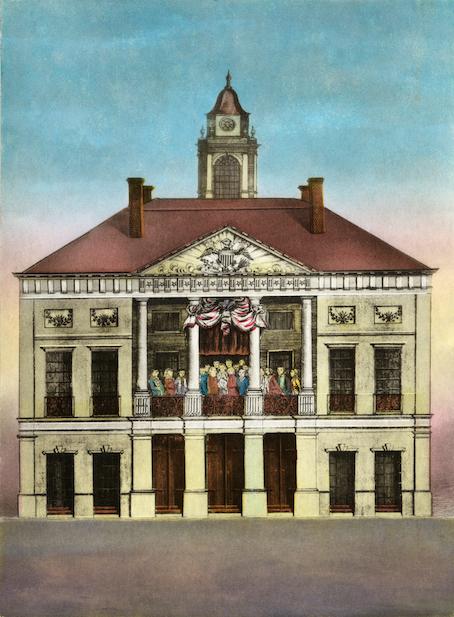
Federal Hall, New York, where President George Washington was inaugurated as first president of the young republic, redesigned by Pierre L'Enfant. By Amos Doolittle - This image is available from the United States Library of Congress Prints and Photographs division under the digital ID ppmsca.15703. Public Domain, https://commons.wikimedia.org/w/index.php?curid=16091763
|
|
An advice for all ages
Upon his return, L'Enfant urged America not to let its guard down and spend for its defense. He wrote in imperfect English: "...a neutral Power must be ready for war, and his trade depends on the means of protecting and making his colors respected. America, neutral without [a] navy, without troops or fortified harbors could have nothing but calamity to expect." She cannot live free and develop in safety without "power to resent, ability to protect"...
Several French fellow engineers such as Louis Duportail, Louis de Tousard or Etienne Béchet, Sieur de Rochefontaine, remained active in the US Army, and worked on fortifications in the Eastern seaboard.
Embracing a new nation:
L'Enfant chose a civilian path, and established a successful and highly profitable civil engineering firm in New York City. He achieved fame as an architect by redesigning the City Hall in New York for the First Congress of the United States, renamed Federal Hall, alas demolished in laters years.
L'Enfant also designed the altar, called "Glory" at St Paul's Chapel of Trinity Church in Wall Street (209 Broadway, New York, NY 10007) where fellow French military engineer, Sieur de Rochefontaine, who served as Chief of Engineers of the US Army Corps of Engineers, in buried with an impressive monument. The altar is still visible, with a historical marker, in the only remaining Colonial-era church of Manhattan, where George Washington prayed after his inauguration.
As a noted and prosperous architect, he was friend with dignitaries such as Alexander Hamilton, or gov. Morris, L'Enfant also designed furniture and houses for the wealthy.
Freemasonry in New York:
While L'Enfant was in New York City, he was initiated into Freemasonry. His initiation took place on April 17, 1789, at Holland Lodge No. 8, F & A M, which the Grand Lodge of New York F & A M had chartered in 1787. L'Enfant took only the first of three degrees offered by the Lodge and did not progress further in Freemasonry. Our society member Pierre de Ravel d'Esclapon of New York City who wrote a very interesting and well documented article on his Masonic initiation:
Pierre "Peter" Charles L'Enfant is thus in company of illustrious, immortal Free Masons contemporaries such as George Washington, or Wolfgang Amadeus Mozart. Some masonic signs with star-shaped angles can indeed, according to some, be deciphered in the city's grid.
|
|
HIS IMMORTAL MASTERPIECE:
THE DESIGN OF THE FEDERAL CAPITAL CITY
WASHINGTON, D.C.
|
|
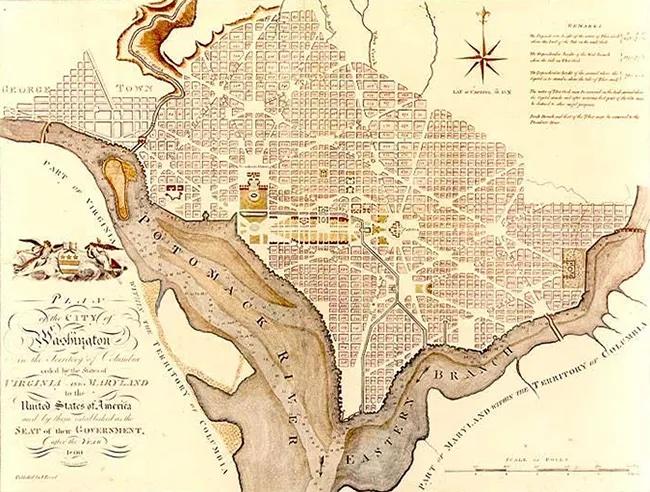
Map of Washington, 1792, Photo: National Park Service |
|
A visionary:
In 1789, the new Constitution of the United States gave the newly organized Congress of the United States authority to establish a federal district up to 10 miles square in size.
In a letter dated September 11, 1789, L'Enfant proposed his services, and his vision, to George Washington:
"Sir, the late determination of Congress to lay the foundation of a city which is to become the capital of this vast empire offers so great an occasion of acquiring reputation to whoever may be appointed to conduct the execution of the business that your Excellency will not be surprised that my ambition and the desire I have of becoming a useful citizen should lead me to wish a share in the undertaking...
"...No nation, perhaps, had ever before the opportunity offered them of deliberately deciding on the spot where their capital city should be fixed.... And, although the means now within the power of the country are not such as to pursue the design to any great extent, it will be obvious that the plan should be drawn on such a scale as to leave room for that aggrandizement and embellishment which the increase of the wealth of the nation will permit it to pursue at any period, however remote. Viewing the matter in this light, I am fully sensible of the extent of the undertaking".
If this is not a statement from a visionary, then, what is?
Appointment as Chief Planner:
In July 1790 the First Congress passed the "Residence Act", a political compromise between the north and south, and between Secretary of the Treasury Alexander Hamilton of New York and Secretary of State Thomas Jefferson, of Virginia, setting the site of the new federal district and national capital to be on the shores of the Potomac River.
Consequently, President Washington appointed L'Enfant in 1791 to plan the new "Federal City" (later named the "City of Washington") under the supervision of three Commissioners, whom Washington had appointed to oversee what would later become the "District of Columbia".
In a letter, George Washington writes: "Since my first knowledge of the gentleman's abilities in the line of his profession, I have received him not only as a scientific man, but one who has added considerable taste to professional knowledge; and that, for such employment as he is now engaged in, for prosecuting public works and carrying them into effect, he was better qualified than any one who had come within my knowledge in this country."
On March 2, 1791, Washington announced to Colonel Dickens, of Georgetown, the coming of the major: "An eminent French military engineer starts for Georgetown to examine and survey the site of the federal city."
A few days later the arrival of "Major Longfont" [sic] was recorded by the Georgetown Weekly Ledger.
|
|
PLANS FOR A MAJESTIC CAPITAL |
|
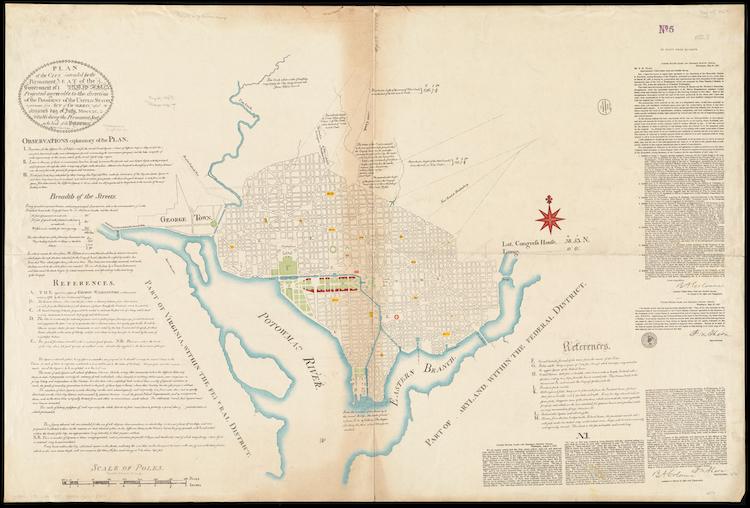
By Peter Charles L'Enfant - Library of Congress: Plan of the city intended for the permanent seat of the government of t(he) United States ...; Facsimile of manuscript of L'Enfant plan. Created and published by the United States Coast and Geodetic Survey, Washington, D.C. (1887), Public Domain, https://commons.wikimedia.org/w/index.php?curid=50638693
|
|
An entire city plan done in less than 6 months!
Arriving on a rainy, foggy night, L'Enfant immediately set himself to work with a zeal and enthusiasm that was shared by all French émigrés at the time, so in love with the ideals of this new republic. Fellow painter Trumbull noted in his memoirs: "Then to Georgetown, where I found Major L'Enfant drawing his plan of the city of Washington; rode with him over the ground on which the city has since been built. Where the Capitol now stands was then a thick wood." (May, 1791.)
He arrived in Georgetown in March 9, 1791, and by June 22, L'Enfant presented his first plan for the federal city to the President, with a second augmented plan submitted on August 19. During these incredibly short 6 months, he had surveyed the landscape, selected the major sites, drew streets, avenues, circles, squares, even a canal, in a district composed of hills, forests, marshes, and plantations.
Later on, his successor Andrew Ellicott who had assisted him in the survey and mapping kept the overall layout with some revisions. President Washington retained a copy of one of L'Enfant's plans, showed it to the Congress, and later gave it to the three Commissioners.
The U.S. Library of Congress now holds both plans. The first plan identifies "Peter Charles L'Enfant" as its author in the last line of an oval in its upper left corner.
George Washington endorsed L'Enfant's ideas, which many thought were simply crazy and too monumental.
Site of the US Capitol:
L'Enfant selected the place for the Capitol, a place called "Jenkin's Hill", which he described as a "pedestal awaiting a monument", at the highest point overlooking the Potomac. However, some of L'Enfant's plans, including a huge waterfall cascading down Capitol Hill, were never realized.
Site of The White House:
He also selected the place for the White House (so named in 1817, but originally called the Federal House), which, he wrote, will be "adding to the sumptuousness of a palace the convenience of a house and the agreeableness of a country seat".
Streets, Avenues, Circles, Squares:
He sketched wide avenues and streets ""Attention has been paid to the passing of those leading avenues over the most favorable ground for prospect and convenience."
The plan specified that most streets would be laid out in a grid. To form the grid, some streets (later named for letters of the alphabet) would travel in an east–west direction, while others (named for numbers) would travel in a north-south direction. Broader diagonal grand avenues, later named after the states of the Union, crossed the north/south-east/west grid. These "grand avenues" would intersect at circles and rectangular plazas that would later honor notable Americans and provide open space.
George Washington's support:
The wide distance between these seats of government was criticized by many, as it could take considerable time and effort, in fog and at night, to bring messages back and forth. George Washington saw advantages to it, enabling a more stately functioning of government, and dismissed objections.
Above all, L'Enfant was guided by his vision of grandeur for the new nation and its capital city: "we must leave to posterity a grand idea of the patriotic interest which promoted it." (L'Enfant's Observations Explanatory of the Plan, inscribed on it)
The Mall:
The centerpiece of L'Enfant's plan was a great "public walk". Today's National Mall is a wide, straight strip of grass and trees that stretches for two miles, from Capitol Hill to the Potomac River. Smithsonian museums flank both sides and war memorials are embedded among the famous monuments to Lincoln, Washington and Jefferson.
A vast undertaking:
The district was dotted with a few farms, that stood in the way of L'Enfant's plans for wide avenues, as he was himself inspired by the wide perspectives and alleys of master architect and "paysagiste" Le Nôtre in Versailles.
However, as often with real estate deals, with expropriations of some properties, and as he ordered rash demolitions of illegally-built homes that run astray of his plans, he made several ennemies, particularly for his high-handed procedure in removing the house of Daniel Carroll, an influential Washington resident, to make way for an avenue. Speculators were unable to conduct their schemes, and the three commissioners became increasingly irritated by L'Enfant's refusal to report to them, and only to George Washington.
Like any artist worth his salt, he would not compromise his designs. He was forewarned several times that his character and insubordination would make the continuation of his tenure impossible. George Washington protected him several times, but at one point became unwilling to waste political capital to continue his defense. Jefferson tried to reason with him, inviting him at lunch and diner to seek compromises, to no avail.
Dismissal:
He never negotiated a salary, nor bothered to copyright his plans, and never received any royalty.
L'Enfant actually made drawings for the Capitol, the President's house, the bridges, the market, etc., which he complained later the commissioners to have unjustly appropriated. (Records of the Columbia Historical Society, II, 140.)
When he presented his bill of $95,500 to Congress, legislators voted to give him only $4,600. At the time of his dismissal, George Washington wrote to the three commissioners, "The plan of the city having met universal applause (as far as my information goes), and Major L'Enfant having become a very discontented man, it was thought that less than from two thousand five hundred to three thousand dollars, would not be proper to offer him for his services; instead of this, suppose five hundred guineas and a lot in a good part of the city were substituted?"
The offer was made; L'Enfant refused, without giving reasons.
|
|
A DIFFICULT END OF A CAREER,
AND DESCENT INTO POVERTY
|
|
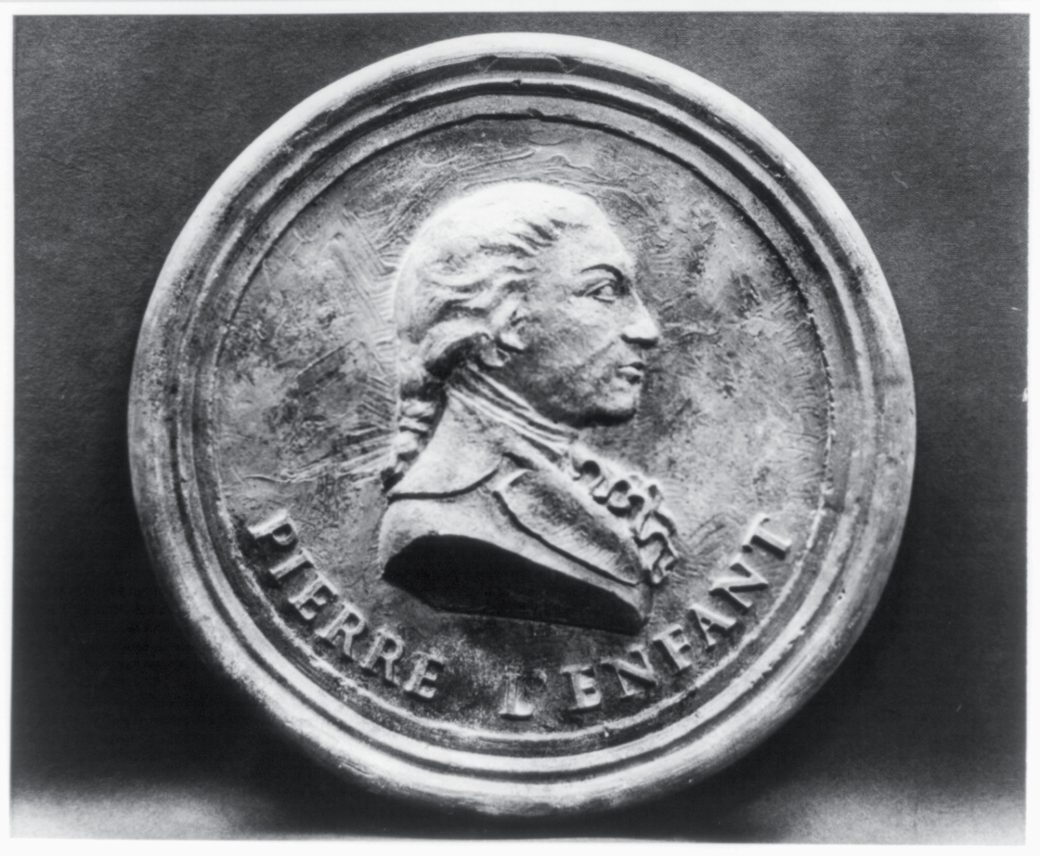
Medal, Pierre Charles L'Enfant
Library of Congress Prints and Photographs Division Washington, D.C. 20540
|
|
A man in his prime, but already down and out:
In spite of his wounds received during the war, he was generally in good health, and his physical appearance was more than amenable. It was his bad temper, inability to seek compromise, or develop a good working relationship with his clients that made his last years increasingly difficult.
"Mr. W.W. Corcoran, who lately departed this life in the city of Washington, full of years and honor ... had a very distinct recollection of the personal appearance of L'Enfant, the latter having been a frequent visitor at his father's house. He described him to me as a tall, erect man, fully six feet in height, finely proportioned, nose prominent, of military bearing, courtly air, and polite manners, his figure usually enveloped in a long overcoat and surmounted by a bell-crowned hat—a man who would attract attention in any assembly." Hugh T. Taggart, in Records of the Columbia Historical Society, XI, 216.
L'Enfant remained active with diverse projects:
- Soon after leaving the national capital area, L'Enfant prepared the initial plans for the city of Paterson, in New Jersey.
-
During the same period (1792–1793) he designed financier Robert Morris' sumptuous mansion in Philadelphia, which was never finished because of his delays and Morris' bankruptcy. Not only L'Enfant was not paid, but he had loaned money to the financier, who recognized "...But he lent me thirteen shares of bank stock disinterestedly, and on this point I feel the greatest anxiety that he should get the same number of shares with the dividends, for the want of which he has suffered great distress." Written about 1800. W.B. Bryan, History of the National Capital, 1914, p. 181.
On two occasions, after many years, Congress voted modest sums for L'Enfant, but they were at once appropriated by his creditors.
- In 1794, L'Enfant was placed in charge of reconstructing Fort Mifflin on Mud Island in the Delaware River below Philadelphia, but later handed the job over to fellow French military engineer Etienne Béchet, Sieur de Rochefontaine.
- In 1812, L'Enfant was offered by then Secretary of State James Monroe a position as a professor of engineering at United States Military Academy, at West Point, New York, but after initially declining that post, taught there from 1813 to 1817.
- In 1814, L'Enfant worked briefly on the construction of Fort Washington near the capital.
He had neglected to collect his French pension, although it had been maintained even during the worse times of the French Revolution, or to collect his share of the proceeds of his father's small farm in Normandy.
At the time of his death, "he only had three watches, three compasses, some books, maps, and surveying instruments, the whole being valued at forty-six dollars" (With Americans of Past And Present Days, by J.J. Jusserand. )
|
|
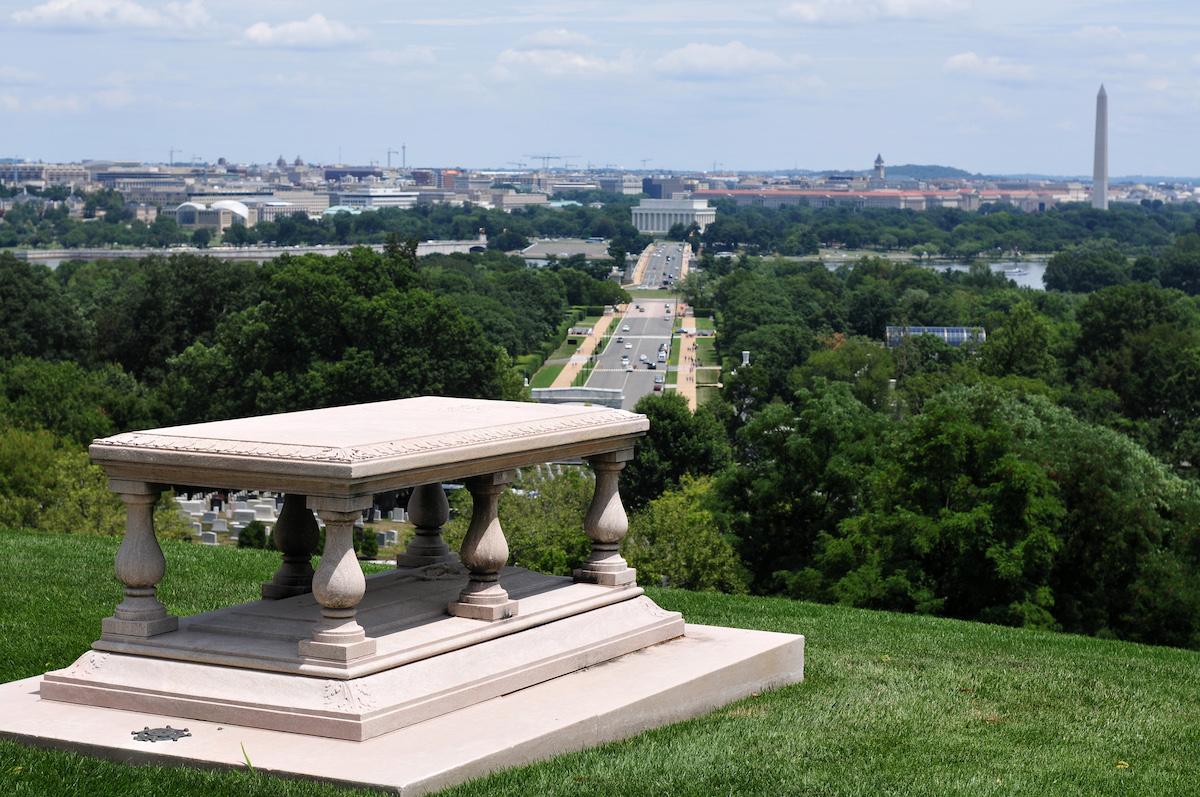
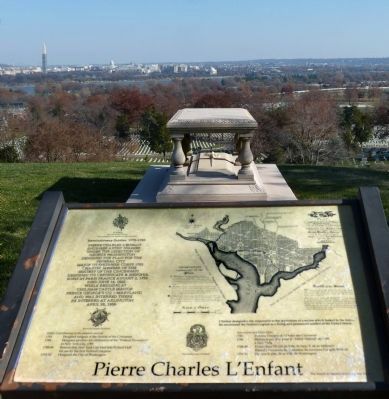
The gravesite of Pierre (Peter) Charles L'Enfant designed by sculptor architect William Welles Bosworth in Arlington National Cemetery below Arlington House, overlooking the Potomac River and Washington, D.C.
By Ralf Roletschek, own work, CC BY-SA 3.0
|
|
Penniless and buried by a tree:
L'Enfant died in poverty on June 14, 1825, hosted by his friend and benefactor William Dudley Digges at his Green Hill farm in Chillum, Maryland, about 8 miles north of Washington D.C. He was never really paid for his work, although others made considerable sums through the implementation of their real estate schemes. Upon his death, he was originally buried unceremoniously at his friends' garden, at the foot of a tree. Years later, anyone looking for where he was buried could find his gravesite overgrown by myrtle and shaded by large cedars. (https://www.geriwalton.com/pierre-charles-lenfant-revolutionary-architect-and-planner-washington-dc/)
Posthumous rehabilitation:
In 1901 and 1902, the McMillan Commission under the leadership of Senator James McMillan, (1838–1902), of Michigan, laid out a plan for a sweeping mall in the area of L'Enfant's widest "grand avenue", which had not yet been constructed.
National honors at the US Capitol:
L'Enfant's remains were exhumed from their burial site at Green Hill and placed in a metal-lined casket.
"Around noon eight army engineers carried L’Enfant’s casket out to the east front of the Capitol and set it on an artillery caisson pulled by six bay mares. Cavalry from Fort Myer led the way, followed by the Corps of Engineers band. A cortege of five hundred people, sometimes outnumbering the crowds flanking them, began its procession up Pennsylvania Avenue and across the Rock Creek bridge to M Street, reversing the direction of L’Enfant’s original ride around the site. Flags flew at half-mast all along the way". (Scott W. Berg, Grand Avenues (New York: Vintage Books, 2007), p. 274.)
After lying in state under the Great Dome of the Capitol, on the 28th of April, 1909, (something never done before, for someone who was not part of the US government).
"When the thousands had passed around the catafalque on which reposed the casket, draped in the American flag - patriotic men and women, school children who, perhaps, had never seen the name of l'enfant on history's page - the great casket was lifted by eight sturdy sergeants of the Engineer Corps and borne to the caisson of an artillery gun, and the long-delayed triumphal march which should have been l'enfant's nearly a century ago, was begun to Arlington" (Report Made to the Columbia Historical Society, May 11, 1909,
https://books.google.com/books?id=28aJswEACAAJ)
A fitting resting place in Arlington:
The hearse, wrapped in the three colors of France and America, was accompanied to Arlington by the French naval and military attachés, and an escort from one of those regiments of engineers to which the major himself had belonged.
L'Enfant was re-interred in front of Arlington House on a slope in Arlington National Cemetery in Virginia, in the presence of President William Howard Taft, of representatives of Congress, the Supreme Court, the Society of the Cincinnati, and other patriotic and artistic societies, and of a vast crowd.
Orations were delivered by the Vice-President of the United States, James Sherman, who concluded: "And turning to you, Mr. Ambassador ... I express the hope that the friendship between our nations, which has existed for more than a century, will be but intensified as time passes, and that we will in the future join hands in advancing every good cause which an all-wise Providence entrusts to our care."
L'Enfant's monument:
In 1911, a monument was placed on top of L'Enfant's grave during a dedication ceremony attended by 350 dignitaries. William Dudley Digges' great-granddaughter, Elanora Carroll Morgan, unveiled the monument, and a band played the national anthem while two soldiers from the Engineers Corps raised the American flag.
President William Howard Taft, Ambassador Jusserand, and Senator Elihu Root spoke. "Few men," Mr. Root said, "can afford to wait a hundred years to be remembered. It is not a change in L'Enfant that brings us here. It is we who have changed, who have just become able to appreciate his work. And our tribute to him should be to continue his work."
Engraved on the monument is a portion of L'Enfant's plan in a diagram map, which Andrew Ellicott's revision and the McMillan Commission's plan had superseded.
Made of white marble, the monument consists of four slabs supported on six posts, with an oak leaf at each corner and a scalloped design around the edges. The east end (facing the Arlington House) depicts L'Enfant's plan for Washington, D.C., with an epitaph below. In 1931, the Daughters of the American Revolution added a bronze marker to the monument. More information on the marble monument itself can be found at:
L'Enfant's historical marker:
In 1995, the American Society of Le Souvenir Français and the Daughters of the American Revolution co-signed a historical marker, located by the monument, and dedicated by French Ambassador Jacques Andréani.
For an account of the ceremony:
|
|
PIERRE "PETER" CHARLES L'ENFANT LEGACY
EXISTING TRIBUTES IN WASHINGTON D.C.
|
|
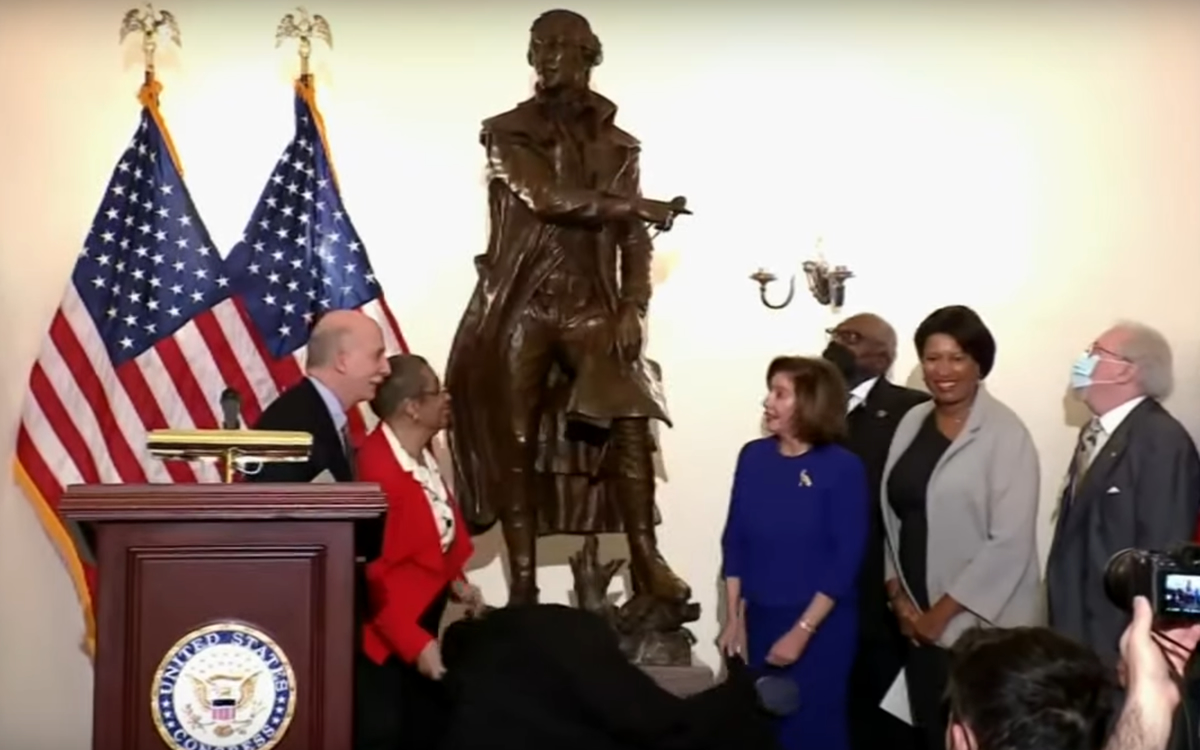
STATUE INAUGURATED FEBRUARY 28, 2022
AT THE UNITED STATES CAPITOL
|
|
From left, D.C. Council Chair Phil Mendelson, Delegate Eleanor Holmes Norton (D-D.C.), U.S. House Speaker Nancy Pelosi (D-Calif.), House Majority Whip James Clyburn (D-S.C.) and D.C. Mayor Muriel Bowser attend the unveiling of the statue of Pierre L'Enfant at the U.S. Capitol on Feb. 28. (Screen capture via WUSA9 YouTube)
|
|
The District of Columbia's drive towards Statehood:
Only States have the privilege to place two statues of prominent leaders in the Capitol, as part of the National Statuary Hall Collection.
The District of Columbia has been has been pushing for years its admission as a State in the Union. So far it only has one representative without voting rights, and D.C. is administered by Congress.
In anticipation to becoming the 51st State, the city commissioned statues to abolitionist Frederick Douglass and Pierre L'Enfant, in 2008.
In 2013, a compromise was passed and Congress allowed only one statue, that of Frederick Douglass. As Representative Holmes Norton declared at the time: “I expect to get his done the way I was able to get Frederick Douglas done"... "It became impossible to refuse Frederick Douglas. I don’t see how the Senate can sit there and say ‘We don't want Pierre L'Enfant — the man who created the very city where the Senate and the House sit.”
For years the statue of Pierre Charles L'Enfant was placed inside the lobby of the Wilson Building which serves as the seat of DC government.
Belated inauguration:
Finally, the dedication of the statue took place on February 28, 2022 at the Memorial Door Foyer in the Capitol.
D.C. Delegate Eleanor Holmes Norton, who arranged for the statue to be installed at the Capitol, said she and other D.C. officials consider the placement of the statue as a symbolic further step in pushing for D.C. to become the nation’s 51st state.
Among those joining Norton in the L’Enfant statue unveiling ceremony were Speaker of the House Nancy Pelosi (D-Calif.), D.C. Mayor Muriel Bowser, and House Majority Whip James Clyburn (D-S.C.).
|
|
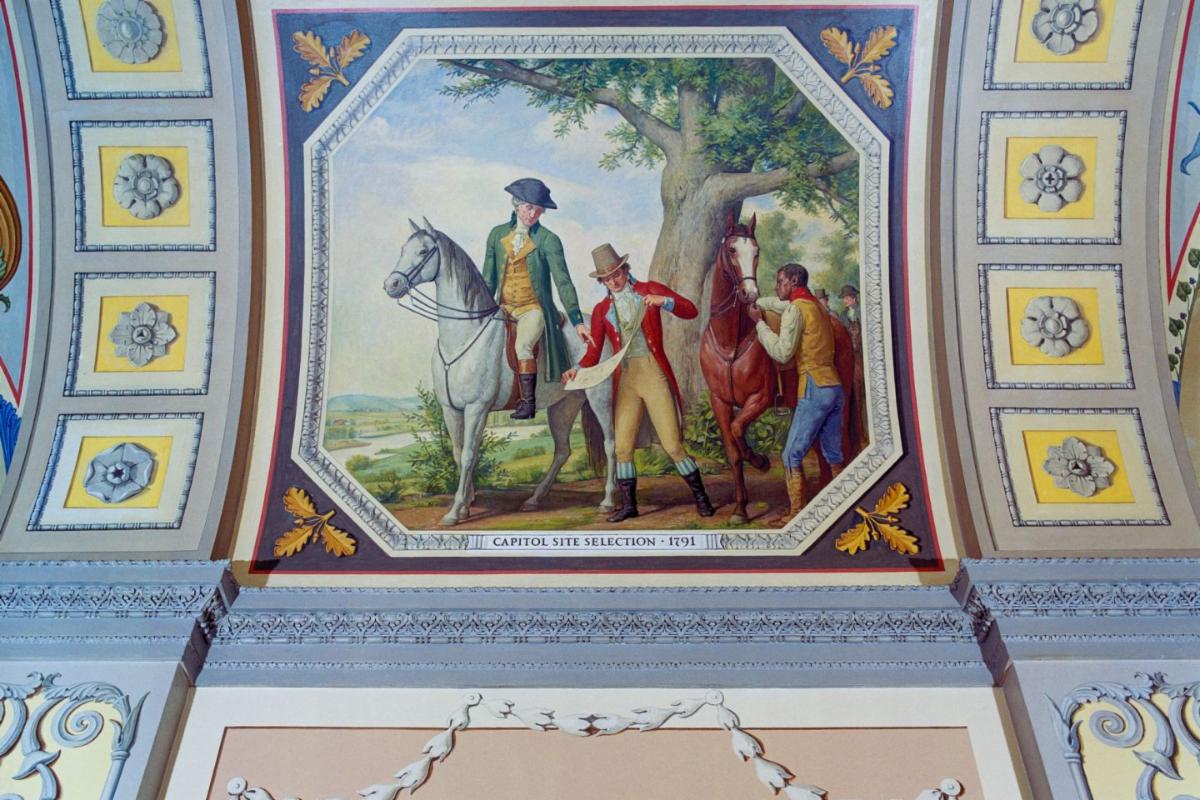
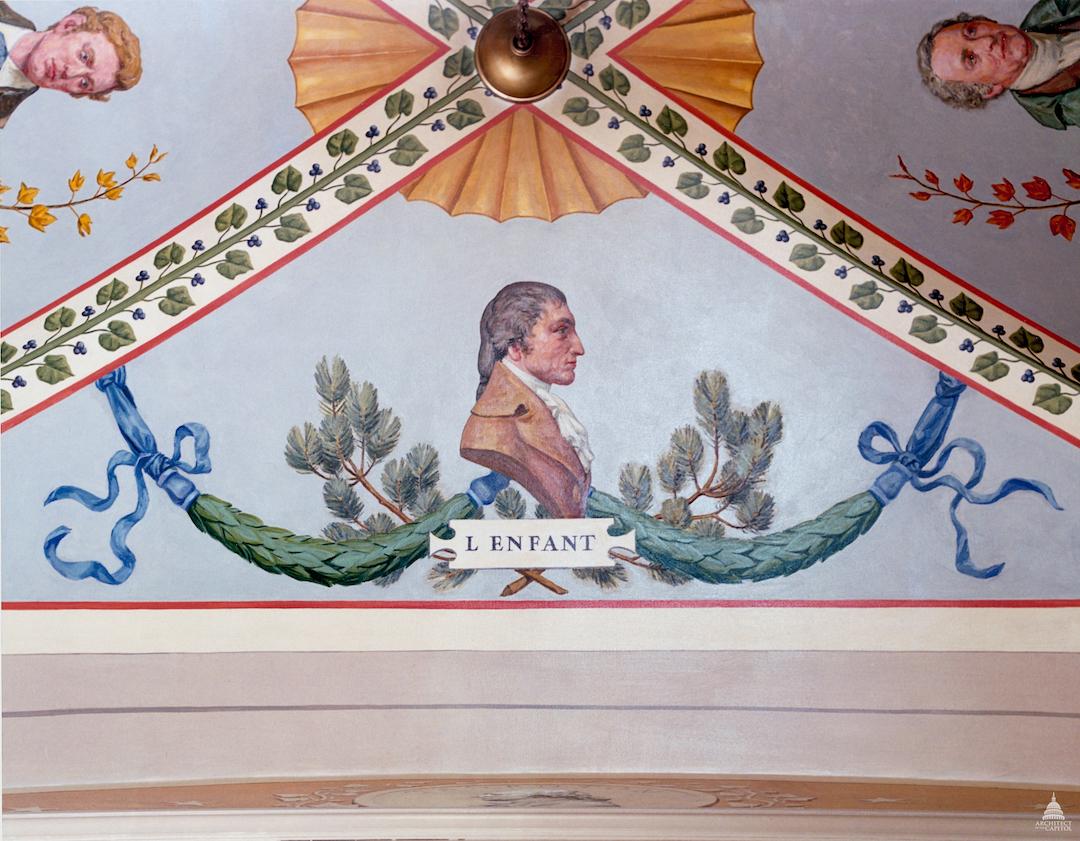
MURAL FRESCOE, CEILING OF U.S. CAPITOL |
|
Top: L'Enfant (center) Pierre Charles L'Enfant (center) shows his city plan to President Washington.
Bottom: “Pierre Charles L’Enfant,” Allyn Cox, oil on canvas applied to the ceiling of the U.S. Capitol, 1973–1974. (From the Architect of the Capitol, by Allyn Cox.
|
|
HISTORICAL MARKER, ARLINGTON NATIONAL CEMETERY |
|
Arlington National Cemetery, Arlington, VA
Photographed By Allen C. Browne, November 29, 2013
NOTE: THIS PLAQUE (inaugurated in 1995 in the presence of French Ambassador Jacques Andréani) IS CURRENTLY MISSING. Along with co-signer The Daughters of American Revolution, your association The American Society of Le Souvenir Français Inc, with the support of other patriotic organizations such as the Society of Honor Guard/Tomb of Unknown Soldier, Military Women Memorial, are in talks with the cemetery administration to replace it, at no cost to the Federal Government.
A DEDICATION CEREMONY is currently planned for Tuesday, June 14, 2022.
|
|
•Inscription:
• Revolutionary Soldier, 1775-1783
Pierre Charles L’Enfant
Engineer, Artist, Soldier
under the direction of George Washington,
designed the plan for the Federal City
Major US Engineer Corps 1782
Charter member of the Society of the Cincinnati,
designed its certificate & insignia
Born in Paris France, August 2, 1755
Died June 14, 1825, while residing at Chilham Castle Manor,
Prince George's Co., Maryland and was interred there
Re interred at Arlington April 28, 1909
L’Enfant designed a city responsive to the aspirations of a nation
which looked to the future.
He envisioned the Nation’s capital as a living and permanent symbol of
the United States.
Public contributions to his adopted country:
1787 · Designed insignia of Society of Cincinnati
1788 · Designed pavilion for celebration of the "Federal Procession" in New York City,
1789 · Remodelled New York City Hall into Federal Hall for use by the first Federal Congress
1791-92 · Designed the City of Washington
• Erected by National Society Daughters of the American Revolution and The American Society of Le Souvenir Francais.
|
|
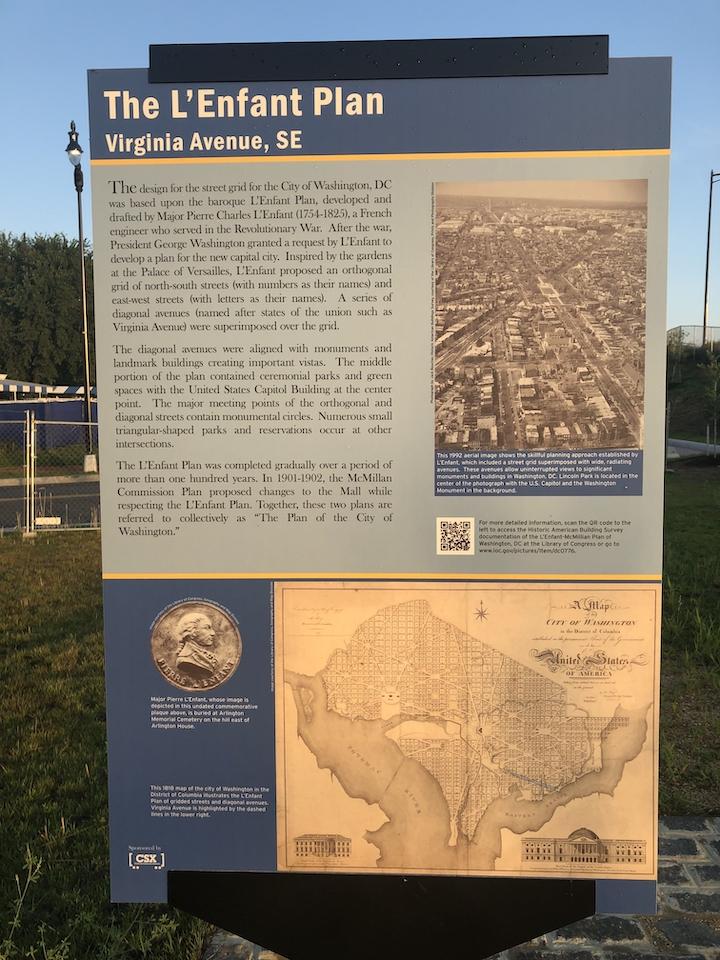
HISTORICAL MARKER, "THE L'ENFANT PLAN" |
|
1098 9th Street Southeast, Washington DC 20003
Photographed By Devry Becker Jones, July 12, 2019, hmdb.org
|
|
• Inscription:
“The design for the street grid for the City of Washington, DC was based upon the baroque L'Enfant Plan, developed and drafted by Major Pierre Charles L'Enfant (1754-1825), a French engineer who served in the Revolutionary War. After the war, President George Washington granted a request by L'Enfant to develop a plan for the new capital city. Inspired by the gardens at the Palace of Versailles, L'Enfant proposed an orthogonal grid of north-south streets (with numbers as their names) and east-west streets (with letters as their names). A series of diagonal avenues (named after states of the union such as Virginia Avenue) were superimposed over the grid."
"The diagonal avenues were aligned with monuments and landmark buildings creating important vistas. The middle portion of the plan contained ceremonial parks and green spaces with the United States. Capitol Building at the center point. The major meeting points of the orthogonal and diagonal streets contain monumental circles. Numerous small triangular-shaped parks and reservations occur at other intersections."
"The L'Enfant Plan was completed gradually over a period of more than one hundred years. In 1901-1902, the McMillan Commission Plan proposed changes to the Mall while respecting the L'Enfant Plan. Together these two plans are referred to collectively as "The Plan of the City of Washington.”
Erected by The CSX Corporation.”
|
|
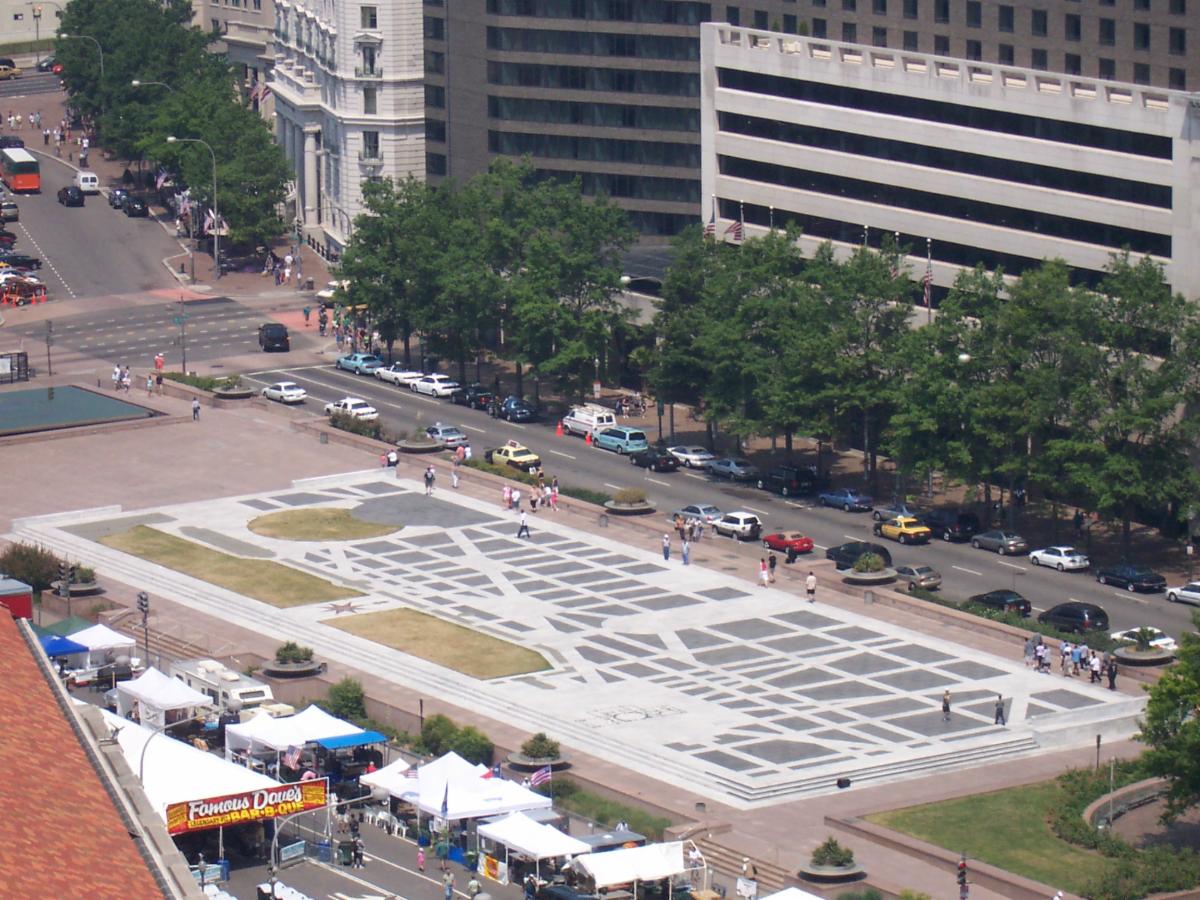
FREEDOM PLAZA AND L'ENFANT PLAZA, WASHINGTON D.C. |
|
CC BY 2.0, https://commons.wikimedia.org/w/index.php?curid=767524
|
|
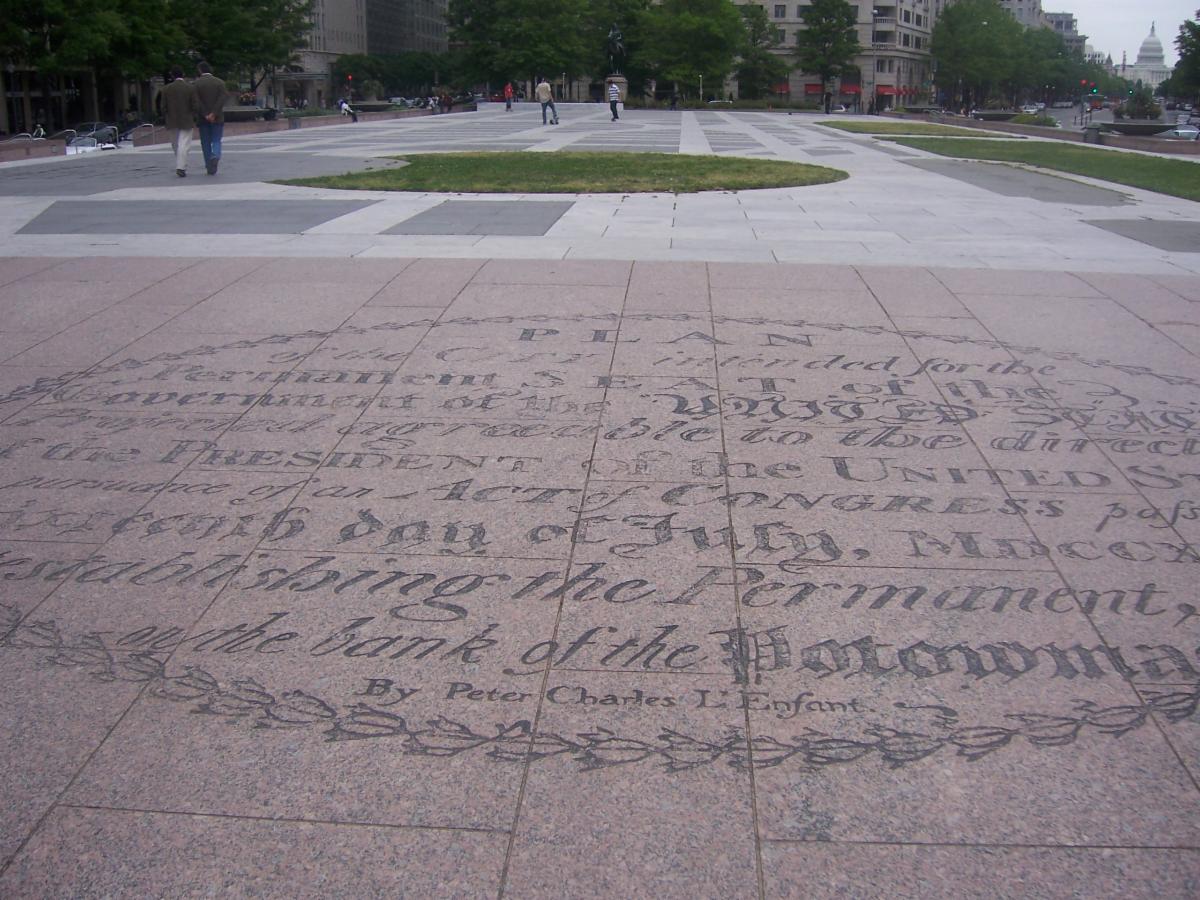
Oval containing the title of L'Enfant's "Plan of the city intended for the permanent seat of the government of the United States..." followed by the words "By Peter Charles L'Enfant" inlaid in Freedom Plaza. (2006)
Own work, Public Domain, https://commons.wikimedia.org/w/index.php?curid=767077
|
|
• L'Enfant Plaza, a complex of office buildings developed in the 1960's (with the 1972 headquarters of the United States Postal Service), with an adjacent L'Enfant Plaza Hotel, now the Hilton Washington DC National Mall The Wharf.
Beneath the L'Enfant Plaza is one of the central rapid transit busy Metro subway stops in Washington, D.C., the L'Enfant Plaza station.
• In 1980, Western Plaza (subsequently renamed to "Freedom Plaza") opened in downtown Washington, D.C., adjacent to Pennsylvania Avenue, N.W.
A raised marble inlay in the Plaza's surface depicts parts of L'Enfant's 1791 plan for the City of Washington. The inlay contains an oval bearing the title of the plan followed by the words "By Peter Charles L'Enfant".
• In 2003, L'Enfant's 1791 Plan for Washington was commemorated on a USPS commemorative postage stamp. The diamond shape of the stamp reflects the original 100 square miles (259 km2) tract of land selected for the District. Shown is a view along the National Mall, including the Capitol, the Washington Monument, and the Lincoln Memorial. Also portrayed are cherry blossoms around the "Tidal Basin" and row houses from the Shaw neighborhood.
John Cogbill, chairman of the National Capital Planning Commission which oversees development in the city, said the Commission strives to fulfill L'Enfant's original vision while meeting the demands of a growing region. "We take [L'Enfant's plan] into account for virtually everything we do," he says. "I think he would be pleasantly surprised if he could see the city today. I don't think any city in the world can say that the plan has been followed so carefully as it has been in Washington."
• Cities like Detroit link their architectural models to Pierre Charles L'Enfant.
Claims that L'Enfant surveyed and platted Perrysburg, Ohio on April 26, 1816 are disputed. As for Indianapolis, Indiana, its grid is clearly inspired by L'Enfant, drafted by L'Enfant's former assistant Alexander Ralston.
|
|
PAST MONTHLY BULLETINS
OUR GOAL: turn the spotlight on a famous, or less famous, episode or historical figure during the long shared history between France and the United States, with illustrations and anecdotes.
You can have access to all our past Monthly Bulletin
since February 2021 by visiting our website:
|
|
Our next Bulletin in May will pay homage to
THE FOUR AMERICANS
WHO WERE NAMED
"COMPAGNONS DE LA LIBÉRATION"
(OUT OF A TOTAL OF 1,038)
DURING WORLD WAR TWO
|
|
ANTOINE DE SAINT EXUPÉRY & LE PETIT PRINCE
New York visit of MM. Olivier d'Agay and Nicolas Delsalle-Mun
|
|
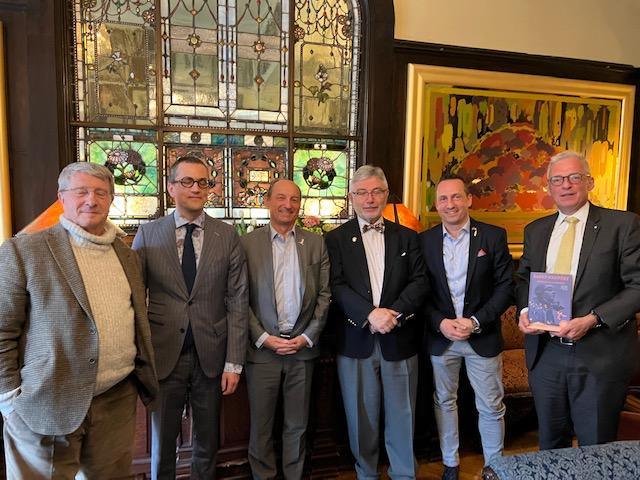
From left to right: Patrick du Tertre, Pierre Gervois, Olivier d'Agay, Francis Dubois, Nicolas Delsalle-Mun, Jean-Hugues Monier at the National Arts Club, NYC |
|
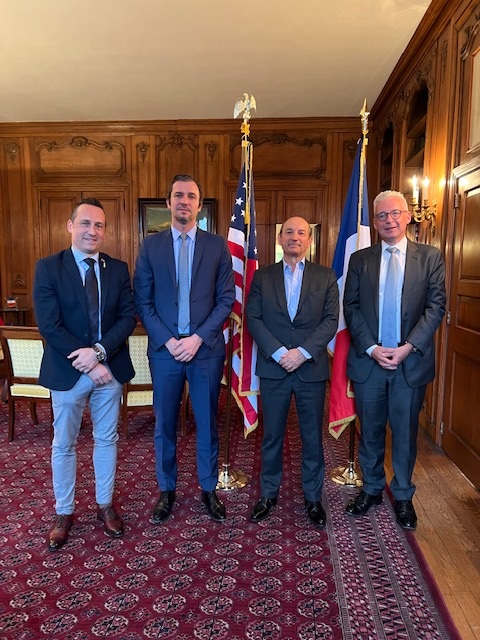
Our association was honored to meet with Mr. Olivier d'Agay, director of the Estate succession of Saint Exupéry d'Agay, and grand-nephew of Saint-Exupéry, author of The Little Prince (to whom we dedicated our Bulletin last month) and Mr. Nicolas Delsalle-Mun, General Director of the Fondation Saint-Exupéry pour la Jeunesse.
Thanks to our Director Francis Dubois, they met other members of our Executive Committee at the National Arts Club, along with Patrick du Tertre, 1st Vice-President of our association, Jean-Hugues Monier, Director and Statue Committee member, and Pierre Gervois, Director and French Air Force reserve Lieutenant. Another meeting was held with the Consul General of France Mr. Jérémie Robert at his office on 5th Avenue.
Our Association's project to erect a sculpture of Le Petit Prince in New York, possibly coupled with a statue of Antoine de Saint Exupéry, is now fully under way, with the blessing and support of the heirs of the immortal author, as well as French diplomatic authorities.
An Honor Committee will be announced shortly, as well as a fund-raising campaign, and the selection of a prestigious site in Manhattan. Stay tuned for more news on this major project, another testimony to the historical bonds uniting France and the United States.
|
|
From left to right: Mr. Nicolas Delsalle-Mun, Mr. Jérémie Robert, Consul General of France in New York, Mr. Olivier d'Agay, Jean-Hugues Monier.
|
|
Since the visit, and to complete last month's bulletin:
• Présentation of the Antoine de Saint Exupéry Youth Foundation
The Antoine de Saint Exupéry Youth Foundation strives to provide generous and sustainable support to local associations, all over the world, by supporting concrete projects for young people in education and environment with the help of its partners.
Reminder of current exhibits and shows :
• The Little Prince at the Broadway Theater, 53rd Street & Broadway
• Musée des Arts Décoratifs, Paris, February 17- June 26 2022
• Brussels Expo, Palais 2, Belgium until June 30, 2022
• Also at L'envol des Pionniers, Site de Légende, Toulouse, until November 6, 2022:
Permanent exhibits and theme parks:
• Musée de l’air et de l’espace, Le Bourget:
Special exhibit honoring Saint-Exupéry, and which displays many of his literary creations. Among them are various early editions of The Little Prince. Remnants of the Free French Air Force P-38 Lightning in which he disappeared, and which were recovered from the Mediterranean in 2004, are also on view.
• Pierpont-Morgan Library in NYC:
To view the original manuscript of "The Little Prince". It is currently on loan to the Musée des Arts Décoratifs in Paris.
• Parc du Petit Prince, Ungersheim (near Mulhouse) Alsace:
• We also would like to share this remarkable gem of a radio interview of Antoine de Saint Exupéry by Richard Thomas in the studios of Radio City at Rockefeller Center on August 3, 1939:
• We received valuable additional information regarding the years spent in New York by Antoine de Saint-Exupéry and his wife Consuelo, which we will share in an upcoming bulletin, in view of a future "Saint Exupéry Itinerary in New York". Stay tuned!
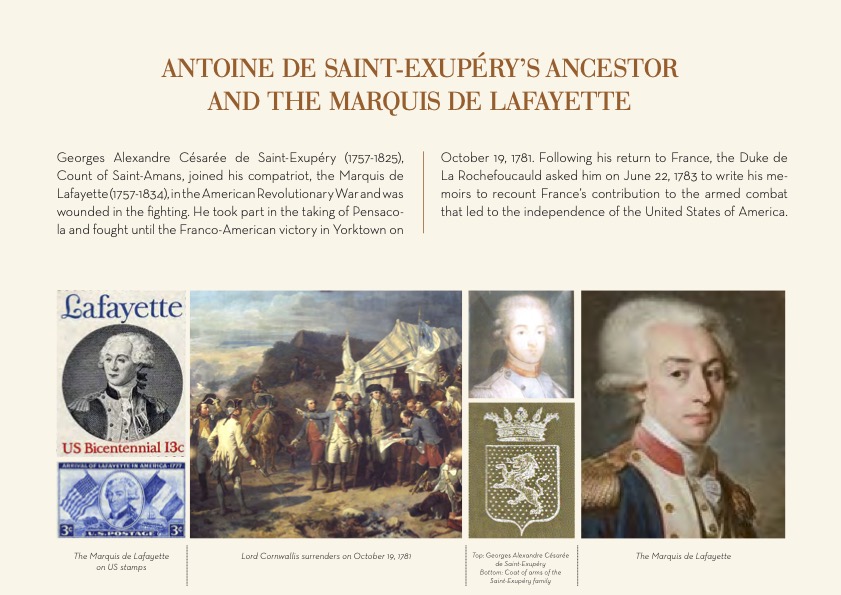
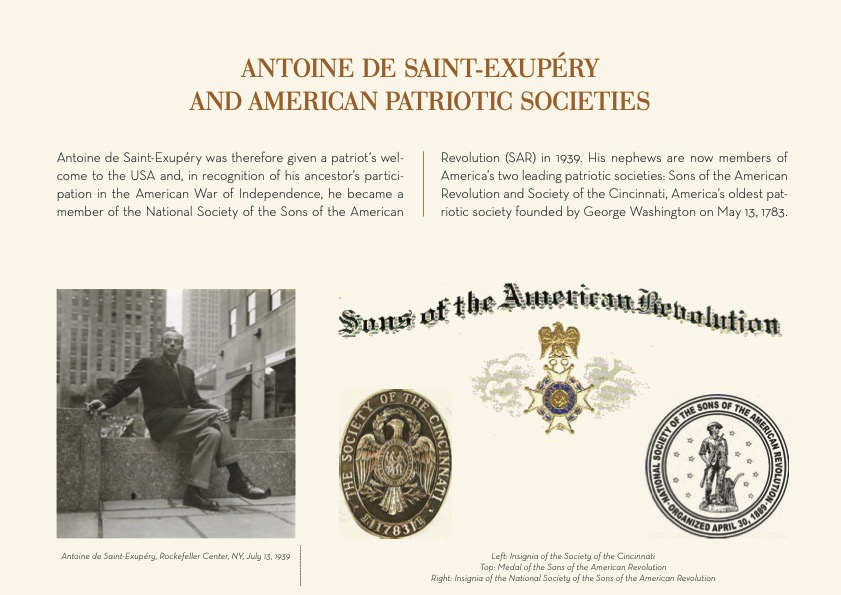
TO ADD TO LAST MONTH BULLETIN, MORE INFORMATION ON
ANTOINE DE SAINT EXUPÉRY'S ANCESTORS AND DESCENDANTS' UNIQUE BONDS WITH THE UNITED STATES:
|
|
ANNOUNCEMENTS - SAVE THE DATE - NYC |
|
SAVE THE DATE:
WREATH LAYING CEREMONY at NOTRE-DAME CHURCH
Friday May 6th, at 11:00AM
• On the occasion of a visit in New York by the President-General of Le Souvenir Français in Paris, the Contrôleur Général des Armées (2S) Serge Barcellini, a wreath-laying ceremony will be held at Notre-Dame Church, 405 West 114th Street in Manhattan on Friday, May 6th, at 11:00AM. All are welcome to join, in order to pay respect to our Fallen soldiers.
• We will be honored to welcome as well on that occasion Madame Nathalie de Gouberville, direct descendant of the Comte de Rochambeau, with her husband Philippe de Gouberville, who will be in New York to preside over the kick-off fund raising of the Friends of Odell House - Rochambeau Headquarters the day before.
• The Odell House in Hartsdale, about 20 miles north of Manhattan, served as Rochambeau's headquarters during the French Army encampment in Phillipsburg, from July 6 to August 19, 1781. Under the dynamic leadership of Susan and David Seal, it is currently being renovated to become a museum.
• Future Memorial at Odell House / Rochambeau Headquarters Museum:
Four French soldiers died and are buried on the property. The American Society of Le Souvenir Français pledged to erect a memorial, including a boulder, a bronze plaque and a bench in their memory, in the garden of the future museum. Stay tuned for more details!
|
|
NEW YORK SCREENING OF "THE GIRL WHO WORE FREEDOM"
Monday, May 16, 2022 at 7:00PM
French Institute Alliance Française, Florence Gould Hall
|
|
Dir. Christian Taylor, 2020, United States, 89 min, color
In English and French with English subtitles
• FIAF presents a special screening of the documentary The Girl Who Wore Freedom, a touching tribute to D-Day and the longstanding French-American friendship. Enjoy the chance to meet “The Girl Who Wore Freedom” in person!
The documentary unveils the untold stories of D-Day from the men, women, and children who lived through German occupation and Allied liberation of Normandy, France. Dany Patrix, Maurice Lecoueur, Henri-Jean Renaud, and others who lived through this turbulent time still speak of a love affair that bonds generations of Free French to the American liberators to this day. One little girl’s story exemplifies how the French saw – and still remember – the bravery and heroism of the American GIs. Her name is Dany Patrix, and she is the thread that weaves us throughout this story. Dany became The Girl Who Wore Freedom when her mother made her a red, white, and blue dress from parachutes, which she wore to honor Allied forces at the first D-Day commemoration.
• Followed by a Q&A with Christian Taylor, Dany Patrix and David Chapman, VP Government and Defense Michelin North America, former Defense Attaché to the U.S. Embassy in Paris.
• In anticipation of Delta Air Lines’ historic flight in partnership with Best Defense Foundation returning 30 WWII Veterans to Normandy for the 78th Anniversary of the landings in June 2022.
Ticket Information:
https://fiaf.org/event/2022-05-the-girl-who-wore-freedom/
FIAF Members: $15
Non-Members: $20
Students with ID: $15
FIAF Florence Gould Hall
55 East 59th Street,
New York, NY 10022
|
|
Presented in partnership with Delta Air Lines, Air France, KLM Royal Dutch Airlines, Credit Agricole, Michelin and Best Defense Foundation.
The American Society of Le Souvenir Français Inc. is pleased to help provide accommodations to Ms. Christian Taylor and Mme Dany Patrix Boucherie during their stay in New York.
|
|
ANNUAL CEREMONY TO HONOR ALLIED SOLDIERS
WHO DIED IN FLANDERS FIELDS
NEW YORK, JUNE 7, 2022
|
|
The Consulate General of Belgium, Delegation of Flanders to the USA, organizes the 13th annual In Flanders Fields Memorial, to honor the sacrifice of hundreds of thousands of Allied Soldiers who died in the "poppy fields", scene of the first chemical attacks in history. |
|
UPCOMING EVENTS ANNOUNCEMENTS
ELSEWHERE IN THE US
|
|
Butts Hill Fort Spring Cleanup: Call for Volunteers !
• The largest Revolutionary War earthwork still standing in southern New England is Butts Hill Fort. It was started by Patriot militia in 1776, then enlarged and completed by British troops occupying Rhode (Aquidneck) Island. It served as the headquarters for General John Sullivan during the Rhode Island Campaign in 1778 and was strengthened by allied French troops under General comte de Rochambeau 1780-81. It is on the National Register of Historic Places and on the National Park Service’s Washington-Rochambeau Revolutionary Route.
Lt Col. Louis de Tousard, another great French artillerist who volunteered under Lafayette and who served at the fort, lost an arm in an epic charge near Quaker Hill. He eventually became an important figure in the nascent US Army. We will surely devote a Bulletin to his many accomplishments in the future.
• The Fort has for years been inaccessible to the public and largely forgotten. The goal of the Restoration Committee is to return it to public use as an historical, educational, and recreational asset.
• Historic Butts Hill Fort needs a spring cleaning. Accordingly, the Battle of Rhode Island Association and the Butts Hill Fort Restoration Committee are asking for volunteers to participate in a spring cleanup. It is scheduled for 8 a.m. to 3 p.m. on Saturday 23 April. The rain date is Saturday, 30 April.
The purpose of this volunteer cleanup is to remove debris remaining from previous clearings and from storm damage.
• The BUTTS HILL FORT RESTORATION COMMITTEE is a committee of the BATTLE OF RHODE ISLAND ASSOCIATION.
The mission of the Committee is to restore and maintain the Revolutionary War fort in order to provide a safe and accessible educational and recreational site that raises public interest in this National Historic Landmark and its role in the Battle of Rhode Island. The Association is a registered 501(c)3 non-profit committed to raising awareness of Rhode Island’s role in the War for Independence. Donations may be made payable to “BoRIA” PO Box 626, Portsmouth, RI 02871.
For more information, contact:
Burton Quist, Director, Battle of Rhode Island Association
401-439-0187
|
|
Upcoming Marker Dedication
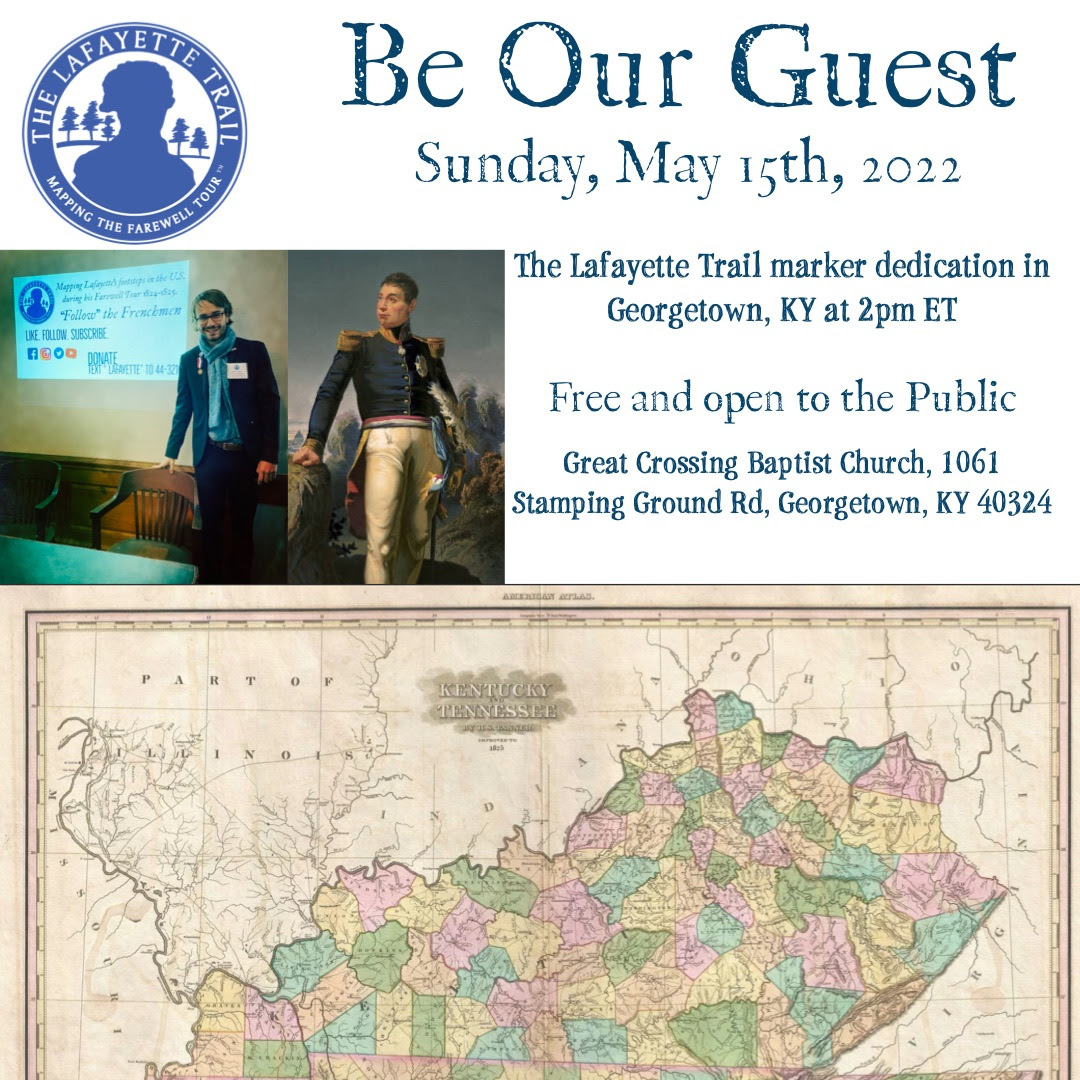
• The Lafayette Trail, Inc. is pleased to announce the upcoming dedication of a new historic marker in Georgetown, KY.
• The marker dedication ceremony will take place at the Great Crossing Baptist Church, located at 1061 Stamping Ground Road, in Georgetown, Kentucky 40324, on Sunday, May 15th, 2022 at 2 pm ET.
• There will be plenty of free parking available at the church for attendees.
|
|
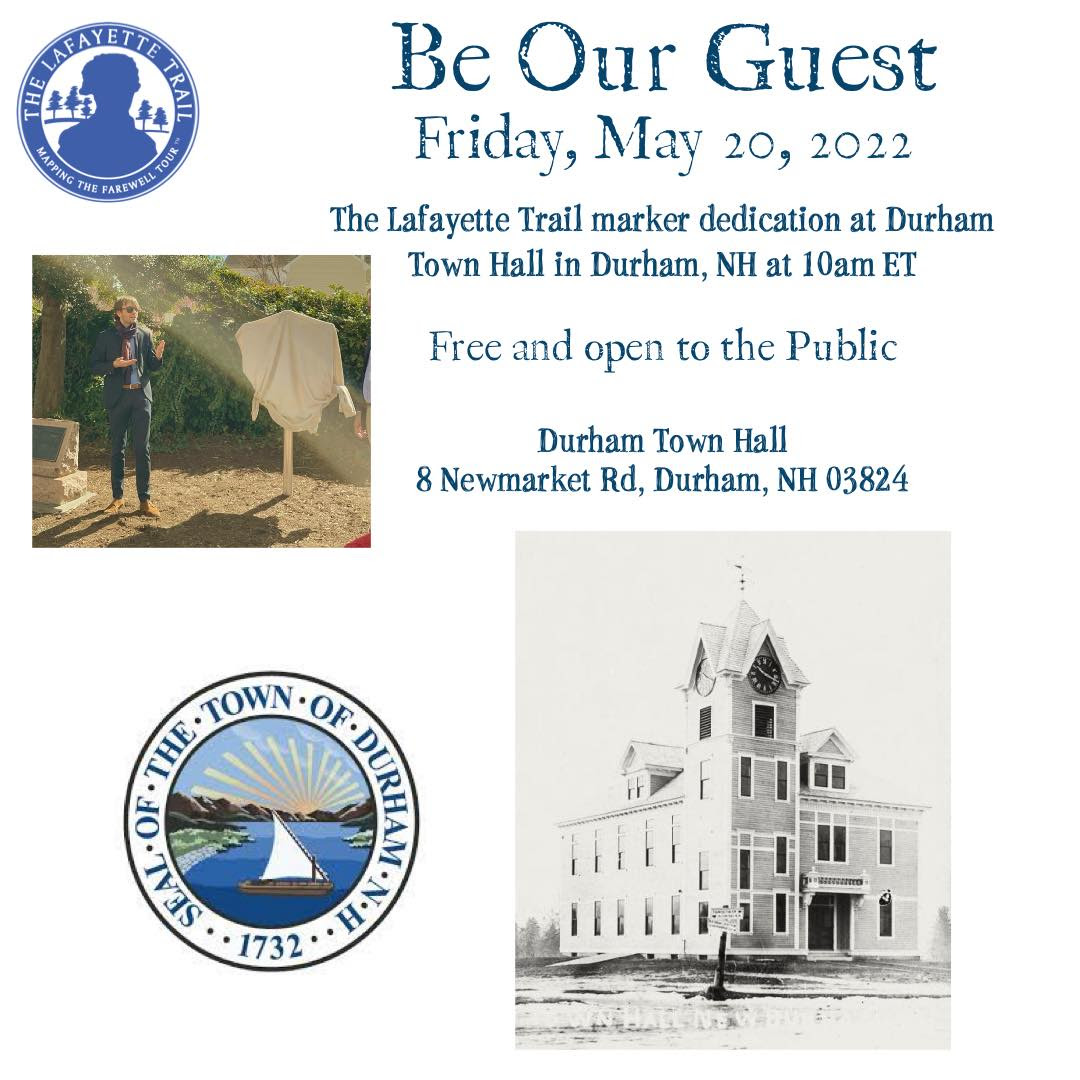
Upcoming Marker Dedication
• The Lafayette Trail, Inc. is pleased to announce the upcoming dedication of a new historic marker at the Durham Town Hall, in Durham, NH on May 20 at 10 am ET. The event will precede the 2 pm at the NH State House organized in observance of New Hampshire Lafayette Day. Durham is located a little over 45 minutes away from Concord by driving.
• The Durham marker dedication ceremony will take place on the site of the new Durham Town Hall, located at 8 Newmarket Road, Durham, NH 03824. Please, proceed to the town hall parking lot where limited parking will be available.
• 10 diagonal parking spaces will be available directly across the street at 15 Newmarket Road, located to the left of the white building. Additional parking will be available along Schoolhouse Lane and Mill Pond Road.
• No registration is required. If you have any questions, please email:
|
|
AMERICAN FRIENDS OF LAFAYETTE
ANNUAL CONVENTION
WEST POINT, JUNE 9-12
|
|
The annual meeting of The American Friends of Lafayette will convene on
June, 9th 2022 at West Point, New York.
Itinerary
Thursday, June 9th
- 7pm Welcome reception at the Thayer Hotel – refreshments, camaraderie & and very special guest speakers.
-
Friday, June 10thBreakfast at the Thayer Hotel
- Bus Tour of West Point Military Academy
- Three-hour Historical Tour with West Point Guides (on and off the bus).
- We will lay a wreath at the Tadeusz Kościuszko Memorial Statue.
- We will visit the Superintendent's Quarters (built in 1820 and visited by Lafayette).
- Inside the Superintendent's Quarters we will see the “Lafayette Clock” given to the Military Academy by Lafayette during his visit in 1824.
- Lunch at local restaurant
- Visit to the West Point Museum
- The West Point Museum is the United States’ oldest federal museum. Its origins can be traced to the American Revolution. Captured artillery pieces, small arms and accouterments brought to West Point became training aids for the fledgling Corps of Cadets and the Revolutionary War artillery park at Fort Clinton (West Point) was a tourist attraction despite the relative isolation of the area in the late 18th century.
- Tour of the The Frederic V. Malek West Point Visitors Center
- Videos on cadet life and West Point history.
- Exhibits include a full-scale cadet barracks room, a cadet uniform room, cadet daily life, academic fields of endeavor and the admissions process.
- The Annual Banquet of the American Friends of Lafayette
- Keynote speaker will focus on Adrienne Lafayette
Saturday, June 11th
- Breakfast at the Thayer Hotel
- Annual Business Meeting of the American Friends of Lafayette
- Lunch
- Bus Tour
- DeWint House – George Washington’s Headquarters on four different occasions.
- Major John André Monument - the Site of Major John Andre's Hanging and Burial.
- Visit to Odell House which was General Rochambeau's headquarters during the summer of 1781.
- Dinner at the Old ‘76 House
- The Old ’76 House was built in 1668 and served as the “prison” of the Revolution’s most notorious spy, Major John André.
- Robert Norden will discuss the specifics of John André and Benedict Arnold’s relationship.
Sunday, June 12th
- Optional Sailing trip on the Hudson River
- A separate email with more detail will be sent soon. This will be an optional event with a separate registration fee.
Registration INFO
Our official hotel is the Historic Thayer Hotel on the grounds of the United States Military Academy. This is truly a spectacular hotel on the banks of the Hudson River. The AFL has negotiated a VERY special rate of $219 per night (+ taxes and fees). To reserve your room, simply call 845-446-4731 and choose option 1 to reach the reservations team. Please reference the “American Friends of Lafayette Rate code”.
Deadline to make your reservation at the Historic Thayer Hotel:
May 9th. No rooms will be available after May 9th.
The registration fee for the annual meeting is $200 per person. This includes all meals (two breakfasts, two lunches and two dinners). This also includes all transportation (buses Friday and Saturday), tours, entrance fees, guides and speakers. Please see the full itinerary below.
REGISTRATION ENDS MAY 9th.
Since the Historic Thayer Hotel is on the grounds of the USMA, security is VERY tight. In order to get on the grounds of the USMA you must provide identification details BEFORE you arrive. Consequently, we ask you to complete the online registration.
GUEST SPEAKERS:
- LTC Seanegan Sculley (Military Academy Professor and Author) will discuss West Point during the Revolutionary War.
- AFL President Emeritus, Robert Crout will discuss the Lafayette’s relationship with West Point Cadets.
- AFL President, Alan Hoffman will discuss Lafayette’s antislavery lament
- Robb Norton (owner of the Old 76 House) will discuss the Revolutionary War in the Hudson Valley
- And finally, in the spirit of “The Year of Adrienne”, our keynote speaker for the annual banquet will be none other than Diane Windham Shaw. Diane will educate and entertain us on the life Adrienne Lafayette. Diane is the Curator for the American Friends of Lafayette and Director Emerita of Special Collections & College Archives at Lafayette College
|
|
SAVE THE DATE
Newport, Rhode Island
Rochambeau Celebration - July 9, 2022
Weekend "Tribute to France" - July 9-10
|
|
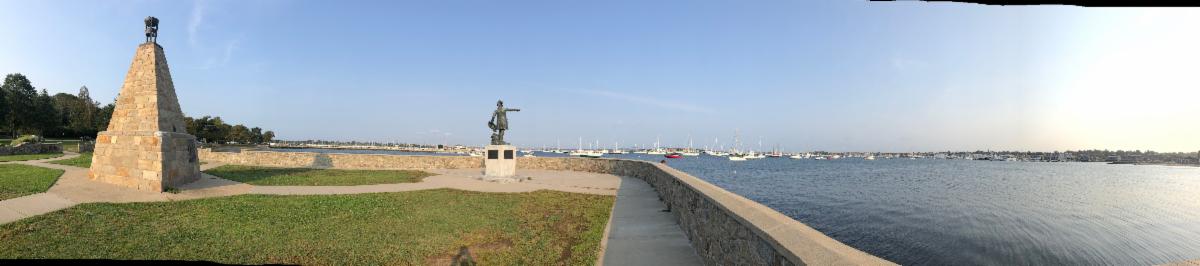
Monument to the French Fleet and Statue of Rochambeau,
Panoramic photo: Thierry Chaunu (2021)
|
|
OnSaturday, July 9, 2022 a ceremony will be held at the Statue of Rochambeau sponsored by Alliance Française of Newport, as part of a weekend of "Tribute to France", under the auspices of the Newport Historical Society, to celebrate the arrival of the French Army led by General comte de Rochambeau in 1780, coming to the rescue of the Continental Army.
Preliminary Schedule
-
Welcome remarks by Mr. Andrew Snook, President of the Alliance Française of Newport
- Reading of a Proclamation or Citation by RI Governor Daniel J. McKee or his representative
- Laying of wreath(s) at the Rochambeau statue/monument by the Deputy Consul General of France in Boston, Ms. Anouk Dumas or the Honorary Consul of France in Providence, former Lt. Governor of Rhode Island Mr. Roger Begin.
- Remarks by Jean-Baptiste Donatien de Vimeur, comte de Rochambeau (Newport Historical Society reenactor)
- Firing of cannon from ship(s) at anchor in Newport Harbor, including 91’ Schooner Tree of Life (flying the French fleur de lis flag).
More details to follow in our next Bulletins!
|
|
OUR MISSIONS:
• To preserve the memory of the French soldiers, sailors and airmen who gave their lives for freedom, and who are buried in the United States.
• To honor French Citizens who did great deeds in the United States, or with a strong connection with the United States,
• To promote the appreciation for French culture and heritage in the United States, and the ideals that unite our two nations, in order to pass the torch of memory to younger generations.
• To strengthen the long-standing traditional bonds of friendship between the American and French peoples, and to this end: erect or maintain memorials and monuments and encourage historical research, public presentations and publications in the media.
We are looking to expand our geographic coverage with Regional Delegates in cities such as Austin, or Houston (SouthWest), New Orleans (Louisiana), Savannah, Jacksonville or Miami (SouthEast), Boston or Newport (New England).
The American Society of Le Souvenir Français, Inc. is an independent American corporation, apolitical, established in 1993 in NY, with 501 (c) 3 non-profit status.
|
|
Did you know that a portion of every purchase you make on Amazon can benefit American Society of Le Souvenir Francais Inc, at no cost to you?
Simply go to: smile.amazon.com, designate American Society of Le Souvenir Francais Inc. as your beneficiary, and shop away
|
|
Help us implement several historic commemorative projects celebrating the 244-year-old Franco-American friendship and alliance! |
|
The American Society of Le Souvenir Français, Inc. is a registered NY State non-profit corporation and has full IRS tax exempt 501(c)3 status. All donations are tax deductible.
Contact: Thierry Chaunu, President
697 Third Avenue #341 New York, NY 10017
|
|
|
|
|
|
|