October 14, 2026 | Volume 6 | Issue 12 | As of Epidemiological Week 39 | | Welcome to the Florida Disease Activity Update from
the desk of Dr. Jonathan Day. | | |
It continues to be Clarke’s privilege to share Dr. Day's weekly analysis of arbovirus disease activity in Florida with mosquito control professionals and public health professionals across the state. Our shared goal with Dr. Day is to provide timely and actionable information that mosquito control and public health programs can use to make operational decisions and protect the public from vector-borne diseases.
An archive of all past newsletter issues remains available on the Clarke website.
| | |
Q. Steve from Palm Beach, Florida asks: “It seems to me based on we've seen so far this year in Hillsborough County that we should focus all our efforts on Aedes aegypti control when it comes to dengue transmission in Florida. I brought this point up to a colleague a few years ago who responded with, "well then how does dengue transmit in locations in Asia where Aedes aegypti isn’t found?” It was a nice thought-provoking response, and I thought you may have some insight on the topic.
A. Dengue transmission in the absence of Aedes aegypti in some parts of the world, especially Asia, has always been an intriguing question. There is little question that throughout most of the world Ae. aegypti is the primary urban vector of DENV. However, there are places that have dengue with no appreciative Ae. aegypti populations. There are also places that have recorded significant dengue epidemics, where there should not have been an epidemic. I am thinking specifically of Philadelphia, PA in 1780 where there were hot summers and, in 1780, a constant flow of infected Ae. aegypti mosquitoes and dengue-infected travelers coming to port in sailing ships.
The issue with DENV is that there is at least one other competent secondary vector, Aedes albopictus, that serves as the primary sylvatic dengue vector. Both Ae. aegypti and Ae. albopictus are currently on the move and projected to become major problems in a variety of habitats where they are currently rarely reported (see Laporta et al. 2023 in the Suggested Readings below). Even when Ae. aegypti are rare in dengue endemic locations, Ae. albopictus may be there to pick up the slack.
There is little question that, to date, Ae. aegypti is the primary dengue vector in Florida and that major control efforts should be directed against this important vector species. It would be most interesting to know how many Ae. albopictus pools have been analyzed so far this year in Florida. We know that there have not been any positive pools and I hope that this species is being considered as a possible secondary dengue vector.
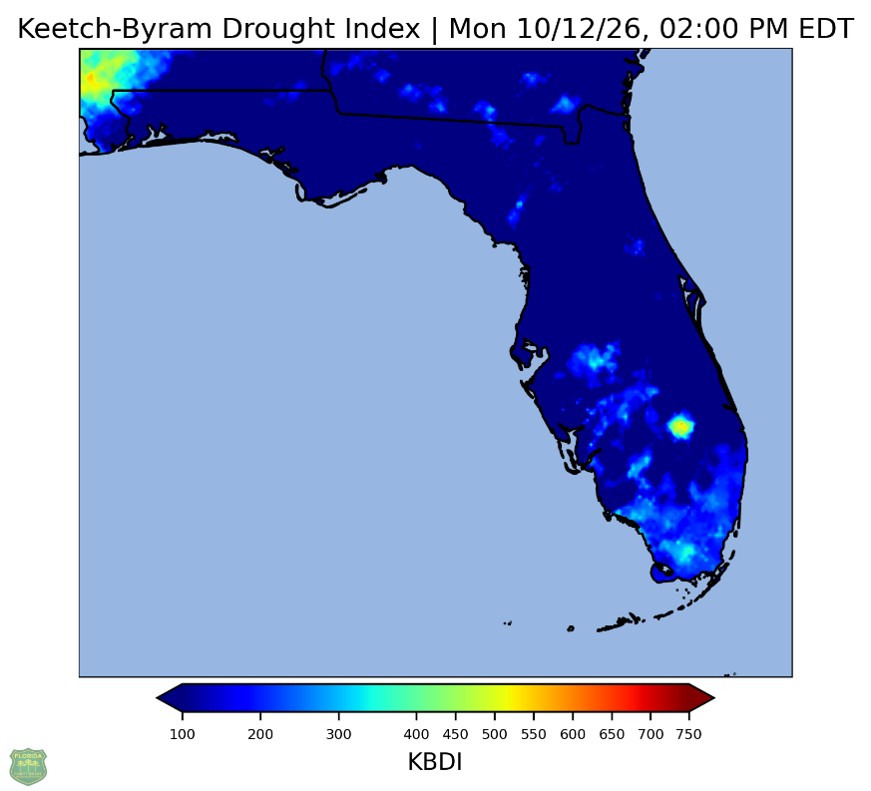
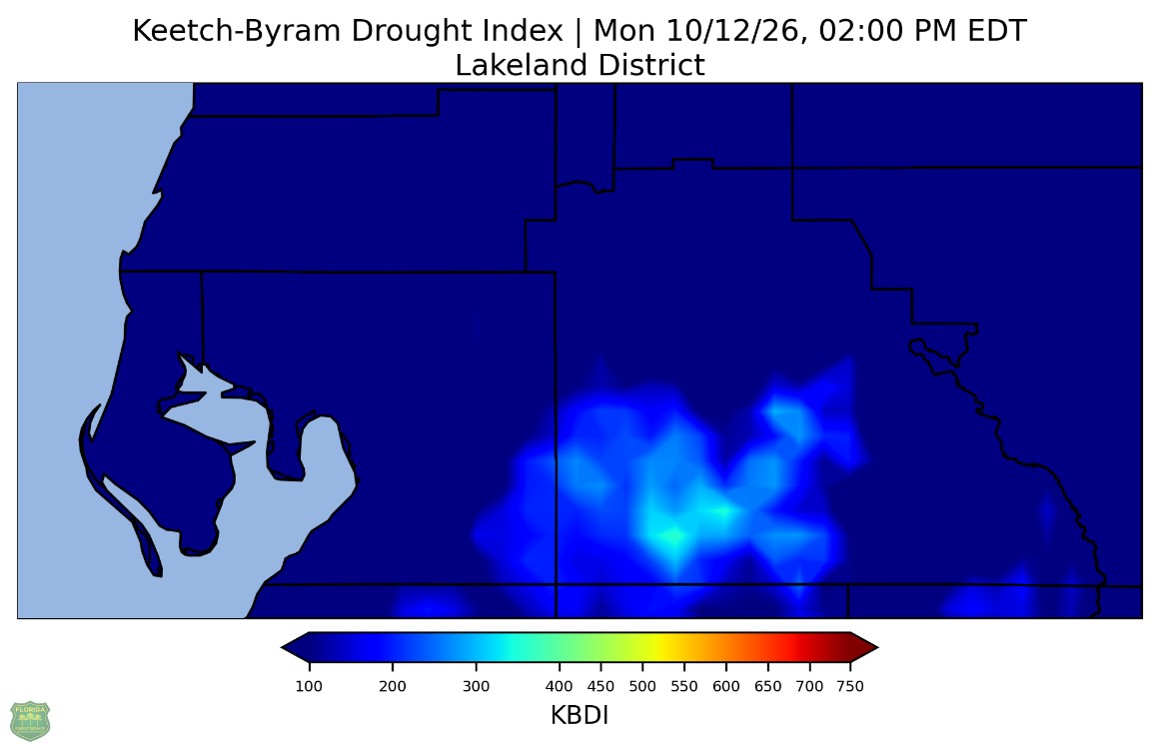
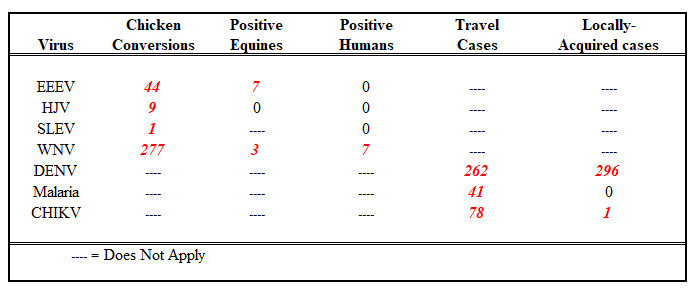
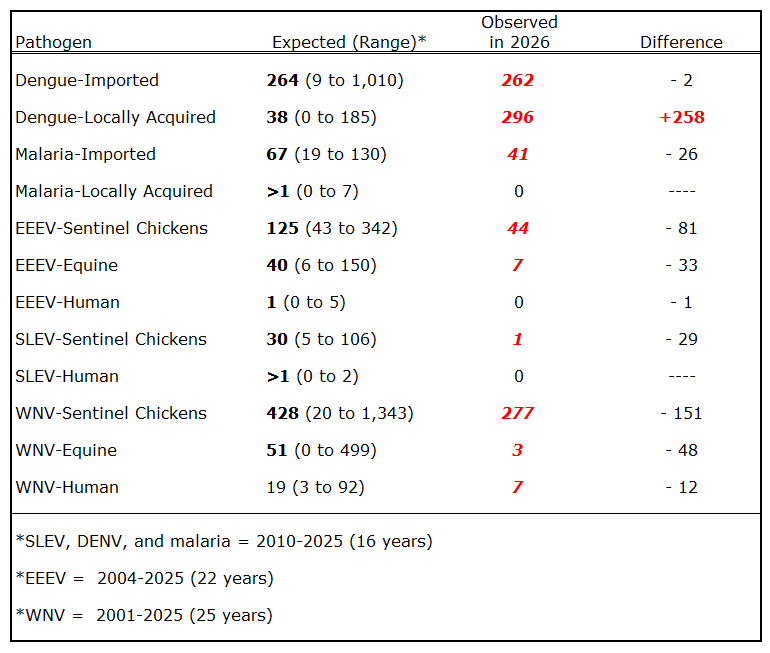
| | The dengue epidemic in the Tampa Bay area of Florida continues to roll on with no end in sight. This event may mark a new reality for Florida with annual dengue outbreaks on the horizon, The current ground water conditions are certainly not helping (Figure 1). The ground is saturated in the Tampa Bay area where dengue continues to be transmitted (Figure 2). The groundwater conditions favor continued dengue transmission in two ways. First, these wet conditions favor the continued reproduction, including blood feeding with multiple host contacts, and oviposition of vector mosquitoes, especially Aedes aegypti (but don’t forget Culex nigripalpus and Cx. quinquefasciatus). Second, the saturated ground allows infected vector mosquitoes to disperse further than they would under dry conditions. | | Figure 1. The Florida Keetch-Byram Drought Index for 10/12/26. | | Figure 2. The 10/12/26 Keetch-Byram Drought Index for the Lakeland District of Florida where there is currently a widespread outbreak of locally acquired dengue | | The table below summarizes the status of vector-borne disease transmission and pathogen introductions in Florida as of 10/3/26. | | |
Dengue Virus
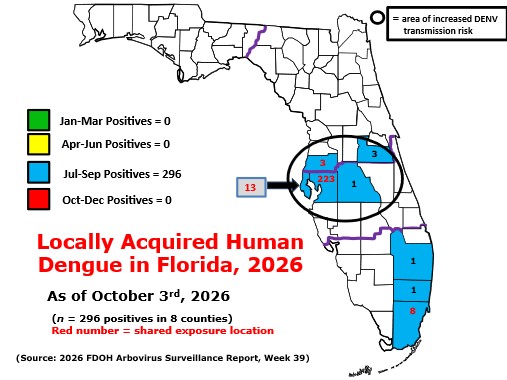
Forty-four new cases of locally acquired dengue were reported last week: 36 in Hillsborough County, seven in Pinellas County, and one in Broward County. The statewide total of locally acquired dengue now stands at 296 cases (Figure 3).
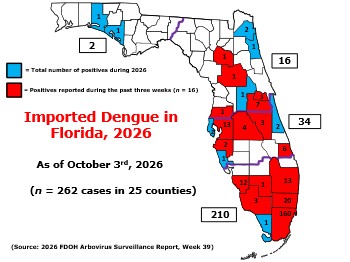
| | Figure 3. The spatial and temporal distributions of locally acquired dengue cases in Florida as of 10/3/26. | Figure 4. The spatial distribution of the 262 imported dengue cases reported in Florida as of 10/3/26. Counties shaded red indicate areas where new travel cases have been reported in the past three weeks and represent regions at increased risk of local dengue transmission in the coming weeks. | Seventeen new travel-associated dengue cases were reported last week in Florida (Figure 4) bringing the 2026 total to 262 (Table 2). New cases were reported in 16 Florida counties, placing many more areas at risk for future locally acquired dengue transmission. | | |
Eastern Equine Encephalitis Virus
One EEEV antibody-positive sentinel chicken was reported last week in Orange County, bringing the Florida 2026 total to 44 positive sentinels.
| | |
Malaria
Three new travel associated human malaria cases were reported last week in Broward, Hillsborough, and Pinellas Counties bringing the 2026 total to 41. Thirty-five of the cases have been Plasmodium falciparum, two P. ovale, and four P. vivax.
| | |
St. Louis Encephalitis Virus
No additional indicators of SLEV transmission were reported last week.
| | |
West Nile Virus
One new human case of West Nile virus was reported last week in Holmes County. This was a neuroinvasive case, and the individual was infected with WNV in mid-August.
One new WNV-positive equine was reported last week in Okeechobee County. The horse was infected with WNV in mid-September.
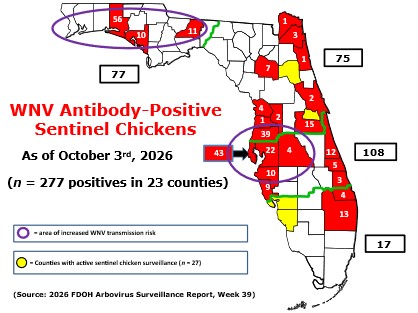
Forty-two new WNV antibody-positive sentinel chickens were reported last week in a wide variety of Florida counties, bringing the 2026 Florida total to 277 positive sentinels (Figure 5).
| | Figure 5. The spatial distribution of 277 WNV antibody-positive sentinel chickens in Florida as of 10/3/26. | | |
Chikungunya Virus
Two new travel-associated cases of CHIKV were reported last week in Miami-Dade County, bringing the 2026 total to 78.
| | A summary of the observed and expected number of imported and local mosquito-borne viruses and diseases in Florida as of 10/3/26 appears in the table below. | | |
It is evident from Figure 3 that the central Florida peninsula, along with South Florida, is primed for local dengue transmission. This may come into play during future arboviral transmission seasons when all of Florida south of Gainesville has the potential to host outbreaks of locally acquired dengue. As the climate continues to warm, significant populations of Aedes aegypti will expand into habitats now occupied by Ae. albopictus (see the Suggested Readings below).
The long-term forecast is for a warm and wet winter that will continue to favor Ae. aegypti populations. It is possible that local dengue transmission will continue well into the winter of 2026/2027 in southern Florida.
One positive note is that travel-associated dengue cases appear to be on the decline but stay tuned for next week’s report.
Even though we are well beyond the risk of a widespread outbreak of eastern equine encephalitis virus during the current Florida arboviral transmission season, the positive sentinel chicken reported last week in Orange County indicates that infected mosquitoes continue to be on the wing. As with dengue, the warm, wet winter forecast will extend the risk of EEE transmission, especially in North and Central Florida.
As with dengue and EEEV, the continued transmission of WNV, as indicated by positive humans, equines, and sentinel chickens, indicates that large numbers of infected mosquitoes continue to be active throughout the state.
| | |
The focus of this week’s A Question From Our Readers is the vectors responsible for dengue transmission around the world. A fascinating report by Laporta et al. (2023) tries to understand the environmental drivers that will determine the future distributions of the two major dengue vectors, Aedes aegypti and Ae. albopictus.
The author’s Simple Summary reads: “Aedes aegypti and Aedes albopictus mosquitos pose threats of arboviral disease emergence to humans in future climates. Unique mosquito georeferenced data from VectorMap and comprehensive environmental data from WorldClim v. 2.1 were herein used to analyze a global scenario of climate change under a socioeconomic pathway of regional rivalry. Results showed that this shared socioeconomic pathway is likely to affect vector-borne diseases. Climate changes on both vector species distributions will surely have major impacts on public health decision making.” The outlook is not positive and future populations of Ae. aegypti will be found in abundance in habitats where they are currently absent or periodic visitors.
As apparent confirmation of the above forecast, a paper by Peng et al. 2026 confirms the confusing dynamics of Ae. aegypti and Ae. albopictus populations in China by documenting the characteristics, including vector populations, of dengue outbreaks in China between 2005 and 2023.
The authors report that “the combined effects of global climate shifts and the adaptive evolution of mosquitoes have rendered certain tropical regions inhospitable for Aedes survival due to extreme temperatures. At the same time, Aedes albopictus has successfully established populations across a wider range of altitudinal gradients. In warmer regions, these populations no longer require hibernation, while those in temperate areas can endure cold winters by entering a state of dormancy. Furthermore, urban microenvironments offer warmer conditions than natural habitats, enhancing the survival prospects of Ae. aegypti mosquitoes that have adapted to urban settings.” In short, both mosquito species are adapting to become better dengue vectors in China and likely around the world.
Suggested Readings
Laporta GZ, AM Potter, JFA Oliveira, BP Bourk, DB Pecor and Y-M Linton. 2023. Global distribution of Aedes aegypti and Aedes albopictus in a climate change scenario of regional rivalry. Insects 2023, 14, 49. https://doi.org/10.3390/insects14010049
Peng K, Huang X, Huang P, Zhao H, Pan X, Xu N, Yin H, Yang Y, Han C, Gong M, and Liu H. 2026. Dengue outbreaks in China during 2005-2023: A systematic analysis. Front. Cell. Infect. Microbiol. 16:1920586.
https://doi.org/10.3389/fcimb.2026.1920586
| | |
Additional Resources
FMCA Dengue Virtual Briefing: Watch the discussion with mosquito control and public health experts on dengue activity and response efforts in Florida.
Watch Here
Disease Activity Archive: Catch up on previous Florida Disease Activity Updates and follow how mosquito-borne disease activity has changed throughout the season.
View Past Issues
Dengue Resources: Clarke’s Dengue PR Kit provides ready-to-use resources to help mosquito control programs communicate with their communities about dengue and prevention.
| | | | Jonathan Day, Professor Emeritus of Medical Entomology at the University of Florida and stationed at the Florida Medical Entomology Laboratory in Vero Beach is a national expert on mosquitoes and other blood-feeding arthropods that transmit diseases to humans, domestic animals, and wildlife. In collaboration with other researchers, Dr. Day has developed an effective system for monitoring and predicting epidemics of mosquito-borne diseases. | | |
Acknowledgments: This analysis would not be possible without the tireless efforts of multiple agencies across Florida. At least 27 Florida agencies collect serum samples from sentinel chickens each week and mail them to the Florida Department of Health Tampa Branch Laboratory for analysis, compilation, and reporting. Data are summarized by researchers at the Florida Department of Health in Tallahassee and reported weekly as the Florida Arbovirus Surveillance Report.
Contributors to this summary and full report include: Andrea Morrison, PhD, MSPH, Rebecca Zimler, PhD, MPH, and Olga Ospina, MPH, Florida Department of Health, Bureau of Epidemiology; Lea Heberlein, DrPH, Peter Dumoulin, PhD, MS, Maribel Castaneda, and Amanda Davis, MT (AAB) MB (ASCP), and Brittany Rowlette, BS, Florida Department of Health Bureau of Public Health Laboratories, and Dr. Joe Fisch, Florida Department of Agriculture and Consumer Services, Division of Animal Industry, Tallahassee, FL.
Daily updates of the Keetch-Byram Drought Index (KBDI) are produced by the Florida Department of Agriculture and Consumer Services, Forest Service.
The U.S. Drought Monitor is jointly produced by the National Drought Mitigation Center at the University of Nebraska-Lincoln, the United States Department of Agriculture, and the National Oceanic and Atmospheric Administration. Map courtesy of NDMC.
The Newsletter is edited and distributed by Jordan Brown.
| | |
Clarke has been helping make communities more livable, safe and comfortable since 1946.
Learn more about our work in protecting public health on clarke.com.
| | | | |