November 11, 2026 | Volume 6 | Issue 16 | As of Epidemiological Week 43 | | Welcome to the Florida Disease Activity Update from
the desk of Dr. Jonathan Day. | | |
It continues to be Clarke’s privilege to share Dr. Day's weekly analysis of arbovirus disease activity in Florida with mosquito control professionals and public health professionals across the state. Our shared goal with Dr. Day is to provide timely and actionable information that mosquito control and public health programs can use to make operational decisions and protect the public from vector-borne diseases.
An archive of all past newsletter issues remains available on the Clarke website.
| | |
Q. Sean from Daytona Beach, Florida asks: “Besides being a highly domestic mosquito species, are there any other characteristics that make Aedes aegypti an excellent disease vector?”
A. Yes. The common name of Aedes aegypti is “The Yellow Fever Mosquito.” This mosquito species is an exceptional vector of yellow fever, dengue, Zika, chikungunya, and diseases yet to be discovered. As discussed in the last issue of the Newsletter, this is due in part to the fact that this mosquito is highly domestic, living alongside us in our homes, schools, recreational areas, and workplaces.
Living alongside us in our homes and other structures Ae. aegypti encounters an unusual problem. Most mosquito species acquire flight and maintenance energy from sugar in the form of nectar, honeydew, extrafloral nectaries, and fallen fruit. Blood is used by most mosquito species for the formation of eggs. Sources of sugar are rarely found inside buildings while blood sources are abundant at these sites. To remedy the sugar problem, Ae. aegypti has evolved an ability to partition blood meals for maintenance and egg development (see the Suggested Readings below).
Relying on blood for both egg development and nutritional reserves (flight energy and overall maintenance) the Ae. aegypti females living alongside us require many more blood meals than do mosquitoes living in habitats where sugar is abundant. These multiple blood meals translate to many more host contacts and opportunities to either acquire dengue virus or transmit the virus once mosquitoes are infected.
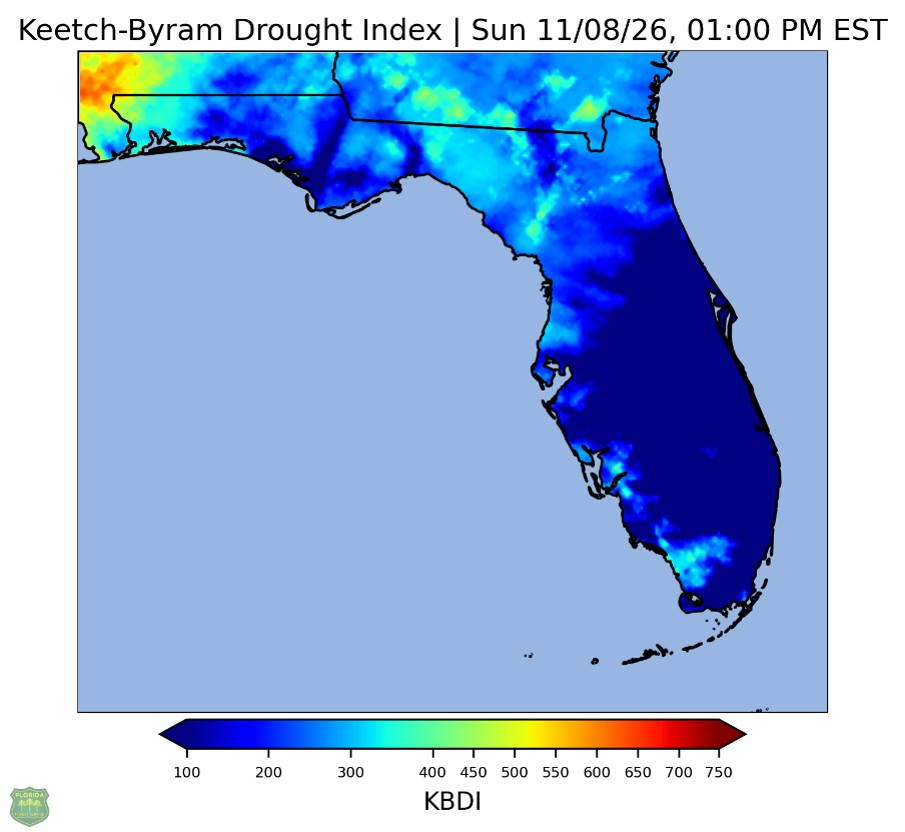
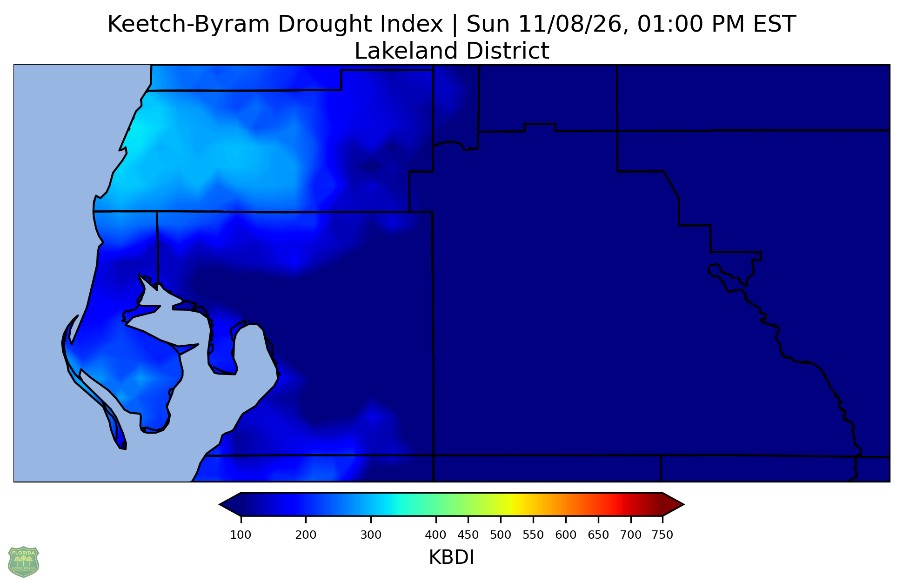
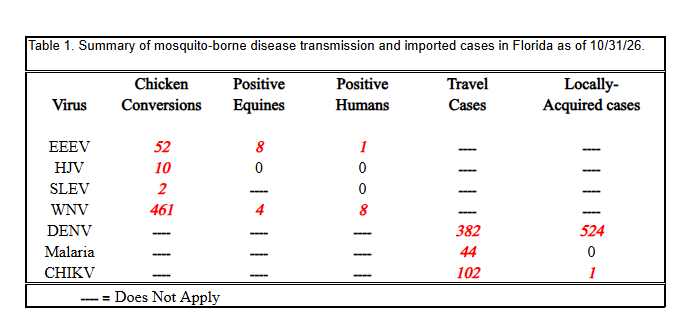
| | The warm and moist Florida autumn continues. Wet conditions persist almost everywhere in Florida (Figure 1) and especially in the Tampa Bay area (Figure 2). These conditions will continue to favor the reproduction and dispersal of the primary dengue vector, Aedes aegypti. | | Figure 1. The Florida Keetch-Byram Drought Index for 11/8/26. | | Figure 2. The 11/8/26 Keetch-Byram Drought Index for the Lakeland District of Florida (Tampa Bay region) where there is currently a widespread epidemic of locally acquired dengue. | | Table 1 below summarizes the status of vector-borne disease transmission and pathogen introductions in Florida as of 10/31/26. | | |
Dengue Viruses
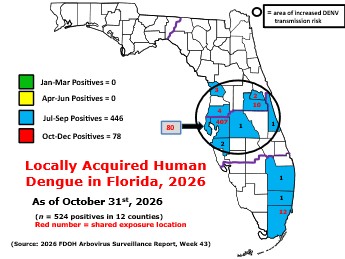
Thirty-nine new cases of locally acquired dengue were reported last week in four Florida Counties (Hillsborough, Pinellas, Miami-Dade, and Orange). The statewide total of locally acquired dengue now stands at 524 cases (Figure 3).
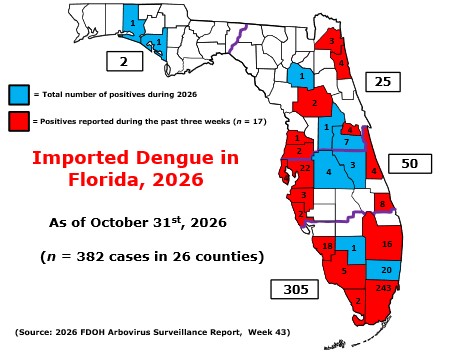
| | Figure 3. The spatial and temporal distributions of 524 locally acquired dengue cases in Florida as of 10/31/26. | Twenty-seven new travel associated dengue cases were reported in six Florida Counties last week (Figure 4), bringing the 2026 total to 382 (Table 2). Eighteen new cases were reported last week in Miami-Dade County. | | Figure 4. Spatial distribution of the 382 imported dengue cases reported in Florida as of 10/31/26. Counties shaded red indicate areas where new travel cases have been reported in the past three weeks and represent regions at increased risk of local dengue transmission in the coming weeks. | | |
Eastern Equine Encephalitis Virus
One new EEE-positive equine case was reported in Columbia County, bringing the Florida total to eight. The Columbia County equine was infected in early October.
Two new EEEV antibody-positive sentinel chickens were reported in Leon and Walton Counties last week, bringing the 2026 Florida total to 52 positive sentinel chickens.
| | |
Malaria
One new travel associated human malaria case was reported last week in Orange County, bringing the Florida total to 44 for 2026.
| | |
St. Louis Encephalitis Virus
No additional indicators of SLEV transmission were reported in Florida last week.
| | |
West Nile Virus
One new WN-positive equine was reported last week in Columbia County with infection in early October. This is the same horse that was positive for EEEV described above.
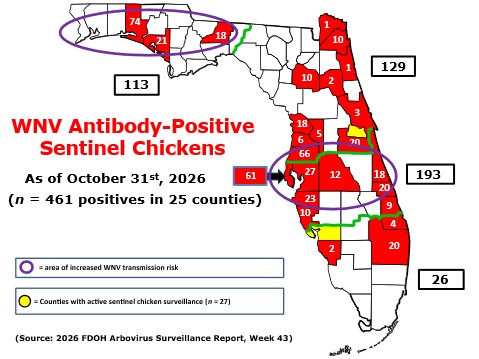
Sixty new WNV antibody-positive sentinel chickens were reported last week in 16 Florida counties, bringing the 2026 Florida total to 461 positive sentinels (Figure 5).
| | Figure 5. The spatial distribution of 461 WNV antibody-positive sentinel chickens in Florida as of 10/31/26. | | |
Chikungunya Virus
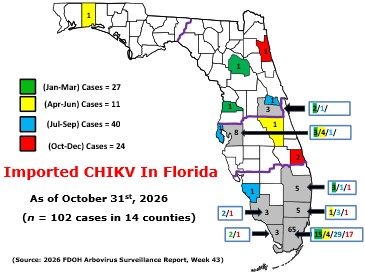
Eight new travel associated cases of CHIKV were reported last week in Miami-Dade (six new cases), Monroe, and St. Lucie Counties, bringing the Florida 2026 total to 102 (Figure 6).
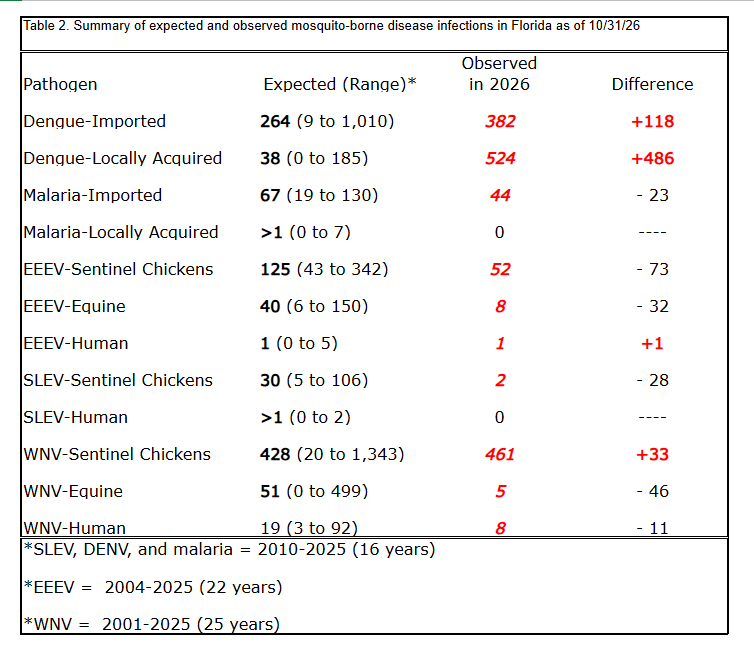
| | Figure 6. The spatial and temporal distributions of 102 travel associated CHIKV cases in Florida as of 10/31/26. | A summary of the observed and expected number of imported and local mosquito-borne viruses and diseases in Florida as of 10/31/26 appears in Table 2 below. | | |
Locally acquired dengue infections continue to be reported in Central Florida (Tables 1 and 2). As of Epidemiological Week 43 (October 25- 31), 524 locally acquired human dengue cases were reported in 12 Central Florida Counties (Figure 3). This epidemic has been fueled by two factors: 1. A steady stream of travel associated dengue cases into Central Florida (Figure 4) and 2. Environmental conditions that have favored the reproduction and dispersal of the primary dengue vector, Aedes aegypti. (Figures 1 and 2).
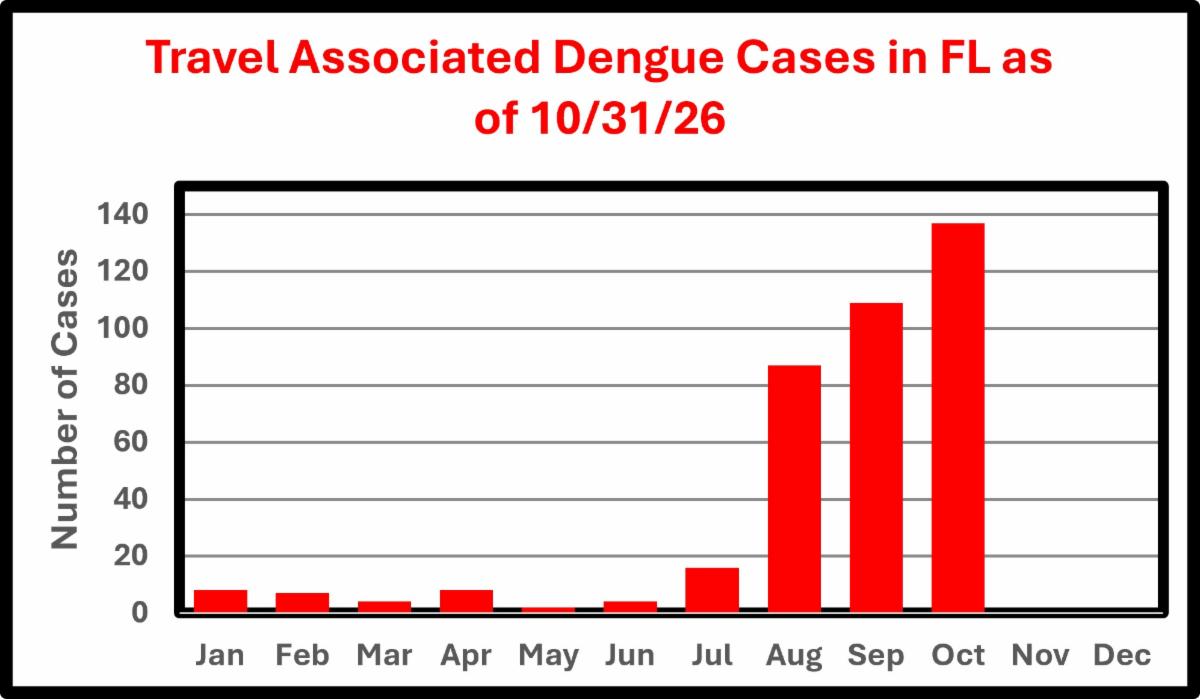
The introduction of dengue virus in infected travelers continues unabated (Figure 7). The majority (298 (78%)) of these have been the DEN-2 serotype. Most of the cases (323 (84%)) traveled from Cuba. Travel associated dengue cases entering Florida show no sign of slowing.
| | Figure 7. The temporal distributions of 382 travel associated dengue cases in Florida as of 10/31/26. | | |
The EEE-positive equine reported last week in Columbia County, and the two EEEV antibody-positive sentinel chickens reported in Leon and Walton Counties indicate that infected mosquitoes are still present and emphasize the risk of arboviral transmission in Florida is never zero.
The risk of an outbreak of locally acquired malaria in Florida is very low despite the report of a new travel associated case in Orange County last week. The risk of local malaria transmission will increase next spring as the populations of Anopheles vectors increase. In 2026, most of the Florida introductions were Plasmodium falciparum (37/44 = 84%), and most of the infected travelers entered Florida from Africa.
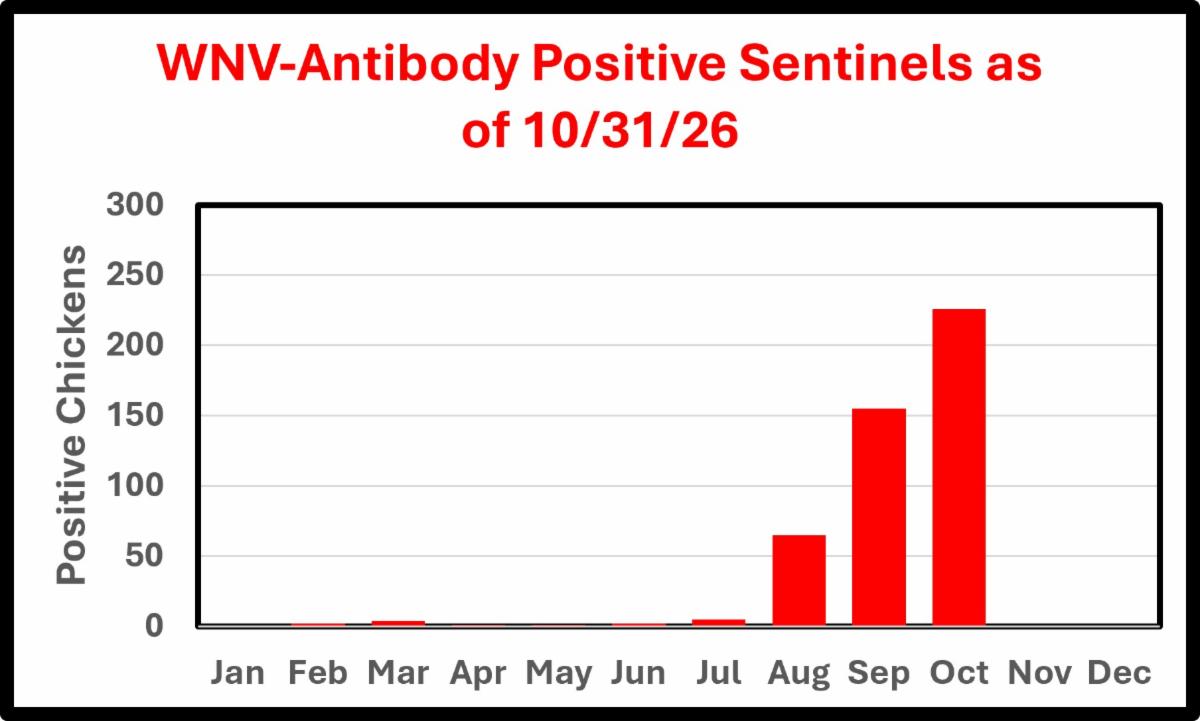
Finally, transmission of WNV to sentinel chickens in Florida continues at a frantic pace (Figure 8). Last week, 60 positive sentinel chickens were reported in 16 Florida Counties. Focal transmission hot spots included Pasco County (8 new positives), Pinellas County (8), and Walton County (7). The good news is that the fall migration is just about over, and that will limit the source of autumn amplification hosts and should reduce the number of infected mosquitoes.
| | Figure 8. The temporal distributions of 461 WNV antibody-positive sentinel chickens in Florida as of 10/31/26. | | |
Aedes aegypti tends to exist in and around sugar-poor habitats including human homes and businesses. Most mosquito species utilize sugar for flight energy and maintenance (see the answer to A Question From Our Readers above). Aedes aegypti has circumvented this problem by evolving the ability to partition blood meals into energy resources and egg production.
In the laboratory study cited below (Naksathit et al. 1999), the authors reported that both large and small Ae. aegypti increased glycogen and sugar levels significantly when fed only blood. Glycogen is converted to sugar for flight energy, and the production of glycogen following blood feeding indicates that at least part of the blood meal is used for maintenance and flight energy. The authors also reported that, Ae. aegypti realized an energetic advantage when they fed on blood within two days of emergence. Most newly emerged mosquito species seek sugar soon after emergence. Aedes aegypti seeks blood within the first two days of emergence, a fact that greatly increases their vector potential.
Scott et al. (1997) reported Ae. aegypti obtained a reproductive advantage when feeding only on human blood. Aedes aegypti females living close to humans were observed to take multiple human blood meals during each gonotrophic cycle, did not feed on sugar, and were more fecund than females that fed on both blood and sugar. Aedes aegypti females synthesize most of their energy reserves from blood.
These results explain why Aedes aegypti is an unusually efficient vector of human disease. Not only do they live alongside us, inside and adjacent to our homes, but they also depend on our blood for both energy and reproduction. Their frequent blood feeding results in a high reproductive rate for them and the viruses they transmit.
Suggested Readings
Naksathit AT, JD Edman, and TW Scott. 1999. Utilization of human blood and sugar as nutrients by female Aedes aegypti (Diptera: Culicidae). J. Med. Entomol. 36(1): 13-17.
Read It Here
Scott TW, J Naksathit AT, JF Day, P Kittayapong, and JD Edman. 1997. A fitness advantage for Aedes aegypti and the viruses it transmits when females fed only on human blood. J. Am. Soc. Trop. Med. Hyg. 57: 235-239.
Read It Here
| | |
Additional Resources
Disease Activity Archive: Catch up on previous Florida Disease Activity Updates and follow how mosquito-borne disease activity has changed throughout the season.
View Past Issues
Dengue Resources: Clarke’s Dengue PR Kit provides ready-to-use resources to help mosquito control programs communicate with their communities about dengue and prevention.
| | | | Jonathan Day, Professor Emeritus of Medical Entomology at the University of Florida and stationed at the Florida Medical Entomology Laboratory in Vero Beach is a national expert on mosquitoes and other blood-feeding arthropods that transmit diseases to humans, domestic animals, and wildlife. In collaboration with other researchers, Dr. Day has developed an effective system for monitoring and predicting epidemics of mosquito-borne diseases. | | |
Acknowledgments: This analysis would not be possible without the tireless efforts of multiple agencies across Florida. At least 27 Florida agencies collect serum samples from sentinel chickens each week and mail them to the Florida Department of Health Tampa Branch Laboratory for analysis, compilation, and reporting. Data are summarized by researchers at the Florida Department of Health in Tallahassee and reported weekly as the Florida Arbovirus Surveillance Report.
Contributors to this summary and full report include: Andrea Morrison, PhD, MSPH, Rebecca Zimler, PhD, MPH, and Olga Ospina, MPH, Florida Department of Health, Bureau of Epidemiology; Lea Heberlein, DrPH, Peter Dumoulin, PhD, MS, Maribel Castaneda, and Amanda Davis, MT (AAB) MB (ASCP), and Brittany Rowlette, BS, Florida Department of Health Bureau of Public Health Laboratories, and Dr. Joe Fisch, Florida Department of Agriculture and Consumer Services, Division of Animal Industry, Tallahassee, FL.
Daily updates of the Keetch-Byram Drought Index (KBDI) are produced by the Florida Department of Agriculture and Consumer Services, Forest Service.
The U.S. Drought Monitor is jointly produced by the National Drought Mitigation Center at the University of Nebraska-Lincoln, the United States Department of Agriculture, and the National Oceanic and Atmospheric Administration. Map courtesy of NDMC.
The Newsletter is edited and distributed by Jordan Brown.
| | |
Clarke has been helping make communities more livable, safe and comfortable since 1946.
Learn more about our work in protecting public health on clarke.com.
| | | | |