|
Each month, we will feature one of the plants on the Time to Restore list. Butterfly milkweed (Asclepias tuberosa) has been identified as a priority species for both Louisiana and Texas. The range of this species spans from California all the way up to Northeast Canada and includes all four of our Time to Restore states.
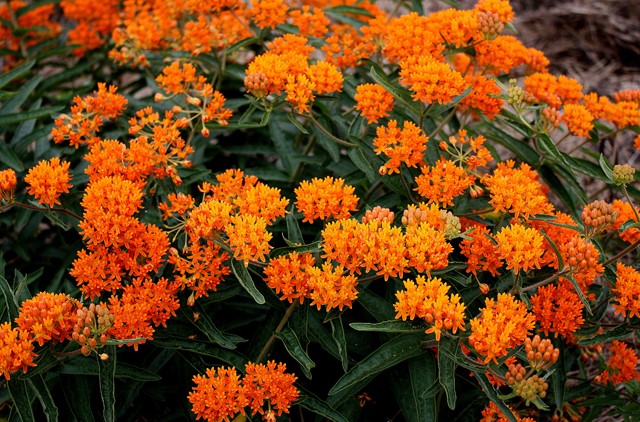
This species can be easy identified by its large, flat-topped clusters of bright-orange flowers. This species is still flowering in many parts of the South Central region.
If you are looking for ways to identify this species if it does not have flowers, the Ladybird Johnson Wildflower Center says "The leaves are mostly alternate, 1 1/2-2 1/4 inches long, pointed, and smooth on the edge...The abundance of stiff, lance-shaped foliage provides a dark-green backdrop for the showy flower heads." Unlike other milkweed species, the stems and leaves do not have milky sap.
You can observe this species as a single plant in Nature's Notebook. If you have more than one plant, consider monitoring 2-3 individuals at the same site to capture the variation between plants. If you have multiple plants growing together that are difficult to differentiate, register the plant as a patch and make your observation considering the patch as a whole.
For the plant pictured above, you would report:
Flowers or flower buds - yes
Open flowers - yes
Fruits - no
Ripe fruits - no
If you were also answering the optional intensity question, you would report:
Flowers of flower buds - 11-100 (counting the number of inflorescences)
Open flowers - 95% or more
Questions? Reach out to Erin@usanpn.org.
|