|
Objects | Memories
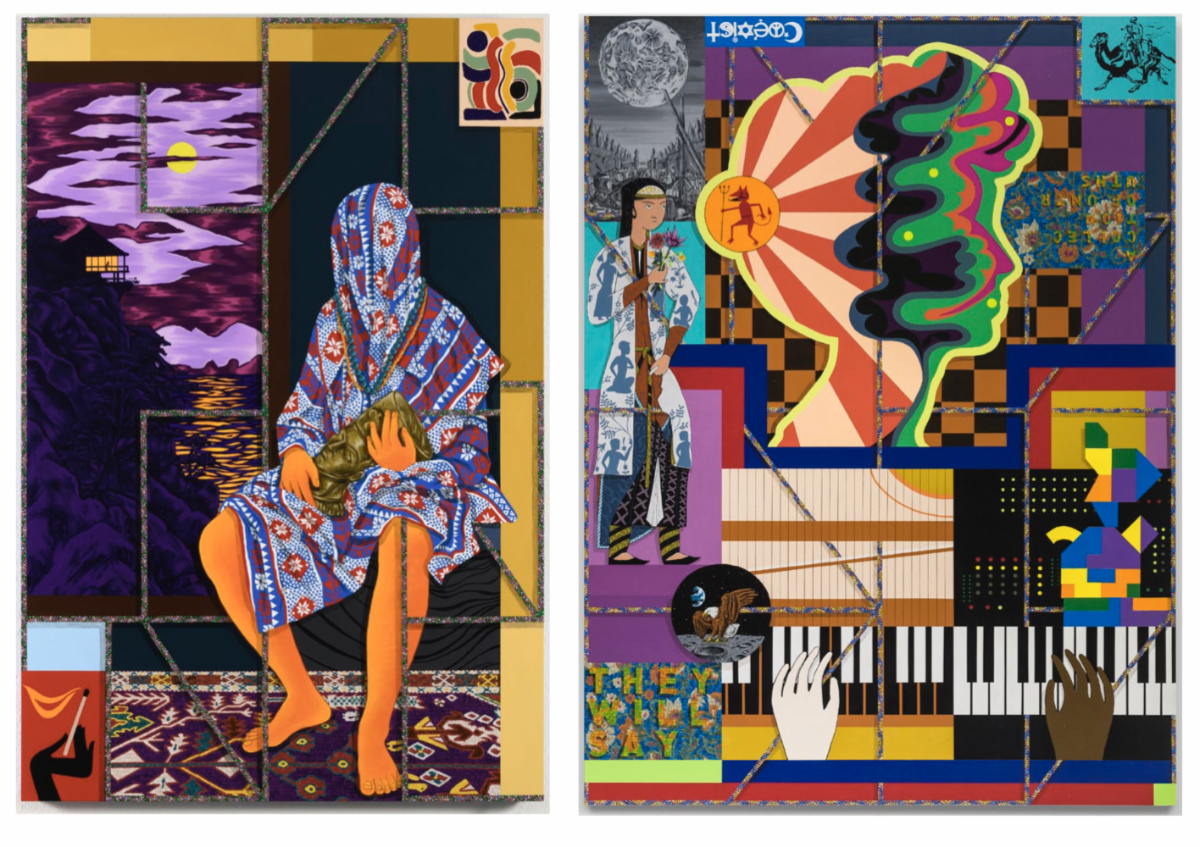
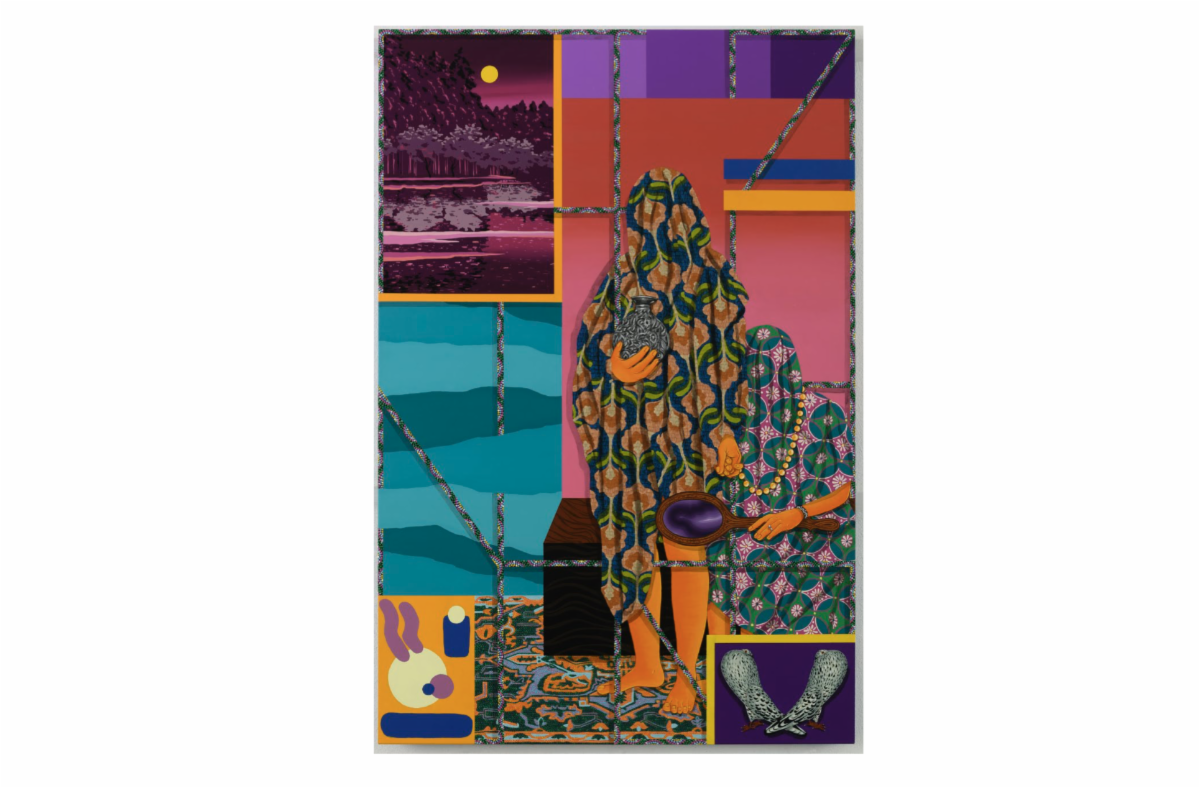
Fallah tells personal stories associated with objects such as heirloom jewelry, collected textiles, or dolls, calling attention to the power of things to create bonds and evoke memories. Two paintings in this section center on veiled figures, surrounded by various objects that take the place of physiognomic characteristics, and record aspects of the sitters, the roads they have travelled, and the people for whom they care.
Portraiture
Fallah collaborates closely with the individuals he portrays in constructing their “likenesses.” He visits and interviews them at home, looking for patterns of significance. Eschewing such markers of identity as gender, skin color, and ethnicity, he obscures the heads and bodies of his sitters with patterned fabrics. He then surrounds them with objects and symbols that span cultures and generations, challenging simplistic assumptions about who a person is based on their appearance.
Stained Glass
For this series of four windows, Fallah collaborated with Los Angeles-based Judson Studios, the oldest family-run stained-glass workshop in America, whose team meticulously translated the artist’s elaborate compositions into fused and leaded glass panels. Throughout his career, Fallah has experimented with oil and acrylic paints, seeking to achieve a high degree of luminosity to elicit emotional responses. The collaboration with Judson enabled him and the studio team to explore and expand the expressive potential of color and light.
Autobiography
Fallah draws inspiration from a variety of visual expressions unique to his adoptive city of Los Angeles, home to millions with migration stories. Reflections on cultural inheritance, diaspora, and homeland thread through his work. While addressing such ills as hatred, greed, and corruption, his paintings also offer hopeful and sentimental messages, aggregating the life lessons Fallah wishes to share with his son. For example, No Gods, No Masters (2020) calls out racist stereotypes through the depiction of Middle Eastern characters, while also referencing his son’s storybooks, quotations from Islamic manuscript paintings, and popular American illustrations.
Allegory
The canvases in this section are divided into grid-like spaces, each a treasury of references to cultural heritage, emblems of devotion, family heirlooms, and references to modern art that coalesce into cautionary tales, social commentary, and stories of love. They Will Say a Collection of Untruths (2022) critiques the American promise of co-existence of religions and “races.” The psychedelic profile in the center riffs on a Milton Glaser graphic from a 1960s teen magazine feature on “combination skin.”
Sculpture
Fallah’s sculptures—hand-painted on flat sheets of cut aluminum—continue to challenge the expectations of portraiture, excluding references to gender, ethnicity, or class. The vibrant colors and dense patterns that appear elsewhere in Fallah’s work cover the entirety of these figures. According to the artist, these patterns function as skin, offering a protective layer to other life-giving organs, which are represented by the objects and symbols painted on the cut-outs or rendered as part of the figures’ outlines.
A Dual Presentation in Los Angeles
Concurrent with Amir H. Fallah: The Fallacy of Borders organized by the Fowler Museum at UCLA (January 29–May 14, 2023), Shulamit Nazarian, Los Angeles will present Fallah’s work in the solo exhibition War on Wars, on view February 15–March 25, 2023. The artist has also produced a new neon sign, titled CHANT, soon to be installed on the front of Shulamit Nazarian gallery. The piece is intended to generate attention and awareness, as well as funds from its sale, for the “Woman, Life, Freedom” movement in Iran.
The presentation of Fallah’s art across Los Angeles reflects his ongoing dialogue with the city— one with a broadly diasporic character, including, among others, the largest Iranian population outside Iran. Shulamit Nazarian and the Fowler Museum are both committed to representing artists whose perspectives are often proximal, but insufficiently highlighted. Fallah’s work engages stereotypes of “distant” cultures and empowers viewers to read his work through visual signs and systems.
A Dual Presentation in Los Angeles
About the Artist
Amir H. Fallah (b. 1979, Tehran, Iran; lives and works in Los Angeles, CA) received his BFA in Fine Art & Painting at the Maryland Institute College of Art and his MFA in painting at the University of California, Los Angeles. His work has been shown extensively in solo and group exhibitions across the United States and abroad. His solo presentations have appeared at the Museum of Contemporary Art in Tucson, AZ; South Dakota Art Museum, Brookings, SD; Schneider Museum of Art, Ashland, OR; San Diego ICA, CA; and the Nerman Museum of Contemporary Art, Overland, KS.
Credits
Amir H. Fallah: The Fallacy of Borders is organized by the Fowler Museum at UCLA and curated by Amy Landau, director of education and interpretation. Major support is provided by the Fowler Contemporary Council Fund, Clough/Hillenburg Fund, and Fay Bettye Green Fund. Additional generous support is provided by the Younes & Soraya Nazarian Family Foundation, Peyton Family Foundation, George R. and Nancy Ellis Endowment Fund, Farhang Foundation, Azita and George Fatheree, Tad Freese and Brook Hartzell, Pamela and David Hornik, Cheryl and Bruce Kiddoo, Shulamit Nazarian Gallery, Orna Delrahim, Aryan Papoli and Abas Goodarzi, First Financial Capital Inc and Katy Saei, Connie McCreight, Jay Geller and Lowell Gallagher, and Avant Arte.
About the Fowler
The Fowler Museum at UCLA explores global arts and cultures with an emphasis on Africa, Asia, the Pacific, and the Indigenous Americas—past and present. The Fowler enhances understanding of world cultures through dynamic exhibitions, publications, and public programs, informed by interdisciplinary approaches and the perspectives of the cultures represented. The work of international contemporary artists is presented within complex frameworks of politics, culture, and social action.
Museum Information
308 Charles E Young Dr N | Los Angeles, CA 90095 | fowler.ucla.edu/visit Parking in UCLA Lot 4: 198 Westwood Plaza at Sunset Blvd, $3/hr Rideshare drop-off: 305 Royce Drive
Hours: Wednesday–Sunday, 12–5 pm Admission to the Fowler is free
CAPTIONS
Top—left to right:
Amir H. Fallah (b. 1979, Tehran, Iran), Protector 1, 2022; acrylic on canvas; Courtesy of the artist and Ginsberg Family Collection
They Will Say a Collection of Untruths, 2022; acrylic on canvas; Courtesy of the artist and Shulamit Nazarian, Los Angeles
Bottom
Urn, 2022; acrylic on canvas; Courtesy of the artist and Shulamit Nazarian, Los Angeles
|