|
Yesterday's midterm elections delivered a spectacular two-fingers to Trump's administration.
Lessons for us?
Trump's appetite for taking a chainsaw to government bureaucracy, supported by DOGE, found an ear-splitting echo in the approach championed by Streeting.
I'm told; after a weekend of braggadocio, on a Monday morning, a bright young man became a very silly boy…
"Cut the bureaucracy."
"Sack the managers."
Promise "enormous savings"…
... work out what everyone was doing afterwards.
Trump has come unstuck, and by the misfortune of coincidence, so has Streeting.
The National Audit Office has published its examination of ICB restructuring… ouch!
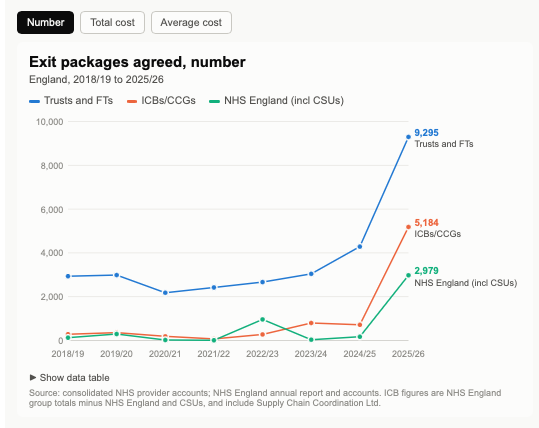
ICBs were instructed to cut running costs by 43%. Around 8,000 posts were expected to disappear. Redundancy payments are estimated at £582m, and…
… here's the killer.
The NAO cannot establish whether organisations have retained the skills and capacity needed to do their jobs.
In other words, people have gone, without knowing whether the NHS can manage without them.
ICBs struggled to plan their workforces because, their responsibilities were still changing. Who's going to do what we don't know what we want them to do.
Think about that.
Decide how many people to get rid of. Then decide what work needs doing.
Management by chainsaw. So brave, so bold, so bl@@dy stupid.
There's nothing wrong with removing duplication, reducing overheads or making management more efficient.
It's essential, but…
… competent managers start with the work, understand the processes, establish the capabilities needed and then design the organisation.
Now we have Yvette Cooper. I confess to being a fan, (rock solid CV) but she needs much better advice, and...
... at least she's trying to right the wrongs that should never have been wronged in the first place.
She's written to NHS staff… +1,100 words, a procession of organisational arrangements, one apology and not a single mention of the waiting-list promise.
If this is DH++ clarity, I'd hate to see confusion.
- A new NHS Group,
- a transitional Special Health Authority,
- a Clinical Council,
- a Patient Experience Director and
- another oversight group.
Gimme strength… people just want to know three things.
- What's happening?
- What does it mean for me?
- When will I know?
For an exercise intended to simplify the future for the people left, this is hopeless…
... as communications go, it’s the Zimmermann Telegram all over again.
The most interesting passage is an apology.
Cooper acknowledges the disruption and uncertainty caused by the reforms and apologises to staff.
Well... sort of.
A carefully worded apology. Not for the decision. Not for the consequences. For the uncertainty.
The subtext… she's saying Streeting made a mess of it.
Cooper inherited the wrecking ball and is trying to work out how to rebuild the house.
Nearly two years after announcing the abolition of NHSE, the government is only now preparing to show staff the yet unfinished operating model.
Formal consultation begins by January, with implementation scheduled for April. The law requires at least 45 days' advance consultation for large-scale redundancies.
Cooper's timetable allows more, but…
… scarcely inspires confidence that staff can meaningfully influence the final design.
Is consultation intended to shape the organisation, or simply legitimise decisions already taken?
We know the answer.
An extraordinarily compressed timetable for reorganising the leadership of one of the world's largest healthcare systems.
The Permanent Secretary, SpADS and senior officials advising ministers?
Who challenged the assumptions?
Who tested the risks?
Who asked what would happen when thousands of experienced people disappeared?
Perhaps they did… let's see the evidence.
In Cooper's lengthy letter, there's no mention of waiting lists. No mention of restoring the 18-week standard to 92% by March 2029. Currently, it's around 65%.
The patients are waiting for appointments, diagnoses, operations and treatment.
The NHS is trying to improve productivity, expand capacity, manage demand, reorganise and keep the show on the road.
Meanwhile, national leadership is preoccupied with creating another organisation...
...on top of a reorganisation...
...reorganising the previous reorganisation...
...and deciding who's left...
...to report to whoever is left.
Surely the purpose of reorganising the NHS is to make it better at delivering care?
Where's the explanation of how these changes will get patients treated faster? Where's the evidence that the disruption is worth it?
This summer 21 patients died after heatwave ambulance delays and the DH++ is still colouring in maps.
Americans have reminded their politicians that voters eventually judge governments by results, not rhetoric.
Cooper should reflect on that.
The future of America was not safe in Trump’s hands and the reluctant conclusion is; the future of the NHS is not safe in Labour’s hands.
We don't need another organisation chart.
We do need the right people, with the right skills, doing the right jobs, accountable for results.
We don’t need politicians writing epistles,
We do need fewer people waiting for treatment, and this is the single and only priority.
Patients didn't join waiting lists because the NHS had the wrong organisation-chart, and…
...they won't come off the list because Whitehall has drawn-up a another one.
|