Anterior Segment Section Newsletter
September 2025 | | |
In this Issue:
• Message from the Chair
• Academy 2025 Boston Anterior Segment Section Events:
- Diplomate Prep Course (not just for Diplomates) No Fee for Section Members
- Anterior Segment Section Symposium
- A Call for Section Volunteers
• Anterior Segment Research Highlights
• Case Report
| | |
|
Academy 2025 Boston is less than a month away! The annual Academy meeting represents world class education and the opportunity to collaborate with the top optometrists and vision scientists from around the globe. I invite you to join us for our annual Symposium and connect with your colleagues at the Section business meeting. The annual business meeting is the perfect place to learn more about the Anterior Segment Section and how you can become involved.
Safe travels and see you in Boston.
Scott B. Han, OD, FAAO
Chair, Anterior Segment Section
| | Diplomate Prep Course (not just for Diplomates) No fee for Section Members! | | Join Like-Minded Members at the Anterior Segment Section Symposium: | | |
This course will serve as the 2025 Section Symposium for the Anterior Segment Section. It will highlight emerging research, including the Zoster Eye Disease Study (ZEDS). It will also debate recent clinical advances in prophylaxis and prevention, especially vaccinations. Clinical management and surgical advances for challenging cases will be presented and discussed by the panelists.
Friday, October 10, from 3:30 pm – 5:30 pm, Room 107 ABC
SS-14: When the Eye Mingles with Shingles – Advances in Zoster Eye Disease
Christen Kenrick, OD, FAAO, Dipl AAO, Dipl ABO
Kathryn Colby, MD, PhD
Jia Yin, MD, PhD, MPH
| | Call for Section Volunteers | | Are you interested in getting involved in the Academy and the Anterior Segment Section? Come to our annual business meeting taking place on Friday, October 10, from 12:00 pm - 1:00 pm, in the Otis Room (Westin Lobby Level). RSVP with the link below. | | Anterior Segment Research Highlights: | | |
● GLP-1RAs may be associated with reduced risk of ocular inflammation (non-infectious uveitis). A new JAMA Ophthalmology cohort study of more than 500,000 patients found that those prescribed GLP-1 receptor agonists (GLP-1RAs) had about a 50% lower risk of developing noninfectious uveitis compared with matched controls. This protective association was consistent in patients both with and without diabetes. When compared with other diabetes medications, GLP-1RAs were associated with significantly lower uveitis risk than metformin or insulin, and they showed similar risk to SGLT2 inhibitors when analyses accounted for single-drug use. Taken together, these findings suggest that GLP-1RAs may offer ocular anti-inflammatory benefits in addition to their metabolic effects, though the evidence is observational and cannot yet establish causation. Nevertheless, these findings open the door to new questions and highlight how advances in metabolic medicine are beginning to intersect with eye disease and immune regulation.
● The TFOS DEWSIII 2025 Publications are here! Structured into four main companion papers, each with a different role. Choose your own adventure:
| | |
Case Medical History:
A 72 y/o female presented with complaints of blurred vision, photophobia, and pain on a scale of 4/10 (with 10 being the worst) OU. She had a longstanding history of severe dry eye disease, secondary to LASIK and Sjögren's Syndrome.
Previous Treatments:
Prior treatments included cyclosporin ophthalmic solution 0.1% BID OU, autologous serum eye drops (ASEDs) 40% QID OU, varenicline solution 0.03mg (nasal spray) BID, warm compresses QID, fish oil, and in-office therapies of IPL, thermal pulsation, and low-level light therapy. She also had previously been fit in scleral lenses (for the sole purpose of therapeutic relief) but reported that she could only wear one lens at a time due to her vision getting blurry after only 30 minutes of wear time.
Additional Case Findings:
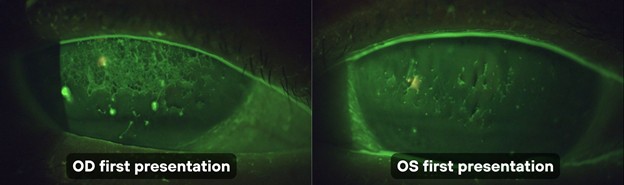
Exam findings revealed scattered filaments with mucous strands (OD>OS), 4+ confluent punctate epithelial erosions OD, 2+ confluent, centralized punctate epithelial erosions OS, and an immediate TBUT OU. Her corneal sensitivity testing was reduced in all quadrants OU.
| | |
Diagnosis:
Filamentary keratitis, neurotrophic keratitis, Sjögren's syndrome with keratoconjunctivitis OU.
Treatment:
The patient was anesthetized and filaments were debrided with jeweler's forceps. The patient was started on topically compounded 10% N-Acetylcysteine QID OU and prednisolone acetate 1% ophthalmic solution q2h x 2 weeks, then QID x 2 weeks OU. She was instructed to continue with her former therapeutics and at home therapies. We temporarily discontinued scleral lenses OU to optimize our pharmaceutical interventions. Of note: the patient was seen every 2 weeks for follow up, but images were included at timeframes that reflect changes in clinical outcome.
4 Weeks Post Presentation:
| | |
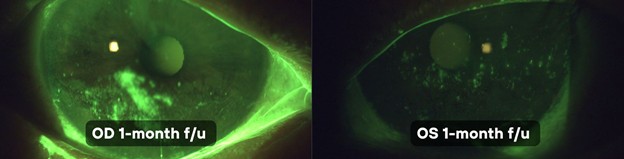
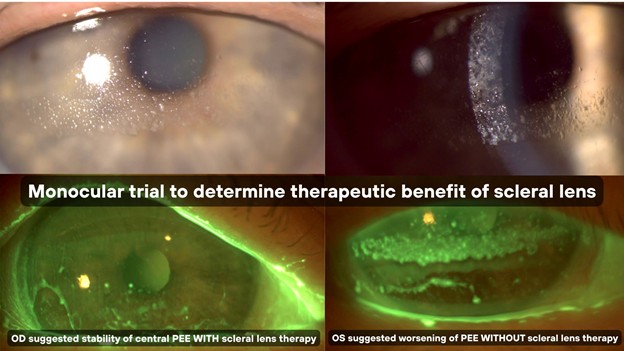
At 4 weeks the filaments appeared to dissipate and the patient was finding improved comfort despite persistent epithelial defects. We tapered her prednisolone acetate 1% ophthalmic solution to BID OU and decided to continue with topically compounded 10% N-Acetylcysteine QID OU. A prior authorization was started for cenegermin-bkbj 0.002% for the treatment of neurotrophic keratitis. At this time we wanted to address the potential of scleral lens wear for therapeutic benefit. I asked the patient to RTC in 2 weeks for follow-up to perform a monocular trail of scleral lenses (wearing in OD only) to determine if the cause of blur was anterior or posterior to the scleral lens.
6 Weeks Post Presentation:
| | |
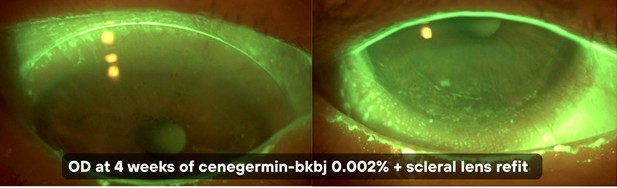
On examination, it was determined that the cause of the blur was more related to deposits on the anterior surface of the lens, likely due to a poor tear film in excess of proteins, lipids, and mucus. This was emphasized by the increased central PEE OS that occurred without protection of the scleral lens. We co-managed the patient with her primary care optometrist to refit her scleral lenses and started her on cenegermin-bkbj 0.002% 6x/day OU. The patient was to return in 4 weeks for a follow up.
10 weeks post presentation:
| | |
On follow up, the patient experiences significant relief with combined therapies and reported sustained clarity of vision and comfort with her scleral contact lenses. Discussions included revisiting in office therapies for tear film rehabilitation and maintenance as well as switching from ASEDs to platelet rich plasma (PRP) eye drops.
Case Takeaways:
This case highlights the complexity of managing concurrent filamentary and neurotrophic keratitis in the setting of severe dry eye and Sjögren’s syndrome. A multimodal approach—incorporating pharmacologic therapies, biologics, and scleral lens rehabilitation—proved essential in reducing symptoms, restoring comfort, and improving visual function.
| | |
About the Author:
Dr. Emilie Seitz earned her Doctor of Optometry degree from the Pennsylvania College of Optometry at Salus University and completed a residency in Ocular Disease and Primary Eye Care at the Salisbury VAMC in North Carolina. She holds active optometry licenses in both North Carolina and Ohio. Dr. Seitz has advanced clinical experience in ocular surface disease and previously practiced at Clear Eyes and Aesthetics, a dry eye–focused specialty center. She has authored numerous publications on dry eye and glaucoma management and is a proud Fellow of the American Academy of Optometry, where she serves on the Anterior Segment Section. Dr. Seitz is also actively involved in the Ohio Optometric Association and will serve as the next Zone Governor for her district. Now based in Cincinnati, she continues to focus on ocular disease management while exploring her next professional opportunity.
| | | Download the Academy.25 App | | |
Download the Academy.25 app to browse all available continuing education, explore the exhibit hall, view venue maps, complete session evaluations, unofficially monitor your CE credits, access handouts, and much more! Use the buttons below to download the app now to your preferred mobile device. Please be sure to refresh your app periodically to keep your app up to date.
New this year, course evaluation survey links will appear 5 minutes before each session ends. You must be logged in to complete the survey. Your feedback directly impacts the educational planning for future Academy meetings.
| | Last Chance to Register for Academy 2025 Boston! | | | | |