|
November 18, 2024
Dear Aoki Community:
This past Saturday, November 16 was the International Day of Tolerance. The United Nations General Assembly adopted a resolution in 1996 to memorialize this day as a commitment to fulfilling the goals written in the Declaration of Principles on Tolerance. The document defines tolerance as "... respect, acceptance, and appreciation of the rich diversity of our world's cultures, our forms of expression, and ways of being different."
Tolerance is not concession nor the acceptance of social injustice or the abandonment of personal convictions. Tolerance should be regarded as a principle obligating us and government institutions to uphold human rights, diversity, and democracy with impartiality. This principle should be embedded in our arduous work to improve our world and not allow division to impede our goal as a movement - to make this world one that affirms the humanity of every being.
In Solidarity,
| |
|| Aoki Center Updates || | |
|
This week! Join us for three incredible events:
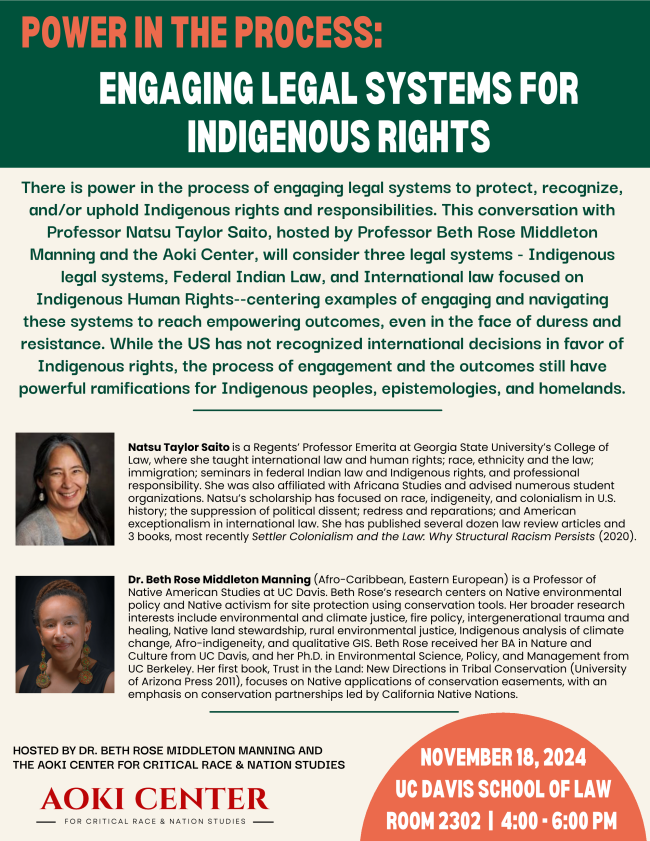
Power in the Process: Engaging Legal Systems for Indigenous Rights
Monday, November 18 from 4:00 to 6:00 PM: Featuring experts in indigenous studies and rights under international law Natsu Taylor Saito and Beth Rose Middleton Manning.
There is power in the process of engaging legal systems to protect, recognize, and/or uphold Indigenous rights and responsibilities. This conversation with Professor Natsu Taylor Saito, hosted by Professor Beth Rose Middleton Manning and the Aoki Center, will consider three legal systems Indigenous legal systems, Federal Indian Law, and International law focused on Indigenous Human Rights--centering examples of engaging and navigating these systems to reach empowering outcomes, even in the face of duress and resistance. While the US has not recognized international decisions in favor of Indigenous rights, the process of engagement and the outcomes still have powerful ramifications for Indigenous peoples, epistemologies, and homelands.
Can't attend in-person? Livestream Here.
| |
|
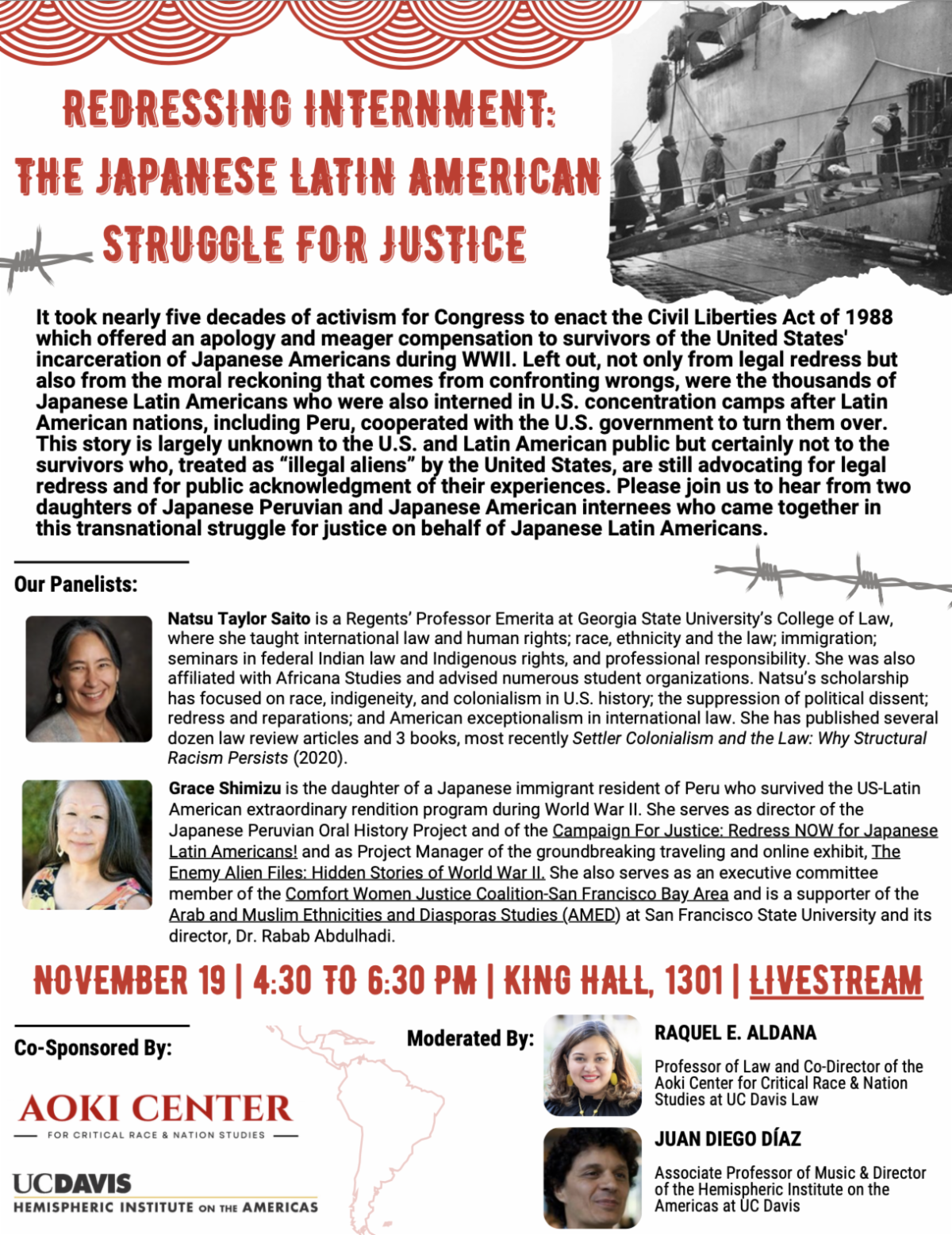
Redress for Japanese Latin Americans Under the U.S. WWII Rendition Program
Tuesday, November 19 from 4:30 to 6:30 PM: Featuring expert in international law Professor Natsu Taylor Saito and coordinator of the Campaign for Justice Grace Shimizu. Co-sponsored by the UCD Hemispheric Institute of the Americas.
It took nearly five decades of activism for Congress to enact the Civil Liberties Act of 1988 which offered an apology and meager compensation to survivors of the United States' incarceration of Japanese Americans during WWII. Left out, not only from legal redress but also from the moral reckoning that comes from confronting wrongs, were the thousands of Japanese Latin Americans who were also interned in U.S. concentration camps after Latin American nations, including Peru, cooperated with the U.S. government to turn them over. This story is largely unknown to the U.S. and Latin American public but certainly not to the survivors who, treated as “illegal aliens” by the United States, are still advocating for legal redress and for public acknowledgment of their experiences. Please join us to hear from two daughters of Japanese Peruvian and Japanese American internees who came together in this transnational struggle for justice on behalf of Japanese Latin Americans.
Can't attend in-person? Livestream Here.
|  | |
|
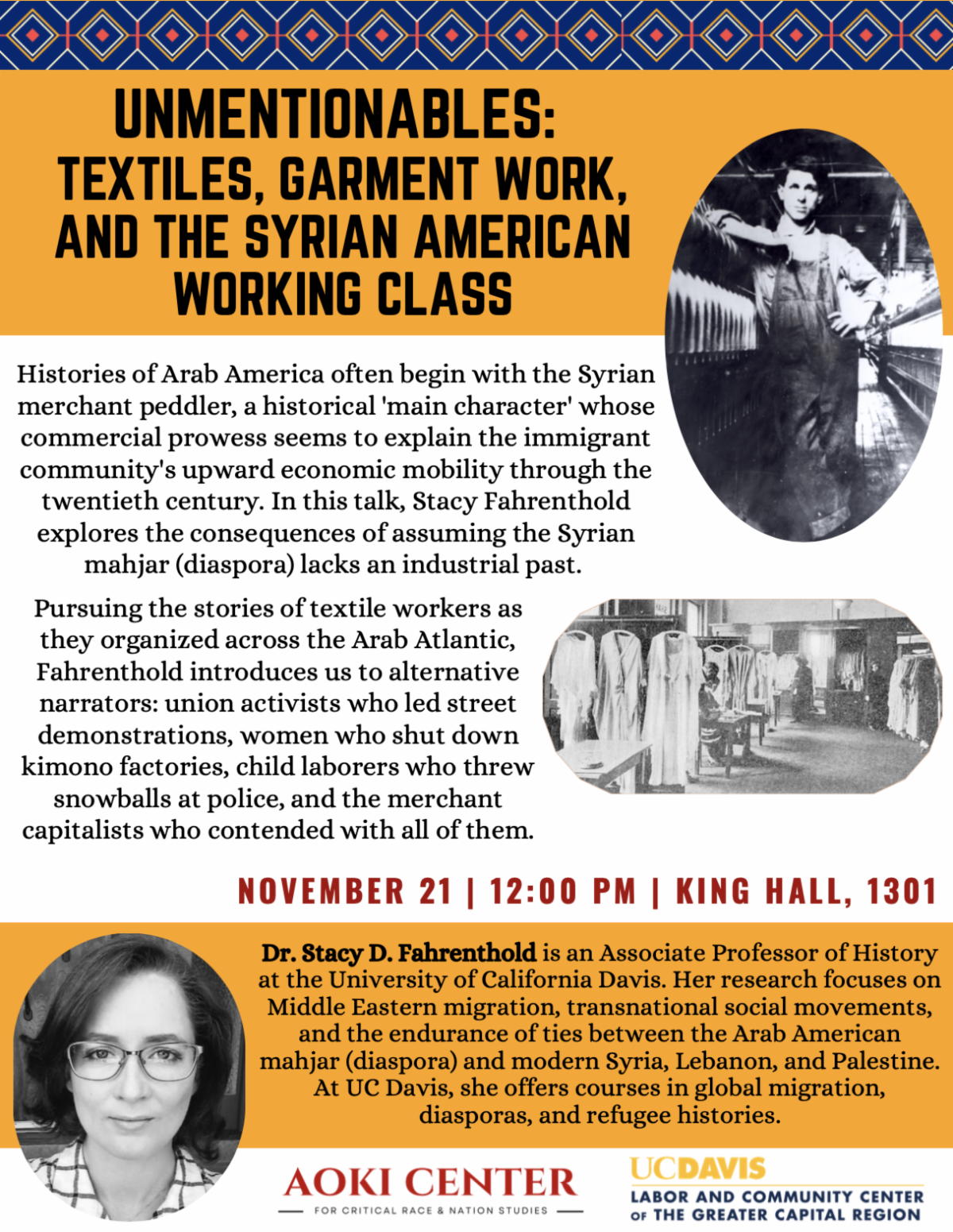
Unmentionables: Textiles, Garment Work, and the Syrian American Working Class
Thursday, November 21 from 12:00 to 1:00 PM: Presented by Dr. Stacy D. Fahrenthold who will discuss her project on a labor history of Arab Americans in the industry before 1934. The talk touches on immigration, race in labor politics, diaspora capitalism, and supply chains in the textiles businesses between the Middle East and the Atlantic world. Co-sponsored with the UC Davis Labor Center.
Can't attend in-person? Livestream Here.
| |
|
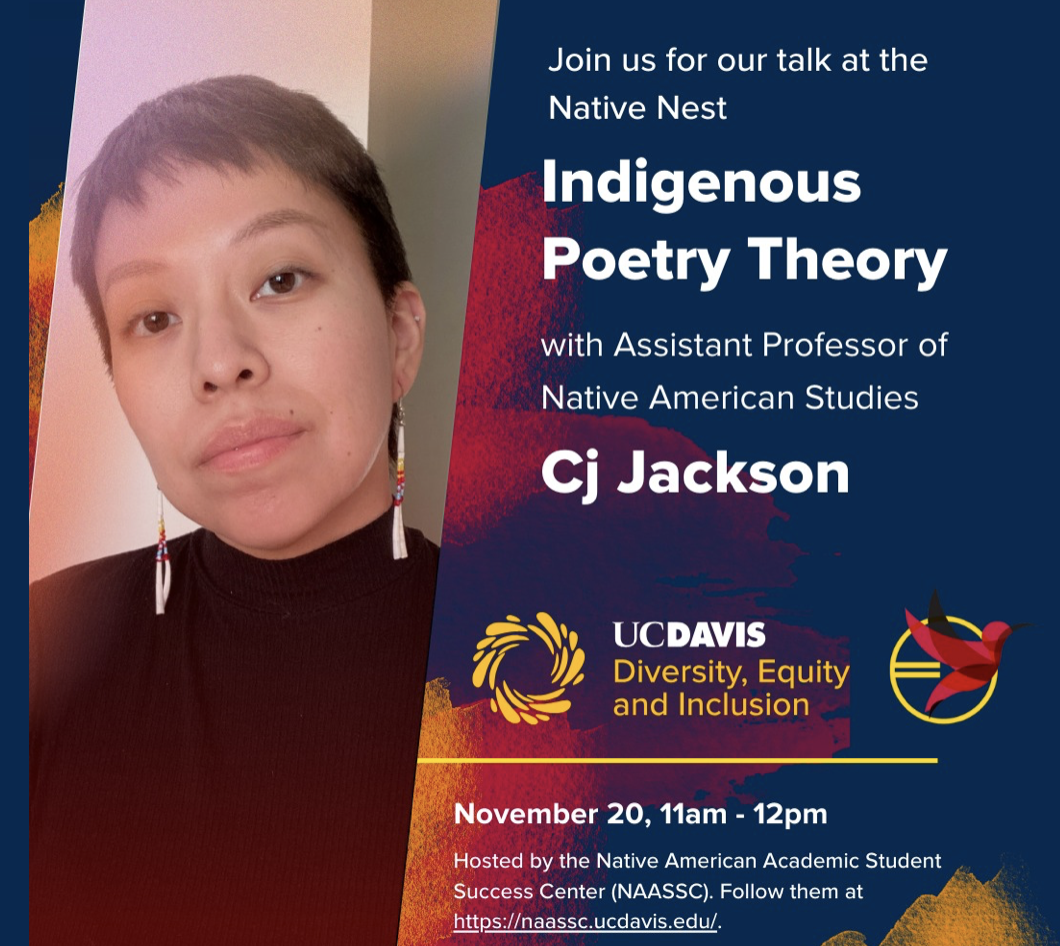
NAASSC Hosts: "Indigenous Poetry Theory" by Cj Jackson
The Native American Student Success Center (NAASSC) invites you to a presentation by Professor Cj Jackson on "Indigenous Poetry Theory."
Wednesday, November 20 | 11:00 to 12:00 PM | Native Jest (University House)
| |
|
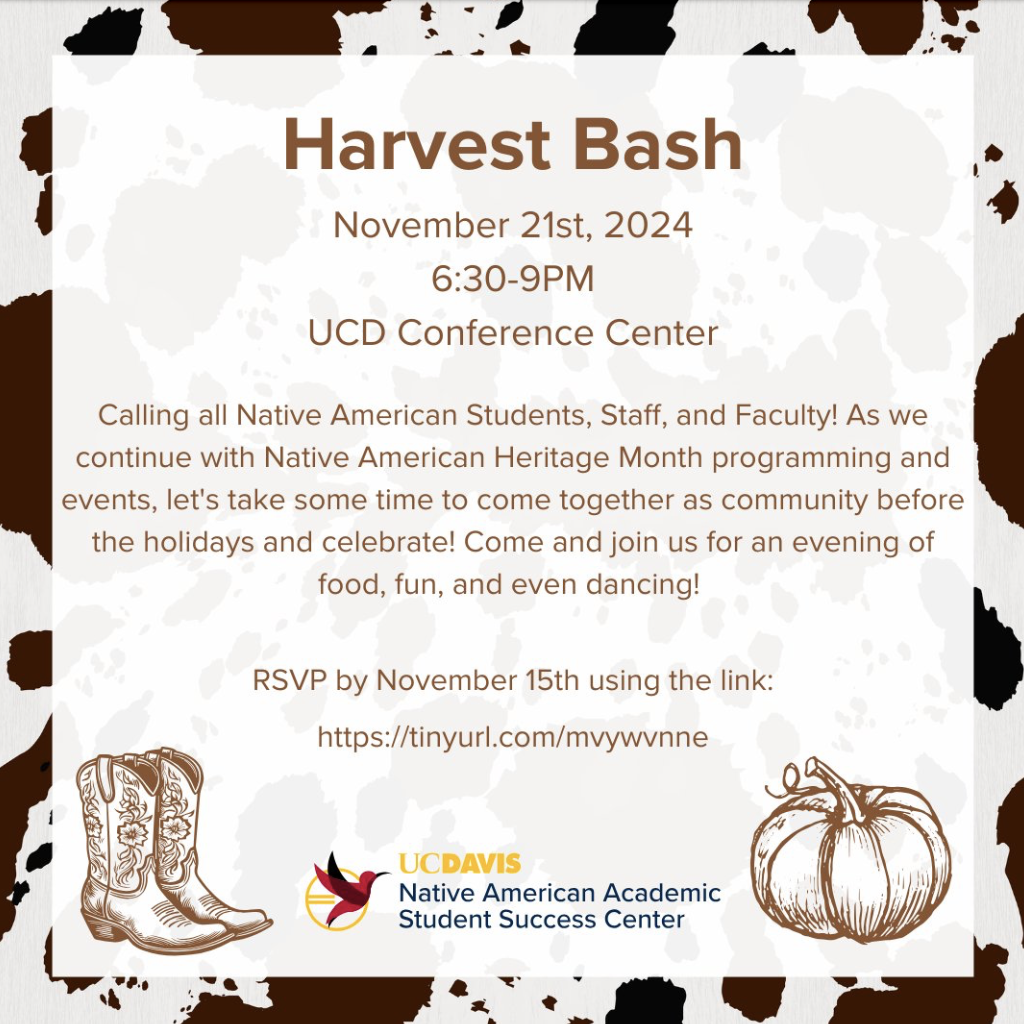
Native Nests Hosts Harvest Bash for Native American UCD Students, Staff, and Faculty
The Native Nest is calling all Native American students, staff, and faculty! As we continue with Native American Heritage Month programming and events, they invite you to take some time to come together as community before the holidays and celebrate! Join them for an evening of food, fun, and even dancing.
Thursday, November 21st, 2024 | 6:30 - 9:00 pm | UCD Conference Center | RSVP
| |
|
Celebrate with the Office of Academic Diversity: UCD Achieves HSI Eligibility
With gratitude and excitement, we are reaching out to share the wonderful news. UC Davis has officially achieved HSI (Hispanic-Serving Institution) eligibility, now proudly serving over 8,000 Latinx students. This milestone reflects the commitment of so many within our community. You can read the full announcement here: UC Davis Achieves HSI Eligibility.
To celebrate, we invite you to a special reception Avanza HSI Celebration on Friday, November 22, from 6 pm to 7:30 pm at the Mondavi Center’s Vanderhoef Studio Theatre. This event is open to everyone, free of charge, and no RSVP or ticket is required.
| |
|
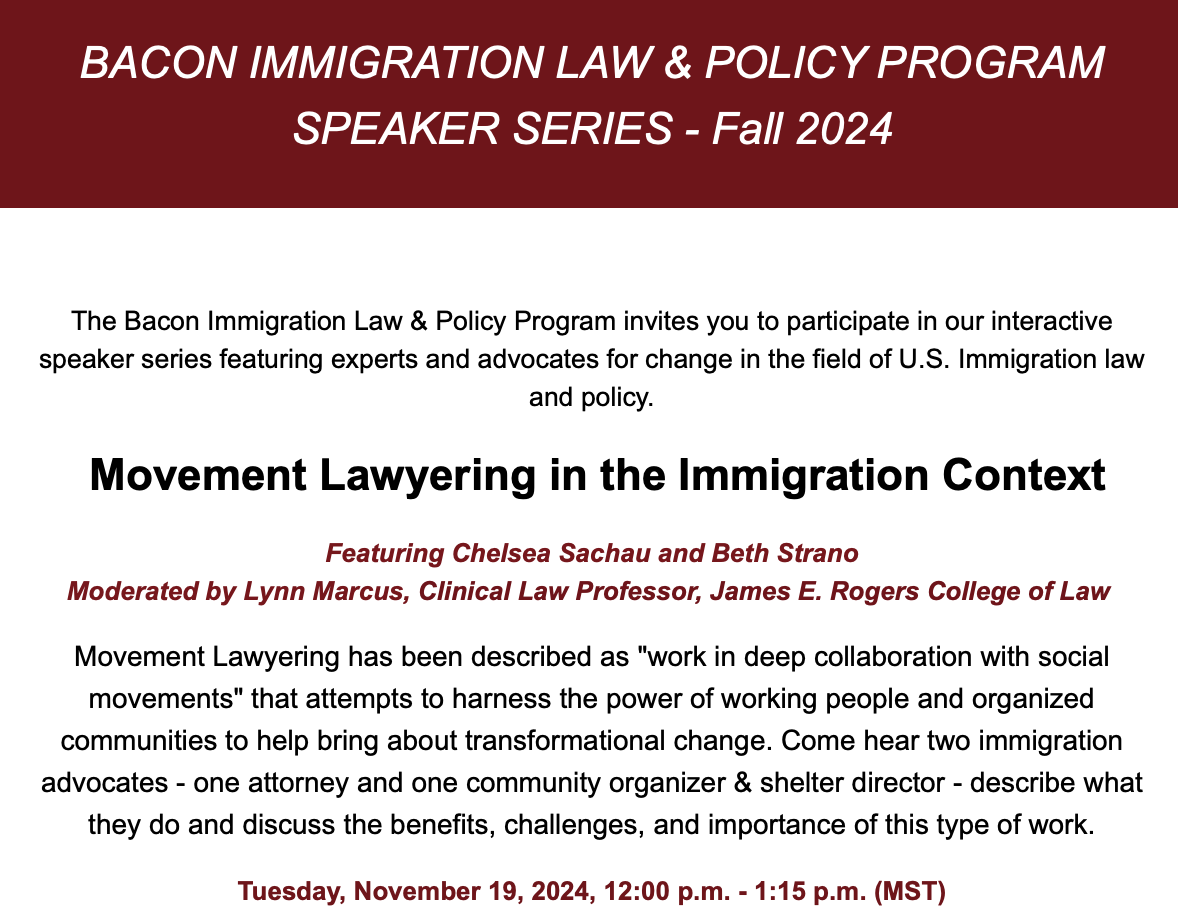
Movement Lawyering in the Immigration Context
Movement Lawyering has been described as "work in deep collaboration with social movements" that attempts to harness the power of working people and organized communities to help bring about transformational change. Come hear two immigration advocates - one attorney and one community organizer & shelter director - describe what they do and discuss the benefits, challenges, and importance of this type of work.
Tuesday, November 19 | 12:00 - 1:15 PM (MST) | Register Virtually
| |
|
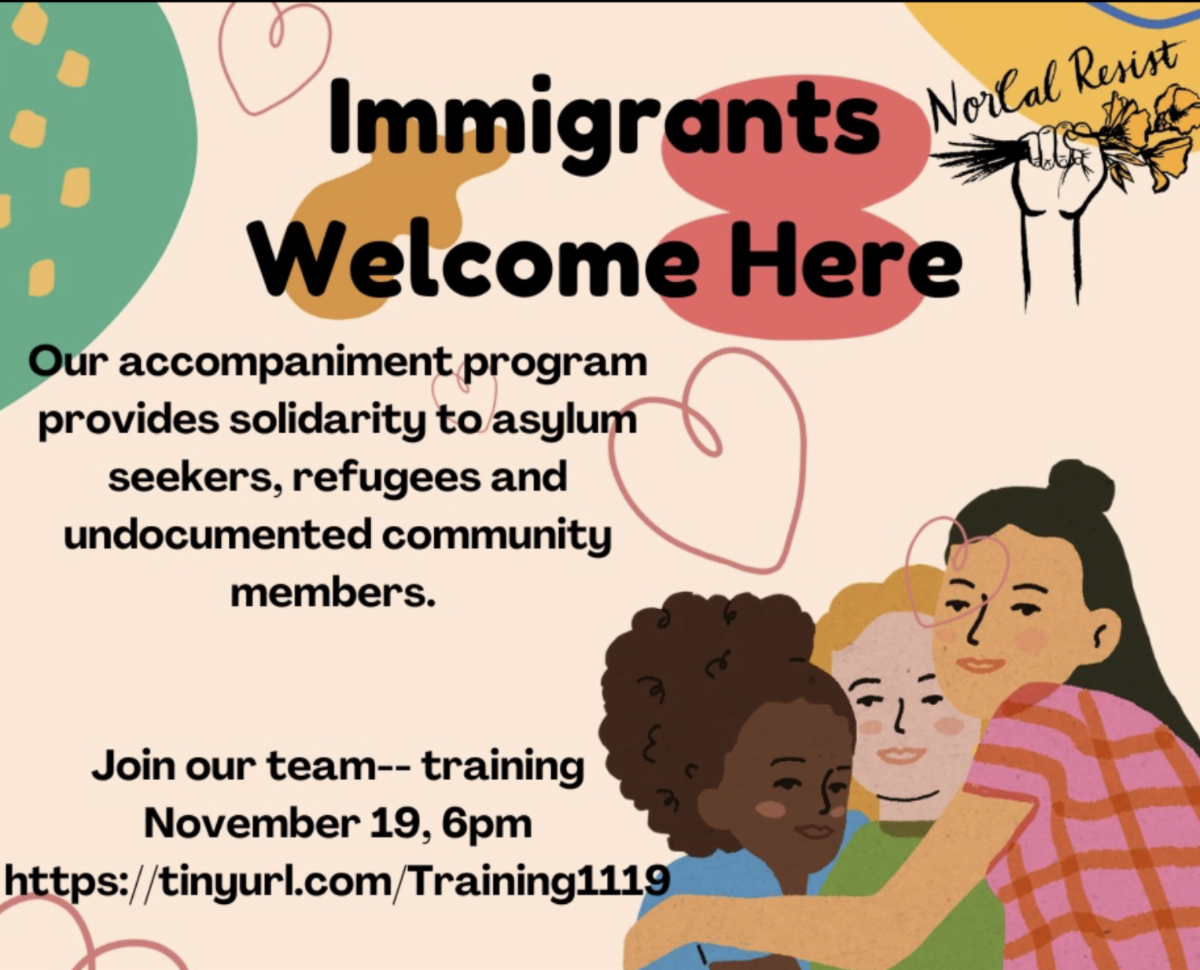
NCR's Immigrant Accompaniment Program
What is accompaniment? It means going along with someone else to handle a task that can be intimidating or stressful, particularly if you're new to this country and our area. Our accompaniment team goes with folks to immigration court, ICE check-ins, school enrollment, and even helps people with grocery shopping and other tasks.
Why do we do this? It can be difficult for newly arrived asylum seekers to get around-they likely cannot afford a vehicle, don't have a drivers license, and aren't yet familiar with public transit. Language barriers and total unfamiliarity with our region make things even harder. Having a friend along to help can take so much of the fear factor out of these activities.
Attend the training, ask questions, and be part of this critical work! No special language or other skills needed, just the ability to be kind and patient.
Tuesday, November 19 | 6:00 PM | Virtual Link
| |
Money + Action = Power with the Ella Baker Center
Join the Ella Baker Center in an evening of reflection and action to strengthen the movement for racial and economic justice!
In tough political moments, where do you turn to? Who do you count on to keep fighting towards the north star of freedom for all people? It can be overwhelming when it feels like the "tough on crime" narrative is so loud – but it doesn't have to be.Together we will dive into stories we learned about what it means to give – time, talent, and treasure – and what it will take to see a world without prisons in our lifetimes.
This is a virtual community space for people to come together and move towards collective action. We will share our principles for resource organizing, including taking action to move resources to our movement. We Keep Us Safe – in this and all times.
Tuesday, November 19, 2024 | 6:00 to 7:30 PM | Virtual | RSVP HERE
| |
|
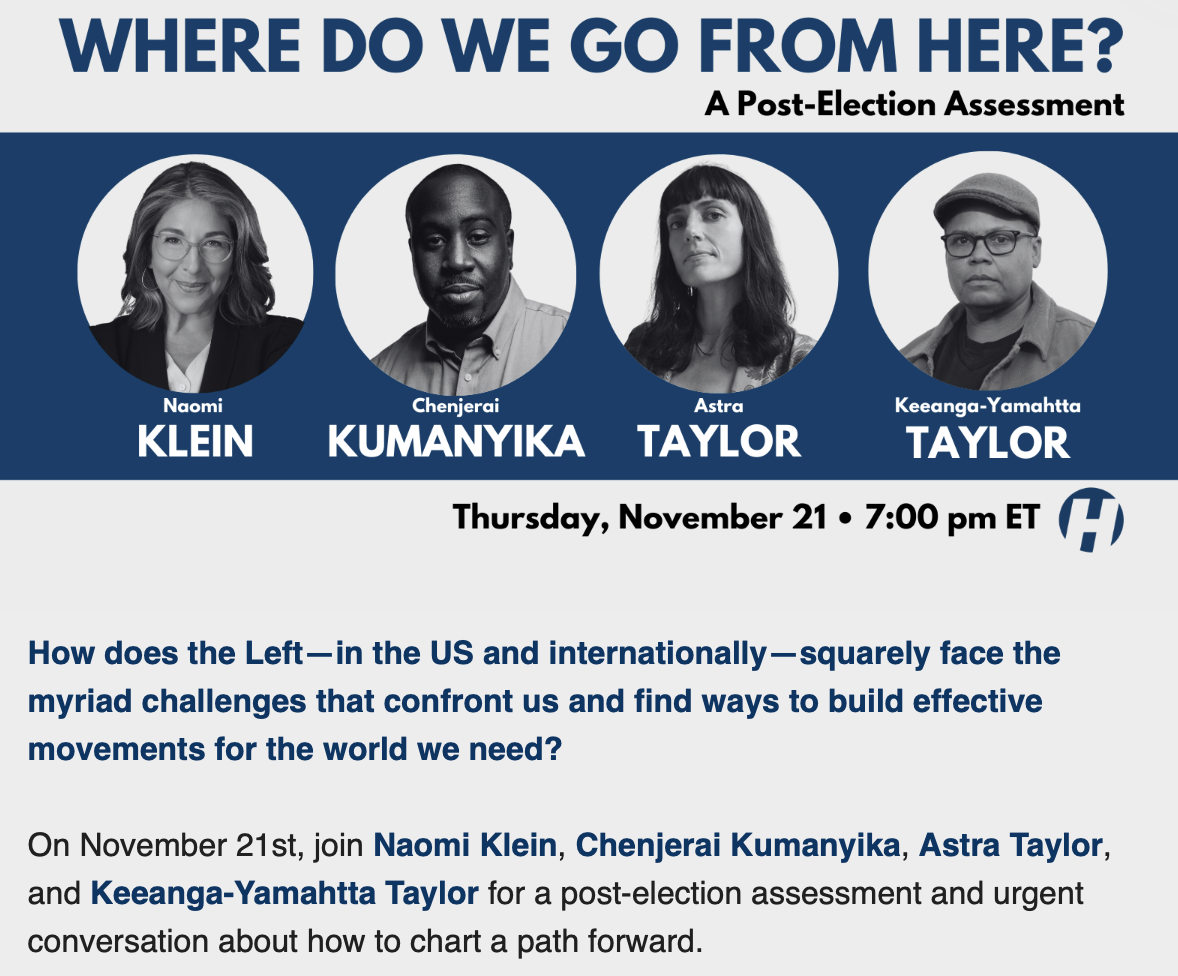
Join Haymarket Books for a Post-Election Assessment Discussion: Where Do We Go From Here?
How does the Left—in the US and internationally—squarely face the myriad challenges that confront us and find ways to build effective movements for the world we need?
Naomi Klein, Chenjerai Kumanyika, Astra Taylor, and Keeanga-Yamahtta Taylor moderate this post-election assessment and urgent conversation about how to chart a path forward.
Thursday, November 21 | 7:00 pm ET | RSVP HERE
| |
|
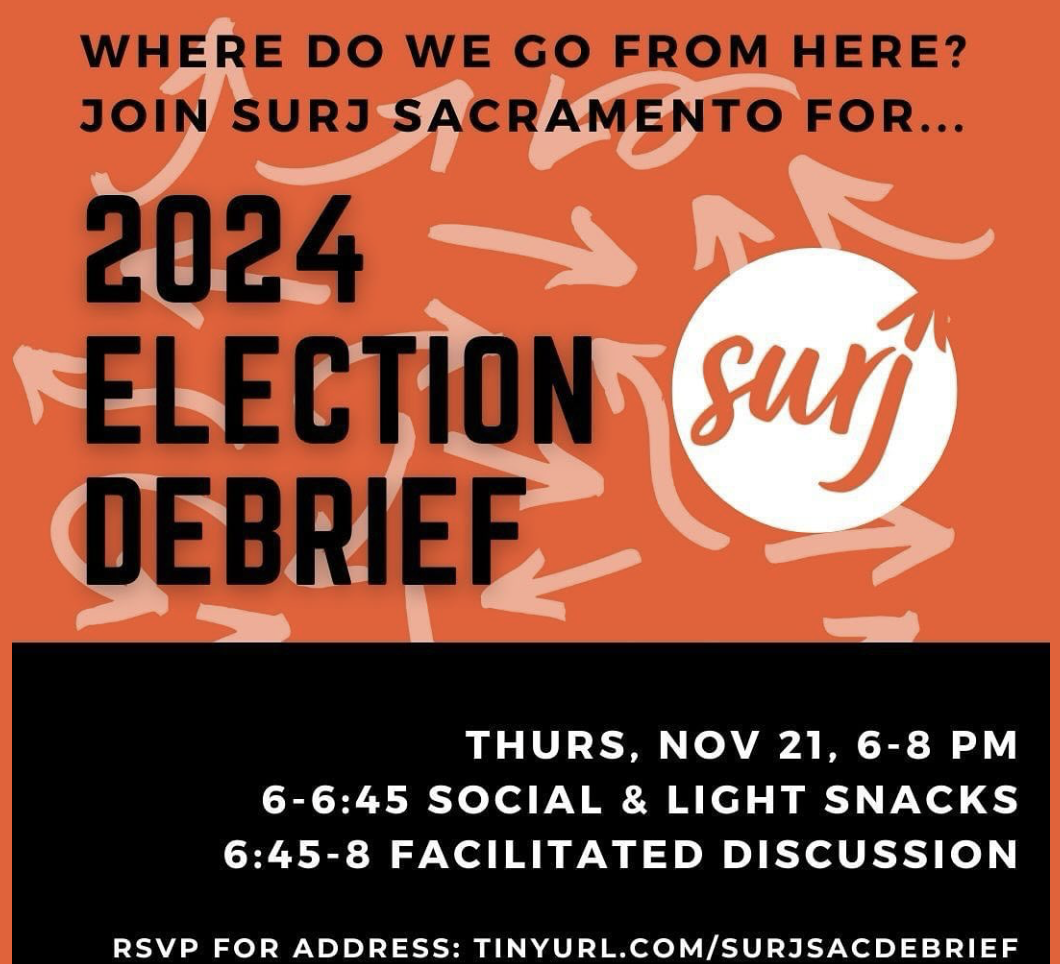
Standing Up for Racial Justice (SURJ) Hosts Election Debrief
Whatever you're feeling 1 week post election - rage, despair, apathy - the fight against white supremacy is bigger than Trump, and it takes all of us. Our goal for the time is to connect with & support one another, discuss the impact of white supremacy in the election (at all levels), and identify ways we as white people can take action in local and national organizing. All are welcome.
Thursday, November 21 | 6 to 8 PM | Downtown Sacramento | RSVP for Address
| |
|
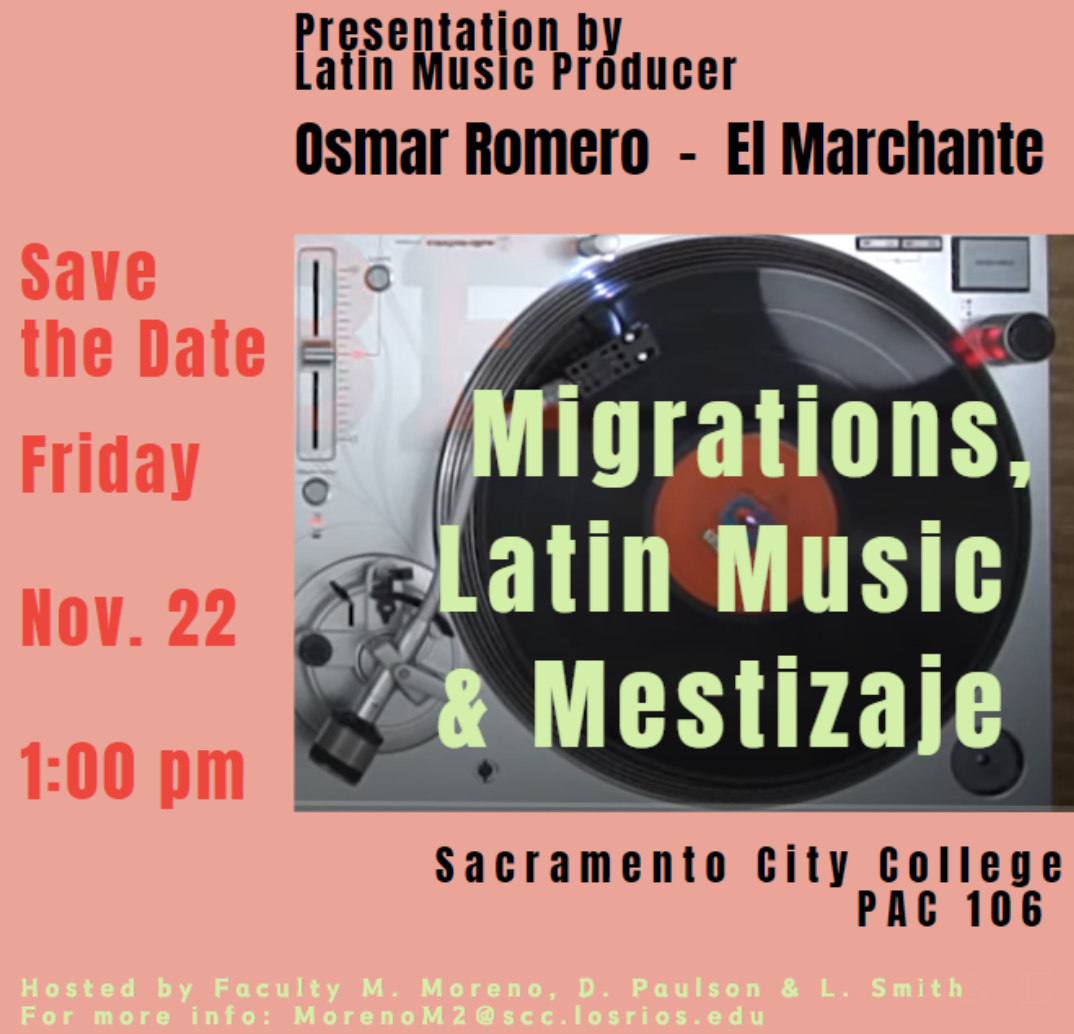
Save-the-Date: Migrations, Latin Music, and Mestizaje by Osmar Romero (El Marchante)
Latin migration is not merely the movement of people across borders; it is the constant reconfiguration of cultural music identities. In this process, music becomes a critical space where the fusion of diverse influences produces mestizaje, a dynamic and ongoing formation of identities. In the United States, this is particularly evident, where the blending of sounds and rhythms has given rise to hybrid genres like jazz, salsa, and hip hop. In this workshop, through listening to various pioneering Latin vinyl records, we will analyze how these forms of mestizaje are not just reflections of migration, but complex negotiations of historical identities, power, and belonging. It will allow us to trace how migrant communities reshape cultural landscapes, producing new meanings and connections that continually transform the sonic and social fabric of this nation.
Osmar Romero (El Marchante) Biography - Romero is a professional music and event producer. He grew up and studied in Venezuela and migrated to Los Angeles, with a blend of salsa, cumbia, jazz, and hip hop fusion of Latin American traditional rhythms. Romero collaborates with artists, labels, and blends an array of Latin sounds. He uses music to present the intersectionality of identity, power, and practices of belonging.
Friday, November 22 | 12:00 to 1:30 PM | Sacramento City College, PAC 106
|  | |
|
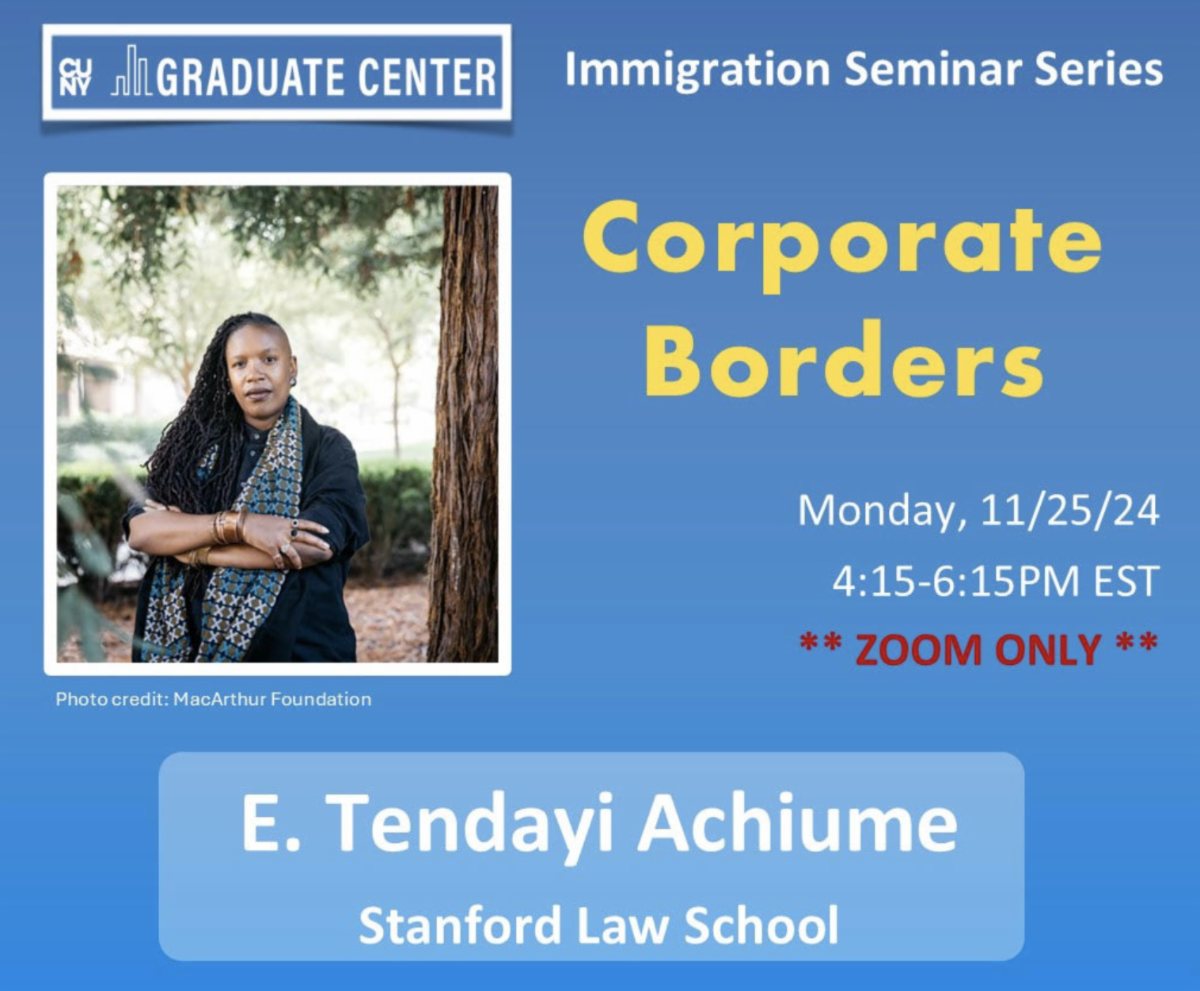
Next Monday: "Corporate Borders" With Professor E. Tendayi Achiume
Most legal theory treats border governance as a function of nation-state sovereignty, and as primarily the domain of the state. Yet transnational corporations have a long, colonial history of making and using borders and race together as technologies of economic profit. Even in the present, corporate enterprise plays a material role in constituting the meaning and application of national borders, and corporations profit immensely from forms of jurisdictional arbitrage made possible by legal categories, including racialized and racializing legal categories. The border is, in some meaningful but not totalizing sense, for and by the corporation, and ‘corporate borders’ are racial borders. This talk will explore a legal conception of, what I provisionally term racial corporate borders. It will also ask what difference it makes to engage with corporations as de facto sovereign or super-sovereigns as the baseline from which border justice is re-imagined. If the neocolonialism of borders, and the racial injustices embedded in these borders are significantly a corporate affair, what sort of reorientation is required in legal scholarship, advocacy and policymaking on the future of borders and migration governance?
Monday, November 25 | 4:15 to 6:15 EST | Virtual | Register
|  | |
||Podcast Recommendation|| | |
|
Listen - Dual Justice: America's Divergent Approaches to Street and Corporate Crime by Anthony Grasso
The United States incarcerates its citizens for property crime, drug use, and violent crime at a rate that exceeds any other developed nation – and disproportionately affects the poor and racial minorities. Yet the U.S. has never developed the capacity to consistently prosecute corporate wrongdoing. This disjuncture between the treatment of street and corporate crime is often narrated as hypocrisy. Others suggest that the disparity is rooted in a conservative backlash after the civil rights movement and the Great Society or a legacy of slavery, Jim Crow, and the racialization of crime.
In Dual Justice: America's Divergent Approaches to Street and Corporate Crime (U Chicago Press, 2024), Dr. Anthony Grasso interrogates the intertwined histories of street and corporate crime to find that the differences in punishment are more than modern hypocrisy.
| |
Are you passionate about an issue and would love to express your thoughts and research through our Aoki Blog? We would love to collaborate with on a post!
Reach out to Giselle at gigarcia@ucdavis.edu to get started! Don't forget to check out our Aoki Blog for inspiration!
| | | | |