ADVOCACY UPDATE

WHAT'S AHEAD IN LANSING THIS FALL

Courtesy of Karoub Associates, August 2026


With the state budget complete and the November election approaching, Michigan lawmakers return to Lansing facing a familiar challenge: finding common ground in a divided Legislature. Depending on the outcome of the November election, there may not even be a lame duck this year.


The Republican-led House and Democratic-led Senate remain far apart on many of the state’s biggest policy questions. While both parties are eager to show voters they are addressing the issues that matter most, the compressed legislative calendar means only a handful of major initiatives are likely to reach the governor’s desk.

Here’s where we expect lawmakers to focus their attention.


Affordability Takes Center Stage

Affordability will be the dominant theme if there is a fall session. House Republicans have prioritized broad property tax relief, lower utility costs and housing affordability, while Senate Democrats continue to emphasize targeted tax relief, health care affordability and protections for working families.


Although sweeping tax reform is unlikely to become law this year, narrower proposals addressing property taxes, homeowner relief and consumer costs could gain bipartisan support.


Energy and Health Care

Energy policy will remain a significant topic as lawmakers debate rising utility bills, electric grid reliability and implementation of Michigan’s clean energy laws. Large disagreements remain over the state’s long-term energy strategy, making targeted consumer protection and reliability measures more likely than comprehensive reform.

Health care also presents opportunities for bipartisan action. Hospital pricing transparency, medical debt, prescription drug costs and consumer protections all remain active issues that could advance before year’s end.


Education and Workforce

Although the school aid budget has already been approved, lawmakers are expected to continue discussions around literacy, student achievement, workforce development and educator shortages.


Broad changes to Michigan’s school funding system are unlikely this year, but more focused legislation involving reading proficiency, career and technical education, teacher recruitment and workforce development could continue moving through the legislative process.


Transparency and Election Administration

Government transparency remains a priority for Senate Democrats, particularly efforts to expand the Freedom of Information Act to cover the Legislature and governor’s office.


While comprehensive FOIA reform still faces significant political hurdles, narrower ethics and transparency measures could gain traction.


Election administration is another area to watch. A bipartisan proposal to move Michigan’s primary election from August to May has support from many election officials and stands a better chance than broader election policy debates.


Housing and Economic Development

Housing affordability continues to drive conversations around zoning, development incentives and first-time homeownership. At the same time, lawmakers are expected to continue debating Michigan’s economic development strategy, including business incentives, regulatory reform and workforce competitiveness.


While large new incentive programs appear unlikely, targeted licensing reforms and regulatory updates often become some of the session’s most successful bipartisan accomplishments.


What Is Most Likely to Pass?

The biggest political debates will not necessarily produce the biggest legislative accomplishments.


Major overhauls involving property taxes, school finance, energy policy and government transparency still face significant partisan obstacles. Instead, the measures most likely to become law are practical, bipartisan bills that solve specific problems, enjoy broad stakeholder support and carry limited fiscal impacts.


For organizations working in and around state government, the message is clear: broad policy conversations will dominate the headlines, but progress is most likely to come through targeted legislation with clear bipartisan appeal.


AAM will continue to work for you by collaborating with local, state, and federal partners to educate legislators on the realities of the multifamily rental industry and to support initiatives that focus on increasing housing supply rather than on regulation.

AAM’s LEGISLATIVE FOCUS


This current legislative term has proven challenging for virtually every industry sector seeking to advance substantive policy, largely due to the Legislature’s deeply divided political environment. Despite these challenges, AAM and its lobbying firm, Karoub Associates, have remained highly engaged, working strategically behind the scenes to build support, identify opportunities, and position priority housing policies for advancement while simultaneously working in opposition to regulatory bills that would harm the housing industry.


AAM’s primary focus has been on policies that increase Michigan’s housing supply and address barriers to housing development, including the Housing Readiness package. These proposals would modernize restrictive local ordinances and give communities greater flexibility to accommodate housing development through measures such as smaller lot sizes, reduced parking requirements, expanded opportunities for accessory dwelling units (ADUs), and streamlined planning and permitting processes. Increasing housing supply remains a critical component of addressing affordability and ensuring Michigan communities can meet growing housing demand.


At the same time, AAM has taken an equally strong position against proposals that would add significant regulatory burdens to housing providers. These efforts have included opposing rent control, restrictions on fees landlords may charge tenants, limitations on tenant screening practices, and proposals that would allow tenants to complete repairs themselves and charge the costs back to landlords. Through sustained lobbying, coalition building, and direct engagement with legislators, AAM has successfully helped prevent many of these proposals from advancing out of committee or gaining momentum as the Legislature approaches the lame-duck session.


While these efforts represent meaningful progress, now is not the time to ease up. The November election will significantly affect the makeup of the Legislature and, consequently, the direction of housing policy in the next session. The outcome will likely shape both the reintroduction of stalled housing legislation and the emergence of new proposals that would negatively affect rental housing providers if passed into law.


AAM and Karoub must therefore remain proactive and engaged through the remainder of this term, using the coming months to protect the industry’s interests, strengthen relationships with key policymakers, build support for housing-supply solutions, and prepare for what could be a substantially different legislative landscape in the next session.

AAM Member Seminar 

FHA AND AGENCY FINANCING

FOR MULTIFAMILY RENTAL PROPERTIES

9 15 2026 aam.jpg

Join us for a focused lunch seminar exploring FHA and Agency financing strategies for multifamily investors in today’s market. We’ll cover key differences, recent updates, current terms, and practical insights on navigating HUD and Agency executions to optimize your next transaction.


Guest Speaker: Charlie Krisfalusi - Walker and Dunlop

Charlie Krisfalusi is a senior director of Affordable Production at Walker & Dunlop, based in Birmingham, Michigan. In this role, he is responsible for originating multifamily loans, with a focus on the Midwest region. His proficiencies include acquisition, bridge, affordable housing, tax credit, and construction take-out financing. Mr. Krisfalusi has over 14 years of experience in the commercial real estate industry and has expertise in the lending programs of the U.S. Department of Housing and Urban Development (HUD), Fannie Mae, and Freddie Mac.


TUESDAY, SEPTEMBER 15 FROM NOON - 1:00 P.M.

Place: AAM FIRST FLOOR CONFERENCE ROOM 

30400 Telegraph Road, Bingham Farms, MI 48025


Cost: FREE TO AAM MEMBERS; $10 per guest, Includes lunch


Questions? Call Holly Tatman at 810-488-1157

AAM’s 2027 MULTIFAMILY RENTAL MARKET OUTLOOK

THURSDAY, NOVEMBER 19TH

AAM Forecast plus QR 11 2026.jpg

This is a must attend event for every multifamily property owner!


Timeline:

10:30 - 11:30 a.m. Registration & Networking Coffee Hour

11:30 a.m. Luncheon and Program


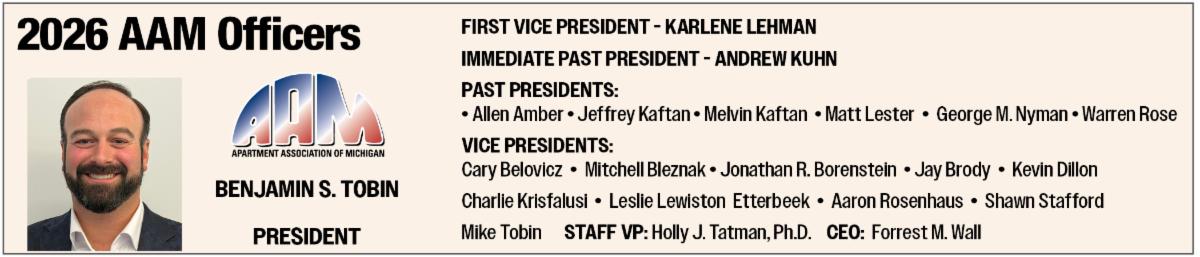
  • Outgoing President’s Remarks – Andrew Kuhn, Sunrise Communities
  • Incoming President’s Remarks - Benjamin Tobin, Group Five Management Co.
  • Market Outlook Update - Kevin Dillon, Berkadia Real Estate Advisors, LLC.


Expert Panel Discussion:  

  • ANDREW KUHN - Sunrise Communities: AI in Action: Practical AI & Technology Integration to Enhance Operations
  • LESLIE LEWISTON ETTERBEEK - LR Management: Winning the NOI Battle: Managing Costs Without Sacrificing Performance
  • MIKE TASSONI - Monarch: How Large Owners Invest: Acquisition Criteria & Portfolio Strategy
  • TBD - Financing Mechanisms And Capital Market Platforms


Location:      

The Townsend Hotel, 100 Townsend Street, Birmingham, MI 48009


Cost:         

Early Bird Pricing Through October 31:$110/Member; $249/Non-Member

Beginning November 1:$140/Member; $279/Non-Member


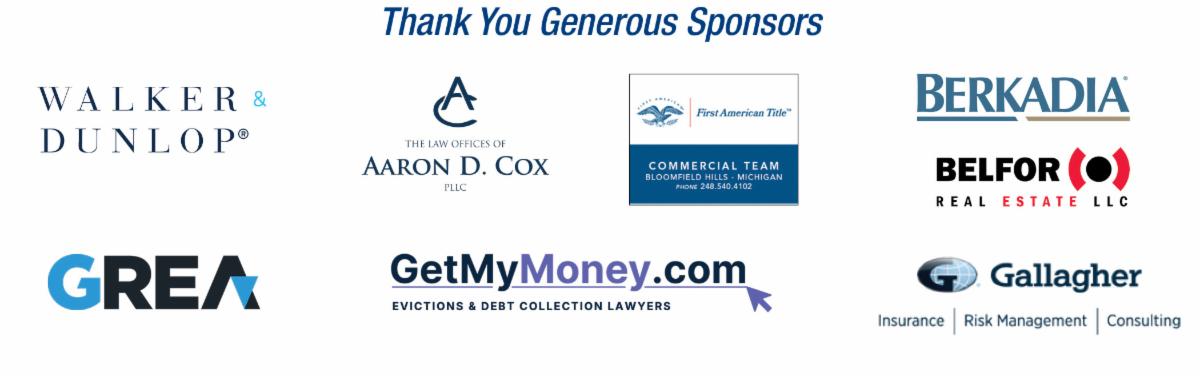
For information on becoming a sponsor, 
please contact Holly J. Tatman, Ph.D. at 810-488-1157

AAM Outlook Sponsors updated.jpg
QR for AAM PAC.png

THE IMPORTANCE OF YOUR PAC CONTRIBUTION

Just as important as membership, the Apartment Association of Michigan Political Action Committee (AAM-PAC) needs your support. AAM-PAC accepts contributions from members and aggregates them into one fund, which then financially supports those elected officials who understand the important role of rental housing in Michigan’s economy. You must be an AAM or HBA Member to contribute to the fund. Remember, an AAM-PAC contribution must be made via personal, partnership, LLP, or LLC check or credit card. Members - make your PAC Contribution online by scanning the QR Code or BY PRESSING HERE. 

QR for AAM Join.png

AAM MEMBERSHIP

We need your help to maintain our strong voice for the multifamily rental property industry. It starts with membership. Membership supports our staffing and lobbying efforts, as well as communications, education, and member benefits. For just $2.80 per unit (minimum dues $500), multifamily rental property owners can support the organization that tells your story in Lansing. Associate members (suppliers or service organizations) can join for $1,000 annually. If you are not currently a member, we strongly urge you to join today online BY PRESSING HERE. If you have questions about member benefits, contact AAM at 248-737-4477.

AAM Officers correct 8 26.jpg

FOLLOW US

Facebook