|
FROM THE PRESIDENT'S DESK: GROWING INTERCONNECTION IN HEALTH POLICY
By Jim Scott, President and CEO
| | |
Pricing decisions made in London, Berlin, or Tokyo don't stay there anymore.
That was the key takeaway from Beyond MFN: A Blueprint to Global Market Access Strategy, an event I moderated last month in Philadelphia. The conversation, which featured Applied Policy's Brittany La Couture and other market access experts from the United States and Europe, considered how Most Favored Nation drug pricing policies are reshaping manufacturers' approaches to market access and pharmaceutical reimbursement.
| | |
The participants did not agree on what the future will look like or how quickly changes will unfold. However, they shared a recognition that what a manufacturer accepts in one market can increasingly determine what it can charge in another, with consequences that extend far beyond any single country's formulary.
Interconnection is the thread running through this month's newsletter. Healthcare policy has always involved interconnected decisions, but those connections are becoming more complicated. Questions that once seemed specific to a single program, sector, or market now carry implications across the broader system, and translating policy decisions into operational practice is rarely straightforward.
This edition of Applied Policy Insight explores several examples of that dynamic. In addition to examining the international implications of MFN policies, we consider the key themes from the Northern Virginia Health Policy Forum's discussion of Medicare accountable care organizations and provide an overview of this month's HCPCS coding meeting. We also feature research on the long-term sustainability of physician payment under Medicare, conducted as part of an Applied Policy practicum project, alongside highlights from the May MACPAC meeting.
I am also delighted to introduce the newest members of the Applied Policy team.
As always, our goal is to help readers understand not only what is changing, but why those changes matter and what they may mean for the healthcare organizations, manufacturers, providers, and patients navigating them.
| | MFN POLICIES RESHAPE MARKETS AND MARKET ACCESS STRATEGIES | | Most Favored Nation drug pricing policies are creating a new strategic paradigm in which decisions made in one market can directly affect reimbursement in another. | | |
The Trump administration's Most Favored Nation drug pricing policies are reshaping global pharmaceutical market access. While some industry leaders maintain that the full impacts of MFN policies will not be seen until 2027, the early evidence suggests that changes in government, health system, and manufacturer policies and practices are already underway.
Historically, pharmaceutical manufacturers have been able to approach global market access as a collection of national or regional challenges that did not necessarily intersect. This allowed for the development of pricing and reimbursement strategies specific to individual markets. Companies could pursue the U.S. market separately from those in countries with different evidence requirements or payment models. While the individual approaches may have informed each other, they did not need to be managed as a single integrated strategy.
MFN drug pricing is altering this dynamic. Now, what a manufacturer accepts in one market can directly impact what it can charge in another. The commercial logic that once allowed for independent U.S. and international strategies is under growing pressure.
| | |
CMS HOLDS BIANNUAL HCPCS MEETING
By Sampat Nidadavolu, Health Policy Manager
| The June 1 HCPCS Public Meeting offered a look at how CMS evaluates new technologies, payment methodologies, and Medicare benefit categories before issuing final coding decisions. | |
The Centers for Medicare & Medicaid Services (CMS) convened its First Biannual 2026 Healthcare Common Procedure Coding System (HCPCS) Public Meeting on June 1 in Baltimore, Maryland. The meeting considered 53 products across 38 agenda items spanning wound care, compression therapy, neuromodulation devices, prosthetics, orthotics, and infusion systems. The items ranged from ocular pressure goggles for patients with glaucoma to a barrier designed to contain aerosolized medical waste when hospital toilets are flushed.
HCPCS Level II codes identify products, supplies, equipment, and certain drugs and biologicals used in Medicare billing and reimbursement. As Applied Policy has previously discussed, for manufacturers and suppliers, securing a code is often a critical step toward market access. However, a code alone does not guarantee reimbursement.
Prior to the public meeting, CMS’s HCPCS Workgroup reviews applications and issues preliminary determinations on whether a product warrants a unique code, whether it fits within an existing Medicare benefit category, and how it should be paid. The public meeting gives stakeholders an opportunity to respond to those determinations before they are finalized.
| | MEGHAN BASLER PROMOTED TO HEALTH POLICY MANAGER | |
Meghan Basler, MA, CPC, CPB | | |
Applied Policy is pleased to announce the promotion of Meghan Basler to Health Policy Manager.
Since joining the firm in 2022, Basler has become a trusted resource on reimbursement and health policy, helping our hospital and health system clients navigate complex payment systems, coding requirements, and regulatory changes. During her time at Applied Policy, she earned both her Certified Professional Coder (CPC) and Certified Professional Biller (CPB) credentials.
| | | | “Meghan has a remarkable ability to break down complex policy and reimbursement issues into practical guidance that helps our clients make informed decisions,” said Chief Operating Officer John Voorhees. “Her promotion reflects both the significant contributions she has made to the firm and her commitment to continued professional growth.” | | APPLIED POLICY WELCOMES LEXI HARTRANFT AS HEALTH POLICY ASSOCIATE | |
| | |
Applied Policy is pleased to welcome Alexis “Lexi” Hartranft as a Health Policy Associate.
Hartranft joins the firm with a background spanning public health research, federal oversight, and health policy analysis. She most recently served as an analyst with the U.S. Government Accountability Office (GAO), where she supported audits of federal agencies including CMS, helped agency leadership prepare for congressional testimony, and responded to technical assistance requests from Congress.
| | | | |
Hartranft began her GAO tenure as an Analyst Graduate Student Trainee while completing her Master of Public Health at the University of North Carolina at Chapel Hill. She has described being “drawn to public health because of the opportunity to make meaningful impacts on people's lives at a systems level,” a conviction that runs clearly through her career.
That commitment showed up in her work as research staff at the Center for Community Health Innovation in Virginia, where she focused on food access, physical activity, and childhood obesity. Among her contributions, she supported community planning efforts that identified a food desert and ultimately helped bring a grocery store and plaza to an underserved neighborhood—a tangible example of policy work translating into community change. She also presented research at the International Society of Behavioral Nutrition and Physical Activity Conference and co-authored work published in the Journal of Public Health Management & Practice.
“The opportunity to improve lives through health policy is what drew me to Applied Policy,” Hartranft said. “I am excited to combine my educational background and professional experience to help clients navigate complex healthcare challenges and support efforts to improve health outcomes.”
At Applied Policy, Hartranft will support hospital systems and healthcare organizations as they navigate an increasingly complex policy environment. She brings what she describes as “an eager, collaborative mindset and a supportive problem-solving approach” to her new position.
“We are delighted to welcome Lexi to Applied Policy,” said COO John Voorhees. “Her combination of research experience, federal policy expertise, and commitment to improving health outcomes will make her a valuable addition to our team.”
In addition to her Master of Public Health, Hartranft holds a Bachelor of Science in Health and Exercise Science from Roanoke College.
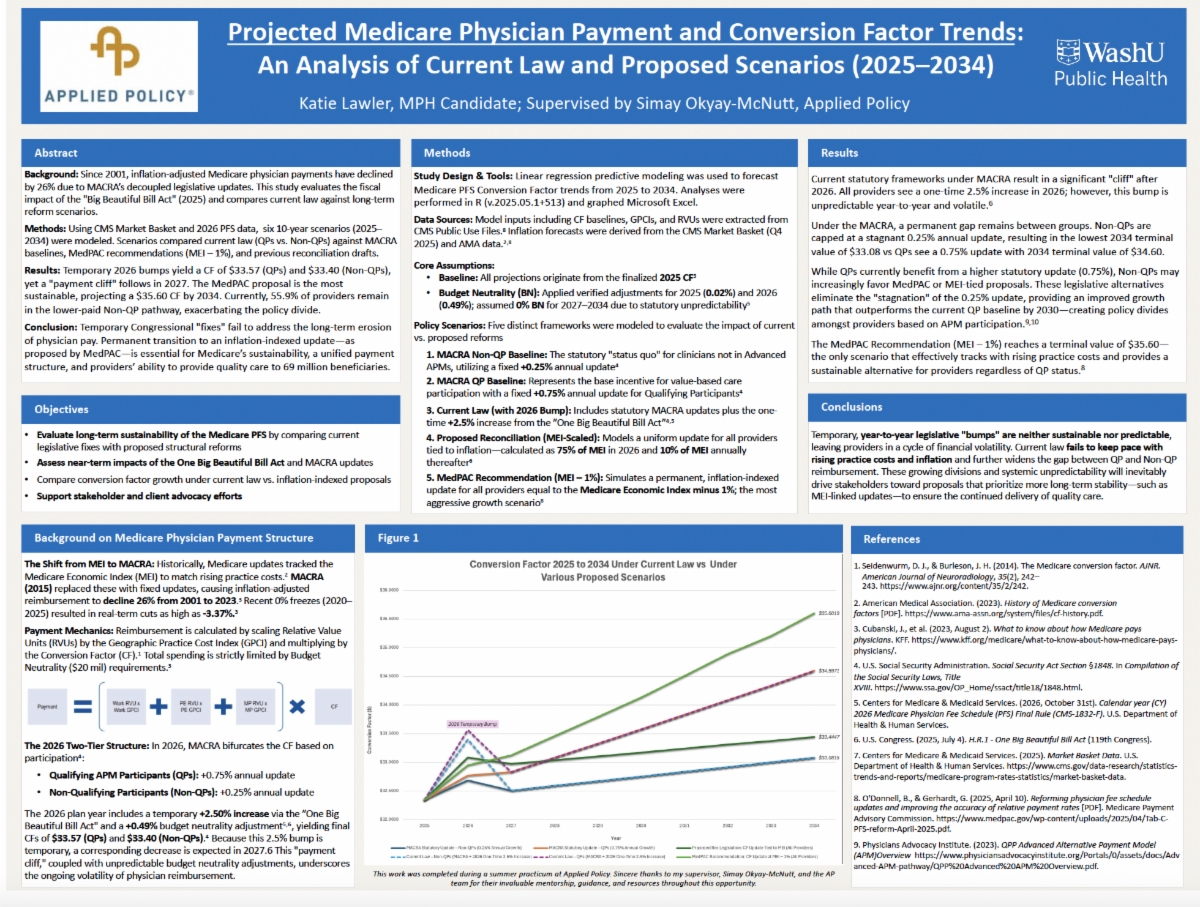
| | A 10-YEAR LOOK AT MEDICARE PAYMENT UNDER CURRENT LAW AND PROPOSED REFORMS | | Drawing on CMS data and long-range modeling, an Applied Policy practicum project examined competing approaches to Medicare physician payment reform. | | |
How sustainable is Medicare physician payment under current law?
The answer to this question has significant implications for physician reimbursement, practice sustainability, and the nearly 69 million beneficiaries covered by Medicare. It also served as the foundation for a recent practicum project conducted at Applied Policy examining Medicare Physician Fee Schedule conversion factor trends under current law and several proposed reform scenarios through 2034.
Completed by Katie Lawler with guidance from Senior Health Policy Manager Simay Okyay McNutt, the project drew on CMS data, long-range modeling, and policy analysis to examine how different update structures could shape physician reimbursement over the coming decade.
Lawler modeled six payment scenarios from 2025 through 2034, comparing current law against several proposed reform approaches, including inflation-linked updates and recommendations from the Medicare Payment Advisory Commission (MedPAC).
Among the findings was a projected “payment cliff” following temporary 2026 increases, as well as continued divergence between qualifying alternative payment model participants and other providers under the Medicare Access and CHIP Reauthorization Act (MACRA).
In presenting her findings at Washington University in St. Louis in May, Lawler noted that under current law, neither Alternative Payment Models (APMs) nor non-APM payment pathways keep pace with rising practice costs. “Although the temporary ‘bump’ helps, it won't keep pace with inflation down the line and is not guaranteed year-to-year.”
| | Click on image to download pdf of poster | | |
NVHPF CONSIDERS FUTURE OF MEDICARE ACOS
By Annie Tuttle, Health Policy Associate
| | As CMS prepares to launch the LEAD model in 2027, panelists examined the history, current state, and future of accountable care organizations. | | |
On May 27, the Northern Virginia Health Policy Forum hosted a discussion on The Future of Medicare Accountable Care Organizations (ACOs). Moderated by Jim Scott, President and CEO of Applied Policy, the conversation featured Emily Brower, President and CEO of the National Association of ACOs (NAACOS), and Sean Cavanaugh, Chief Policy Officer at Aledade and former Deputy Administrator and Director of the Center for Medicare at the Centers for Medicare & Medicaid Services.
The session considered how ACOs have become a central component of Medicare’s value-based care strategy and explored the two pathways Medicare offers providers: the Medicare Shared Savings Program (MSSP), a permanent program established under the Affordable Care Act, and models operated through the CMS Innovation Center (CMMI). Brower described ACOs as a model that “better supports the care delivery model primary care would do every day, if that’s what was paid for.” Cavanaugh noted that the concept has attracted bipartisan support because it seeks to improve care while lowering costs without reducing benefits or relying on provider payment cuts.
Much of the discussion focused on the Long-term Enhanced ACO Design (LEAD) model, CMMI’s newest ACO model. LEAD is set to launch on January 1, 2027, following the conclusion of the ACO Realizing Equity, Access, and Community Health (REACH) model at the end of this year. Brower explained that LEAD introduces a “whole practice” approach, often referred to as a full-TIN approach, that aligns more closely with MSSP by requiring all providers within a participating tax identification number to be included, rather than providing for the inclusion of only certain clinicians. She noted that this practice-based network configuration will result in more patients in the practice being included in the ACO. LEAD’s ten-year performance period, which is the longest CMS has tested for an ACO model, is intended to provide greater stability and predictability than prior CMMI models and to attract organizations that have historically remained outside of ACO participation, including smaller, independent, rural, and safety-net providers.
| | |
MACPAC APPROVES RECOMMENDATIONS FOR JUNE REPORT TO CONGRESS
By Emma Hammer, Health Policy Manager
| | |
At its May meeting, the Medicaid and CHIP Payment and Access Commission (MACPAC) voted on a series of recommendations that will be included in its June 2026 Report to Congress. The recommendations addressed automation in Medicaid prior authorization, implementation of Medicaid community engagement requirements, oversight of Programs of All-Inclusive Care for the Elderly (PACE), access to residential behavioral health services for children and youth, and transitions from pediatric to adult coverage for children and youth with special healthcare needs. Most recommendations received unanimous support.
Among the most notable actions, commissioners unanimously endorsed recommendations aimed at increasing transparency and oversight of automated prior authorization systems, including requirements for human review of adverse determinations. MACPAC also approved a recommendation urging CMS to develop a transparent framework for monitoring and evaluating Medicaid community engagement requirements and their effects on enrollment, employment, health outcomes, and program spending.
| | WELCOME TO OUR SUMMER INTERN CLASS | | |
Applied Policy is pleased to introduce its summer intern class.
Marissa Kieser is an incoming third-year Doctor of Pharmacy student at the University of Wisconsin, where she expects to complete her degree in 2028.
Marissa previously interned at Walgreens, where she helped patients understand medication regimens and navigate insurance barriers to accessing necessary medications. She has also completed clinical hours across a range of settings, including retirement homes, outpatient and independent pharmacies, large health systems, and small hospitals.
She is interested in building a career helping healthcare organizations navigate policy, medication access, and other barriers to providing the best possible care to patients.
Serene Nazare is a rising junior at the University of Southern California, where he is pursuing a Bachelor of Science in Public Health and a Master of Science in Healthcare Decision Analysis. He expects to complete both degrees in spring 2028 and ultimately intends to pursue a degree in dentistry, with a long-term goal of specializing in orthodontics.
Serene previously interned with the Association for the Advancement of Medical Instrumentation in its Standards Department, where he assisted with standards document processing, project data management, and editorial support activities.
Although only a few weeks into the program, Serene said he has already gained insight into the complexities of health policy, including how programs such as Medicare and Medicaid can change across administrations. He looks forward to continuing to develop his knowledge of health policy and healthcare consulting.
Erica Stephens joins Applied Policy with a Bachelor of Arts in Cognitive Neuroscience and Psychology from the University of Virginia and a Master of Public Health with a focus in Health Systems and Data Analytics from the Johns Hopkins Bloomberg School of Public Health, which she completed this spring.
Her background spans research, consulting, program evaluation, and risk analysis, with experience at institutions including Johns Hopkins Medicine, the NIH National Cancer Institute, and Citigroup. Across those roles, she has focused on translating data and research into practical solutions, work that reflects her broader interest in using policy, technology, and analytics to strengthen health systems and expand access to care.
That interest has personal roots. Growing up on a tobacco farm in rural Virginia, Erica saw firsthand how geography, provider shortages, and limited resources can shape access to care, an experience that informs her interest in rural health, maternal and child health, Medicaid, and digital health innovation.
| | On the Docket/Under Review | | |
Applied Policy is following these regulatory actions currently under review at the Office of Management and Budget:
- Strengthening Oversight of Accrediting Organizations (AO), Burden Reduction, and Related Provisions (CMS-3367)
- Medicare Drug Price Negotiation Program (CMS-4215)
- CY 2027 Hospital Outpatient PPS Policy Changes and Payment Rates and Ambulatory Surgical Center Payment System Policy Changes and Payment Rates (CMS-1850)
- CY 2027 Revisions to Payment Policies under the Physician Fee Schedule and Other Revisions to Medicare Part B (CMS-1848)
- CY 2027 Changes to the End-Stage Renal Disease (ESRD) Prospective Payment System and Quality Incentive Program (CMS-1846)
- Exchange Pre-Enrollment Eligibility Verification (CMS-9873)
- CY 2027 Home Health Prospective Payment System Rate Update and Home Infusion Therapy Services Payment Update (CMS-1844)
- Strengthening the Integrity of Medicaid and CHIP Managed Care, Financing, and Access to Care (CMS-2450)
- Request for Information: Comprehensive Review of the Essential Health Benefits Framework and Typical Employer Standard (CMS-9874)
- Short-Term, Limited-Duration Insurance (CMS-9881)
- Request for Information: Clinical Laboratory Improvement Amendments (CLIA) of 1988 Regulations (CMS-3485)
- Request for Information: Pharmacy Benefit Manager Compensation and Data Collection (CMS-4218)
See all rules under OMB review here.
| | Applied Policy continues to track executive orders that could impact healthcare and health policy. Access our regularly updated page below. | | EO CALLS FOR REVIEW OF CHILDHOOD VACCINE RECOMMENDATIONS | |
On May 29, President Trump issued an executive order directing federal agencies to align U.S. childhood vaccine recommendations with what the administration describes as the scientific consensus and best practices of peer, developed countries.
The order follows a Department of Health and Human Services (HHS) assessment comparing U.S. immunization recommendations with those of other developed countries, examining vaccine uptake, public trust, clinical evidence, and vaccine mandates. The assessment, for which former acting director of the FDA’s Center for Drug Evaluation and Research Tracy Beth Høeg was co-lead, found that the United States recommends more childhood vaccine doses than peer nations and identified a subset of vaccines consistently recommended across those countries.
The order instructs the Centers for Disease Control and Prevention (CDC) and its Advisory Committee on Immunization Practices (ACIP) to review the assessment and consider updates to the childhood and adolescent immunization schedule, including recommendations that provide greater flexibility in the timing and sequencing of routine vaccinations. It also instructs federal agencies to align immunization-related regulations, funding, and coverage policies with any revised CDC schedule while continuing to ensure coverage without cost sharing for all vaccines included on the schedule through private insurance, Medicaid, the Children's Health Insurance Program, and the Vaccines for Children Program.
The order also emphasizes protections for parental authority, religious liberty, disability accommodations, and equal protection under the law, and directs HHS to share the assessment with state officials as a resource for evaluating state vaccination policies.
| | INSIGHT JOKE OF THE MONTH FOR JUNE | | How do you host a party in space? | | | | Follow Applied Policy on LinkedIn for updates on our research, events, and policy analysis. | | Questions, comments, or concerns? Please contact us at news@appliedpolicy.com | | | |
Applied Policy, L.L.C., is a health policy and reimbursement consulting firm strategically located minutes from Washington, D.C.
| | | | |