|
ARTICLES
OTHER INFO
- Upcoming Events
- Resources
- Payments Grants and Loans
INFORMATION FOR LIVESTOCK KEEPERS
SURVEYS
| |
|
Maine Weather and Climate Update
The latest National Weather Service (NWS) forecast shows generally seasonable weather for the next several days with temperatures near normal and two or three precipitation events. On Saturday, a spring storm system will bring mostly rain to the southern half of the state and rain, snow, and mixed precipitation across the north. Daytime high temperatures are forecast to range low 40s to mid 30s south to north. The storm passage will bring colder air for Sunday and lingering flurries with high temperatures ranging 30s to 20s south to north. A weaker storm system is forecast overnight Monday. Temperatures are forecast this week with highs in the 40s and 50s in the south and 30s and low 40s in the north. A warm wave could develop mid to late week bringing precipitation, mostly rain, statewide. As always, be sure to check weather.gov for the latest weather forecast for your area. For detailed winter weather information refer to the NWS Caribou and Gray forecast office pages.
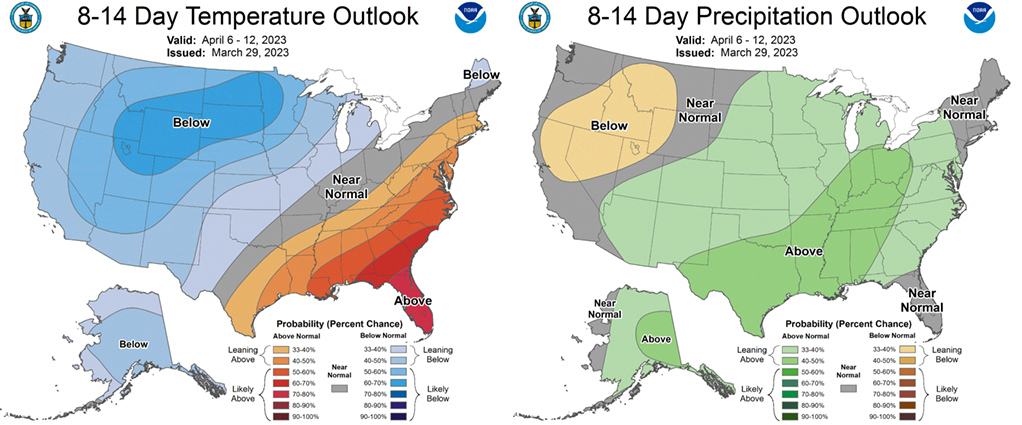
The NWS Climate Prediction Center 8–14 day outlook probability maps for April 6–12 show below to near normal temperature and normal precipitation. The one-month outlook for April (issued March 16) leans above normal temperature and equal chance of above or below normal precipitation. Looking further out, the three-month seasonal outlook for April–June (issued March 16) also leans toward above normal temperature and equal chance of above or below normal precipitation.
Hydrology: The Northeast Drought Early Warning System Dashboard shows most streamflow and groundwater gauges reporting normal conditions statewide, but there are lingering 30-day and 60-day precipitation deficits. The NWS Regional Snow Analysis maps also suggest that snowpack and extent is near normal for the end of March. Early drought indicators are being monitored closely as the spring melt continues these nest few weeks.
Sean Birkel, Assistant Extension Professor, Maine State Climatologist, Climate Change Institute, Cooperative Extension University of Maine. For climate/weather questions related to agriculture, send Sean e-mail at birkel@maine.edu
| | |
|
Maine Food Convergence
The goal of the 2023 Convergence Event is to co-create a space for the Convergence Community to explore how shifts in the food system can advance social and racial equity while also increasing climate resilience. The event will facilitate conversations, most of which will center voices of those who have experienced inequities within our food system. It will help participants connect, deepen relationships, explore collaborations, and celebrate each other while working towards an equitable climate and food future.
May 18: Virtual Only Event Tickets
May 25th: Virtual & In-Person Tickets
| | |
|
|
UMaine Extension opens farm labor and compensation practices survey
Please consider participating in this survey to gather data about farm labor and compensation. The study will help researchers provide information to agricultural operators and workers about average wages and benefits that can be used in your decision making.
The survey is anonymous and takes approximately 30 minutes. Participants will have a chance to enter a drawing to win a $75 gift card to a farm outfitter (such as Tractor Supply).
To participate, follow this link to the survey to begin: https://bit.ly/2023AgLaborSurvey Please respond to the survey by 20 April 2023.
| | |
|
|
Conservation Innovation Grants
NRCS is announcing the availability of Conservation Innovation Grants (CIG) State Program funding to stimulate the development and adoption of innovative conservation approaches and technologies. CIG generally funds pilot
projects, field demonstrations, and on-farm conservation research. Applications due: May 19, 2023 Applications must be received by 11:59 pm Eastern Time.
| | |
|
|
Hygienic Design for Harvesting and Handling Equipment
Three produce harvesting and handling equipment workshops will be offered in April. Come learn about how to assess the cleanability of your equipment and any modifications made to your equipment. Chris Callahan from UVM and Robson Machado from UMaine will talk about cleaning & sanitizing and equipment design considerations. A checklist will be provided that can be used to assess your own equipment.
- April 4: Wild Blueberry Growers Workshop
- April 5: Apple Growers Workshop
- April 6: Vegetable Growers Workshop
Register at the UMaine Extension Agricultural Workshop website, contact Theresa.Tilton@maine.edu or call 207-942-7396.
| | |
|
Open Farm Day Signup
It's time for farms to sign up for Open Farm Day; the deadline is May 1. The event is July 23. There will be a webinar April 5th at 5 pm for farms who want to learn more. RSVP here. More information and resources including how to signup for Open Farm Day 2023.
| | |
|
|
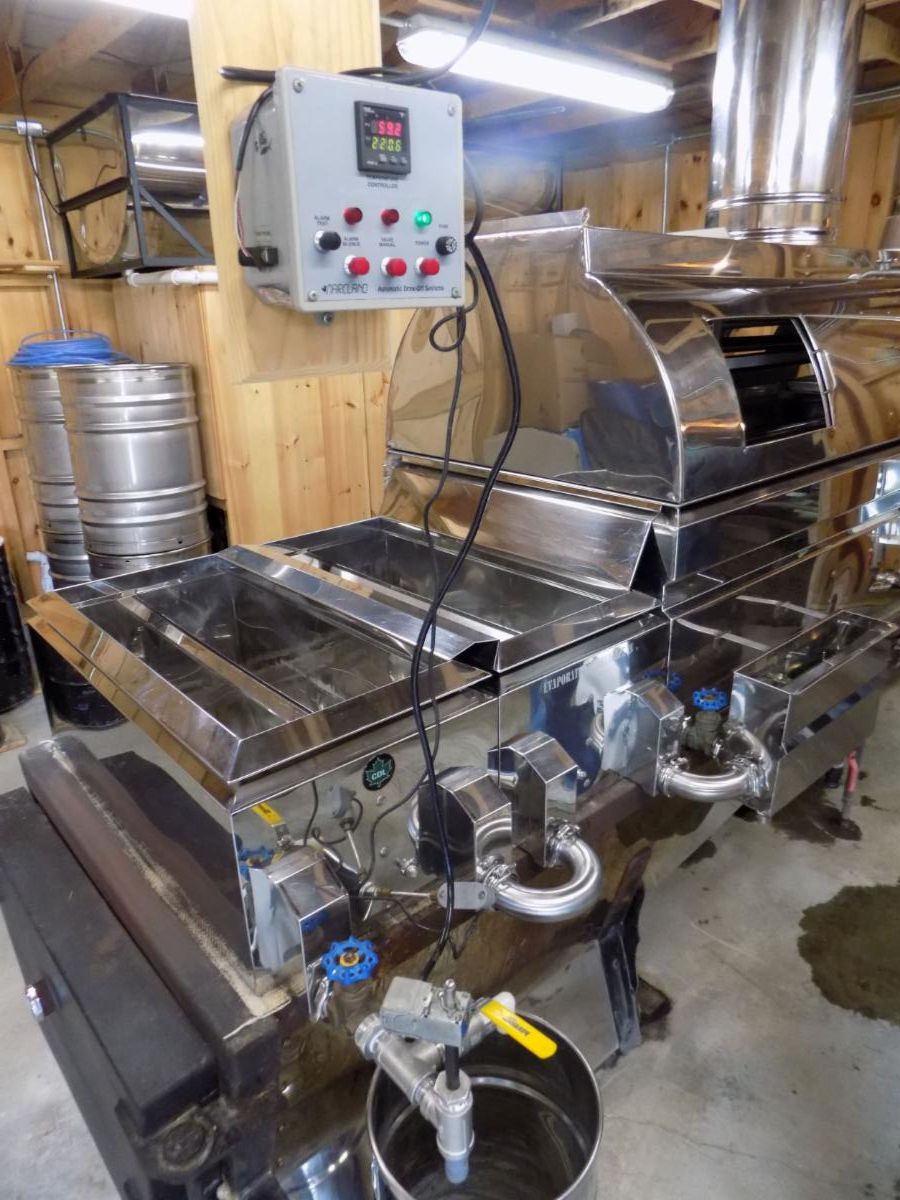
Diversification of the Syrup Industry
Syrup is most commonly produced from maples, but other types of trees can also be used. For example, there is a large birch syrup industry in Alaska and Canada, there are a handful of commercial walnut syrup producers in the U.S., and there is a commercial beech syrup producer in New York. These syrups are growing in popularity and typically sell for 4 to 6 times the price of maple syrup. Sugar maple has many advantages that make it particularly well-suited for syrup production but technologies developed to improve the efficiency of maple syrup production—such as vacuum pumps and reverse-osmosis filtration—have created possibilities for expanding to other species. Novel syrups provide consumers with new flavors and new economic opportunities for producers.
A recent UNH research report on the Diversification of the Syrup Industry detailed some preliminary results from the saps of trees other than maple that may need to utilize reverse osmosis to become feasible since they are more dilute than sugar maple sap. They did conduct taste test and willingness to purchase these alternative syrups. Read more about their research results here.
Source: UNH INSPIRED, a publication of the New Hampshire Agricultural Experiment Station (Winter 2023)
| |
Meetings - Webinars - Upcoming Events | |
|
Sessions preceded by ** are eligible for Pesticide Re-certification Credits.
-
April 1: 29th Rural Living Day, Mt. View HS, Thorndike
-
April 2: Seed and Scion Exchange, Unity
-
April 3: Low Infrastructure Agritourism: Picnicking and Walking Trails, online
-
April 4: Growing Great Tomatoes, Peppers, Melons and More!, online
-
**April 4: Produce Harvesting & Handling Equipment Wild Blueberry Growers Workshop, Hope
-
April 4: Diagnosing Plant Problems: AmericanHort, online
-
April 5: Open Farm Day Ideas Webinar, online
-
**April 5: Produce Harvesting & Handling Equipment Apple Growers Workshop, Monmouth
-
Apr. 6: Identity and Identification in Rural Collective Entrepreneurship (agritourism focus), Orono or online
-
**Apr. 6 Hygienic Equipment Design for Vegetable Growers, Auburn
-
April 11: Beyond the Apple: Growing Unique Fruit in Maine, online
-
April 11: Global Agritourism Network (GAN) Lauch, online
-
April 18: NH Vegetable & Berry Growers’ Roundtable: Strawberries Planting & Harvesting System, online
-
April 18, 19, 27, 28: F2I: Farm to Institution New England, online & Rhode Island
-
April 19 to 26: Start Your Maine 4-H Volunteer Journey, online
-
April 20: Policy Approaches for Dual-Use and AgriSolar Practices, online
-
April 20: Mushroom Workshop: Outdoor Log Production and Indoor Growing, Food Safety Considerations, online
-
April 20-21: Produce Safety Alliance Grower Training, online
-
April 27: Swine 101: Raising Pasture Pork
-
April 27: Mushroom Workshop: Value-added Processing, Packaging, and Labeling, online
-
May 1: Adolescent Mental Health, online
-
May 1: Deadline to sign up for Open Farm Day (July 24)
-
May 3: Washing, Skirting, and Preparing a Freshly-Shorn Fleece from the Shakers’ Flock, New Gloucester.
-
May 4 : Mushroom Workshop: Marketing and Sales, online
-
May 12 – 14: Maine Fungi Fest, Portland
-
May 13 & 14: Maine State 4-H Youth Conference, Windsor Fairgrounds
-
May 18 Maine Food Convergence, online
-
May 25: Maine Food Convergence, Winthrop
-
July 21: Northeast Mechanical Weed Control Field Day, Thorndike
-
July 23: Open Farm Day, MDACF
| |
Information for Animal Keepers | | |
|
|
Organic Livestock Producer Parasite Management Survey
At UC Davis School of Veterinary Medicine and UC Agriculture Natural Resources Cooperative Extension, we have designed a survey aimed at cattle, sheep, or goat producers that are Certified Organic, in transition to be certified, or implementing organic practices. Our goal is to learn about: a) dewormers drugs used and the perceived efficacy, and b) integrated parasite management practices and their perceived efficacy.
Survey results will help us to identify critical areas that need additional research or extension services related to parasites management in organic production.
Click here to participate in the survey.
If you have any questions, comments or concerns please contact the principal investigators (Dr. Alda Pires: pireslab@ucdavis.edu and Dr. Noelia Silva del Rio: nsilvadelrio@ucdavis.edu) or Teresa Miranda at teresa.fernandes.miranda@gmail.com
| | |
|
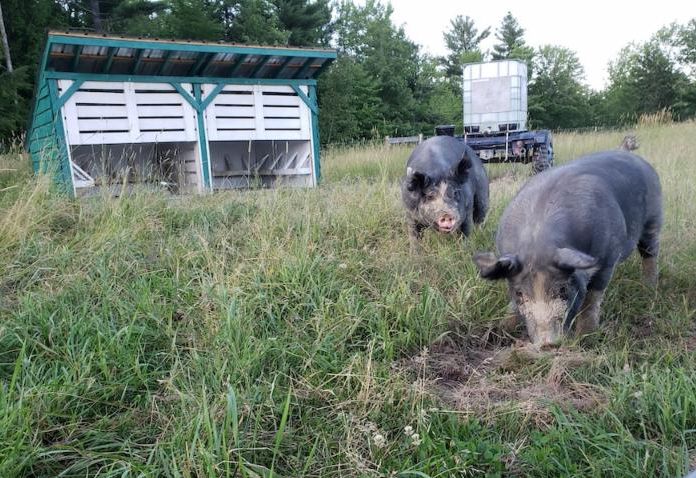
Swine 101: Raising Pastured Pork
This seminar will be held in multiple locations across the state, and a meal will be provided at no cost (smoked pork!). Join Dr. Colt W. Knight, UMaine Extension State Livestock Specialist, for a 2-hour primer on raising pastured pork. Topics include: breed selection, basic reproductive information, swine nutrition, fencing, housing, meat yield, and more.
Thursday, April 27, 2023. 11:00 AM to 1:00 PM
More info and registration.
| | |
|
|
The Nature Conservancy's Grazing Lands Program Survey
The purpose of this study is to validate and refine a set of indicators that are relevant and feasible for ranchers to collect and monitor, and that can support ranch management, reporting to agencies and market actors, and storytelling to consumers and the public. This survey is intended for ranch and rangeland owners, operators, and employees, and is focused on understanding current approaches and challenges to ranch planning and monitoring, as well as additional needs and approaches to monitoring that could improve long-term ranch viability. The results will be used to inform the development of the final TNC Toolbox as a resource for ranchers and other actors in the supply chain.
It will take about 20 minutes to complete and at the end of the survey you can provide your contact information to be entered into a drawing for a $50 gift card.
Click here to take the survey.
| |
|
National Cover Crop Survey -
Farmers are invited to share their thoughts on cover crops in an online survey at bit.ly/CoverCrop23. Why do you plant cover crops…or why don’t you? What do you want to know? Your insight will help guide research, communications, seed development, and more. After completing the questionnaire, you may enter a drawing for one of three $100 Visa gift cards.
Project ITCH: “Is Tick Control Helping?”
The New England Center of Excellence in Vector-Borne Diseases (NEWVEC) is seeking your help in better understanding residential tick control recommendations and results.
Phase 1, NEWVEC survey about what you are doing at your home to reduce the incidence of ticks and tick bites. Participants in this survey will be eligible for consideration for Phase 2.
Phase 2, NEWVEC through a lottery process select residential properties to participate in a research study to test what’s working. Participating selected households will get free evaluation of their property.
To learn more about NEWVEC and Project ITCH, and/or sign-up to receive updates on NEWVEC projects go to their website.
Fruit and Vegetable Grower Feedback Needed on Produce Safety Costs, Needs, and Barriers
The Produce Safety Alliance (PSA) Team and personnel from the Northeast Center to Advance Food Safety (NECAFS) at the University of Vermont would like to understand the costs and the barriers of beginning or expanding food safety practices on farms and in packinghouses to make educational materials more relevant to fruit and vegetable growers and packers. To do this, we have developed a survey to collect food safety information from fruit and vegetable growers across the country.
| |
|
USDA Ag Marketing Service
| |
Edited by:
Brett Johnson, Extension Professional,
Nick Rowley, Extension Professional,
Chris Howard, New Farms Project
| |
Information in this publication is provided purely for educational purposes. No responsibility is assumed for any problems associated with the use of products or services mentioned. No endorsement of products or companies is intended, nor is criticism of unnamed products or companies implied.
Photos by Edwin Remsberg and others.
| |
|
University of Maine Cooperative Extension: Penobscot County
307 Maine Ave Bangor, ME 04401 207-942-7396 or 800-287-1485
Visit Our Website
University of Maine Cooperative Extension: Piscataquis County
207-564-3301 or 800-287-1491
Donna Coffin - Voicemail 207-262-7726
Visit Our Website
University of Maine Cooperative Extension: Cumberland County
(207) 781-6099 or 1-800-287-1471
Visit Our Website
University of Maine Cooperative Extension: Oxford County
207.743.6329 or 1.800.287.1482
Visit Our Website
University of Maine Cooperative Extension: Somerset County
207.474.9622 or 1.800.287.1495
Visit Our Website
University of Maine Cooperative Extension: Androscoggin / Sagadahoc Counties
207.353.5550 or 1.800.287.1458
Visit Our Website
| |
In complying with the letter and spirit of applicable laws and pursuing its own goals of diversity, the University of Maine System does not discriminate on the grounds of race, color, religion, sex, sexual orientation, transgender status, gender, gender identity or expression, ethnicity, national origin, citizenship status, familial status, ancestry, age, disability physical or mental, genetic information, or veterans or military status in employment, education, and all other programs and activities. The University provides reasonable accommodations to qualified individuals with disabilities upon request. The following person has been designated to handle inquiries regarding non-discrimination policies: Director of Equal Opportunity, 101 Boudreau Hall, University of Maine, Orono, ME 04469-5754, 207.581.1226, TTY 711 (Maine Relay System). 11/22 | | | | |