|
Greetings from PCAP!
Last month has been very busy for PCAP, with nine webinars and four in person seminars that included presentations about habitat management for different species at risk: Northern Leopard Frogs, Loggerhead Shrikes, Sprague's pipits, Baird's Sparrows, Chestnut Collared longspur, Ferruginous Hawks and others.
More than five hundred people also enjoyed eight webinar presentations during the PCAP Prairie's Got the Goods Week, which addressed a variety of topics such as wetland ecology and management, wetlands' flood control, the influence of grazing and beef production on native prairie biodiversity and carbon sequestration, among other momentous themes. If you miss any of these presentations, or you want to watch some of them again, please visit our PCAP YouTube Channel
here.
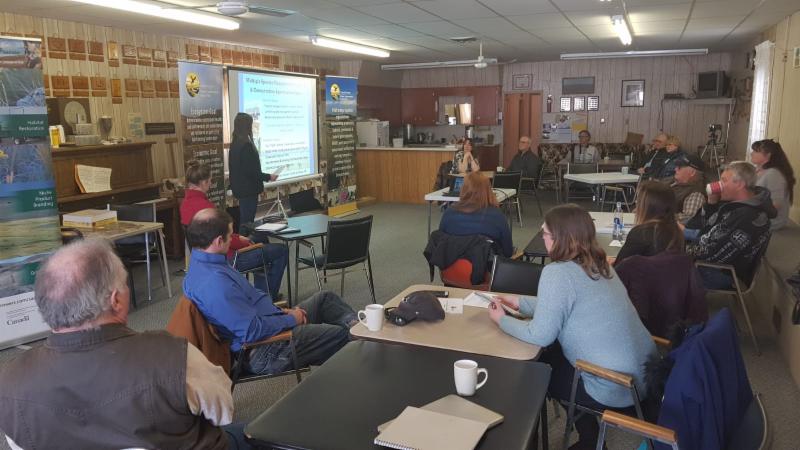
PCAP also hosted, along with SODCAP Inc., a successful workshop for landowners and land managers about implementation of Multiple Species Management plans in the prairie region. The workshop, held in Consul, SK on March 12, was followed by annual Nature Saskatchewan's Conservation Appreciation Supper.
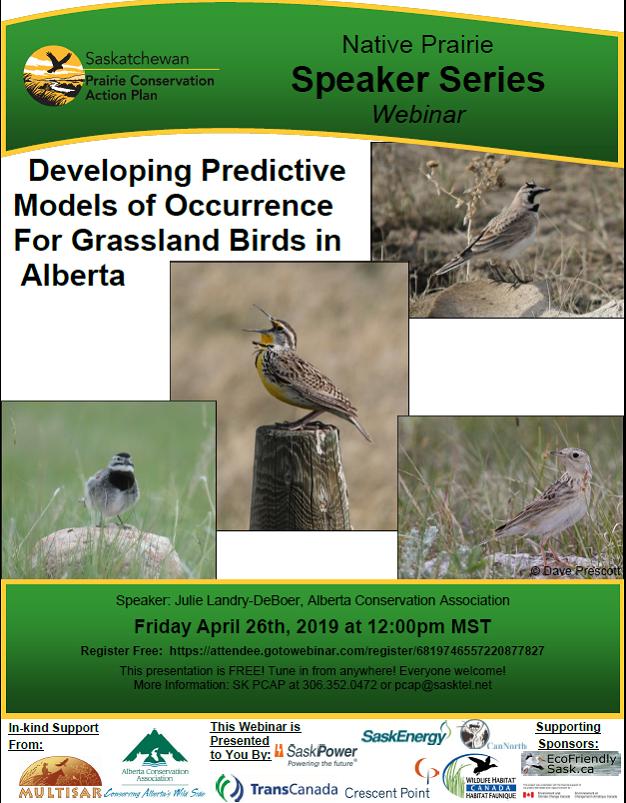
For the April edition of the Native Prairie Speaker Series, Julie Landry-Deboer from the Alberta Conservation Association will be presenting about predictive models for grassland songbirds. Please register for free
here!
Finally, we would like to thank the generous support from our sponsors: Crescent Point Energy, SaskEnergy, SaskPower, SaskWater, TransCanada, CanNorth, Mosaic, EcoFriendly Sask, Wildlife Habitat Canada and Environment and Climate Change Canada, as well as the continuous support of all the PCAP's Partners.
Please feel free to contact us at any time; we are pleased to receive your questions, comments or new programing ideas.
Sincerely,
Diego Steinaker, SK PCAP Manager
Caitlin Mroz,
SK PCAP Stewardship Coordinator
Julie-Anne Howe,
SK PCAP Education Coordinator
Ph. 306 352 0472
pcap@sasktel.net
|
SK PCAP WEBINAR
Native Prairie Speaker Series
Julie Landry-Deboer, Alberta Conservation Association
Friday April 26, 2019 - 12:00 pm MST
|
Multiple Species
Management
Workshop
On March 12th, SK PCAP and SODCAP Inc.organized a Workshop for landowners and land managers on Multiple Species Management Managers. Presenters included Katherine Taylor and Brad Downie form the Alberta Conservation Association, Maggi Sliwinski from
Grasslands National Park,
Krista Connick Todd from SODCAP Inc. and PCAP's Chair Orin Balas. The workshop also included a ranch planning activity, lead by Krista. The workshop was followed by the Nature Saskatchewan's Conservation Appreciation Supper.
|
|
Assuming a steady state between carbon (C) gains and losses,
greenhouse gases (GHG) inventories that follow a widely used simplified procedure (IPCC Tier 1) tend to underestimate the capacity of soils in
grazing-land
to sequester C. In this study we compared the C balance reported by (i) national inventories that followed the simplified method (Tier 1) of IPCC (1996/2006), with (ii) an alternative estimation derived from the
meta-analysis
of science-based, peer-reviewed data. We used the global databases (i) EDGAR 4.2 to get data on GHG emissions due to land conversion and livestock/crop production, and (ii) HYDE 3.1 to obtain historical series on land-use/land cover (LULC). In terms of sequestration, our study was focused on C storage as soil organic carbon (SOC) in rural lands of four countries (Argentina, Brazil, Paraguay and Uruguay) within the so-called MERCOSUR region. Supported by a large body of scientific evidence, we hypothesized that C gains and losses in grazing lands are not in balance and that C gains tend to be higher than C losses at low livestock densities. We applied a two-way procedure to test our hypothesis: i) a theoretical one based on the annual conversion of belowground biomass into SOC; and ii) an empirical one supported by peer-reviewed data on SOC sequestration. Average figures from both methods were combined with LULC data to reassess the net C balance in the study countries. Our results show that grazing lands generate C surpluses that could not only offset rural emissions, but could also partially or totally offset the emissions of non-rural sectors. The potential of grazing lands to sequester and store soil C should be reconsidered in order to improve assessments in future GHG inventory reports.
|
|
by Cameron N. Carlyle (University of Alberta)
Cattle and beef production have gained a negative opinion by some segments of the general public. However, past research done within the Canadian Prairie and in other regions have demonstrated that with appropriate management, cattle on native grasslands can increase some of the EG&S that we value. The cattle industry through the maintenance of large areas of native grasslands, rather than crop production, support wildlife habitat and avoid the loss of carbon that occurs with cultivation. Many studies highlight that moderate levels of grazing maintain biodiversity and soil carbon at levels above what these systems provide when grazing is removed, and especially above the level provided by other land uses, such as cultivation. Currently though, with few exceptions, the primary revenue from grasslands is by beef production. Conservation of these lands through policy that provides incentives to landowners to continue grazing these lands at moderate rates, rather than alternate land-uses, is key to the long term maintenance of EG&S and human well-being.
|
|
PCAP's Webinar Presentations Online!
Prairie's Got the Goods Week (March 18-22, 2019) was
a week-long series of webinars about the ecological goods and services provided by Native Prairies. You can watch the presentations online now in the following links:
8. "The influence of grazing management on plant community diversity and production across Western Canada", by Jessica Grenke (U of Alberta).
|
|
| |
|
|
|
Upcoming Events!
April 10th, 7 -8:30 pm,
Yorkton, SK
April 17th, 7-8:30 pm,
Swift current, SK
April 10th, 5-6 pm,
Regina, SK
April 11th, 5-6 pm, Saskatoon, SK
by Julie Landry-Deboer
April 15th (12:00 PM CST)
NCC Habitat Restoration
April 27 th, 2019, 10 am - 3 pm
Fairy Hill, Regina, SK
NCC Habitat Restoration
May 4
th (Saturday)
form 9 am to 3 pm
Meeting Lake, Saskatoon/Prince Albert
Back to the Field Workshop
SRM - Prairie Parkland Chapter
May 28-29 -
Val Marie, Sk
---------------------------
Conferences and webinar presentations online:
or
|
Petition to the Minister of Environment and Climate Change. As well as loss of native prairie, we are losing wetlands at a great rate. Grassland species rely on wetlands as part of the prairie ecosystem. The petition requests that drainage projects be physical activities requiring an Environmental Assessment under the Canadian Environmental Assessment Act, 2012.
For more information and sign the petition please visit this page.
Close for signature: April 3, 2019 at 11:47 am (EDT).
|
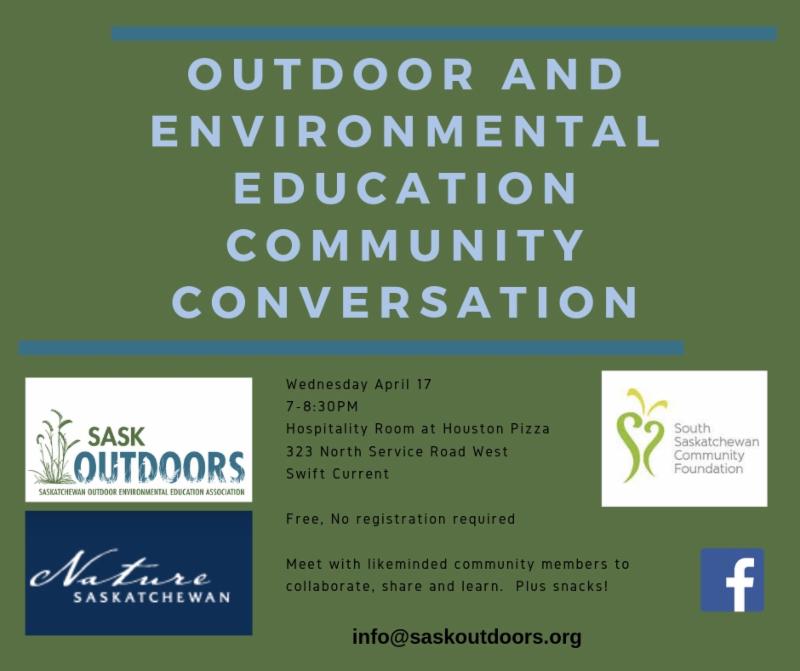
OUTDOOR AND ENVIRONMENTAL EDUCATION COMMUNITY
CONVERSATION
Friday April 12, 7-8:30 PM
Yorkton Public Library
Wednesday April 17, 7-8:30 PM
Hospitality Room at Houston Pizza
323 North Service Road West,
Swift Current
Free. No registration required.
info@saskoutdoors.org
|
Celebrate National Volunteer Week with NCC in Regina and Saskatoon!
Regina Volunteer
Appreciation Night
Where: Bushwakkers (2206 Dewdney Ave), Regina
Wednesday, April 10, 2019
5:00 to 6:00 p.m.
Saskatoon Volunteer Appreciation Night
Where: The Two Twenty (220 20 Street West), Saskatoon
Thursday, April 11, 2019
5:00 to 6:30 p.m.
Join NCC staff, Board members and Conservation Volunteers for a casual meet and greet! We will enjoy a short presentation about current research and volunteer programming. The rest of the time can be spent mingling and meeting new, like-minded people. Some beverages and appetizers will be provided.
----------------------------------------
NCC Habitat Restoration
April 27 th, 2019, 10 am - 3 pm
Fairy Hill, Regina, SK
----------------------------------
|
|
NatureCity Festival!
Tuesday, May 21 to Sunday, May 27
Saskatoon, SK
The
seventh
annual NatureCity Festival is set to run from Tuesday, May 21 to Sunday, May 27, with a varied line-up of opportunities to get outside and enjoy the excitement of spring on the prairies -- right here in beautiful Saskatoon. Since the Festival's beginnings in 2013, we have shared our collective love for Nature with thousands of our neighbours, young and old alike, and we have begun to situate care and respect for the natural world as a civic priority.
For more information please visit this website.
|
|
The Saskatchewan Co-operative Wildlife Management Survey
The Saskatchewan Co-operative Wildlife Management Survey, formerly the Co-operative Deer Management Survey, is a long-standing, volunteer-based survey that provides the ministry with valuable productivity and herd structure information. Participants have the opportunity to conveniently record observations using the new mobile SK CWMS application, that is compatible with both Apple and Android smart phones.
Although the SK CWMS application will allow participants to record observations at any time of year, there are key periods where it is particularly important to record your observations for each species:
- White-tailed deer and mule deer: Sept 1 to Nov 30
- Moose: Sept 1 to Dec31
- Elk: Sept 1 to Feb 28
- Sharp-tailed Grouse: March 1-July 15
- Wild Turkey: Dec 1 to March 1
|
|
Diego Steinaker, Editor, Saskatchewan Prairie Conservation Action Plan Newsletter
306-352-0472 |
|
|
SK PCAP gratefully acknowledges financial support in 2018-2019 from:
Ducks Unlimited Canada, Canada North Environmental Services, EcoFriendlySask.ca, Information Services Canada, Parks Canada - Grasslands National Park of Canada, Rancher's Stewardship Alliance Inc., Saskatchewan Cattlemen's Association,
Saskatchewan Ministry of Agriculture, Saskatchewan Ministry of Environment - Fish and Wildlife Development Fund,
SaskEnergy,
SaskPower, SaskTel, University of Saskatchewan - College of Agriculture and Bioresources, Water Security Agency.
SK PCAP gratefully acknowledges in-kind support for 2018-19 from:
Agriculture and Agri-Food Canada - Science and Technology Branch, Canadian Parks and Wilderness Association, Canadian Western Agribition, Environment Canada - Canadian Wildlife Service, Friends of Wascana Marsh, Meewasin Valley Authority, Native Plant Society of Saskatchewan, Nature Conservancy Canada, Nature Saskatchewan, Parks Canada - Grasslands National Park, Prairie Wind & Silver Sage, Ranchers Stewardship Alliance Inc., Redberry Lake Biosphere Reserve, Saskatchewan Association of Rural Municipalities, Saskatchewan Association of Watersheds, Saskatchewan Cattlemen's Association, Saskatchewan Environmental Society, Saskatchewan Forage Council, Saskatchewan Forage Industry Network, Saskatchewan Ministry of Agriculture, Saskatchewan Ministry of Environment, Saskatchewan Ministry of Economy, Saskatchewan Ministry of Education, Saskatchewan Ministry of Tourism, Parks, Culture and Sport - Royal Saskatchewan Museum and Friends of the Royal Saskatchewan Museum, Saskatchewan Research Council, Saskatchewan Stock Growers Association, Saskatchewan Wildlife Federation, Saskatoon Nature Society, SaskEnergy, SaskOutdoors, SaskPower, Society for Range Management - Prairie Parkland Chapter, South of the Divide Conservation Action Program Inc., University of Regina - Prairie Adaptation Research Collaborative, University of Saskatchewan - College of Agriculture and Bioresources, Wild About Saskatoon-Nature City Festival.
|
|
|
|